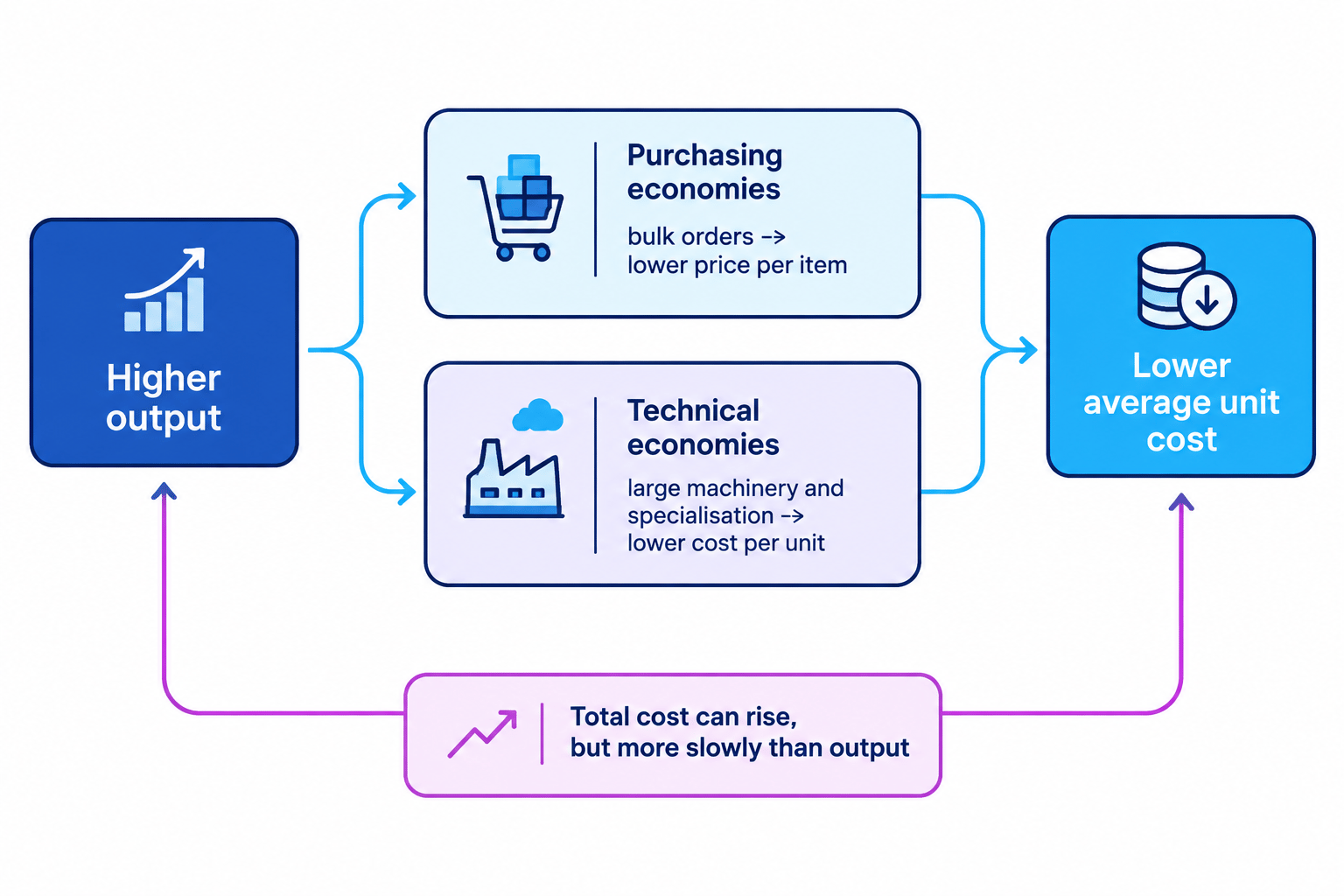
Why growth lowers the cost of each unit
Definition
Economies of scale: the cost advantages a business gains as it grows, so that the average cost of each unit falls as output rises.
Average unit cost: the total cost of production divided by the number of units produced, in other words what it costs the business to make one unit.
- Growth spreads the fixed costs of the business, such as rent, machinery and management salaries, over a much larger number of units, so each unit carries a smaller share of them.
- At GCSE there are two types you need: purchasing economies and technical economies.
- The benefit of a lower unit cost is a choice: the business can cut its price and take sales from rivals, or hold the price and keep the saving as extra profit on every sale.
Calculating average unit cost
- The formula is average unit cost=total costoutput\text{average unit cost} = \frac{\text{total cost}}{\text{output}}average unit cost=outputtotal cost, and it is not given to you in the exam.
- A garden furniture maker has total costs of £120,000 a year and produces 10,000 planters, so average unit cost=£120,00010,000=£12\text{average unit cost} = \frac{\pounds120{,}000}{10{,}000} = \pounds12average unit cost=10,000£120,000=£12.
- Each planter costs £12 to make, so at a selling price of £20 the business keeps £8 per planter towards its profit.
- It then wins a contract with a garden centre chain, buys timber in bulk and runs its machinery all week, taking total costs to £200,000 and output to 25,000 planters, so average unit cost=£200,00025,000=£8\text{average unit cost} = \frac{\pounds200{,}000}{25{,}000} = \pounds8average unit cost=25,000£200,000=£8.
- The unit cost has fallen by £4, so at the same £20 price the business now keeps £12 per planter instead of £8, a much wider profit margin on every sale.
- Alternatively it could drop the price to £16 and still make £8 per planter, which would have been impossible at the old unit cost.
Common Mistake
- A falling unit cost does not mean falling total costs, since total costs rose from £120,000 to £200,000 in this example.
- Economies of scale exist when total costs rise more slowly than output rises.
- Divide total cost by output, never the other way round, or the answer comes out as a number of units per pound and means nothing.
Purchasing economies of scale
- Purchasing economies, also called bulk-buying economies, come from ordering materials or stock in large quantities and paying less for each item.
- Suppliers offer the discount because one large order is cheaper for them to process and deliver than many small ones, and because they want to keep a big customer.
- Because materials are usually a variable cost, a lower price per item feeds straight through to a lower cost of making each unit.
Example
- Tesco orders millions of tins of beans at a time and pays far less per tin than an independent corner shop ordering a few cases.
- That lower buying price is why the supermarket can put the tin on the shelf at a price the corner shop cannot match and still make a profit.
Technical economies of scale
- Technical economies come from using large-scale machinery and production methods that only make sense at high output.
- A machine is a fixed cost, so running it flat out spreads its price over far more units and cuts the cost per unit.
- A £500,000 machine costs £50 per unit if it makes 10,000 units, but £5 per unit if it makes 100,000.
- Large output also allows a production line where each worker or robot repeats one task, which is faster and wastes fewer materials than one person building the whole product.
- The Nissan plant in Sunderland builds hundreds of thousands of cars a year on an automated line, which is why its cost per car is far below that of a small specialist manufacturer.
Note
- Purchasing economies are about what the business pays for the things it buys in.
- Technical economies are about the equipment and methods the business uses to produce.
- Unit costs do not fall for ever, and what happens when a business grows too large is covered in the article on diseconomies of scale.
Exam technique
- Calculate the average unit cost needs total cost divided by output, so check you are using total cost for the whole period and the output for that same period.
- If a question gives you two years of data, work out both unit costs and state the size of the fall, because the comparison is the point.
- Name the type of economy, purchasing or technical, and give the mechanism rather than writing that the business is bigger so costs are lower.
Self review
- Define economies of scale.
- State the formula for average unit cost.
- A firm has total costs of £90,000 and produces 15,000 units: what is its average unit cost?
- Explain how a purchasing economy lowers the cost of each unit.
- Why can total costs rise at the same time as unit costs fall?