What customers expect from quality
Definition
Quality: a good or service that consistently meets the expectations of the customers it is aimed at, so that it is fit for purpose.
- Fit for purpose: the product does the job the customer bought it for, and keeps doing it for as long as they were led to expect.
- The same every time: consistency is what customers notice, so the tenth purchase has to match the first, and a business that is excellent on Monday and careless on Friday has a quality problem.
- Expectations in the production of goods: buyers expect the item to work, to be safe, to match its description and to be identical to the last one they bought.
- Expectations in the provision of services: customers expect the service to be reliable, delivered on time and handled by staff who know what they are doing, and because a service is produced in front of them it cannot be checked and put right before they receive it.
Common Mistake
- Quality does not mean expensive or luxury, because it is judged against what the customer was promised.
- An Aldi own-label pizza and a Greggs sausage roll are high quality when they taste the same every time and match what shoppers expect for the price they paid.
- A £900 phone that arrives with a flickering screen is poor quality, however much it cost.
How a business identifies quality problems
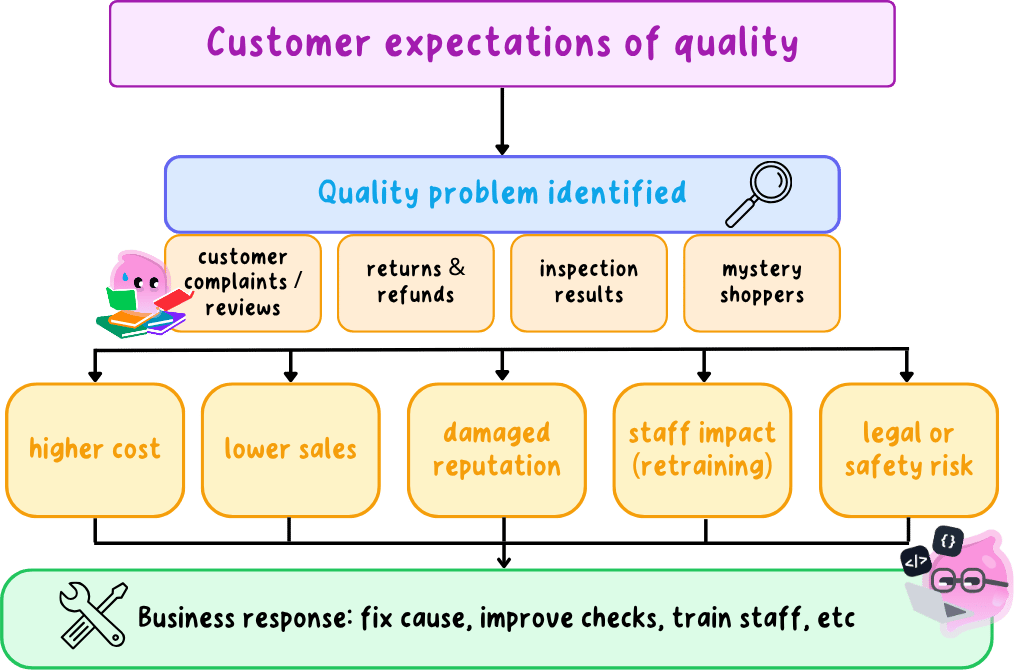
- Customer complaints: complaints made in store, by phone or by email name the fault directly and show how often it is happening.
- Returns and refunds: goods sent back, refunded or repaired under guarantee prove that a fault got past the business's own checks and reached a customer.
- Online reviews and ratings: star ratings and written reviews on Google, Trustpilot or a retailer's own site expose problems that most customers never bother to report to the business.
- Failed inspections: items rejected during checks point to a fault in the materials, the machinery or the method before the goods ever leave the premises.
- Falling repeat business: when regular customers quietly stop ordering, there is a quality problem nobody has complained about, which is why sales figures matter as well as complaints.
Example
- Currys records how many of each washing machine model come back within the guarantee period.
- One model returning far more often than the rest lets its buyers challenge the manufacturer before the fault reaches the review pages.
How a business measures quality
- Wastage and rework rate: the share of output scrapped or made a second time measures how much of production is going wrong.
Example
wastage rate=units wastedunits produced×100
\text{wastage rate} = \frac{\text{units wasted}}{\text{units produced}} \times 100
wastage rate=units producedunits wasted×100
- A bakery scraps 300 of the 12,000 loaves it makes in a week.
- That 2.5% is flour, labour and oven time the bakery has already paid for and thrown away, so halving it releases cash without selling one extra loaf.
- Return rate: returns as a percentage of items sold show whether faults are reaching customers, and tracking the figure product by product shows which line is at fault.
- Complaint numbers and satisfaction scores: counting complaints each week, or scoring survey answers out of ten, gives a figure for service quality where there is no physical item to inspect.
Note
A quality figure means nothing on its own, so a 3% return rate has to be compared with the target, with last month or with a rival before anyone can act on it.
Consequences for customers and reputation
- Lost customers: a customer let down once switches to a rival and often never returns, so the loss is every future purchase they would have made, not only the sale that went wrong.
- Bad word of mouth: unhappy customers post reviews and photographs that reach thousands of people within hours, and a one-star review stays visible to every future shopper for years.
- Damage to the brand: the damage outlasts the fault itself, so a business can put the problem right in a week and still be losing sales because of it a year later.
- Lost contracts: a supermarket will drop a supplier whose deliveries keep failing its checks, taking a whole revenue stream with it.
Example
- If one Greggs shop served undercooked sausage rolls, photographs and reviews would spread far beyond that single shop.
- Customers judge the whole brand, so a fault in one outlet costs sales in hundreds of others that did nothing wrong.
What poor quality costs the business
- Refunds and replacements: money already taken has to be handed back, or a second item supplied free, so the business pays twice to make one sale and often pays the return postage as well.
- Wasted materials and rework: a scrapped item destroys the materials, labour and machine time already spent on it, and reworking a fault uses those resources a second time on a unit that should have been finished.
- Product recalls: an unsafe or mislabelled product forces the business to trace owners and repair, replace or destroy goods it has already sold, which is expensive and very public.
- A car maker recalling one model pays to contact every owner, ship in parts and pay dealers to fit them, a bill far larger than the few pence per car a better component would have cost.
- Staff time: handling complaints, processing returns and hunting for the cause use hours that could have been spent producing and selling.
Exam technique
- Questions here usually read analyse the consequences for the business of poor quality, so take one consequence and follow it through to sales, costs or reputation rather than listing four.
- Choose the consequence that fits the business you are given, because a village café is hurt most by local reviews while a manufacturer is hurt most by a recall.
- Where the case gives a return rate or a wastage percentage, quote it and say what it costs that business, rather than describing the fault in words alone.
Self review
- What does quality mean in business?
- Why can a cheap product be a high quality product?
- Name three ways a business identifies quality problems.
- How is a wastage rate worked out, and what does it tell the owner?
- Give three costs a business faces when quality goes wrong.
