The income statement covers a period of time
Income statement: a financial statement showing the revenue a business earned, the costs it paid and the profit or loss it made over a period of time, normally one trading year.
- The period is part of the statement: it is headed for the year ended 31 March, so every figure in it is a total built up over twelve months of trading.
- One busy week and one dead week both disappear into those totals, which is why this is the statement used to judge how the business performed.
A limited company has to publish these statements every year; who reads them and why is covered in the article on the purpose of financial statements.
The five lines of the income statement
- Revenue, also called turnover or sales, is the money earned from selling goods or services during the period, before any cost has been taken off.
- Cost of sales is the direct cost of the goods actually sold, such as the frames, tyres and parts a bike shop bought for the bikes it sold that year.
- Gross profit is what is left when the cost of sales has been taken off revenue, so it measures the profit on the trading itself, before any running cost of the business is counted.
- Expenses, also called overheads, are the indirect costs of running the business, such as rent, salaries, insurance, advertising and utility bills.
- Net profit is what is left when those expenses have been taken off gross profit, and it is the figure that finally belongs to the owners.
- Gross profit and net profit are two different figures and swapping them changes the answer: gross profit ignores every expense, net profit ignores nothing.
- If a question says only profit, look at which line the figures you have been given come from before you answer.
Working out gross profit and net profit
Kirkstall Cycles, an independent bike shop in Leeds, had revenue of £180,000 last year, a cost of sales of £108,000 and expenses of £45,000.
| Kirkstall Cycles | Year ended 31 March | £ |
|---|---|---|
| Revenue | 180,000 | |
| Cost of sales | 108,000 | |
| Gross profit | 72,000 | |
| Expenses | 45,000 | |
| Net profit | 27,000 |
- Three of those figures are ones the shop records from its own trading, revenue, cost of sales and expenses, while the other two, gross profit and net profit, are worked out from them, which is why the statement is read downwards.
- Neither of the two formulae below is given to you, so both have to be learned.
- Take the shop's £180,000 of revenue and £108,000 of cost of sales straight from the table above.
- That £72,000 is what the trading generated, and it is the only pot the shop has to pay its rent, its wages and every other running cost out of.
- The owner should read it as the ceiling on what she can afford to spend on overheads.
- The £45,000 of expenses then comes off that trading profit.
- The £45,000 of expenses swallowed nearly two thirds of the trading profit, leaving £27,000 as the reward for the year's work.
- The shop is profitable, but a £10,000 rent rise would cut that reward by more than a third, so the owner has a reason to fix her rent on a longer lease.
The statement of financial position is a snapshot in time
Statement of financial position: a financial statement listing what a business owns and what it owes on one single date, giving a snapshot of its position at that moment in time.
- It does not cover a period at all. Where the income statement adds up twelve months of trading, this statement is true for one day only, the date printed at the top of it.
- That is why the picture can change fast: if Kirkstall Cycles buys a £6,000 van the day after its statement date, or pays off £5,000 of its loan, the published snapshot is already out of date.
- Size makes no difference to this. Tesco plc reports its position as at one date at the end of February, so the stock it sells and the suppliers it pays in the following week appear nowhere on that statement.
- It answers a different question from the income statement: not whether the year made a profit, but what the business owns and owes right now.
- The income statement is a film of the whole year, while the statement of financial position is one photograph taken on one day.
- A photograph taken a week later could look quite different, which is why the date on it matters as much as the figures on it.
Assets and liabilities
Assets: the things a business owns or is owed, such as premises, equipment, stock, money owed by customers and cash.
Liabilities: the amounts a business owes to somebody else, such as a bank loan, an overdraft and money owed to suppliers.
- Kirkstall Cycles lists as assets £16,000 of shop fittings and £6,000 of workshop tools, £24,000 of bikes and parts held as stock, £3,200 owed to it by a local school for a repair contract, and £4,500 of cash in the bank.
- It lists as liabilities an £18,000 bank loan, a £2,000 overdraft and £5,400 owed to its wholesaler for stock delivered but not yet paid for.
- The test that separates the two is the direction the money is owed: money owed to the business is an asset, money owed by the business is a liability.
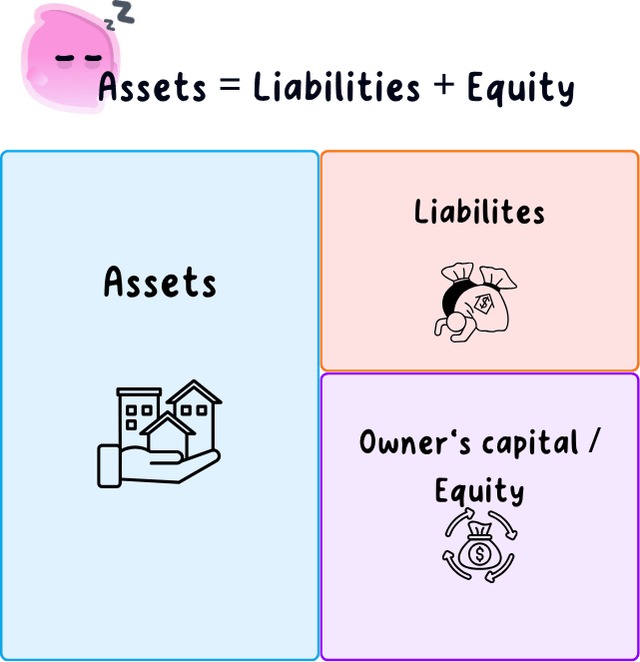
The £3,200 owed by the school is an asset even though it is a debt, because the debt belongs to the shop rather than being owed by it, and reversing assets and liabilities in this way is the commonest error on this statement.
How the statement groups what is owned and owed
- The statement does not leave those items in one long list. It sorts them into the components below, splitting both assets and liabilities by how soon they turn into cash or fall due for payment.
- Non-current assets are the things the business keeps and uses for more than a year, such as Kirkstall's £16,000 of shop fittings and £6,000 of workshop tools.
- Current assets are expected to become cash within a year: the £24,000 of stock, the £3,200 the school owes and the £4,500 in the bank.
- Current liabilities have to be paid within a year, so the £2,000 overdraft and the £5,400 owed to the wholesaler both sit here.
- Non-current liabilities are repaid over more than a year, which is where the £18,000 bank loan belongs.
- Capital, also called equity, is the money the owners put in plus the profit kept in the business, and it matches what is left once the liabilities are set against the assets.
- The split is what makes the statement readable, because it shows the owner that £7,400 of Kirkstall's debts fall due within the year while the £18,000 loan does not, so the two are nothing like the same worry.
Kirkstall Cycles set out as a statement of financial position
The statement always balances, because everything the business owns had to be paid for by somebody, either a lender or the owner.
total assets=total liabilities+capital \text{total assets} = \text{total liabilities} + \text{capital} total assets=total liabilities+capital| As at 31 March | £ | |
|---|---|---|
| Non-current assets | ||
| Shop fittings | 16,000 | |
| Workshop tools | 6,000 | |
| Total non-current assets | 22,000 | |
| Current assets | ||
| Stock of bikes and parts | 24,000 | |
| Owed by the school | 3,200 | |
| Cash at bank | 4,500 | |
| Total current assets | 31,700 | |
| Total assets | 53,700 | |
| Current liabilities | ||
| Overdraft | 2,000 | |
| Owed to the wholesaler | 5,400 | |
| Total current liabilities | 7,400 | |
| Non-current liabilities | ||
| Bank loan | 18,000 | |
| Total non-current liabilities | 18,000 | |
| Total liabilities | 25,400 | |
| Capital | ||
| Capital introduced by the owner | 12,000 | |
| Retained profit | 16,300 | |
| Total capital | 28,300 | |
| Total liabilities and capital | 53,700 |
- Check the balance before you read anything else off the statement.
- That is exactly the £53,700 of total assets higher up the table, so the two halves agree.
- If those two totals do not match, a figure has been missed or put in the wrong section, so the shop's own bookkeeper treats the check as the first thing she does each year.
- Most of what the shop owns is stock rather than money, because £24,000 of the £31,700 of current assets is bikes and parts while only £4,500 is cash at the bank, so the owner depends on selling that stock to get at the value shown here.
- That is why the £7,400 due within the year is the tighter half of the borrowing: the overdraft and the wholesaler have to be paid largely out of bikes that have not sold yet.
- The £16,300 of retained profit is profit from earlier years that was left in the business rather than taken out by the owner, which is why a profitable year strengthens this statement as well as the income statement.
When you are asked to identify the components of a statement, or handed a list of items to sort, decide which of the two statements each item belongs to before you write anything.
- What period does an income statement cover, and what does a statement of financial position refer to?
- Name the five lines of the income statement in order from revenue to net profit.
- Revenue is £180,000 and cost of sales is £108,000: what is gross profit, and what formula did you use?
- Name the five components of the statement of financial position, and say why total assets must equal total liabilities plus capital.
- Is money owed by a customer an asset or a liability, and why?
