Trophic levels describe feeding positions
Trophic level
A trophic level is the feeding position of an organism along a particular food chain.
- A food chain shows one route by which material and energy pass between organisms through feeding.
- A food web combines several food chains and shows that many organisms have more than one food source.
- An arrow points from the organism being eaten to the organism that eats it, showing the direction of transfer.
- A trophic level is assigned by following a particular feeding route, rather than by the size or appearance of the organism.
Food-chain arrows point from food to feeder, not in the direction in which a predator moves to catch its prey.
Producers start food chains
Producer
An organism that makes its own food by photosynthesis and so supplies the food and biomass that begins a food chain.
- Green plants and algae act as producers because they make organic substances using carbon dioxide and water in photosynthesis.
- They use light energy to build these substances, forming the biological material on which the rest of the chain depends.
- Producers occupy the first trophic level, written as level 111.
- Grass, pondweed and microscopic algae can therefore all occupy the same trophic level despite their different sizes and habitats.
- A producer still needs water, mineral ions and suitable conditions, but it does not obtain its organic food by eating another organism.
Consumers feed on other organisms
Consumer
A consumer is an organism that obtains organic food by feeding on other organisms or their material.
- Consumers obtain organic substances by feeding on organisms or their material rather than making all their organic food from inorganic raw materials.
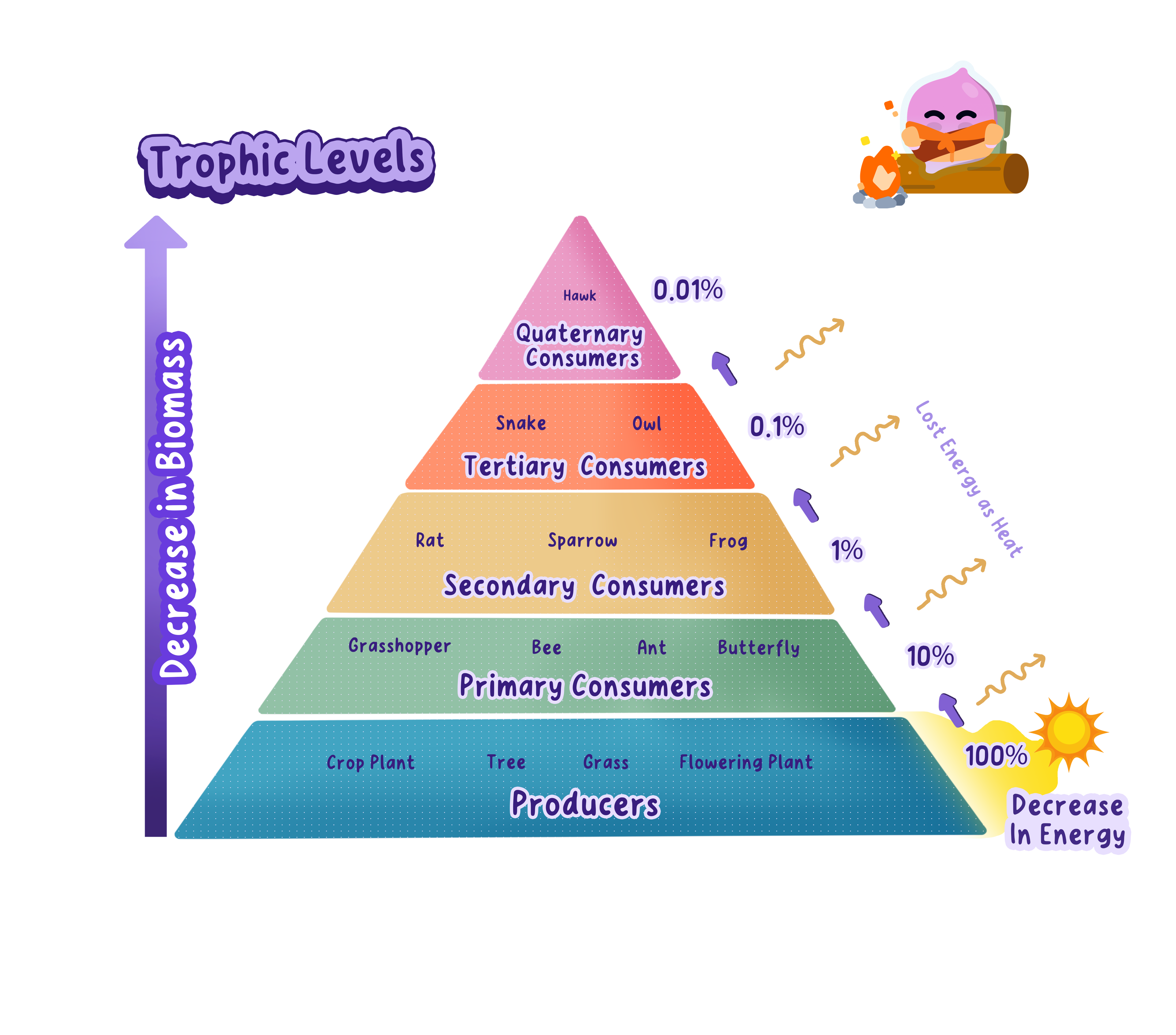
- A primary consumer eats a producer and occupies trophic level 222.
- A secondary consumer eats a primary consumer and occupies trophic level 333.
- A tertiary consumer eats a secondary consumer and occupies trophic level 444.
- If a further consumer eats the tertiary consumer, it is a quaternary consumer at trophic level 555.
- The consumer name counts the feeding steps after the producer, while the trophic-level number includes the producer.
- In the chain grass→grasshopper→frog→heron\text{grass}\rightarrow\text{grasshopper}\rightarrow\text{frog}\rightarrow\text{heron}grass→grasshopper→frog→heron, grass is the producer at level 111.
- The grasshopper eats the producer, so it is the primary consumer at level 222.
- The frog eats the primary consumer, so it is the secondary consumer at level 333.
- The heron eats the secondary consumer, so it is the tertiary consumer at level 444.
Diet and feeding position
Herbivore
A herbivore is an animal that feeds on plant or algal material.
Carnivore
A carnivore is an animal that feeds on other animals.
Omnivore
An omnivore is an animal that feeds on both plant and animal material.
- A herbivore feeding directly on a producer is a primary consumer.
- A carnivore can be a secondary, tertiary or higher consumer depending on the feeding route being followed.
- An apex predator has no regular predators in the food web being considered, but its trophic-level number depends on the length of that feeding route.
- Diet labels alone are not enough to assign every organism one fixed numbered level.
- The retained pyramid illustrates feeding positions; its transfer percentages are illustrative rather than a rule for every food chain.
Start at a producer and count feeding links along the route shown, giving both the consumer name and its numbered trophic level when requested.
One species can occupy several levels
- An omnivore may feed directly on a producer in one chain and eat a consumer in another.
- A blackbird eating berries acts as a primary consumer, while a blackbird eating a leaf-eating caterpillar acts as a secondary consumer.
- A predator that eats both herbivores and other predators can also feed at more than one trophic level, even if it is not an omnivore.
- Use each stated feeding route to assign its level and do not invent links that are absent from the food web.
- Along berry plant→blackbird\text{berry plant}\rightarrow\text{blackbird}berry plant→blackbird, the blackbird occupies trophic level 222.
- Along leafy plant→caterpillar→blackbird\text{leafy plant}\rightarrow\text{caterpillar}\rightarrow\text{blackbird}leafy plant→caterpillar→blackbird, the blackbird occupies trophic level 333.
- These are two feeding positions of the same species, so a single fixed level would not describe the whole food web.
Decomposers receive material from many levels
- Dead organisms and organic waste can originate from producers and from every consumer level.
- Decomposer bacteria and fungi use this material, so they are not restricted to material from the top predator.
- They are often shown linked to several levels or outside the numbered chain because their feeding cannot be represented by one fixed step after the final consumer.
- A top predator can itself be decomposed after death even though it has no regular predators in the living food web.
- What direction does an arrow point in a food chain?
- Why is a producer assigned trophic level one?
- Which trophic level contains a secondary consumer?
- How can one bird species occupy two trophic levels?
- Why are decomposers not placed only above the top predator?
