The cell membrane
Cell membrane
The partially permeable barrier that surrounds the cytoplasm of a cell and controls which substances enter and leave it.
Partially permeable membrane
A membrane that lets small molecules such as water pass through it but holds back larger molecules.
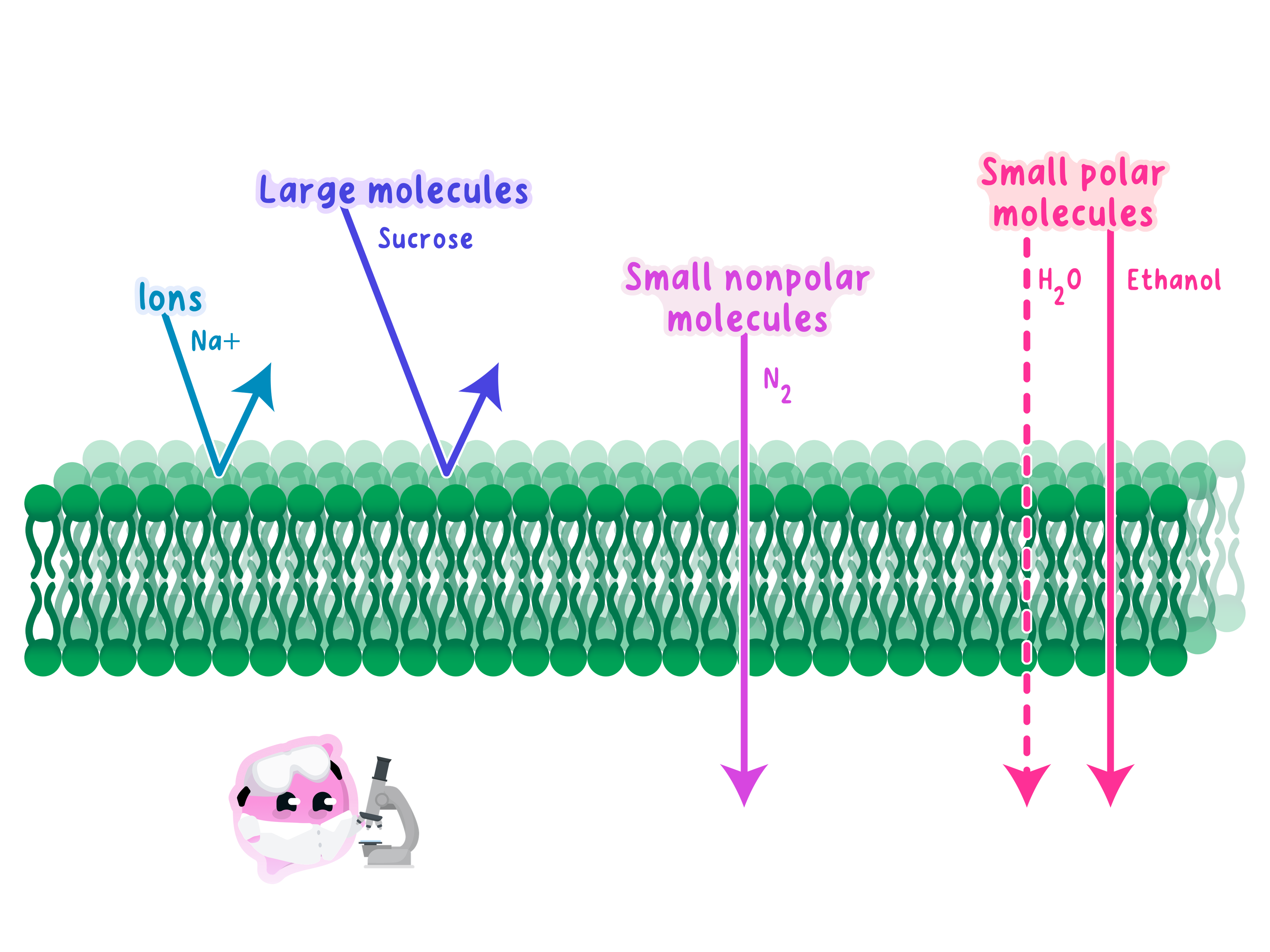
- Every cell is surrounded by a cell membrane, a thin layer that separates the cytoplasm from the surroundings.
- The membrane is partially permeable, so some substances cross it freely while others cannot cross at all.
- Small molecules such as oxygen, carbon dioxide, water, glucose and urea are able to cross it.
- Large molecules such as starch and protein are too big to pass through.
- Charged particles such as mineral ions cross only through protein channels or carrier proteins built into the membrane.
- Three processes move substances across the membrane: diffusion, osmosis and active transport.
- Diffusion and osmosis are passive, which means the cell supplies no energy from respiration to make them happen.
- Active transport is the only one of the three that uses energy released by respiration.
Diffusion
Diffusion
The net movement of particles from a region of higher concentration to a region of lower concentration, down a concentration gradient, caused by the random movement of the particles.
Concentration gradient
The difference in the concentration of a substance between two regions.
- Every particle in a gas or a solution has kinetic energy, so it is always moving.
- Particles collide with one another and bounce off in new directions, so each individual particle moves at random.
- Where particles are crowded together, more of them happen to move away from that region than move into it.
- The overall result is a net movement from the region of higher concentration to the region of lower concentration.
- The difference in concentration between the two regions is the concentration gradient, and particles diffuse down the gradient.
- Diffusion is passive because the movement comes from the kinetic energy the particles already have, not from respiration.
- Net movement stops once the particles are evenly spread out, although the particles themselves never stop moving.
- A steeper concentration gradient increases the rate of diffusion, because the difference between the two regions is greater.
- A higher temperature increases the rate of diffusion, because the particles gain kinetic energy and move faster.
Substances moved by diffusion
- Oxygen diffuses from the blood into a respiring cell, because respiration inside the cell keeps the oxygen concentration there low.
- Carbon dioxide diffuses out of a respiring cell into the blood, because respiration keeps the carbon dioxide concentration inside the cell high.
- Glucose and amino acids diffuse from the small intestine into the blood while their concentration in the gut is higher than in the blood.
- Urea, made in the liver, diffuses out of liver cells into the blood plasma.
- In a leaf, carbon dioxide diffuses in through the stomata and oxygen diffuses out while photosynthesis is taking place.
- The direction is set only by the concentration gradient, so the same substance can move into a cell at one time and out of it at another.
Osmosis
Osmosis
The net movement of water molecules through a partially permeable membrane from a region of higher water potential to a region of lower water potential.
Water potential
A measure of how free the water molecules in a solution are to move, which is highest in pure water and falls as more solute is dissolved.
- Osmosis moves water only, and it happens only across a partially permeable membrane.
- A dilute solution contains many water molecules and little dissolved solute, so it has a high water potential.
- A concentrated solution contains fewer water molecules and more dissolved solute, so it has a low water potential.
- Water molecules are small enough to pass through the membrane, but the dissolved solute molecules are too large to follow them.
- Water molecules cross the membrane in both directions, but more cross from the dilute solution to the concentrated solution.
- The net movement of water is therefore from a region of higher water potential to a region of lower water potential.
- Osmosis is passive, so the cell uses no energy from respiration to move the water.
- Net movement stops when the water potential is the same on both sides of the membrane.
Osmosis in animal and plant cells
Turgid
Describing a plant cell that has gained water by osmosis until its vacuole and cytoplasm press the cell membrane firmly against the cell wall.
Plasmolysis
The pulling away of the cell membrane from the cell wall that happens when a plant cell loses so much water by osmosis that its vacuole and cytoplasm shrink.
- An animal cell placed in a dilute solution gains water by osmosis and swells.
- An animal cell has no cell wall, so nothing resists the pressure of the water entering it.
- A red blood cell placed in pure water takes in so much water that the membrane splits, which is called lysis.
- An animal cell placed in a concentrated solution loses water by osmosis, shrinks and develops a wrinkled surface.
- A plant cell placed in a dilute solution gains water, and the swollen vacuole pushes the cytoplasm and cell membrane hard against the cell wall.
- The cell is then turgid, and the pressure of many turgid cells is what holds a stem upright and keeps leaves spread out.
- The rigid cellulose cell wall resists that pressure, which is why a plant cell does not burst in pure water.
- A plant cell placed in a concentrated solution loses water, the vacuole shrinks and the cell becomes flaccid, so the plant wilts.
- If enough water is lost, the cell membrane pulls away from the cell wall and the cell is plasmolysed.
Osmosis in potato chips
- Aim: to investigate how the concentration of a sucrose solution affects the mass of potato tissue placed in it.
- Apparatus: one large potato, a cork borer of fixed diameter, a white tile, a scalpel, a ruler, six labelled boiling tubes in a rack, sucrose solutions of 0.00.00.0, 0.20.20.2, 0.40.40.4, 0.60.60.6, 0.80.80.8 and 1.0 mol dm−31.0\ \text{mol dm}^{-3}1.0 mol dm−3, a balance reading to 0.01 g0.01\ \text{g}0.01 g, forceps, paper towels, a marker pen and a stopclock.
- Variables: sucrose concentration is the independent variable, percentage change in mass is the dependent variable, and the potato used, the chip length, the chip diameter, the volume of solution, the temperature and the time in solution are all controlled.
- Method, preparing the chips:
- Push the cork borer through a single potato several times so that every cylinder has the same diameter, and take them all from the same potato so their starting water potential matches.
- Trim each cylinder on the white tile to exactly the same length, for example 40 mm40\ \text{mm}40 mm, and cut away any skin.
- Roll each chip once between two paper towels to remove surface liquid, then measure its mass to 0.01 g0.01\ \text{g}0.01 g and record it as the initial mass.
- Method, setting up:
- Label one boiling tube for each concentration and pour the same volume, for example 20 cm320\ \text{cm}^{3}20 cm3, into each one.
- Lower one chip into each tube with forceps so that it is completely covered, then start the stopclock.
- Leave every tube for the same time, typically 303030 minutes or overnight, standing in the same place so the temperature is the same for all of them.
- Method, measuring:
- Lift each chip out with forceps and blot it in exactly the same way, one roll between two fresh paper towels, because liquid left on the surface adds mass that never entered the cells.
- Reweigh each chip to 0.01 g0.01\ \text{g}0.01 g and record the value as the final mass.
- Use at least three chips at each concentration and calculate a mean percentage change in mass.
- What you see: a chip from the most dilute solution comes out longer, firm and heavier, while a chip from the most concentrated solution comes out shorter, floppy enough to bend between your fingers, and lighter.
- Maths: calculate percentage change in mass using change in massinitial mass×100\dfrac{\text{change in mass}}{\text{initial mass}}\times100initial masschange in mass×100, then plot percentage change on the vertical axis against concentration on the horizontal axis and draw a line of best fit.
- Reading the graph: the concentration at which the line of best fit crosses zero change is the concentration whose water potential equals that of the potato cells, because no net osmosis happens there.
- Watch out: use percentage change rather than change in mass, so that chips with slightly different starting masses can be compared fairly.
- Safety: cut on a white tile with the blade moving away from your fingers, and carry the cork borer with the sharp end pointing down.
Percentage change in mass
- A potato chip has a mass of 3.20 g3.20\ \text{g}3.20 g before it is placed in a 0.2 mol dm−30.2\ \text{mol dm}^{-3}0.2 mol dm−3 sucrose solution.
- After 303030 minutes the blotted chip has a mass of 3.44 g3.44\ \text{g}3.44 g.
- The change in mass is 3.44−3.20=+0.24 g3.44-3.20=+0.24\ \text{g}3.44−3.20=+0.24 g.
- Percentage change in mass =change in massinitial mass×100=\dfrac{\text{change in mass}}{\text{initial mass}}\times100=initial masschange in mass×100.
- Substituting gives 0.243.20×100=+7.5%\dfrac{0.24}{3.20}\times100=+7.5\%3.200.24×100=+7.5%.
- The mass increased, so water moved into the cells by osmosis, which means the sucrose solution had a higher water potential than the potato cells.
Active transport
Active transport
The movement of a substance across a cell membrane against its concentration gradient, using carrier proteins and energy released by respiration.
Carrier protein
A protein in a cell membrane that binds one particular substance and changes shape to carry it across the membrane.
- Active transport moves a substance against its concentration gradient, from where it is less concentrated to where it is more concentrated.
- The substance is carried by a carrier protein that spans the cell membrane.
- The substance binds to a site on the carrier protein that only its own shape fits.
- The carrier protein then changes shape and releases the substance on the other side of the membrane.
- Changing shape requires energy, and that energy is released by respiration in the mitochondria.
- Cells that carry out a great deal of active transport, such as root hair cells, contain large numbers of mitochondria.
- Active transport slows and then stops if respiration stops, for example when the oxygen supply to the cell is cut off.
- Mineral ions such as nitrate ions are taken into root hair cells from soil water, even though the soil water is far more dilute than the cell.
- Glucose is absorbed from the small intestine into the blood by active transport once the concentration in the gut has fallen below the concentration in the blood.
Comparing the three processes
- Diffusion moves any small molecule or dissolved substance down its concentration gradient and uses no energy from respiration.
- Osmosis moves water only, across a partially permeable membrane, from higher to lower water potential, and uses no energy from respiration.
- Active transport moves a substance against its concentration gradient using carrier proteins and energy from respiration.
- Only active transport can move a substance from a lower concentration to a higher concentration.
- Only osmosis is restricted to water and to a partially permeable membrane.
- All three supply a cell with the substances it needs and carry away the waste it produces.
Writing about transport
- Name the substance and both concentrations, for example that oxygen moves from the alveolus, where its concentration is higher, into the blood, where it is lower.
- Use the words net movement and down the concentration gradient in a diffusion answer, because the mark is often for one of those phrases.
- Write partially permeable in an osmosis answer rather than permeable or semi-permeable.
- State that active transport uses energy from respiration, since the word energy on its own is rarely enough for the mark.
- You are expected to use the term water potential but never to calculate it.
- Keep the plus or minus sign on a percentage change in mass, because the sign is what shows the direction of osmosis.
- Do not write that diffusion needs no energy at all, because it uses the kinetic energy of the particles themselves; what it needs no energy from is respiration.
- Do not define osmosis as water moving from a high concentration to a low concentration without saying concentration of what.
- Do not claim a plant cell bursts in pure water, because the cellulose cell wall resists the pressure.
- Do not confuse flaccid with plasmolysed; a flaccid cell has lost water, while a plasmolysed cell has lost so much that the membrane has pulled away from the wall.
- Do not pair the initial mass of one chip with the final mass of another when you calculate a percentage change.
- Do not describe root hair cells taking up mineral ions by diffusion, because the ions move from dilute soil water into a more concentrated cell.
- Define diffusion and explain what a concentration gradient is.
- Explain why diffusion and osmosis are described as passive.
- Define osmosis using the term water potential.
- Describe what happens to a red blood cell and to a plant cell placed in pure water.
- Explain how a root hair cell takes up nitrate ions from soil water that is more dilute than the cell.
- Calculate the percentage change in mass of a chip whose mass falls from 4.00 g4.00\ \text{g}4.00 g to 3.60 g3.60\ \text{g}3.60 g.
