Reflex actions
Reflex action
A reflex action is a rapid, automatic response to a stimulus that happens without conscious thought.
- A reflex action has three features that always appear in mark schemes: it is rapid, it is automatic, and it is protective.
- It is automatic because the response happens without you choosing it, so the same stimulus produces the same response every time.
- It is rapid because the impulse does not travel to the conscious part of the brain before the effector acts.
- It is protective because the responses it produces reduce damage, such as moving skin away from a hot surface or shutting the eyelid before dust reaches the eye.
- You still become aware of the stimulus, but only after the response, because a separate set of impulses travels up the spinal cord to the brain while the reflex is happening.
- That is why you pull your hand back from a hot pan first and feel the pain a moment later.
A reflex is fast because the decision is taken in the spinal cord instead of the conscious brain, which removes most of the synapses from the pathway.
The reflex arc
Reflex arc
A reflex arc is the pathway of neurones running from receptor, through sensory neurone, relay neurone and motor neurone, to an effector that brings about a reflex action.
Relay neurone
A relay neurone is a neurone found inside the central nervous system that carries impulses from a sensory neurone to a motor neurone.
- The reflex arc has five components joined in a fixed order.
- receptor→sensory neurone→relay neurone→motor neurone→effector\text{receptor} \rightarrow \text{sensory neurone} \rightarrow \text{relay neurone} \rightarrow \text{motor neurone} \rightarrow \text{effector}receptor→sensory neurone→relay neurone→motor neurone→effector
- The receptor detects the stimulus, such as a pain receptor in the skin detecting a sharp point, and starts an electrical impulse.
- The sensory neurone carries the impulse into the spinal cord.
- At the first synapse a neurotransmitter diffuses across the gap and starts a new impulse in the relay neurone.
- The relay neurone (interneuron) is short and stays inside the spinal cord, and it passes the impulse across a second synapse to the motor neurone.
- The motor neurone carries the impulse back out to the effector along one long myelinated axon.
- The effector carries out the response, so a muscle contracts or a gland secretes.
- The relay neurone also passes impulses on to other neurones running up the spinal cord, which is how the brain is informed of what has just happened.
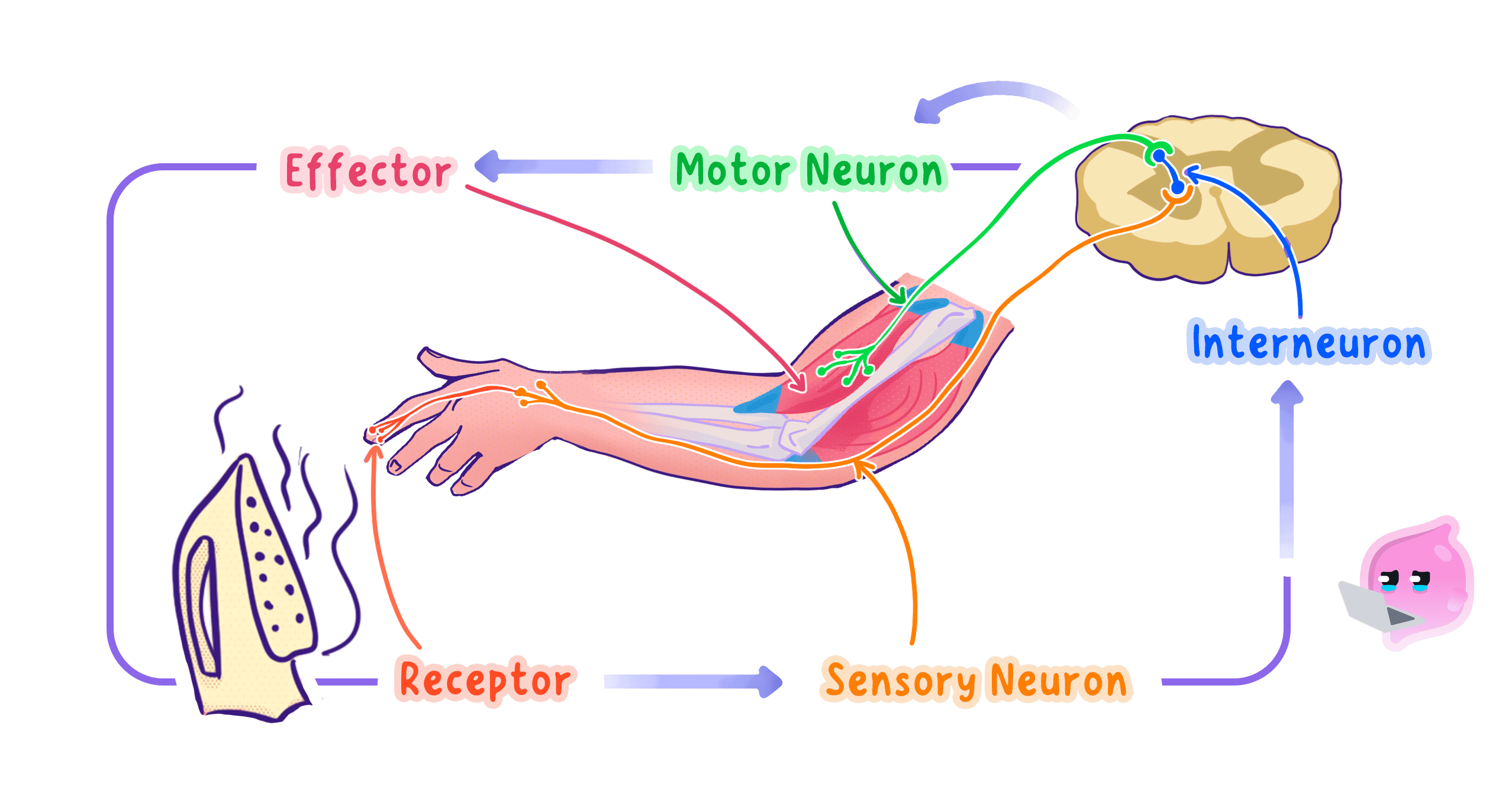
The word arc describes the shape of the route, because the impulse travels in to the spinal cord and straight back out again to a part of the body near where it started.
Inside the spinal cord
Spinal cord
The spinal cord is the column of nervous tissue running inside the backbone that carries impulses between the body and the brain and coordinates many reflexes.
- The spinal cord runs down inside the vertebrae of the backbone, which shield it from being crushed or cut.
- A cross-section shows a butterfly-shaped inner region of grey matter, which contains the cell bodies of relay and motor neurones and the synapses between them.
- Around it lies white matter, which contains myelinated axons carrying impulses up to the brain and back down again.
- The white matter looks pale because the myelin sheaths around those axons are made of fat.
- Sensory neurones enter through the back of the spinal cord, and their cell bodies sit in a swelling just outside the cord itself.
- Motor neurones leave through the front of the spinal cord, with their cell bodies in the grey matter, so impulses in and impulses out use separate routes.
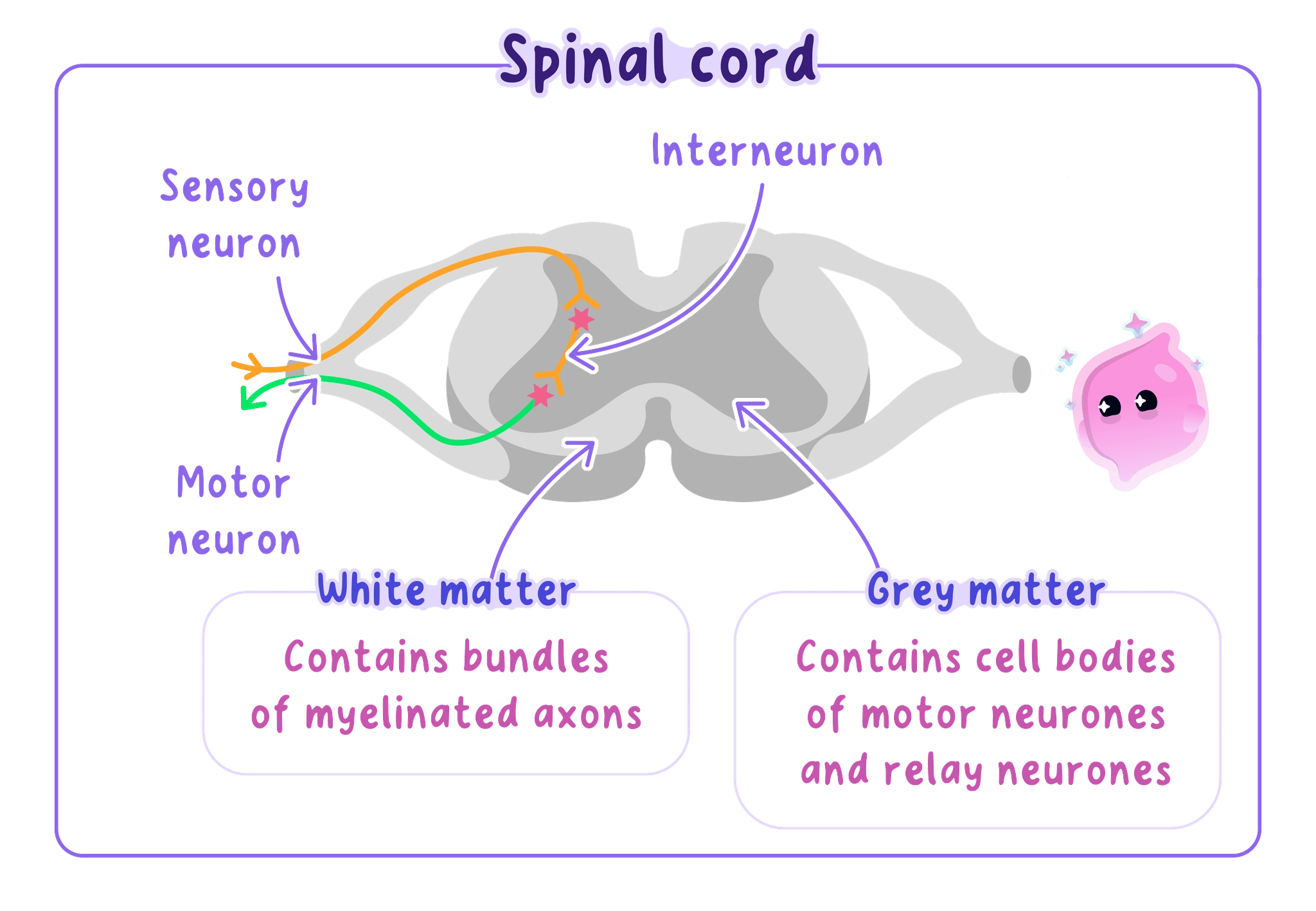
- Do not write that a reflex misses out the central nervous system, because the spinal cord is part of the CNS and is where the relay neurone sits.
- What the impulse misses out is the conscious part of the brain, so write that instead.
Why the structure makes the response fast
- The pathway contains only two synapses, and since crossing a synapse by diffusion is the slowest step, keeping the number low keeps the whole response short.
- The route is short, because the impulse only reaches the nearest part of the spinal cord instead of travelling up to the head and back.
- The sensory and motor neurones are myelinated, so the impulse travels along them at roughly 100 m s−1100\ \text{m s}^{-1}100 m s−1.
- No decision is made, so no time is spent comparing the stimulus with memory or weighing up choices.
- A withdrawal reflex therefore takes roughly 0.02 s0.02\ \text{s}0.02 s, while a voluntary response to the same stimulus takes roughly 0.25 s0.25\ \text{s}0.25 s.
- Saving that fraction of a second is enough to limit a burn to reddened skin rather than a blister.
Tracing the withdrawal reflex
- You take hold of a saucepan handle that is far hotter than you expected.
- Temperature and pain receptors in the skin of your fingers detect the heat and start impulses.
- A sensory neurone carries those impulses along your arm and into the back of your spinal cord.
- A relay neurone in the grey matter receives them across a synapse and passes them straight to a motor neurone.
- The motor neurone carries impulses out to the biceps muscle in your upper arm.
- The biceps contracts, bending your elbow and pulling your hand off the handle.
- Only after your hand has moved do impulses reaching your brain make you aware of the pain.
Reflex and voluntary responses compared
Voluntary response
A voluntary response is a response that is consciously decided by the cerebrum before impulses are sent to the effector.
- Route: a reflex passes through the spinal cord or the base of the brain, while a voluntary response passes through the cerebrum.
- Synapses: a reflex crosses two, while a voluntary response crosses very many more.
- Speed: a reflex takes a small fraction of a second, while a voluntary response takes about ten times as long.
- Control: a reflex is the same every time and cannot normally be stopped, while a voluntary response can be changed to suit the situation.
- Learning: a reflex is present from birth and needs no practice, while a voluntary skill improves the more you repeat it.
- Awareness: in a reflex you notice the stimulus after the response, while in a voluntary response you notice it before.
Reflexes in the body
- The withdrawal reflex pulls a limb away from something sharp or hot.
- The blinking reflex closes the eyelid when something touches the eyelashes or moves quickly towards the face, which keeps grit off the cornea.
- The pupil reflex changes the size of the pupil when the light level changes, which protects the retina.
- The knee-jerk reflex straightens the leg when the tendon below the kneecap is tapped, and doctors test it because a missing response points to damage somewhere in the arc.
- The swallowing and coughing reflexes keep food and dust out of the airway.
Writing about a reflex arc
- Name all five components in order, because the marks are usually one for each stage rather than one for the overall idea.
- When the question says explain how the structure is related to its function, pair each structural point with the speed it produces, such as few synapses and therefore little delay.
- Say the impulse does not pass through the conscious brain, not that the brain is not involved at all.
- If you are given a diagram, use the arrows on it to identify which neurone is which before you start writing.
- The most common lost mark is naming the muscle only as a muscle, so say which muscle contracts in the example given.
When a reflex arc is damaged
- If any one component stops working, the whole response fails, because each part depends on the impulse arriving from the part before it.
- Damage to the receptor means the stimulus is never detected, so no impulse starts.
- Damage to a neurone or to the spinal cord breaks the route, so impulses cannot reach the effector.
- Damage to the effector means the impulses arrive but the muscle cannot contract.
- Testing a reflex therefore tells a doctor that every part of that particular arc is intact.
- Give the three features of a reflex action.
- Name the five components of a reflex arc in order.
- Explain two structural reasons why a reflex is faster than a voluntary response.
- Describe what the grey matter and the white matter of the spinal cord each contain.
- Explain why you feel the pain of a burn only after your hand has moved.
- Give two protective reflexes and state what each one prevents.
