The double circulatory system
Definition
Double circulatory system
A double circulatory system is a circulation in which blood passes through the heart twice for every complete circuit of the body.
Definition
Pulmonary circulation
The pulmonary circulation is the loop of vessels that carries blood from the heart to the lungs and back to the heart.
Definition
Systemic circulation
The systemic circulation is the loop of vessels that carries blood from the heart to the rest of the body and back to the heart.
- The human circulatory system is made of the heart, the blood vessels and the blood they carry.
- It is a closed system, which means the blood stays inside vessels the whole way round instead of washing freely through the body cavity.
- It is also a double system, because blood passes through the heart twice for every complete circuit of the body.
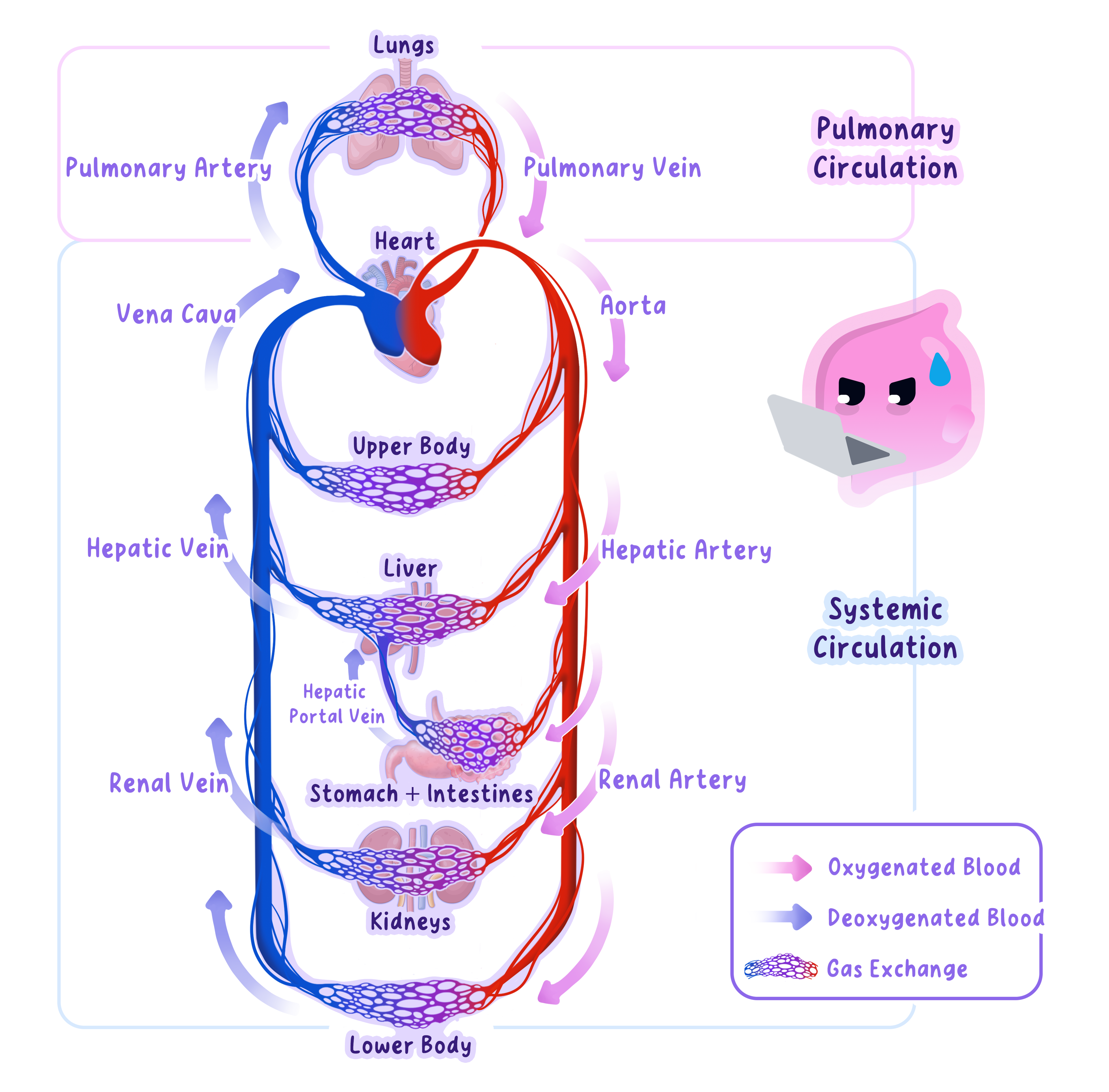
- The first circuit is the pulmonary circulation, which runs from the right side of the heart to the lungs and back to the left side.
- The second circuit is the systemic circulation, which runs from the left side of the heart to the rest of the body and back to the right side.
- The two circuits are joined in series, so all the blood leaving the lungs passes through the heart again before it goes anywhere else.
- The right side of the heart handles only deoxygenated blood and the left side handles only oxygenated blood, and the two never mix.
- Keeping them apart means the blood sent to the tissues is always fully loaded with oxygen.
Why a mammal needs two circuits
- Blood loses a great deal of pressure while it is squeezed through the narrow capillaries of an organ.
- In a single circulatory system, such as a fish has, blood passes through the heart only once per circuit and travels straight from the gill capillaries to the body.
- By the time it leaves the gills its pressure is already low, so it flows slowly to the rest of the body.
- A double system returns the blood to the heart after the lungs, and the left side raises its pressure again before it is sent to the body.
- That second push makes the blood flow much faster, so oxygen and glucose are delivered and carbon dioxide removed at a much higher rate.
- Mammals need that higher rate because they are warm-blooded and respire quickly all the time in order to keep their body temperature steady.
- The pulmonary circuit is kept at a lower pressure than the systemic circuit, because the thin walls of the lung capillaries would be damaged by a high pressure.
- A double system therefore gives each circuit the pressure that suits it, which a single system cannot do.
The arrangement of the main vessels
Definition
Coronary artery
A coronary artery is one of the vessels that branches from the base of the aorta and supplies the heart muscle itself with blood.
- Deoxygenated blood returns from the body in the vena cava and enters the right atrium.
- It passes into the right ventricle and is pumped out through the pulmonary artery to the lungs.
- Oxygenated blood returns from the lungs in the pulmonary vein and enters the left atrium.
- It passes into the left ventricle and is pumped out through the aorta to the rest of the body.
- The pulmonary artery and the pulmonary vein are the two exceptions to the usual rule, because this artery carries deoxygenated blood and this vein carries oxygenated blood.
- The naming rule that always holds is the direction of travel, so an artery leaves the heart and a vein returns to it whatever blood it carries.
- Branches of the aorta carry blood to each organ, so the hepatic artery supplies the liver and the renal artery supplies the kidneys.
- Blood leaves those organs in the matching veins, the hepatic vein and the renal vein, which join the vena cava.
- Blood carrying absorbed food from the small intestine travels to the liver in the hepatic portal vein, so the liver can adjust the glucose and amino acid levels before that blood reaches the rest of the body.
- The coronary arteries branch from the base of the aorta and supply the heart muscle itself, which cannot take oxygen from the blood passing through its chambers.
- Within every organ the artery divides into narrower and narrower vessels until it becomes a network of capillaries, where exchange with the cells takes place.
- Those capillaries then join up into wider and wider vessels that become the vein leaving the organ.
Example
Tracing a red blood cell from the toe to the brain
- The cell leaves the capillaries of the toe and travels back in veins that join the vena cava.
- It enters the right atrium, then the right ventricle, and is pumped into the pulmonary artery.
- In the lung capillaries it picks up oxygen and gives up carbon dioxide.
- It returns in the pulmonary vein to the left atrium, passes into the left ventricle and is pumped into the aorta.
- A branch of the aorta carries it up to the head and into the capillaries of the brain.
- The cell has passed through the heart twice on that one journey, which is what makes the circulation a double one.
Working with the gas exchange system
Definition
Alveolus
An alveolus is one of the microscopic air sacs in the lung across which oxygen and carbon dioxide are exchanged between the air and the blood.
- The circulatory system and the gas exchange system meet at the alveoli, and neither system is any use without the other.
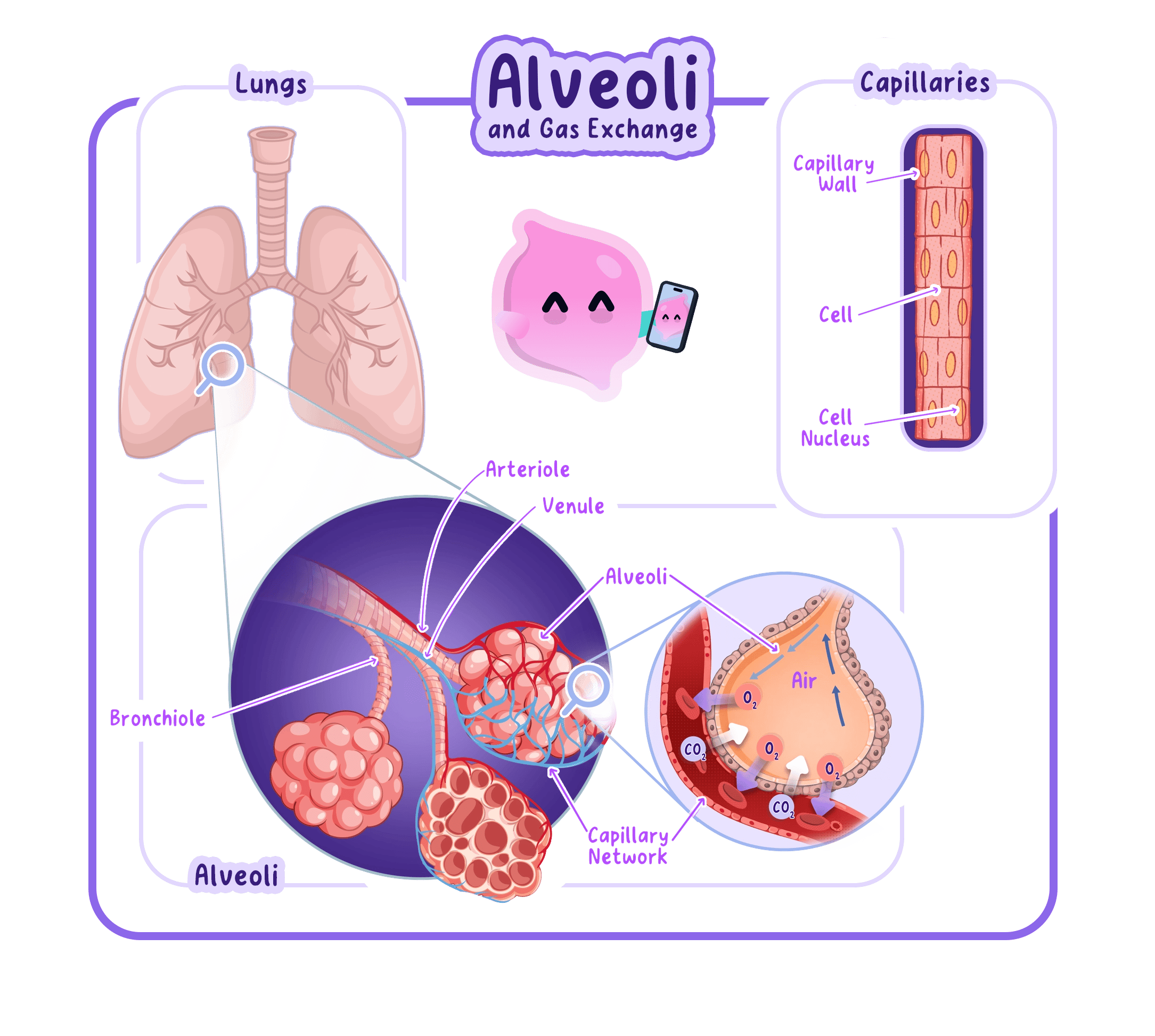
- Air is drawn down the trachea, along the bronchi and bronchioles, and into the millions of alveoli that fill each lung.
- Each alveolus is wrapped in a dense network of capillaries carrying blood from the pulmonary artery.
- That blood has a low oxygen concentration and a high carbon dioxide concentration, because it has just come back from the respiring tissues.
- Oxygen therefore diffuses from the air in the alveolus into the blood, and carbon dioxide diffuses from the blood into the air.
- The circulation keeps that exchange going by carrying oxygenated blood away, which stops the concentrations on the two sides becoming equal.
- Breathing does the same job on the other side, refreshing the air in the alveoli so its oxygen concentration stays high.
- Between them the two systems hold a steep concentration gradient across a wall only two cells thick, which is why exchange is so rapid.
Exam technique
Describing a route through the circulation
- Name every structure in order and do not skip the chambers, because a route question is marked on the sequence.
- Say right or left for each chamber, since atrium on its own does not identify which side of the heart you mean.
- When you are asked why the system is double, give the pressure reason and then the consequence, so that the higher pressure produces a faster flow and a higher delivery rate.
- Remember that a heart diagram is drawn as though you are looking at the person facing you, so the right side of the heart appears on the left of the page.
Common Mistake
- Do not say arteries always carry oxygenated blood, because the pulmonary artery carries deoxygenated blood to the lungs.
- Do not describe the double circulation as blood going round the body twice, because it is the heart that blood passes through twice.
- Do not write that the heart muscle gets its oxygen from the blood inside the chambers, because it is supplied by the coronary arteries.
- Do not say oxygenated and deoxygenated blood mix in the heart, because the two sides are completely separated.
Self review
- Explain what is meant by a double circulatory system.
- Give two advantages a double circulation has over the single circulation of a fish.
- Name the vessel that carries blood from the heart to the lungs and the vessel that returns it.
- Describe the route a red blood cell takes from the vena cava to the aorta.
- Explain how blood flow at the alveoli keeps the concentration gradient for oxygen steep.
