The diagram illustrates the change in diffusion distance as spherical organisms scale up in size.
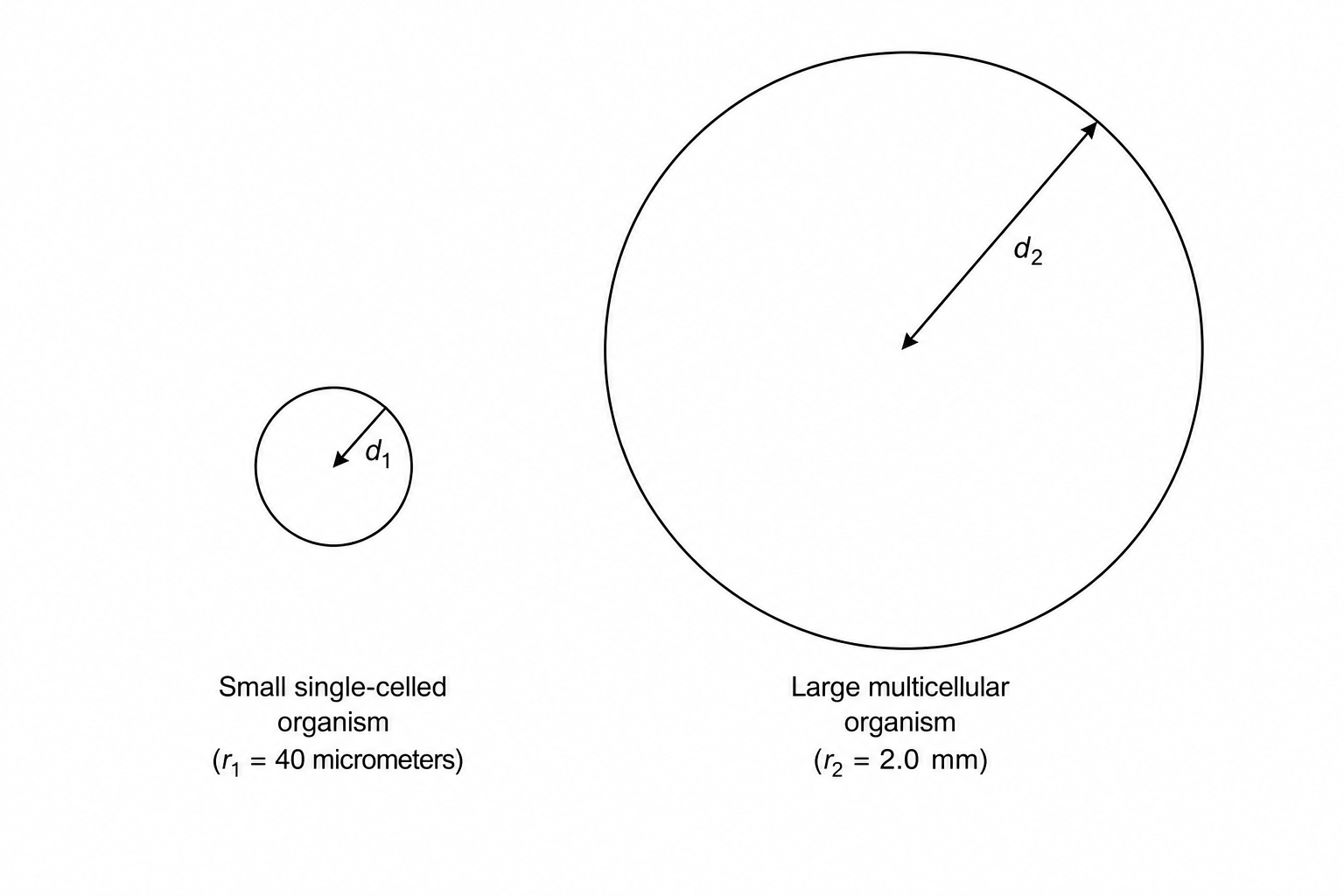
A small single-celled organism of radius r1=40 μmr_1 = 40\ \mu\text{m}r1=40 μm relies entirely on simple diffusion across its body surface for gas exchange. For this organism, the time taken for oxygen to diffuse from the surface to its centre is 0.032 s.
A larger multicellular spherical organism has a radius of r2=2.0 mmr_2 = 2.0\text{ mm}r2=2.0 mm.
Assuming the rate of diffusion is governed by the relation t∝d2t \propto d^2t∝d2 (where t t\,t is the diffusion time and d d\,d is the diffusion distance to the centre), what is the surface area to volume (SA:VSA:VSA:V) ratio of the larger organism and the time taken for oxygen to diffuse to its centre?
SA:V=0.5 mm−1SA:V = 0.5\text{ mm}^{-1}SA:V=0.5 mm−1, Time=1.6 s\text{Time} = 1.6\text{ s}Time=1.6 s
SA:V=1.5 mm−1SA:V = 1.5\text{ mm}^{-1}SA:V=1.5 mm−1, Time=80 s\text{Time} = 80\text{ s}Time=80 s
SA:V=0.5 mm−1SA:V = 0.5\text{ mm}^{-1}SA:V=0.5 mm−1, Time=80 s\text{Time} = 80\text{ s}Time=80 s
SA:V=1.5 mm−1SA:V = 1.5\text{ mm}^{-1}SA:V=1.5 mm−1, Time=1.6 s\text{Time} = 1.6\text{ s}Time=1.6 s