Carbon moves between stores
Carbon cycle
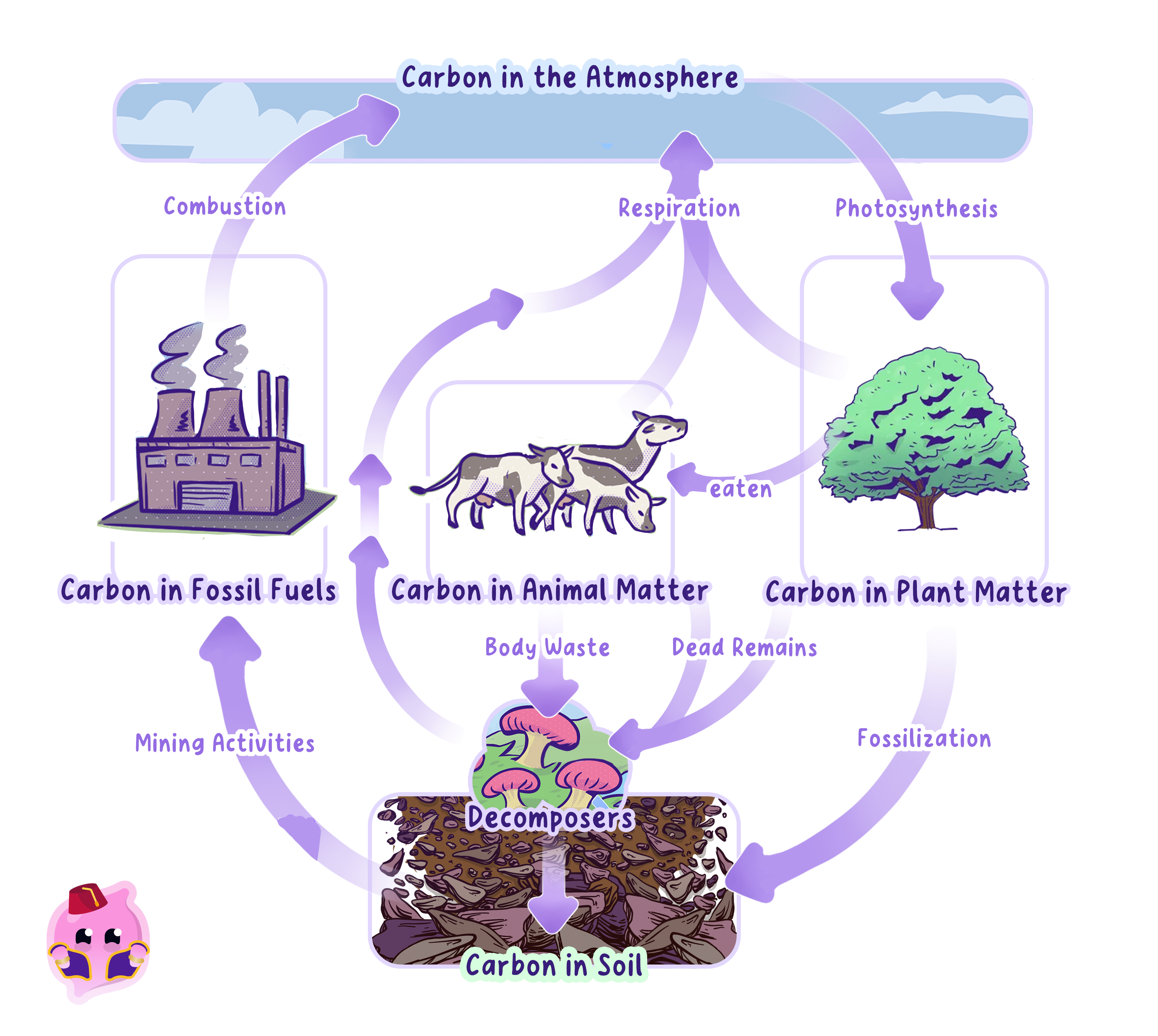
The carbon cycle is the transfer of carbon between organisms and stores in the atmosphere, water, soil and rocks through biological, chemical and physical processes.
- Carbon atoms are needed to build carbohydrates, lipids, proteins and other molecules in living organisms.
- Carbon is stored in the atmosphere, dissolved substances in oceans, living organisms, dead organic material and fossil fuels.
- A store holds carbon, while a process such as photosynthesis or respiration transfers carbon between stores.
- The carbon cycle keeps carbon moving into forms that organisms can use to build new biological material.
Photosynthesis brings carbon into organisms
- Plants and algae take in carbon dioxide from their surroundings and use its carbon to make glucose during photosynthesis.
- Light provides the energy for the reaction: 6CO2+6H2O→lightC6H12O6+6O26\mathrm{CO_2}+6\mathrm{H_2O}\xrightarrow{\text{light}}\mathrm{C_6H_{12}O_6}+6\mathrm{O_2}6CO2+6H2OlightC6H12O6+6O2.
- Carbon in glucose can be used to make other carbohydrates and lipids, or combined with nitrogen-containing substances to make amino acids and proteins.
- When animals eat plants or other animals, carbon-containing molecules pass from the food into the feeding organism.
- Some of the absorbed carbon is incorporated into new cells, so feeding transfers carbon between living organisms.
- Plants obtain the carbon for photosynthesis from carbon dioxide, not from mineral ions absorbed by their roots.
- A carbon atom in atmospheric carbon dioxide is taken into a grass leaf and incorporated into glucose by photosynthesis.
- The grass uses that carbon to build a substance that is eaten by a rabbit.
- If the rabbit uses the carbon-containing substance in aerobic respiration, the carbon can return to the atmosphere in carbon dioxide.
Respiration returns carbon dioxide
- Plants, animals and decomposer microorganisms carry out aerobic respiration, which returns carbon dioxide to the air or surrounding water.
- The overall reaction is C6H12O6+6O2→6CO2+6H2O\mathrm{C_6H_{12}O_6}+6\mathrm{O_2}\rightarrow6\mathrm{CO_2}+6\mathrm{H_2O}C6H12O6+6O2→6CO2+6H2O, with energy released for cellular processes.
- Plants respire during the day and at night, although photosynthesis requires light.
- Dead organisms, fallen leaves and waste transfer carbon into dead organic material.
- Decomposers absorb substances from this material and release carbon dioxide as they respire.
- Some carbon becomes part of decomposer cells or remains in slowly decaying material, so carbon does not all return to the atmosphere immediately.
- For an arrow from the atmosphere to a plant, identify photosynthesis and explain that carbon dioxide is used to make glucose.
- For an arrow from a living organism to the atmosphere, identify respiration and specify that carbon returns as carbon dioxide.
- When explaining carbon release from dead material, connect it to respiration by decomposers rather than stating only that the material disappears.
Combustion releases stored carbon
Combustion
Combustion is a reaction in which a substance burns in oxygen and releases energy.
- When wood burns, carbon stored in the plant material is released mainly as carbon dioxide during complete combustion.
- Some dead organic material avoids complete decay and, after burial and changes over millions of years, can form fossil fuels.
- Coal, oil and natural gas therefore contain carbon that has been stored for a very long time.
- Burning these fuels transfers their carbon into the atmosphere much faster than new fossil fuels form.
- Carbon dioxide also dissolves in oceans, so photosynthesis is not the only process that removes it from the atmosphere.
Carbon stores can change
- A carbon store grows when transfers into it are greater than transfers out, and shrinks when transfers out exceed transfers in.
- A growing forest can accumulate carbon in tree biomass, while its litter and soil also hold carbon.
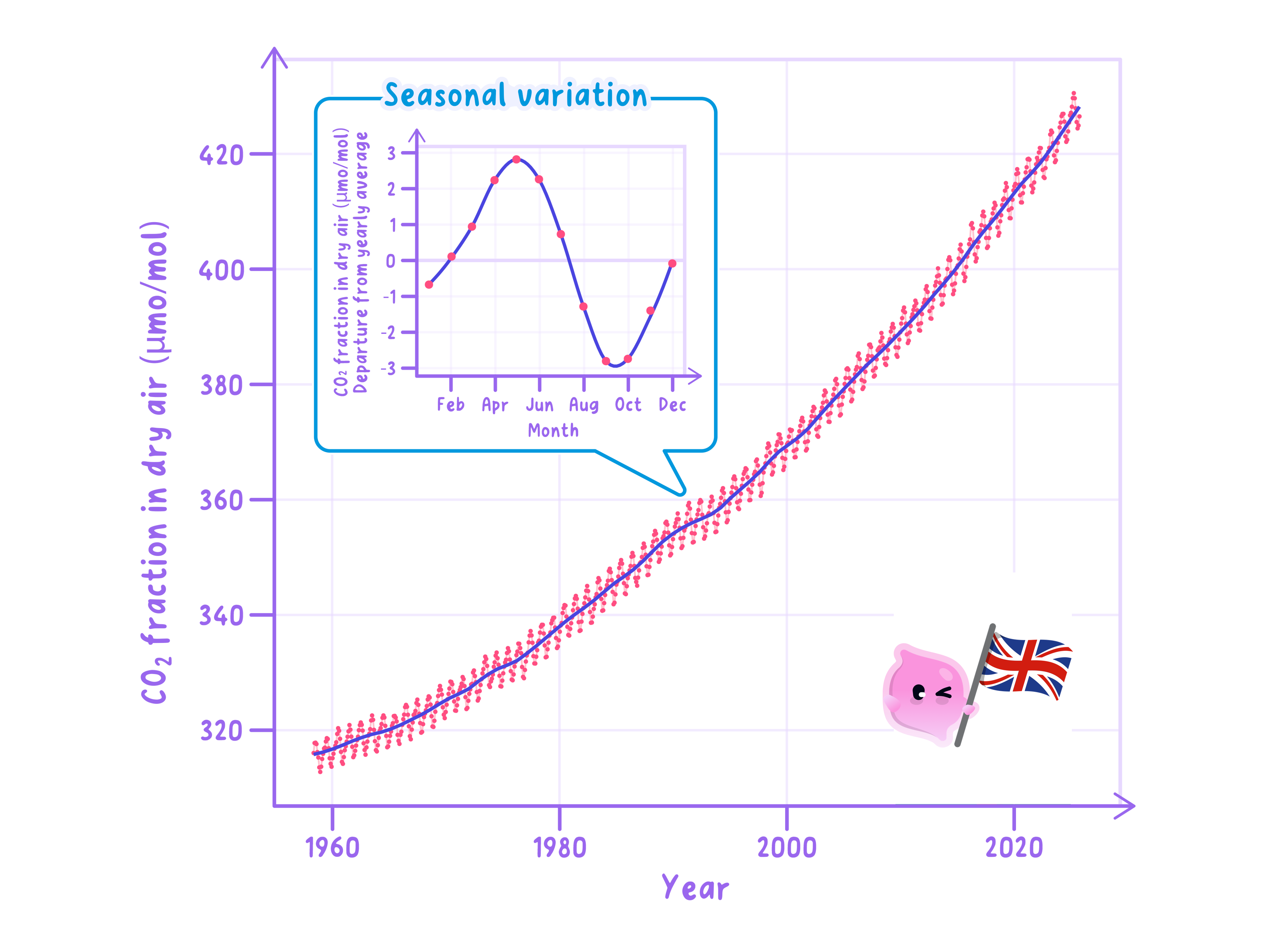
- The amount of carbon in the atmosphere can increase when combustion and respiration add it faster than photosynthesis and other transfers remove it.
- Removing trees reduces carbon uptake by photosynthesis, and subsequent burning or decay can release carbon stored in the trees.
- On a carbon dioxide graph, distinguish a long-term trend from smaller seasonal fluctuations rather than treating every short-term fall as a reversal of the overall trend.
Water circulates through the environment
Water cycle
The water cycle is the continuous movement of water between the atmosphere, land, bodies of water and living organisms.
Evaporation
Evaporation is the change of a liquid into a gas at the liquid’s surface.
Condensation
Condensation is the change of a gas into a liquid.
Precipitation
Precipitation is water that falls from the atmosphere to Earth’s surface as rain, snow, sleet or hail.
- Energy from the Sun causes water to evaporate from oceans, lakes, rivers and moist surfaces.
- Water vapour is carried through the atmosphere, and cooling allows it to condense into tiny liquid droplets that form clouds.
- Cloud droplets join together, or ice crystals grow, until water falls as precipitation, including rain or snow.
- Some precipitation flows over the land as surface run-off, enters streams and rivers, and returns to lakes or oceans.
- Some enters the soil by infiltration and moves deeper into the ground, where it can be stored as groundwater.
- Groundwater can later flow into streams, lakes or the sea, so water follows several possible routes through the cycle.
- Evaporation leaves dissolved salts behind, helping supply fresh water through condensation and precipitation.
- Water vapour is an invisible gas; the visible droplets in a cloud are liquid water, not water vapour.
Organisms depend on water cycling
Transpiration
Transpiration is the loss of water vapour from the leaves and stems of a plant, mainly through the stomata.
- Plants absorb water through their roots and transport it to leaves, where some is used in photosynthesis and most is eventually lost as water vapour.
- Water evaporates from leaf cell surfaces and diffuses out through stomata, returning water to the atmosphere by transpiration.
- Animals take in water by drinking and feeding, and return it through processes including urination, breathing and sweating.
- Water acts as a solvent for reactions and transport, so a continuing supply allows substances to dissolve and move within organisms.
- Water in soil carries dissolved mineral ions to roots, and flowing water transports nutrients through habitats.
- The cycle replenishes rivers, ponds and other freshwater habitats, while rainfall and soil water support organisms on land.
- A prolonged lack of rainfall can reduce available water and shrink aquatic habitats, even though water continues to exist elsewhere in the global cycle.
Evaporation changes liquid water into a gas, while condensation changes water vapour into liquid droplets; neither process changes water into a different chemical substance.
- How does photosynthesis transfer carbon from the atmosphere into living material?
- Why does decomposing material release carbon dioxide?
- How does burning fossil fuels change the atmospheric carbon store?
- What happens to water during condensation?
- How does the water cycle maintain freshwater habitats?
