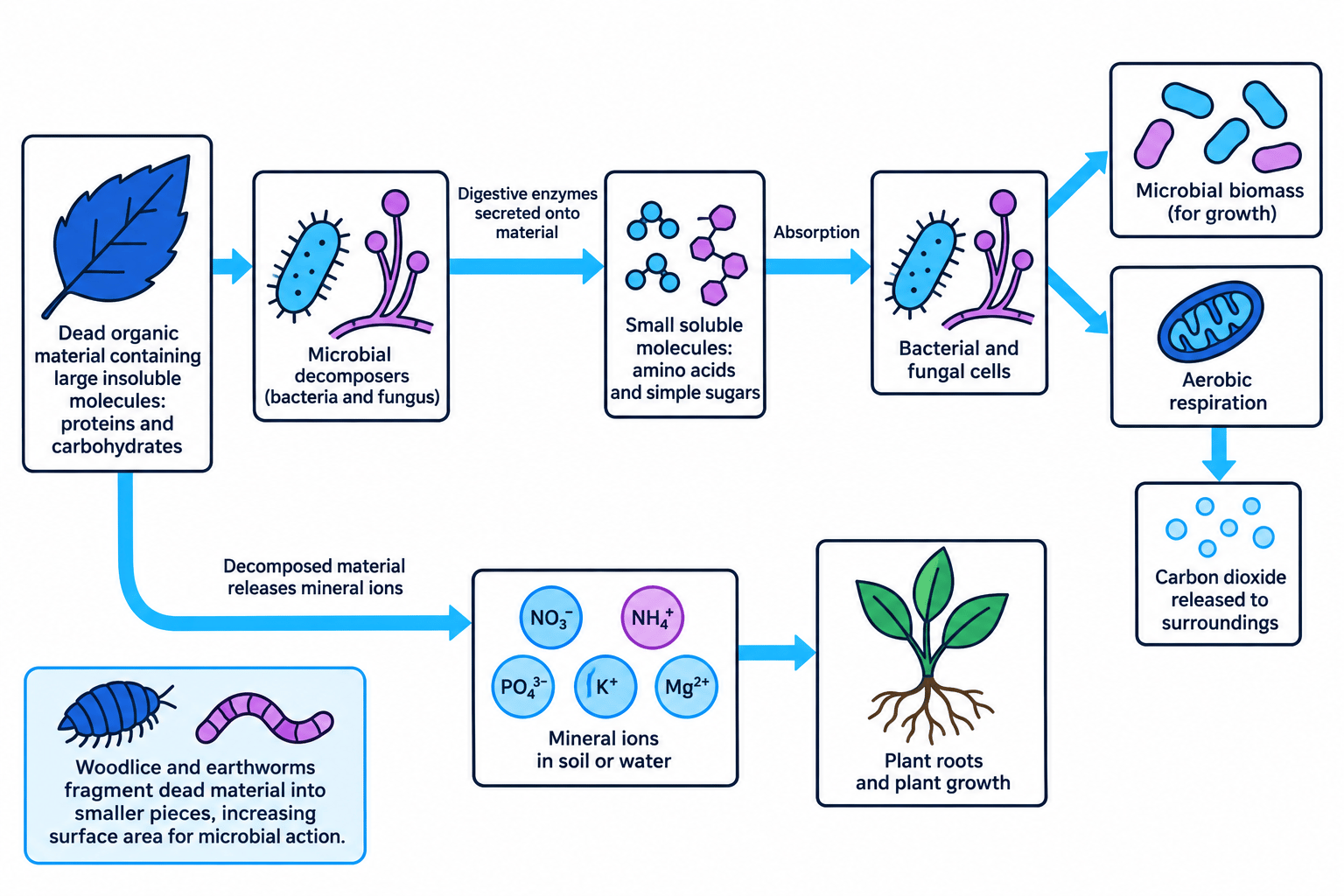
Microorganisms break down organic material
Definition
Decomposition
Decomposition is the breakdown of dead organic material and organic waste into simpler substances by decomposers.
Definition
Decomposer
A decomposer is an organism, such as a bacterium or fungus, that obtains nutrients by breaking down dead organisms or organic waste.
- Many bacteria and fungi obtain nutrients from dead organisms and organic waste, including fallen leaves, dead roots and animal faeces.
- Their activity breaks complex biological material into simpler substances that can move back into the environment.
- A dead organism contains large molecules, such as proteins and carbohydrates, that cannot all be absorbed directly by microbial cells.
- Decomposers secrete digestive enzymes onto the material, so digestion occurs outside their cells.
- The enzymes break large, insoluble molecules into smaller, soluble molecules, such as amino acids and simple sugars.
- The small molecules dissolve in water and can then be absorbed by the microorganisms.
- Absorbed molecules provide materials for growth and substances that can be broken down in respiration.
Exam technique
- An explanation of microbial feeding needs both enzyme secretion onto the material and absorption of the soluble products.
- Use named organisms such as bacteria and fungi when explaining which decomposers carry out the process.
Decomposition returns usable materials
- Some absorbed carbon becomes part of the decomposers’ own cells, so carbon can be temporarily stored in microbial biomass.
- During aerobic respiration, decomposers break down carbon-containing substances and release carbon dioxide into the surroundings.
- That carbon dioxide can subsequently be taken up by photosynthesising organisms.
- The breakdown of nitrogen-containing substances returns nitrogen to the surroundings in mineral forms, with further microbial activity making nitrogen available in forms plants can absorb.
- Other mineral nutrients are also returned to the soil or water as dead material is broken down.
- Plant roots absorb dissolved mineral ions and use them to make new biological molecules, including the proteins needed for growth.
- Without decomposition, dead material and waste would accumulate and a larger proportion of nutrients would remain unavailable to plants.
Common Mistake
Plants absorb mineral ions through their roots and take in carbon dioxide for photosynthesis; they do not obtain their food by absorbing pieces of decaying organisms.
Detritivores help microorganisms
Definition
Detritivore
A detritivore is an animal that feeds on dead organic material and breaks it into smaller pieces.
- Woodlice and earthworms feed on dead organic matter and fragment it into smaller pieces.
- Smaller pieces expose a larger total surface area for microbial colonisation and enzyme action.
- This makes more of the material accessible to bacteria and fungi and can increase the rate at which it is decomposed.
- Detritivores also mix organic matter with soil, bringing it into contact with microorganisms.
- The animal fragments and digests material within its digestive system, whereas microbial decomposers can secrete enzymes onto material outside their cells.
- Both activities contribute to recycling, but an earthworm is an animal, not a microorganism.
Example
- A fallen leaf is chewed into fragments by a woodlouse, exposing more surface for fungi and bacteria.
- Microbial enzymes digest substances in the fragments, and the microorganisms absorb the soluble products.
- As the microorganisms respire and the material is broken down further, carbon dioxide and mineral nutrients return to the surroundings.
Self review
- Which two groups contain the main microbial decomposers?
- Why must large insoluble food molecules be digested before absorption?
- Which process releases carbon dioxide from decomposers?
- How does fragmentation by detritivores help decomposition?
- Why does decomposition support plant growth?