The brain as part of the CNS
Central nervous system
The central nervous system is the brain and spinal cord, which receive impulses from sensory neurones, coordinate a response and send impulses out along motor neurones.
- The brain and the spinal cord together form the central nervous system, and the brain is where the more complex processing happens.
- It is built from billions of neurones, each forming synapses with thousands of others, which is where its processing power comes from.
- It is protected by the bony skull, by tough membranes, and by a layer of fluid that cushions it against knocks.
- Different jobs are handled by different regions, so damage in one place removes particular abilities while leaving others untouched.
- The five regions named in this topic are the cerebrum, the cerebellum, the medulla, the hypothalamus and the pituitary gland.
- Roughly speaking, the higher up a region sits, the more conscious its work is, and the lower down it sits, the more automatic its work is.
The brain is not one processor but a set of regions with separate jobs, which is why a person can lose the ability to balance while their memory and speech stay intact.
The cerebrum
Cerebrum
The cerebrum is the large, folded upper region of the brain that controls conscious thought, memory, language, personality and voluntary movement.
- The cerebrum is the largest region, sitting on top of the rest of the brain and covering most of it.
- Its thin outer layer, the cerebral cortex, is deeply folded, and the folds pack a far greater area of tissue into the space inside the skull.
- More area means more neurones and more synapses, which is what allows complex processing.
- The cerebrum controls conscious thought, memory, language, personality and voluntary movement.
- It also receives impulses from the sense organs, so seeing, hearing and feeling something consciously all happen here.
- It is divided into two halves called hemispheres, joined by a thick band of neurones that lets them exchange information.
- Each hemisphere controls the opposite side of the body, so a stroke in the left hemisphere weakens the right arm and leg.
- Within each hemisphere there are separate areas for movement, for touch, for vision and for speech, which is why damage in one small patch can remove one specific ability.
A patient whose stroke damaged one small region of the left cerebrum could still understand everything said to them but could no longer form the words to reply, which told doctors that region produces speech.
The cerebellum
Cerebellum
The cerebellum is the region beneath the back of the cerebrum that coordinates balance, posture and smooth, precise movement.
- The cerebellum sits underneath the back of the cerebrum, and its surface is folded even more finely.
- It controls balance, posture and the coordination of movement.
- It receives information from receptors in the muscles and joints about where each part of the body currently is.
- It also receives information from the balance receptors in the inner ear about the position and movement of the head.
- It compares that information with the movement the cerebrum has asked for, and adjusts the impulses going to the muscles so the movement comes out smooth and accurate.
- The cerebellum does not decide to move, so a person with cerebellum damage can still choose to reach for a cup but their arm moves jerkily and overshoots.
- It is also where practised skills such as riding a bike or writing become automatic.
A police roadside balance test works because alcohol reaches the cerebellum quickly and interferes with the fine adjustments it makes to posture.
The medulla
Medulla
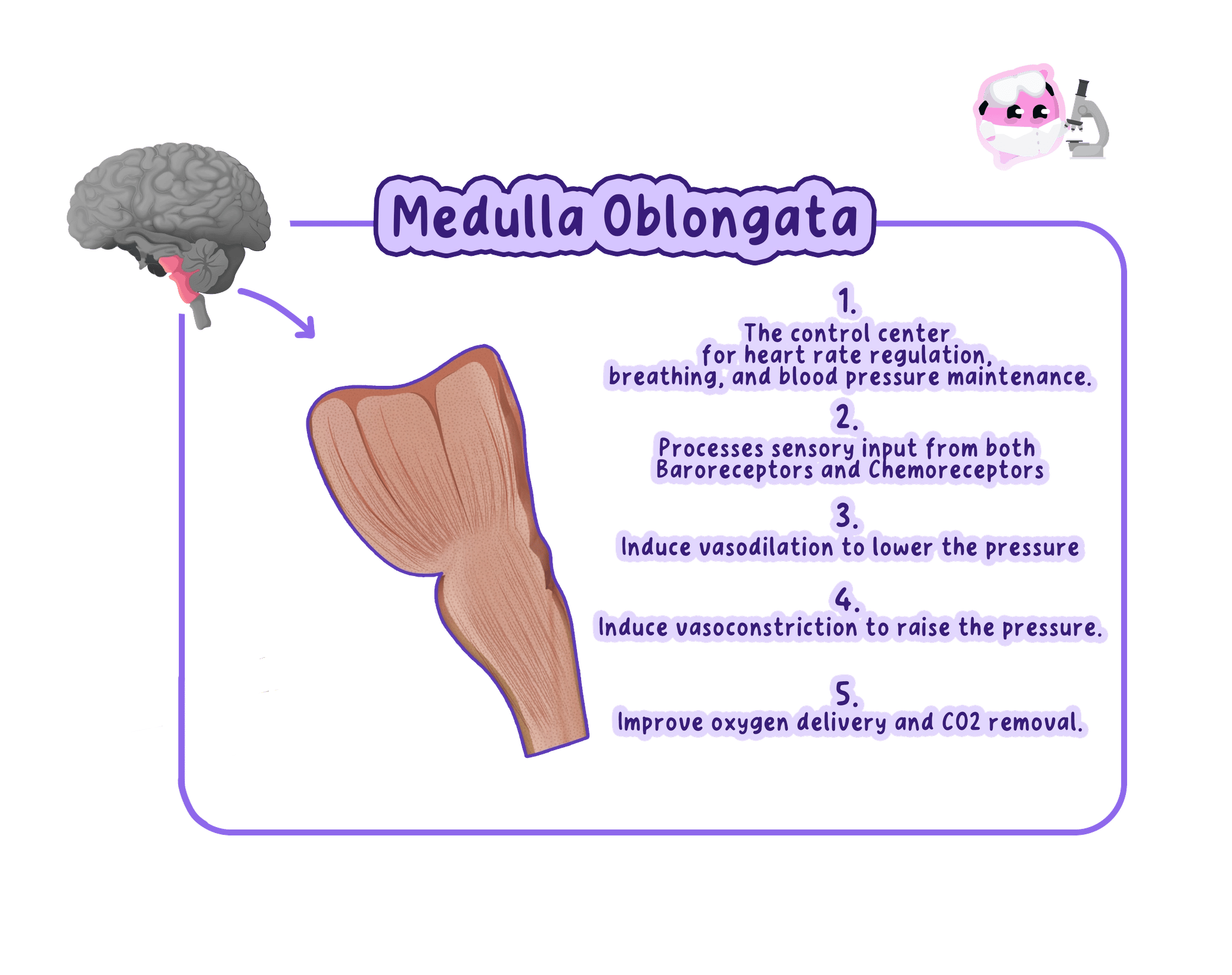
The medulla is the region at the base of the brain, joining the spinal cord, that controls unconscious activities such as heart rate and breathing rate.
- The medulla lies at the base of the brain, where it joins the top of the spinal cord.
- It controls unconscious activities that continue whether you are awake or asleep.
- It sets the heart rate by sending impulses to the heart, speeding it up during exercise and slowing it down at rest.
- It sets the breathing rate by sending impulses to the muscles of the ribs and diaphragm.
- It receives information from receptors that monitor the blood, so a rise in dissolved carbon dioxide makes it increase the breathing rate.
- It also controls blood pressure, swallowing, coughing and vomiting.
- Because these processes keep you alive from moment to moment, damage to the medulla is far more likely to be fatal than damage of the same size in the cerebrum.
- Do not swap the cerebellum and the medulla, because the cerebellum coordinates movement while the medulla controls heart rate and breathing rate.
- Do not write that the medulla controls all muscles, because the muscles you move on purpose are controlled by the cerebrum.
The hypothalamus and pituitary gland
Hypothalamus
The hypothalamus is the region of the brain that monitors internal conditions such as body temperature and water content and triggers the responses that keep them steady.
Pituitary gland
The pituitary gland is a small gland hanging below the hypothalamus that releases hormones which control other glands in the body.
- The hypothalamus is a small region near the base of the brain, just above the pituitary gland.
- It monitors the blood flowing through it, checking its temperature and its water content.
- When a reading moves away from normal it triggers the correcting response, so it acts as the body's thermoregulatory centre.
- It also helps control sleep, hunger and thirst, all of which depend on the state of the blood.
- The pituitary gland hangs just below it on a short stalk, and the hypothalamus controls what that gland releases.
- The pituitary gland releases hormones into the blood, and several of those hormones act on other glands and make them release hormones of their own.
- This pair is therefore the point where electrical control by the brain is turned into chemical control carried in the blood.
- That link explains how a change detected inside the brain can produce a slow, long-lasting response across the whole body.
Matching a region to an ability
- Questions often describe a patient's symptoms and ask which region is damaged, so read the symptom and work backwards to the job.
- Loss of memory, of speech or of conscious control of a limb points to the cerebrum.
- Unsteady walking, poor balance or shaky, badly aimed movements point to the cerebellum.
- An irregular heartbeat or difficulty breathing points to the medulla.
- A body temperature that drifts, or unusual thirst, points to the hypothalamus.
Answering on brain regions
- Name the region and its job in the same sentence, because a bare name rarely gets the explain mark.
- Use unconscious for the medulla and coordination of movement for the cerebellum, since those are the phrases the mark scheme credits.
- On a diagram, find the spinal cord first, because the region joined to it is the medulla and everything else can be placed from there.
- If a case study gives several symptoms, name the one region that explains all of them rather than a different region for each.
Why the regions work together
- A single action usually needs several regions at once, so they are connected by large bundles of neurones.
- Running upstairs starts as a decision in the cerebrum, is smoothed by the cerebellum, and is supported by the medulla raising your heart and breathing rates.
- Meanwhile the hypothalamus notices your blood warming and starts the responses that cool you down.
- Because the regions are so tightly linked, damage in one place often disturbs abilities that seem to belong to another.
- Name the five regions of the brain covered here and give one function of each.
- Explain why the cerebral cortex is folded.
- Describe the information the cerebellum uses to keep a movement smooth.
- Explain why damage to the medulla is especially dangerous.
- State what the hypothalamus monitors in the blood.
- Explain how the hypothalamus and pituitary gland link nervous control to chemical control.
