Why the brain is hard to investigate
Definition
Central nervous system
The central nervous system is the brain and spinal cord, which receive impulses from sensory neurones, coordinate a response and send impulses out along motor neurones.
- The brain is enclosed by the skull, so it cannot be seen or reached without surgery.
- Brain tissue is extremely delicate, so any attempt to reach one region risks destroying healthy tissue on the way in.
- It contains billions of neurones with an enormous number of connections between them, so the wiring is far too complex to map by looking at it.
- Regions do not work in isolation, because most abilities depend on several regions passing impulses to each other.
- Deliberately removing or damaging part of a healthy brain to see what changes would harm the person, so that experiment can never be done.
- Scientists therefore have to work with the damage that has already happened, or with methods that leave the brain intact.
Key Idea
Brain research is limited less by a lack of ideas than by the fact that the one experiment that would settle a question cannot ethically be carried out.
Studying patients with brain damage
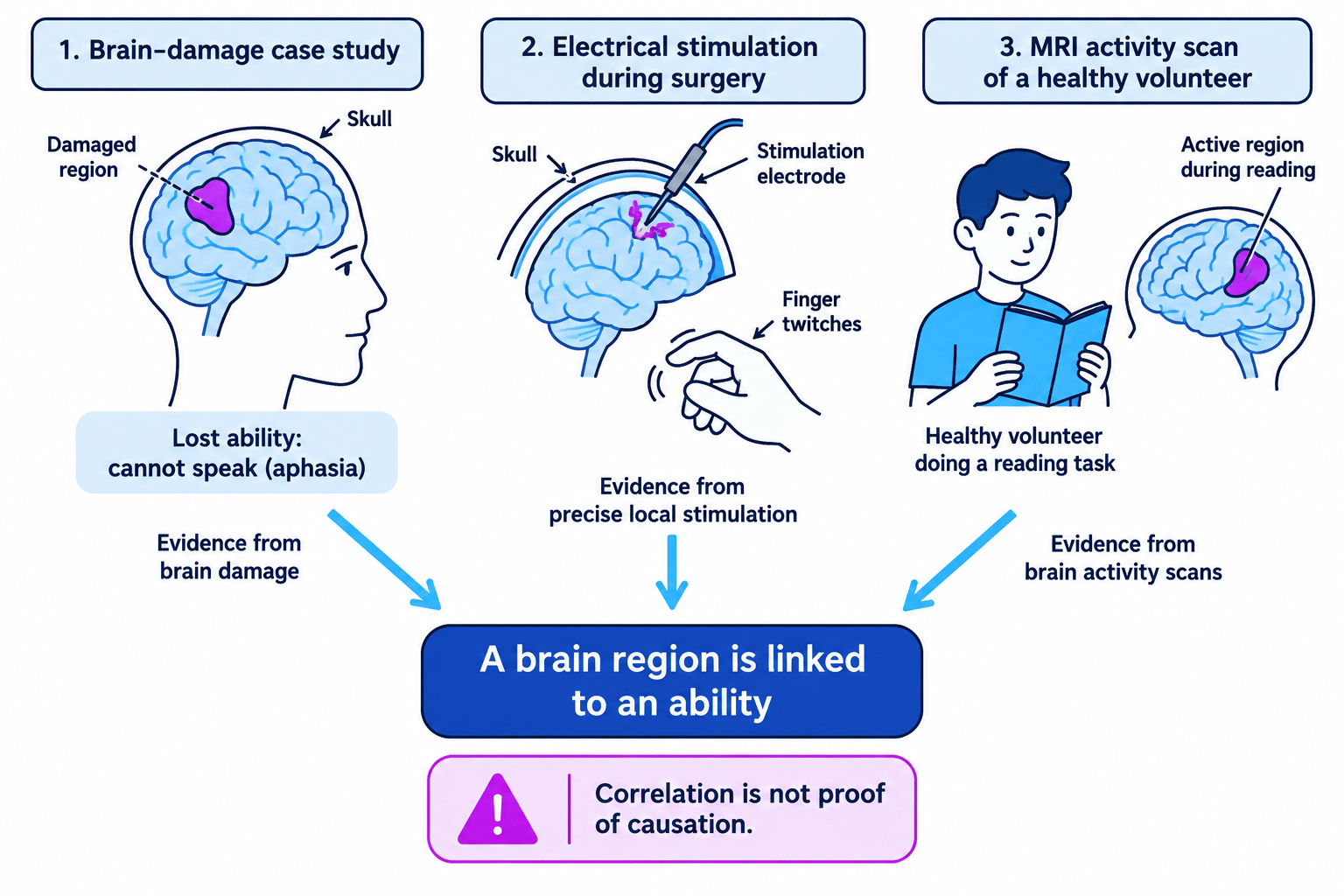
- A case study is a detailed record of one patient whose brain has been damaged by an injury, a stroke, a tumour or an infection.
- Researchers test what the patient can and cannot do, then find out which region was damaged, either by scanning them or by examining the brain after death.
- If a lost ability lines up with a damaged region, that region is likely to be needed for the ability.
- Confidence grows only when many patients with damage in the same place show the same loss.
- Much of what is known about the roles of the cerebrum was built up this way over more than a century.
Example
A patient who can no longer form new memories after an operation, but who still remembers their childhood clearly, shows that storing new memories and recalling old ones are handled by different parts of the brain.
Problems with obtaining case studies
- Suitable patients are rare, because damage confined to one small region hardly ever happens.
- Researchers cannot choose when a case appears, so the work is slow and depends on waiting for an injury to happen to someone.
- Patients are often seriously ill, so testing them may be impossible or may have to be kept very short.
- The sample size is tiny, sometimes a single person, so a result cannot safely be applied to everybody.
- The study cannot be repeated, because no second patient will ever have exactly the same damage.
- There is no control, because the same person cannot be studied both with and without the damage.
Problems with interpreting case studies
- Damage usually spreads across more than one region, so it is hard to tell which of them caused the lost ability.
- A damaged region may only be part of a longer pathway, so the loss may really be caused by the connection being cut rather than by that region doing the job.
- There is rarely a record of what the patient could do before the damage, so the size of the loss has to be estimated.
- The brain can partly reroute a task through other neurones over time, so testing months later may underestimate what was lost.
- Every brain differs slightly in the exact position of its regions, so the same map does not fit everyone.
- A case study therefore shows a correlation between a damaged region and a lost ability, which is weaker evidence than a controlled experiment.
Common Mistake
- Do not write that a case study proves a region controls an ability, because a single unrepeatable observation cannot prove cause.
- Write instead that the evidence suggests a link, and say what further evidence would strengthen it.
Stimulating the brain electrically
- A weak electric current can be applied to a small area of the exposed brain during surgery, and the effect on the patient is recorded.
- The current starts impulses in the neurones of that area, so stimulating one spot may make a finger twitch and stimulating another may produce a sensation or a memory.
- The brain itself has no pain receptors, so the patient can stay awake and describe what they feel while the surgeon works.
- This method gives a very precise map, because the area being tested is being touched directly.
- Its limitation is that it can only be done on patients who already need brain surgery for another reason, so the sample is small and unusual.
- Stimulating a region also produces an artificial burst of impulses, which is not the same as watching that region work normally.
Scanning the brain
Definition
MRI scan
An MRI scan is a technique that uses strong magnetic fields and radio waves to produce a detailed image of the structure of the brain without surgery.
- A scan produces an image of the brain from outside the skull, so no surgery is needed and the person is unharmed.
- An MRI scan uses strong magnetic fields and radio waves to build a detailed image of the structure of the brain, showing exactly where a tumour or a damaged region lies.
- Other scans show activity instead, because active neurones respire faster and so draw more oxygen and glucose from the blood.
- A person can be scanned while reading, listening or moving, and the region that lights up is matched to the task.
- Scanning removed the biggest limitation of case studies, because healthy volunteers can be studied and the same person can be scanned again and again.
- Scanners are expensive and need trained staff, so studies use small numbers of volunteers.
- The person must lie completely still inside a noisy machine, which is difficult for young children and for anyone in pain.
- A bright patch on a scan shows only that a region is more active during a task, which is again a correlation rather than proof that the region produces the ability.
Ethical issues
- Patients must give informed consent, which means understanding what will be done and agreeing to it freely.
- Brain damage can affect memory, understanding and judgement, so the very patients researchers most want to study may be the least able to give that consent.
- Patients are in a vulnerable position, so they must not feel pressured into taking part in order to receive treatment.
- Any procedure must not increase the harm to the patient, so extra surgery purely for research is not allowed.
- Personal and medical details must be kept confidential, which is difficult when a case is so rare that the patient could be identified from the description.
- Using animals instead avoids some of these problems but raises others, because the animal cannot consent and its brain differs from a human one.
- Research is therefore reviewed by an ethics committee before it starts, and the expected benefit has to justify the risk.
Exam technique
Writing about the difficulties
- Separate the practical difficulties from the ethical ones, because a question asking for both wants a point from each side.
- Give a reason with every difficulty, so complex is not enough on its own and needs the number of neurones and connections behind it.
- Use the words small sample, no control and cannot be repeated when you evaluate a case study, since those are the marking points.
- For an evaluate question, finish with a judgement, such as saying that scanning gives the more reliable evidence because it can be repeated on healthy volunteers.
How the evidence builds up
- No single method is strong enough on its own, so scientists look for the same conclusion from several of them.
- When case studies, electrical stimulation and scanning all point to the same region, the conclusion becomes far more secure.
- Because of these limits our understanding of the brain is still incomplete, and it is being revised as scanning technology improves.
Self review
- Give three reasons why the brain is difficult to investigate.
- Describe how a case study of a damaged brain is used to work out what a region does.
- Give two reasons why suitable case studies are hard to obtain.
- Explain two reasons why the results of a case study are hard to interpret.
- State one advantage of scanning over studying patients with brain damage.
- Explain why obtaining informed consent can be difficult in brain research.