Stem cells as a treatment
Stem cell
An undifferentiated cell that can divide to make more cells of the same kind and can differentiate into specialised cells.
Transplant
A transplant is the transfer of cells, tissue or an organ from a donor into a recipient to replace ones that are damaged or missing.
- A stem cell can divide many times and then differentiate into specialised cells, so it can be used to produce new cells to replace ones that have been damaged or lost.
- Many diseases and injuries destroy cells that the body cannot replace on its own, such as nerve cells in the spinal cord or the insulin-secreting cells of the pancreas.
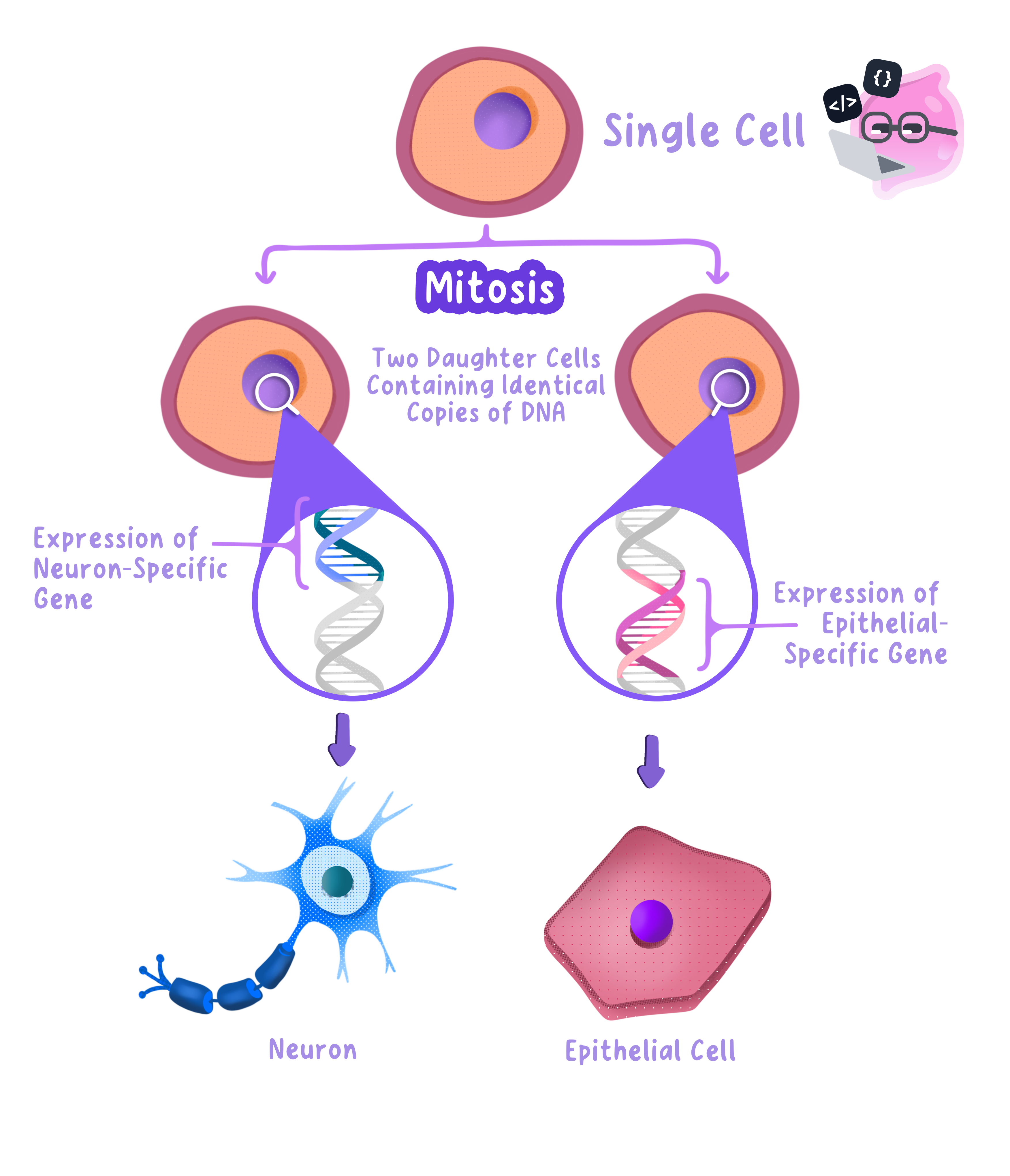
- Stem cells can be grown in the laboratory and treated with chemicals that switch on the genes needed for a particular cell type, so that they differentiate into the cells the patient is missing.
- The new cells are then placed into the patient's body in a transplant.
- In the future, stem cells could also be used to grow whole tissues or organs for transplant, which would reduce the shortage of donor organs.
- Tissues grown from stem cells can also be used to test new drugs, so fewer tests need to be carried out on animals and people.
Uses in medicine
- Some stem cell treatments are already in routine use.
- In a bone marrow transplant, stem cells from a donor's bone marrow are given to a patient with leukaemia, a cancer of the blood, after the patient's own diseased bone marrow has been destroyed.
- The donor stem cells divide and differentiate to produce healthy red blood cells, white blood cells and platelets.
- Sheets of skin grown from stem cells are used to cover severe burns.
- Other stem cell treatments are being tested for conditions that cannot yet be cured.
- Insulin-secreting cells made from stem cells could treat type 1 diabetes, so the patient would no longer need insulin injections.
- New nerve cells could repair damage to the spinal cord and help people with paralysis.
- Replacement brain cells could treat Parkinson's disease, in which a group of brain cells that control movement die.
- Light-sensitive cells could replace damaged cells in the retina and restore some sight to people with certain types of blindness.
Tissue transplantation and rejection
Rejection
Rejection is the destruction of transplanted cells, tissue or an organ by the recipient's immune system because it recognises their antigens as foreign.
Immunosuppressant drug
An immunosuppressant drug is a medicine that reduces the activity of the immune system so that a transplant is less likely to be rejected.
Therapeutic cloning
Therapeutic cloning is producing an early embryo with the same genes as a patient so that its stem cells can be used to treat that patient.
- Every cell carries antigens on its surface, and the pattern of these antigens differs from one person to another.
- When cells from a donor are transplanted, the patient's lymphocytes can recognise the donor's antigens as foreign.
- The lymphocytes then attack and destroy the transplanted cells, and this is called rejection.
- To reduce the risk of rejection, doctors choose a donor whose tissue type is as close as possible to the patient's, often a brother or sister.
- The patient is usually also given immunosuppressant drugs, which reduce the activity of the immune system.
- Immunosuppressant drugs leave the patient more likely to suffer serious infections, and they may have to be taken for many years.
- Rejection can be avoided if the stem cells come from the patient's own body, because the cells carry the patient's own antigens.
- Adult stem cells can sometimes be collected from the patient's own bone marrow, stored and returned after treatment.
- Therapeutic cloning would produce an embryo with the same genes as the patient, so the embryonic stem cells taken from it would not be rejected.
- A drawback of using a patient's own cells to treat a genetic disorder is that those cells carry the same faulty alleles that caused the disease.
Risks of stem cell treatments
- Stem cells divide rapidly, and if their division is not controlled after the transplant they could form a tumour and lead to cancer.
- Stem cells grown in a laboratory could become contaminated with a virus, which would be transferred to the patient and cause an infection.
- The transplanted cells may not differentiate into the right cell type, or they may not work properly once inside the patient.
- Many stem cell treatments are still at the research stage, so their long-term effects are not yet known.
- The treatments are expensive to develop and carry out, so they may not be available to every patient who could benefit.
Ethical issues
Embryonic stem cell
A stem cell taken from an early embryo that can differentiate into any type of cell in the body.
- Collecting embryonic stem cells destroys the embryo, and some people believe that an embryo has the same right to life as a person.
- Other people argue that an embryo a few days old is a small ball of cells with no nervous system, so it cannot feel pain and is not yet a person.
- Most embryos used for research are spare embryos left over from IVF treatment, which would otherwise be thrown away.
- Some people are concerned that therapeutic cloning could lead to attempts to clone whole humans.
- In the UK, research on human embryos is allowed only under licence, and an embryo may not be kept beyond 141414 days of development.
- Using adult stem cells avoids destroying embryos, but they can differentiate into only a limited range of cell types, so they cannot be used to treat as many conditions.
Stem cells for type 1 diabetes
- In type 1 diabetes, the cells in the pancreas that secrete insulin have been destroyed.
- Scientists grow embryonic stem cells in the laboratory and add chemicals that switch on the genes for making insulin, so the cells differentiate into insulin-secreting cells.
- The new cells are transplanted into the patient, where they respond to rising blood glucose by releasing insulin.
- The benefit is that the patient may no longer need several insulin injections every day.
- Because the cells come from another person's embryo, the patient must take immunosuppressant drugs to prevent rejection, which increases the risk of infection.
- The cells must be checked carefully before the transplant, because any that stay undifferentiated could keep dividing and form a tumour.
Discussing stem cell treatments
- A discuss question expects both benefits and risks, and the top marks need points on both sides followed by a conclusion.
- Name a specific condition and explain how the stem cells would help, such as insulin-secreting cells for type 1 diabetes.
- When writing about rejection, state that the immune system recognises the antigens on the transplanted cells as foreign.
- Keep ethical arguments separate from medical risks, because examiners credit them as different points.
- Give the reason behind any ethical objection, such as the destruction of an embryo that some people see as a potential life.
- Do not say that embryonic stem cells are taken from adults, or that adult stem cells can form any type of cell.
- Do not write that immunosuppressant drugs are needed when the stem cells come from the patient's own body, because those cells will not be rejected.
- Give two conditions that stem cells could be used to treat, and state the type of cell needed for each.
- Explain why stem cells transplanted from a donor may be rejected.
- Describe one way of reducing the risk of rejection.
- Give two risks of using stem cells in medicine.
- Give one argument for and one argument against using embryonic stem cells.
