Controlled cell division
- In a healthy body, cells divide by mitosis only when new cells are needed for growth or to repair damaged tissue.
- The timing of each division is controlled by genes in the nucleus of the cell.
- Some of these genes make a cell divide when the body needs more cells, while others stop division once enough cells have been made.
- Cells that are too badly damaged to work properly are normally made to die, so they cannot keep dividing.
- This control keeps each tissue at the right size and makes sure old or damaged cells are replaced at the same rate as they are lost.
What cancer is
Cancer
Cancer is a non-communicable disease in which mutated body cells divide repeatedly without control and can invade other tissues.
Mutation
A mutation is a change in the base sequence of DNA.
Tumour
A tumour is a mass of abnormal cells formed when cells divide without control.
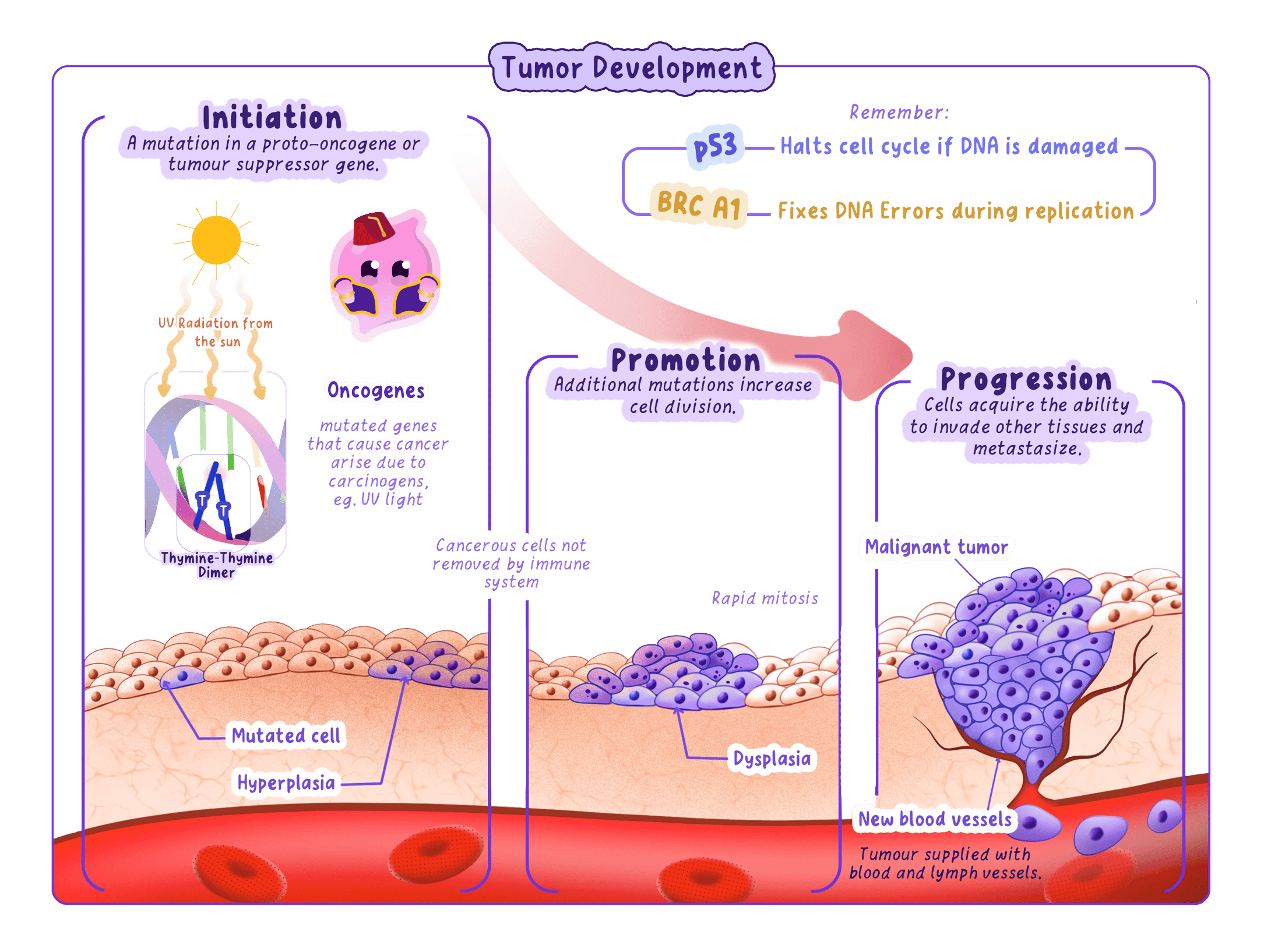
- Cancer begins when changes in a cell's DNA remove the normal control over when that cell divides.
- These changes are mutations in the genes that control cell division.
- A single mutation is rarely enough, and cancer usually develops only after several mutations have built up in the same cell over many years.
- This is one reason why the risk of most cancers increases with age.
- The mutated cell divides again and again, and every daughter cell inherits the same mutations, so the abnormal cells keep multiplying.
- The cancer cells do not respond to the signals that would normally stop division, so they form a growing lump of cells called a tumour.
- The tumour takes nutrients and space from the healthy cells around it, so the tissue can no longer work normally.
- Most mutations that cause cancer happen in body cells during a person's life, so most cancers are not inherited.
- Some people do inherit alleles that make these mutations more likely to lead to cancer, which increases their risk without making cancer certain.
Benign and malignant tumours
Benign tumour
A benign tumour is a tumour that stays in one place, usually inside a membrane, and does not invade other tissues or spread around the body.
Malignant tumour
A malignant tumour is a cancerous tumour whose cells invade neighbouring tissues and can spread in the blood or lymph to form secondary tumours.
Metastasis
Metastasis is the spread of cancer cells from a primary tumour through the blood or lymph to form secondary tumours in other parts of the body.
- Tumours are described as benign or malignant, depending on whether their cells can spread.
- A benign tumour grows in one place, is usually surrounded by a membrane, and does not invade the tissues around it.
- Benign tumours are not cancer, but they can still be harmful if they press on an organ, such as a benign tumour in the skull pressing on the brain.
- A benign tumour can often be removed completely by surgery, and it usually does not grow back.
- A malignant tumour is a cancer, because its cells invade the healthy tissue around it and destroy it.
- Cells can break away from a malignant tumour and enter the blood or the lymph.
- These cells are carried to other parts of the body, where they settle and divide to form secondary tumours.
- The spread of cancer cells in this way is called metastasis.
- The first tumour to form is the primary tumour, and a cancer is named after the organ where the primary tumour began, even when secondary tumours are found elsewhere.
- Metastasis makes cancer much harder to treat, because there may be many tumours in different organs.
- Do not use the words tumour and cancer as if they mean the same thing, because only malignant tumours are cancers.
- Do not describe cancer as a disease you catch or a disease you always inherit, because it is caused by mutations in a person's own body cells.
- Do not write only that cancer cells divide quickly, because the key feature is that their division is no longer controlled.
Causes of the mutations
Carcinogen
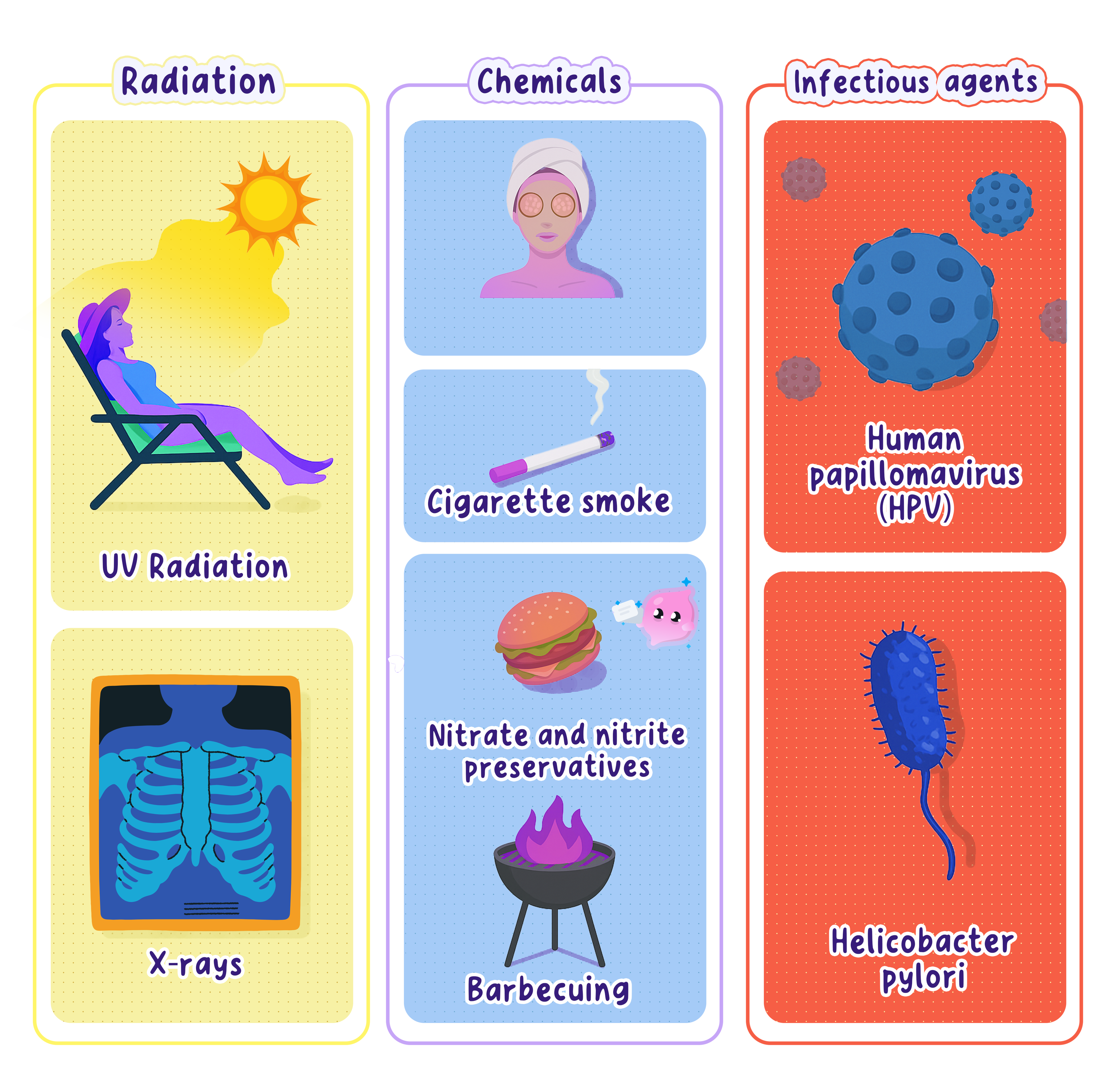
A carcinogen is any chemical, form of radiation or other agent that increases the chance of the mutations that lead to cancer.
- Anything that increases the chance of the mutations that lead to cancer is called a carcinogen.
- Radiation, including ultraviolet light from the Sun and sunbeds and X-rays, can damage DNA directly.
- Many chemicals are carcinogens, including dozens of the substances in tobacco smoke and the fibres of asbestos.
- Some viruses increase the risk of cancer, such as the human papillomavirus, which can cause cervical cancer.
- Lifestyle factors change how much a person is exposed to carcinogens, which is why smoking, heavy drinking and sunbathing all raise the risk of cancer.
Skin cancer after repeated sunburn
- A teenager spends several summer holidays sunbathing without sun cream and is badly sunburnt each year.
- The ultraviolet light penetrates the skin and causes mutations in the DNA of some skin cells.
- Most of the damaged cells are repaired or die, but over many years one skin cell collects mutations in several of the genes that control its division.
- That cell begins to divide without control and forms a small tumour, which appears as a dark, irregular mole.
- If the tumour is malignant, its cells invade the deeper layers of the skin and reach the blood vessels there.
- Cells carried away in the blood can form secondary tumours in organs such as the lungs or liver, which is why doctors remove suspicious moles as early as possible.
Describing how cancer develops
- Start with the cause, a mutation in the genes that control cell division, then describe the uncontrolled division and the formation of a tumour.
- When you compare the two types of tumour, state what each one does, such as a benign tumour staying in one place and a malignant tumour spreading.
- For spreading, name the route, the blood or lymph, and the result, secondary tumours, because these are separate marking points.
- Mention cell division rather than writing only that cells "grow out of control", because the mark is for the idea of uncontrolled division.
- What change in a cell starts the development of cancer?
- Explain why the risk of most cancers increases with age.
- Give two differences between a benign tumour and a malignant tumour.
- Describe how a secondary tumour forms.
- Name two types of carcinogen and give an example of each.
