Fossils preserve evidence
Definition
Fossil
A fossil is a preserved remain, impression or trace of an organism that lived in the past.
- The fossil record is the collection of fossils and information about where and when the organisms they represent lived.
- Fossils can preserve body parts, such as bones, teeth and shells, or traces, such as footprints, burrows and impressions.
- Rapid burial by sediment can protect remains from scavengers and reduce disturbance, increasing the chance that a record of the organism survives.
- Hard structures may remain while softer tissues decay, and minerals can replace or fill parts of the remains as the surrounding sediment becomes rock.
- An organism may also leave a mould or impression that records its shape after the original material has disappeared.
- Some remains are preserved when conditions greatly reduce decay, including freezing or entrapment in resin that later forms amber.
- A fossil does not have to be a complete organism, and its biological value depends on which features or activities have been preserved.
The record shows change
- Comparing fossils from rocks of different ages reveals that the kinds of organisms living on Earth have changed.
- In a sequence of sedimentary layers that has not been overturned or heavily disturbed, lower layers are generally older than the layers above them.
- The ages of the rocks therefore provide a sequence in which fossil characteristics can be compared.
- Some extinct organisms share features with later organisms, supporting the idea that later lineages descended from earlier forms.
- Fossils with combinations of features associated with different groups can provide evidence for evolutionary relationships and changes in body structure.
- A conclusion about change is stronger when it identifies the actual feature, describes how that feature differs between fossils, and relates the difference to their ages.
Example
- Suppose a sequence of related fossil shells has a broad opening in older layers and a narrower opening in younger layers.
- The observation establishes a change in shell form through the dated sequence.
- Shared features elsewhere in the shells support a relationship between the organisms that produced them.
- Together, the similarities and age-related differences support descent with modification, although one short sequence cannot identify every ancestral step.
Gaps in the fossil record
- Fossilisation is uncommon because most organisms are eaten, decomposed or physically broken apart before preservation can occur.
- Soft-bodied organisms are less likely to leave recognisable remains than organisms with hard parts, so early life is poorly represented.
- Even when fossils form, erosion, heat, pressure and geological movement can damage or destroy them.
- Many surviving fossils are buried in inaccessible rocks or have not yet been discovered, so the available sample is incomplete.
- The absence of a fossil from a particular layer therefore does not prove that the organism never lived at that time.
- Gaps limit how confidently every stage can be reconstructed, while the overall record still provides evidence that organisms have changed.
Exam technique
- When explaining a gap, identify a preservation, destruction or discovery problem rather than merely saying that fossils are old.
- Link a fossil comparison to change through time or common ancestry, specifying the feature that supports the conclusion.
Resistance shows evolution happening
Definition
Antibiotic resistance
Antibiotic resistance is the inherited ability of bacteria to survive and reproduce in the presence of an antibiotic that would normally kill them or prevent their growth.
- A bacterial population may contain inherited differences that make some bacteria resistant to a particular antibiotic.
- A random mutation can produce a resistant variant before exposure, without the antibiotic directing that useful change.
- When the antibiotic is present, susceptible bacteria are killed or their reproduction is inhibited, while resistant bacteria are more likely to survive and reproduce.
- The resistant bacteria copy their genetic material during reproduction and pass the resistance variant to descendants.
- Their descendants form an increasing proportion of the population, so an inherited characteristic has become more common across generations.
- This is observable evolution because it concerns a population changing over generations, rather than an individual becoming accustomed to the antibiotic.
- Bacteria can pass through many generations in a short time, allowing the change to be observed much faster than many large changes represented in the fossil record.
- Measurements of the resistant proportion over time are more informative than a final resistant count alone, especially if the total population size has changed.
- Repeated observations support the conclusion more strongly than one sample because small samples can differ by chance.
Example
- In an illustrative bacterial population, 555 out of 100100100 sampled bacteria are resistant before repeated exposure, compared with 808080 out of 100100100 after many generations under the same selection pressure.
- The resistant proportions are 5100×100=5%\dfrac{5}{100}\times100=5\%1005×100=5% and 80100×100=80%\dfrac{80}{100}\times100=80\%10080×100=80%.
- The rise supports a population-level change when the samples are representative and the resistance is inherited.
- The explanation connects the result to greater survival and reproduction of resistant bacteria, rather than claiming that the antibiotic taught susceptible bacteria to resist it.
Shared structures support ancestry
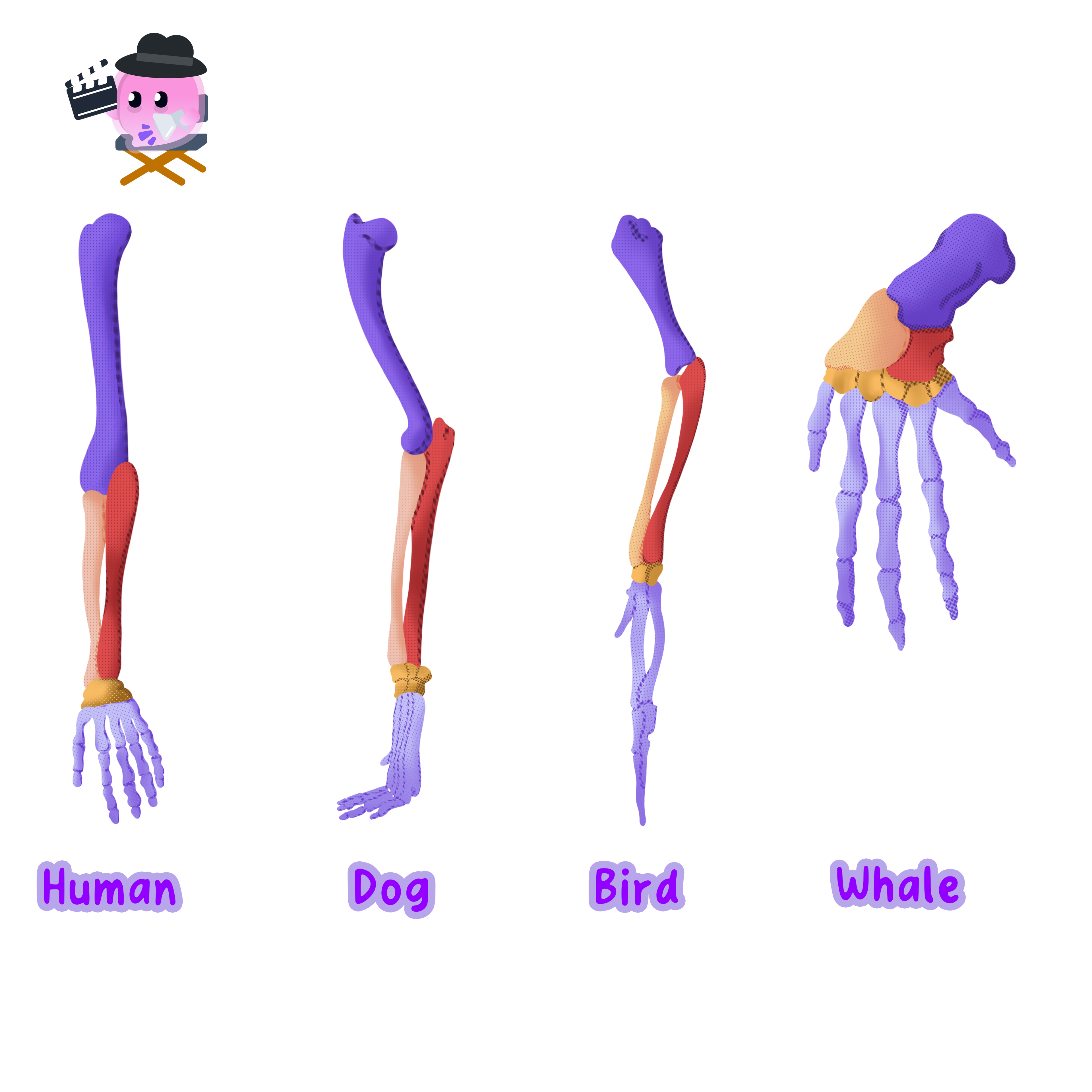
- Homologous structures are structures with a common evolutionary origin that may now perform different functions.
- The illustrated vertebrate limbs contain corresponding bones arranged in a shared basic pattern, although their proportions and uses differ.
- A human arm, dog forelimb, bird wing and whale flipper are used differently, but their corresponding structures support descent from a common ancestor.
- Together with evidence of change through time, inherited structural similarities help explain how related organisms can become different.
Common Mistake
- Bacteria become more commonly resistant within a population; the patient does not become resistant to the antibiotic.
- Do not describe every member of a susceptible population as changing directly into a resistant bacterium.
Self review
- What kinds of remains or traces can form fossils?
- How can fossils from rocks of different ages support evolution?
- Why are soft-bodied organisms poorly represented in the fossil record?
- How does an increase in inherited antibiotic resistance demonstrate evolution?
- Why do corresponding limb bones support common ancestry?
