Darwin's observations
- Charles Darwin developed an explanation of how species could change after comparing organisms, fossils and environments during and after his voyage on HMS Beagle.
- He observed that organisms in different places shared similarities but also had differences associated with their surroundings.
- Island organisms could resemble those on nearby mainland areas while possessing distinctive features, which raised questions about their origins.
- Fossils also showed that some extinct animals resembled living animals from the same broad region.
- These observations supported the possibility that species were related through common ancestry and had changed after populations became separated.
- Darwin also studied variation in domesticated organisms, where breeders could increase the occurrence of inherited characteristics by choosing which organisms reproduced.
- This helped him develop the idea that differences in survival and reproduction in nature could also change populations over generations.
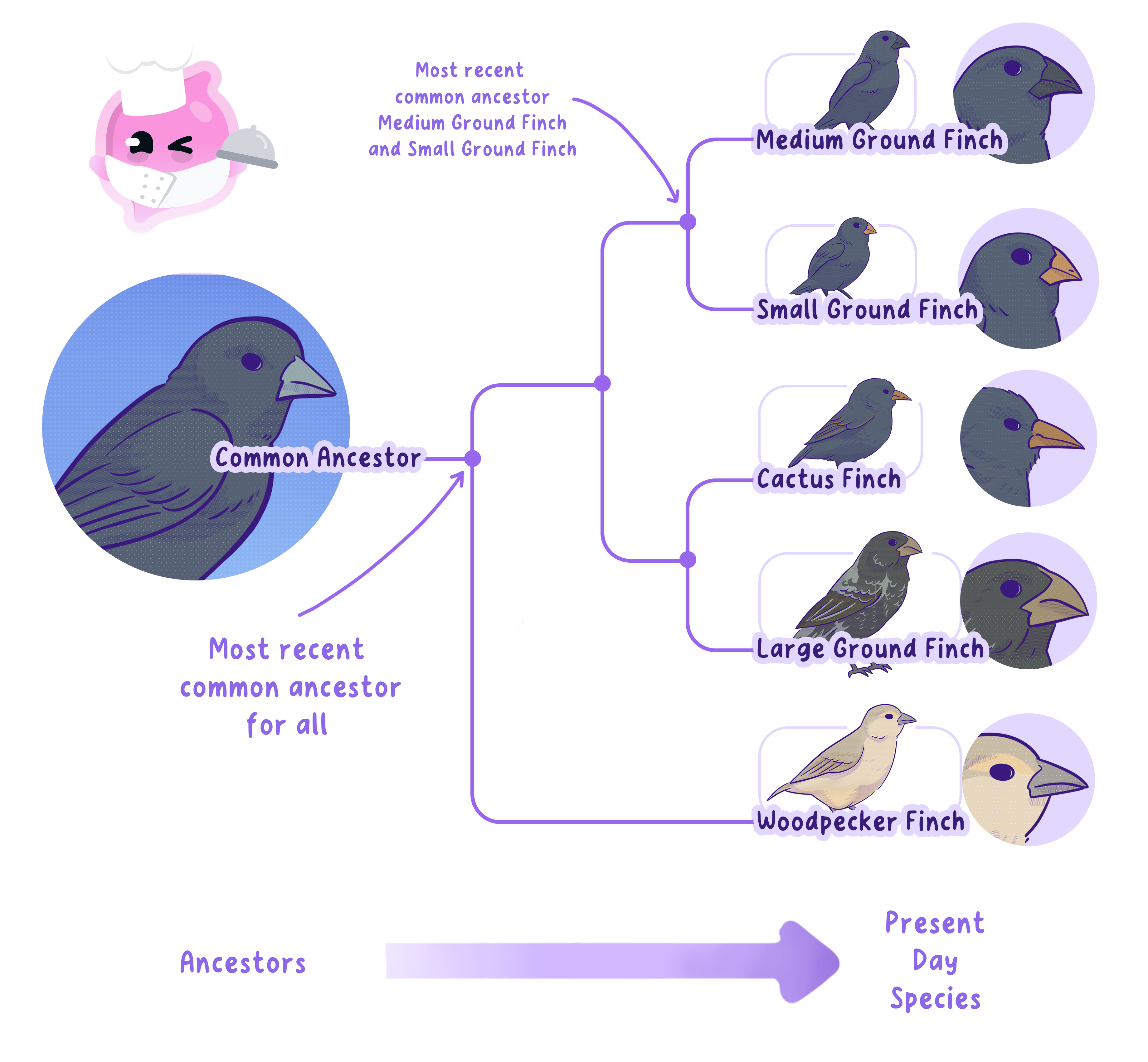
- The finch tree illustrates branching ancestry, with different descendant species traced back to shared ancestral populations.
Wallace and the joint announcement
- Alfred Russel Wallace independently developed an explanation of evolution by natural selection while studying organisms and their geographical distribution.
- His observations in tropical regions, including the Malay Archipelago, showed patterns in where related organisms lived.
- Wallace sent Darwin an account of his ideas in 185818581858, and their explanations were presented together to the Linnean Society that year.
- Darwin and Wallace were not present at that meeting, so a joint presentation does not mean that they personally delivered it together.
- Darwin published On the Origin of Species in 185918591859, setting out an extended argument supported by observations and comparisons.
- Both scientists are credited with identifying natural selection as a mechanism by which populations evolve.
- Their shared explanation connected existing inherited variation with differences in reproductive success, making it possible to explain adaptation without assuming organisms change deliberately.
Exam technique
- When discussing contributions, distinguish Darwin's accumulated observations and published argument from Wallace's independent development of natural selection.
- Connect their work to the explanation of evolution and common ancestry, rather than simply listing names and dates.
Evidence and acceptance
- The theory challenged the widely held view that species were fixed and had been created separately.
- Some objections reflected religious or cultural beliefs, while scientific questions concerned the evidence and the mechanism of inheritance.
- Darwin had assembled substantial evidence, but the fossil record was incomplete and the genetics needed to explain inheritance was not yet established.
- Neither Darwin nor Wallace could use knowledge of genes and DNA in the modern sense to explain how inherited variants were transmitted.
- Later work on inheritance and mutations supplied that missing mechanism and strengthened the explanation of natural selection.
- Further observations could be tested against the theory, allowing scientific confidence to develop as different lines of evidence supported the same explanation.
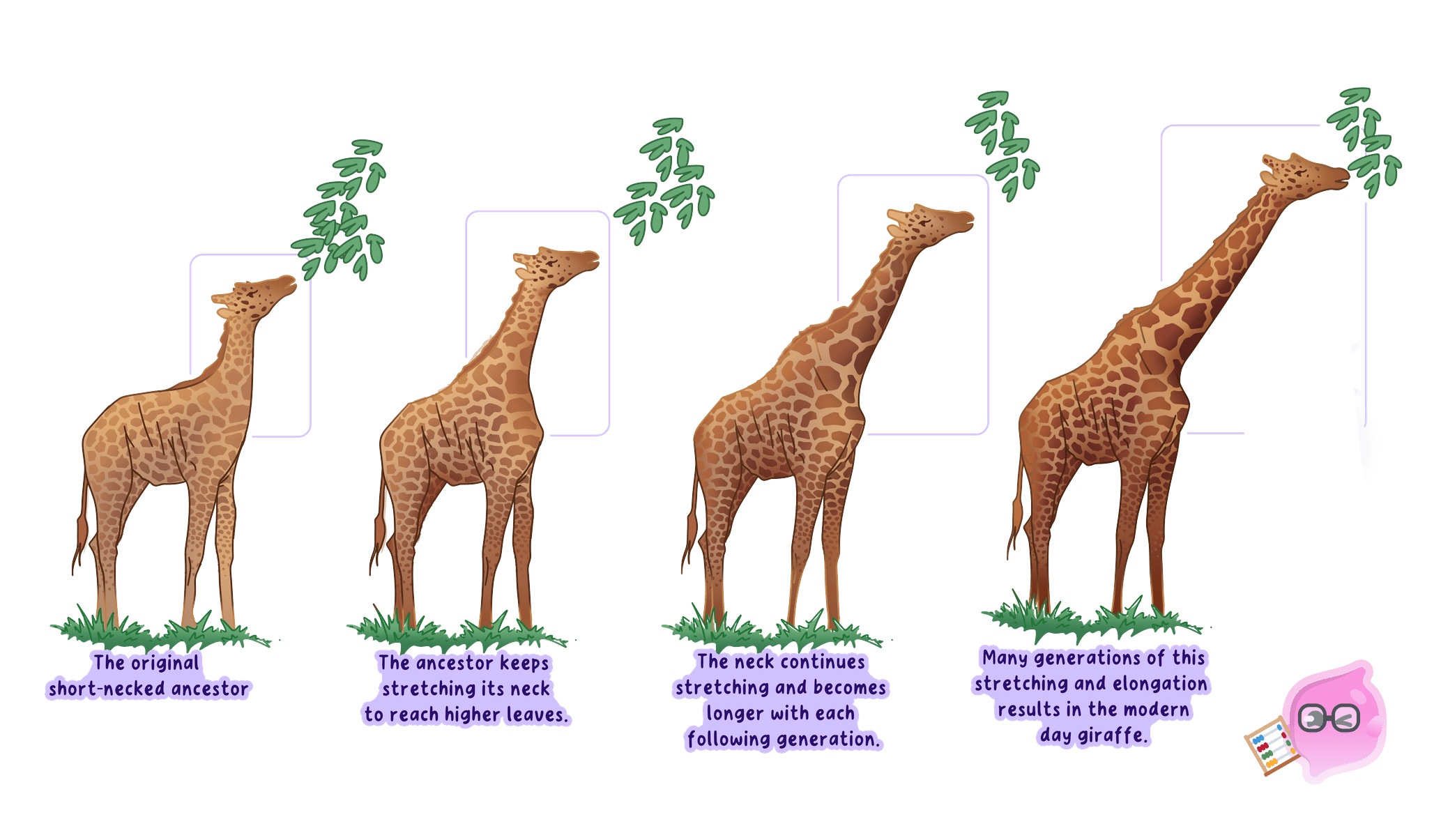
- An earlier proposal by Lamarck suggested that the use or disuse of structures caused changes during life that could then be inherited.
- The giraffe illustration represents that historical proposal: repeated stretching was supposed to lengthen the neck, with the acquired change passed to offspring.
- The natural-selection explanation instead depends on inherited differences already arising within populations and different contributions to later generations.
Common Mistake
A characteristic acquired through exercise or repeated use is not automatically encoded as an inherited change in the reproductive cells.
Impact on modern biology
- Evolution provides a connected explanation for adaptation, the diversity of organisms and the similarities shared by related groups.
- It gives classification an evolutionary basis, because grouping organisms can aim to reflect ancestry rather than appearance alone.
- It also supports predictions about how populations may respond to changing conditions, including the spread of inherited resistance.
- Understanding that populations contain valuable genetic variation informs conservation, because preserving only a few genetically similar individuals may lose much of that variation.
- These applications extend the impact of Darwin's and Wallace's ideas beyond explaining the origin of visible differences between organisms.
Seed banks conserve variation
Definition
Biodiversity
Biodiversity is the variety of living organisms, including variation within species and the range of species and ecosystems.
Definition
Seed bank
A seed bank is a collection of stored seeds kept viable to conserve plant species and their genetic diversity.
- Seed banks store living plant material so that species and genetic variants remain available for future growth.
- Collections should represent many parent plants and, where appropriate, different populations, because seeds from a single parent do not capture all the variation in a species.
- Collecting a representative sample increases the chance of retaining alleles associated with different environmental tolerances and other inherited characteristics.
- Seeds are identified and labelled with their origin so that the stored material can be traced and used appropriately later.
- For species whose seeds tolerate drying and cold storage, dry conditions reduce metabolic activity and low temperatures slow deterioration, extending the period of viability.
- Stored seeds remain living and must be checked for viability, meaning their ability to germinate and grow under suitable conditions.
- If a sample loses viability, fresh material may need to be collected or plants grown to produce replacement seeds while maintaining the collection's genetic diversity.
- Stored seeds can help restore a plant population after local loss and provide material for research into inherited variation.
- A seed bank cannot preserve every species in the same way, because some seeds are damaged by drying or freezing.
- Seed storage also does not maintain all the interactions of a living habitat, so it supports conservation of wild populations rather than replacing habitat protection.
Example
- Two collections each contain seeds from the same plant species, but one was collected from a single parent while the other represents many parents across several populations.
- The second collection is more likely to preserve a wider range of alleles.
- If conditions change, some of those retained variants may allow plants to survive and reproduce under the new conditions.
- The advantage comes from preserving genetic diversity, rather than simply storing a larger number of identical seeds.
Self review
- What observations helped Darwin develop his explanation of evolution?
- What was Wallace's contribution to the theory of natural selection?
- Why did the lack of a genetic explanation create a scientific difficulty for the early theory?
- Why should a seed bank sample many parent plants?
- Why can seed banks not replace habitat protection?
