An optometrist examines a patient's eye and obtains the optical ray diagram shown below.
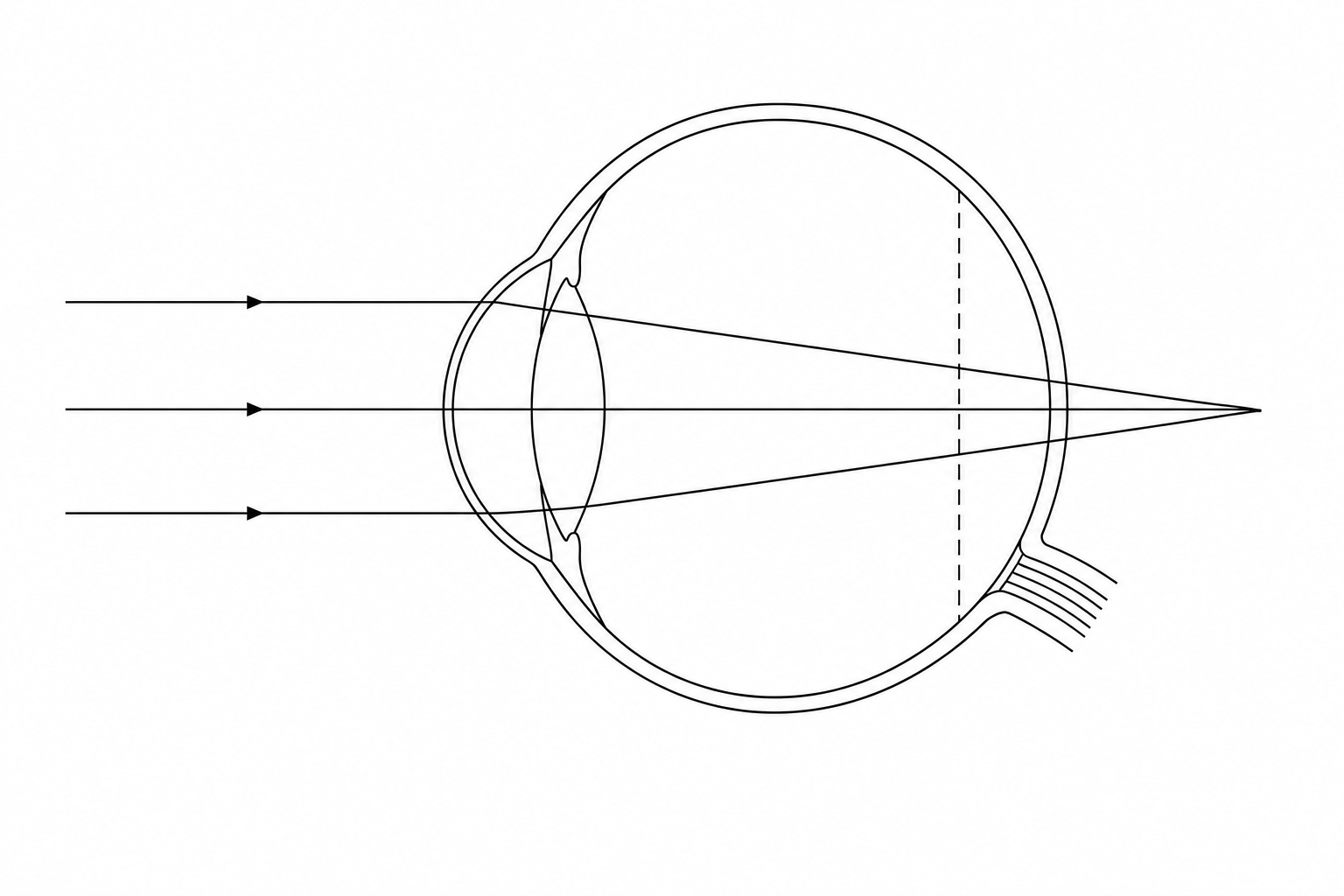
Which of the following correctly identifies the visual defect, a primary physiological cause of this condition, and the type of lens needed to correct it?
Long-sightedness (hyperopia); Eyeball is too long; Concave lens\text{Long-sightedness (hyperopia); Eyeball is too long; Concave lens}Long-sightedness (hyperopia); Eyeball is too long; Concave lens
Long-sightedness (hyperopia); Lens is insufficiently curved (too weak); Convex lens\text{Long-sightedness (hyperopia); Lens is insufficiently curved (too weak); Convex lens}Long-sightedness (hyperopia); Lens is insufficiently curved (too weak); Convex lens
Short-sightedness (myopia); Eyeball is too short; Convex lens\text{Short-sightedness (myopia); Eyeball is too short; Convex lens}Short-sightedness (myopia); Eyeball is too short; Convex lens
Short-sightedness (myopia); Lens is excessively curved (too strong); Concave lens\text{Short-sightedness (myopia); Lens is excessively curved (too strong); Concave lens}Short-sightedness (myopia); Lens is excessively curved (too strong); Concave lens