ADH changes kidney tubule permeability
Definition
ADH
Antidiuretic hormone: a hormone released from the pituitary gland that makes the kidney tubules and collecting duct more permeable to water, so more water is reabsorbed into the blood.
- ADH is antidiuretic hormone, a hormone that reduces water loss in urine.
- It is produced in the hypothalamus and released into the blood by the pituitary gland.
- ADH travels in the blood to the kidneys.
- Its target cells are in the later kidney tubules and collecting ducts.
More ADH increases water reabsorption
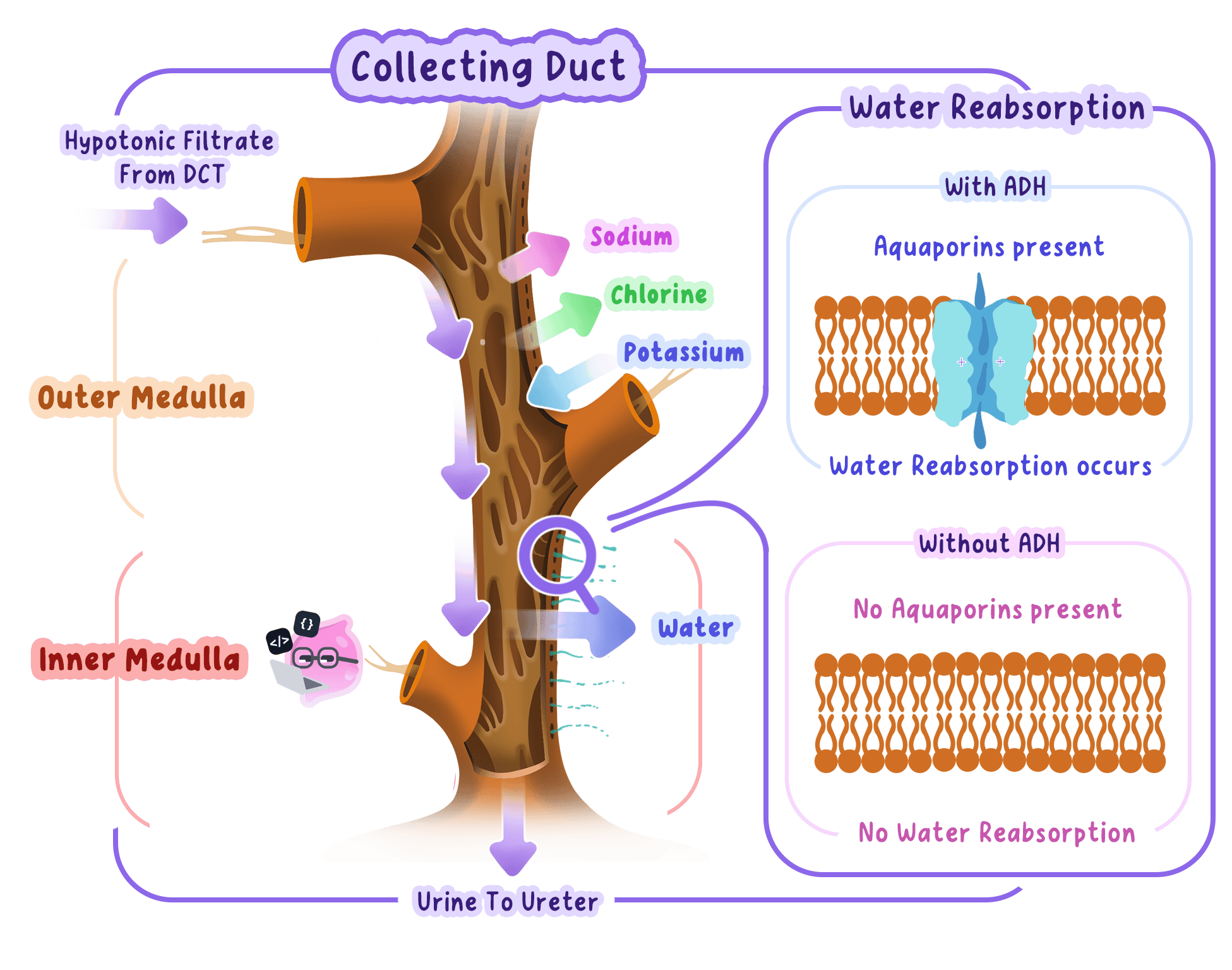
- ADH makes the walls of the kidney tubules and collecting ducts more permeable to water.
- More water therefore moves by osmosis from the tubule fluid into the surrounding tissue and then into the blood.
- Less water remains in the tubule fluid, so a smaller volume of more concentrated urine is produced.
- The reabsorbed water raises the water content of the blood towards normal.
Common Mistake
- ADH is carried to the kidneys in the blood and changes permeability.
- ADH does not travel down the kidney tubule and does not add water directly to the blood.
Less ADH reduces water reabsorption
- When less ADH is released, the tubule and collecting duct walls become less permeable to water.
- Less water leaves the tubule fluid by osmosis.
- More water remains in the tubule fluid, producing a larger volume of more dilute urine.
- Excreting the extra water lowers the water content of the blood towards normal.
Example
- After drinking a large volume of water, less ADH is released.
- Kidney tubules become less permeable, less water is reabsorbed and a large volume of dilute urine is produced.
Negative feedback controls ADH release
Definition
Osmoregulatory centre
The region of the brain that monitors the water content of the blood and controls the amount of ADH released to keep it within narrow limits.
- The osmoregulatory centre in the hypothalamus monitors the water potential of the blood.
- When blood water potential falls, more ADH is released from the pituitary gland.
- More water is reabsorbed by the kidneys, raising blood water potential towards the normal level.
- As the normal level is restored, the stimulus for ADH release decreases, so less ADH is released.
- When blood water potential rises above normal, less ADH is released and more water is excreted.
- This response is negative feedback because it reverses the original change.
Exam technique
- For dehydration, link lower blood water potential to more ADH, greater tubule permeability, more water reabsorption and concentrated urine.
- For excess water, reverse every link in the chain.
Self review
- Where is ADH produced and released?
- How does ADH change kidney tubule permeability?
- What urine is produced when ADH concentration is high?
- What happens when less ADH is released?
- Why is ADH control a negative feedback system?
