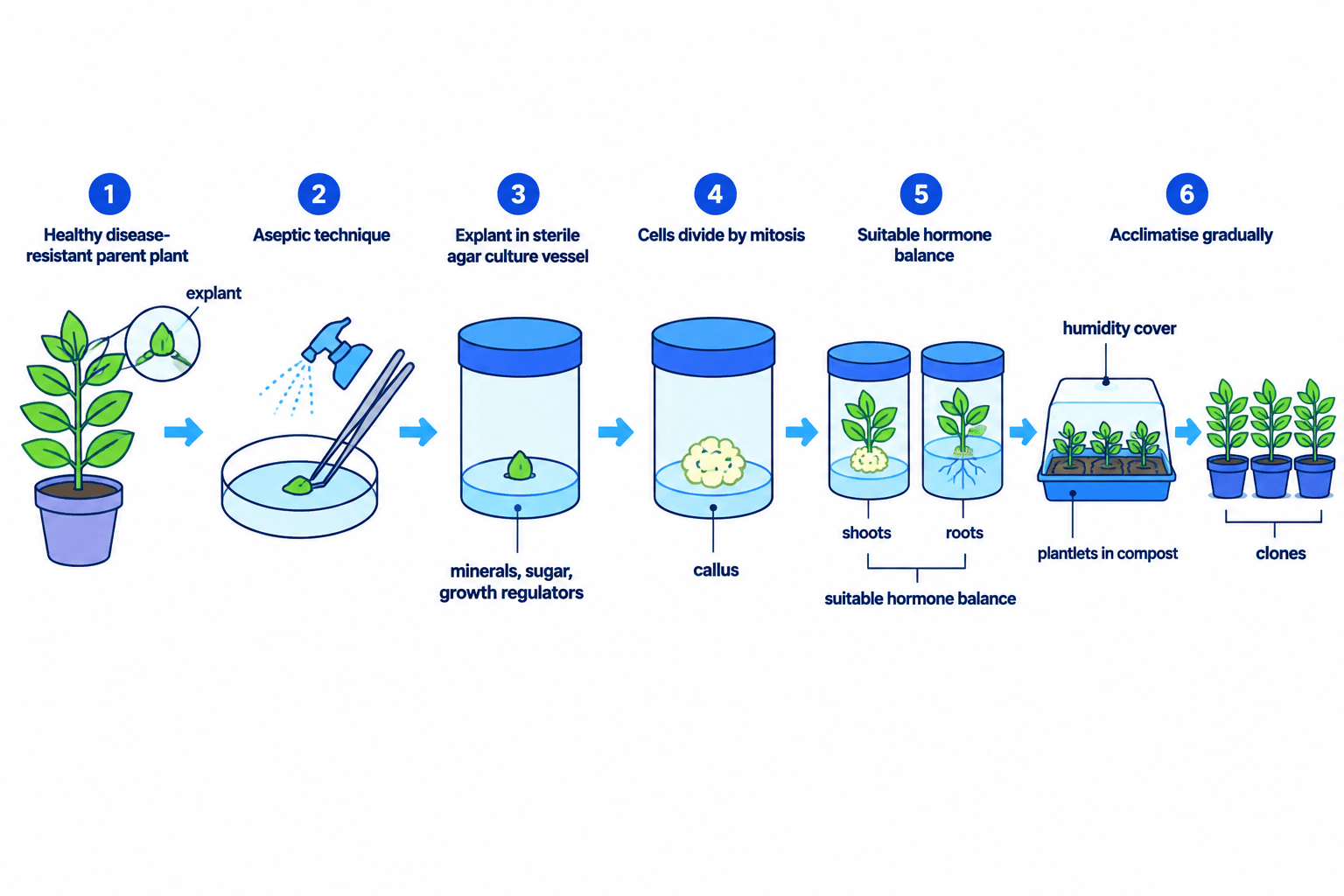
Tissue culture makes genetically identical cells
Definition
Tissue culture
Growing many identical new plants (or cells) from a small sample of tissue on a nutrient medium.
- Tissue culture is the growth of cells or small pieces of tissue on a sterile nutrient medium so that many genetically identical cells or organisms are produced.
- For plants, remove a small piece of tissue called an explant from a parent with the desired characteristics.
- Sterilise the explant and equipment to prevent bacteria or fungi from outcompeting the plant cells.
- Place the explant on sterile agar containing minerals, sugar and plant growth regulators.
- Keep the culture under controlled light and temperature until cells divide by mitosis and form a mass of cells.
- Transfer small groups of cells to media with suitable hormone balances so shoots and roots develop, then move plantlets to compost and acclimatise them gradually.
Common Mistake
Contamination can destroy a culture, so aseptic technique is part of the biological method rather than a minor laboratory detail.
Clones give consistency and rapid production
Definition
Clone
An organism that is genetically identical to another, produced without sexual reproduction.
- A clone is an organism or cell that is genetically identical to another because it was produced from one parent by mitosis.
- A small sample can produce many plants quickly, at any time of year and in little space.
- Rare plants can be conserved and crop varieties with high yield or disease resistance can be copied without losing their allele combination.
- Genetically identical cells allow medical researchers to test treatments while reducing genetic variation between samples.
- All clones may share the same susceptibility to a pathogen, and mutation or contamination can affect many cultures.
Example
A disease-resistant banana plant can supply sterile explants that produce thousands of genetically identical plantlets.
Self review
- What is tissue culture?
- Why must the equipment and medium be sterile?
- How are shoots and roots produced from an explant?
- Give one benefit and one risk of cloning many plants.