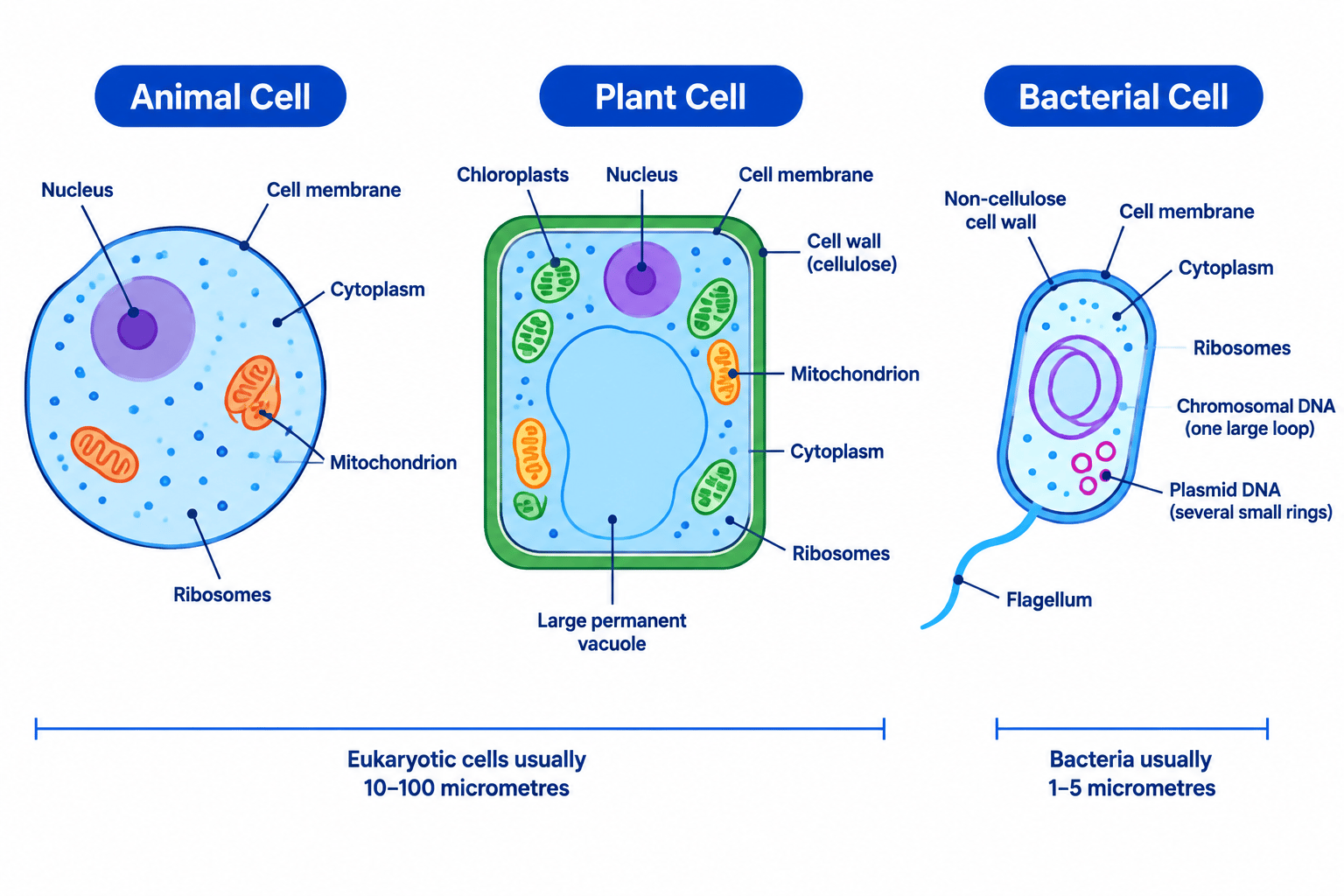
Eukaryotic and prokaryotic cells
Eukaryotic cell
A cell whose genetic material is enclosed inside a nucleus, as in animal, plant and fungal cells.
- Every living organism is built from cells, and every cell belongs to one of two groups.
- In a eukaryotic cell the genetic material is held inside a nucleus, and animal, plant and fungal cells are all eukaryotic.
- In a prokaryotic cell there is no nucleus, so the genetic material lies free in the cytoplasm as one circular chromosome.
- Bacteria are the prokaryotes named in the Edexcel specification, and they are the only ones you are examined on.
- Eukaryotic cells are also far larger, usually 101010 to 100 μm100\,\mu\text{m}100μm across, while a bacterial cell is typically 111 to 5 μm5\,\mu\text{m}5μm across.
- Each structure inside a cell is a sub-cellular structure, also called an organelle.
The shape and contents of an organelle explain the function it carries out, and Edexcel writes its questions to test that link rather than the list of names.
Structures in an animal cell
Organelle
A sub-cellular structure that carries out a particular function inside a cell.
- The nucleus is a large organelle enclosed by its own membrane that holds the cell's chromosomal DNA.
- That DNA carries the instructions for making proteins, which is why the nucleus controls the activities of the whole cell.
- The cell membrane is a thin, partially permeable layer that forms the outer boundary and controls which substances enter and leave.
- Mitochondria are rod-shaped organelles in the cytoplasm and they are the site of aerobic respiration, which releases the energy the cell needs.
- Cells with a high energy demand, such as muscle cells and sperm cells, contain far more mitochondria than cells that use little energy.
- Ribosomes are the smallest organelles, and protein synthesis takes place on them.
- The cytoplasm is the jelly-like fluid that fills the cell and is where most of its chemical reactions happen.
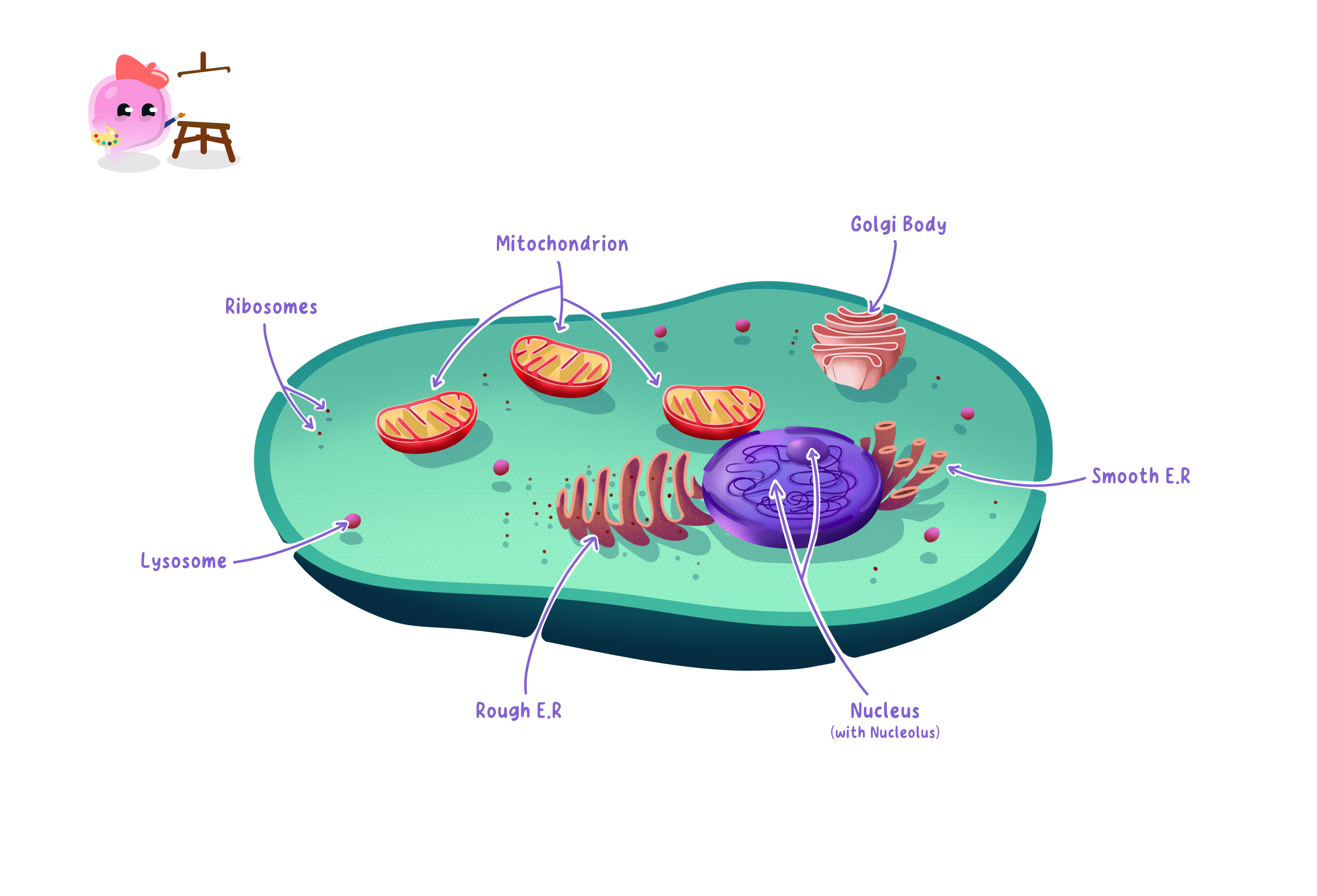
An animal cell has no cell wall, no chloroplasts and no permanent vacuole, so a diagram drawn with a thick rigid outer layer is not an animal cell.
Extra structures in a plant cell
- A plant cell contains every structure an animal cell has, and then three more.
- The cell wall is a rigid layer of cellulose outside the cell membrane.
- It supports the cell and stops it bursting when water moves in, which is why plant tissue stays firm.
- Chloroplasts contain the green pigment chlorophyll, which absorbs light so that photosynthesis can take place.
- The permanent vacuole is a large sac of cell sap whose pressure pushes outwards on the cell wall and keeps the cell firm.
- Not every plant cell has chloroplasts, because root cells are underground and receive no light.
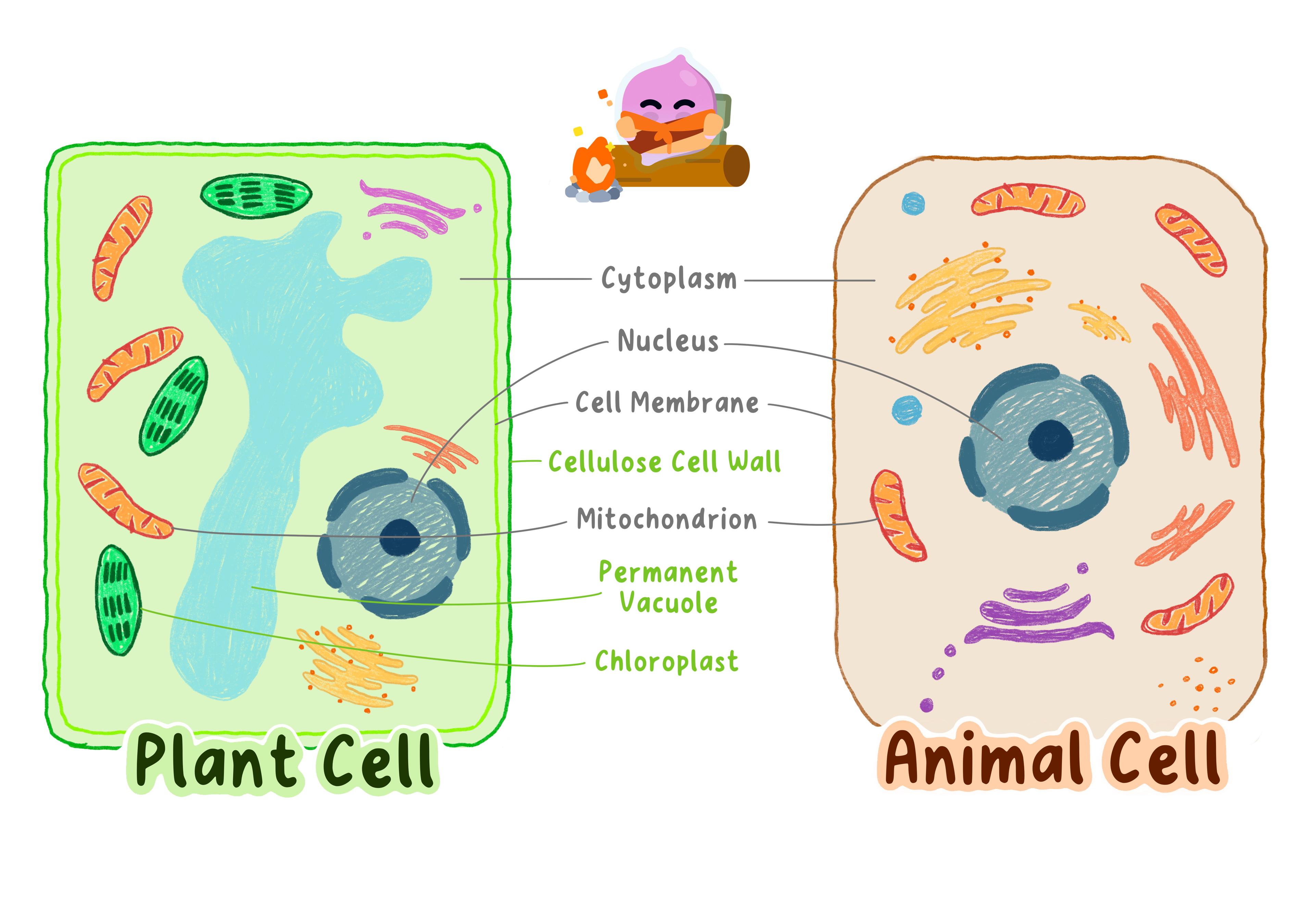
The cell wall and the cell membrane are different structures: the wall is rigid and made of cellulose, and the membrane is the thin partially permeable layer just inside it.
Structures in a bacterial cell
Prokaryotic cell
A cell that has no nucleus, its genetic material instead lying free in the cytoplasm as a single circular chromosome, as in bacteria.
- A bacterial cell holds its chromosomal DNA as one long circular strand floating freely in the cytoplasm.
- It also carries plasmid DNA, small separate circles of DNA holding extra genes such as those for antibiotic resistance.
- A cell membrane surrounds the cytoplasm and controls what passes in and out, exactly as it does in a eukaryotic cell.
- Ribosomes are present, so a bacterium makes its own proteins, although they are smaller than eukaryotic ribosomes.
- Many bacteria also have one or more flagella, long whip-like tails that rotate to drive the cell through liquid.
- There is no nucleus and there are no mitochondria, so a bacterium respires using enzymes held in its cytoplasm and membrane.
Bacteria have a cell wall as well, but it is not made of cellulose, so a cell wall on its own never proves that a cell is a plant cell.
Comparing the three cell types
- Only eukaryotic cells have a nucleus, which is the clearest single difference between them and prokaryotic cells.
- Cell membrane, cytoplasm and ribosomes appear in animal, plant and bacterial cells alike.
- Mitochondria are found in eukaryotic cells only.
- A cell wall is present in plant and bacterial cells but absent from animal cells.
- Chloroplasts and a permanent vacuole are found only in plant cells.
- Check the command word: state wants the name of the organelle, while explain wants the name, the job and the reason the cell needs it.
- The mark most often dropped is the reason, so follow mitochondria with so more energy is released by aerobic respiration for the cell to use.
- Given an unfamiliar cell, read off what it contains and work backwards to its function instead of trying to recall the cell by name.
- Cells do not make energy, they transfer it, so write that respiration releases energy rather than creates it.
- The nucleus stores the instructions for proteins, but the proteins themselves are assembled on the ribosomes.
- Bacterial DNA is described as free in the cytoplasm, never as being inside a nucleus.
- A leaf cell contains chloroplasts and mitochondria together, because plants respire as well as photosynthesise.
- What is the difference between a eukaryotic and a prokaryotic cell?
- State the function of the nucleus, the mitochondria and the ribosomes.
- Name the three structures a plant cell has that an animal cell does not.
- What is plasmid DNA and how does it differ from chromosomal DNA?
- Explain why a muscle cell contains many mitochondria.