The Brain and the Nervous System
Central nervous system
The brain and spinal cord, which receive impulses from receptors, coordinate a response and send impulses to effectors.
- The nervous system is divided into the central nervous system and the nerves that run to and from it.
- The central nervous system, usually shortened to the CNS, is made up of the brain and the spinal cord.
- The CNS receives impulses from receptors, coordinates a response, and sends impulses out to effectors.
- The human brain contains billions of interconnected neurones, and different regions of it carry out different jobs.
- The brain is protected by the bones of the skull, by three membranes called the meninges, and by a cushioning layer of fluid.
The Cerebral Hemispheres
Cerebral hemispheres
The two large folded halves at the top of the brain, responsible for conscious thought, memory, language, intelligence and voluntary movement.
- The cerebral hemispheres are the two large halves that make up the top and front of the brain, and together they are the largest part of it.
- Their outer layer is deeply folded, which packs a far larger surface area of nerve cells into the skull.
- They control conscious thought, memory, language, intelligence and voluntary movement.
- They also process the information arriving from the sense organs, so seeing, hearing and feeling pain all reach conscious awareness here.
- Damage to a cerebral hemisphere, for example after a stroke, can cause loss of speech, memory or movement on one side of the body.
The Cerebellum
Cerebellum
The region at the back and base of the brain that coordinates muscular activity, balance and posture.
- The cerebellum lies at the back and base of the brain, underneath the cerebral hemispheres.
- It coordinates muscular activity, so that the muscles of a movement contract in the right order and with the right force.
- It controls balance and posture, using information from the ears and from receptors in the muscles.
- It makes movement smooth and precise rather than jerky, and it is involved in learning a physical skill.
- Damage to the cerebellum causes unsteady walking, a loss of balance and clumsy, poorly aimed movements.
Riding a bicycle depends on the cerebellum, which constantly compares the intended movement with information from the muscles and the ears, then adjusts the muscle contractions to keep you upright.
The Medulla Oblongata
Medulla oblongata
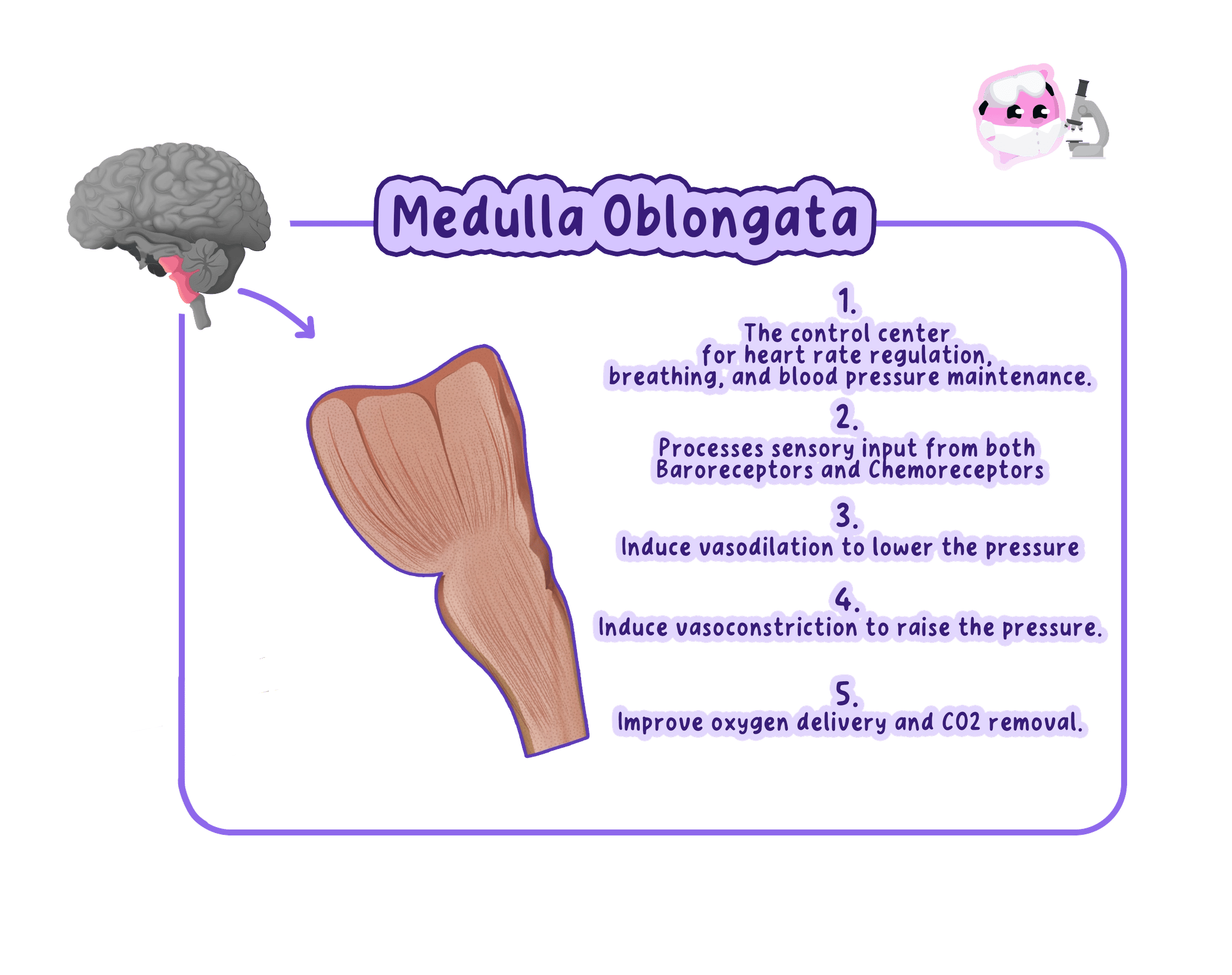
The region at the base of the brain, joining the spinal cord, that controls unconscious activities such as heart rate and breathing rate.
- The medulla oblongata sits at the base of the brain, where it joins the spinal cord.
- It controls unconscious, or involuntary, activities that continue without any thought.
- It regulates heart rate, breathing rate and blood pressure.
- It also controls reflexes such as swallowing, coughing, sneezing and vomiting.
- Because it controls the processes that keep a person alive, damage to the medulla oblongata is usually fatal.
Do not confuse the cerebellum with the cerebral hemispheres. The cerebellum coordinates movement and balance, while the cerebral hemispheres handle conscious thought and decide on the movement in the first place.
Conscious and Unconscious Control
- Conscious control means you decide to act, and the cerebral hemispheres send the instruction.
- Unconscious control happens automatically, and the medulla oblongata handles the processes that must continue while you sleep.
- Some actions involve both, and breathing is the clearest case because it is normally unconscious but can be taken over deliberately.
- The cerebellum sits between the two, refining a consciously chosen movement without any conscious effort.
How the Regions Were Identified
- Much of what is known about the brain came from studying patients with damage to a particular region.
- Comparing the position of the damage with the ability the patient had lost suggested what that region normally does.
- Electrical stimulation during brain surgery gave more direct evidence, because stimulating a small area produces a specific response.
- Scanning techniques now allow the living brain to be studied without surgery, and these are covered in the next section.
- Label questions on a brain diagram are common, and the distractors are always the other three named regions, so learn the position of each as well as its job.
- Give a function that matches the region precisely, because coordination of movement is credited for the cerebellum but not for the cerebral hemispheres.
- When a question describes a patient's symptoms and asks which region is damaged, work backwards from the lost ability to the region that controls it.
- Use the full name medulla oblongata at least once, then the short form if you prefer.
- Name the two organs that make up the central nervous system.
- State three functions of the cerebral hemispheres.
- Which region of the brain coordinates balance and posture?
- Give two unconscious activities controlled by the medulla oblongata.
- A patient has become very unsteady on their feet but can speak and think normally. Which region of the brain is most likely to be damaged?
