Nephrons form urine
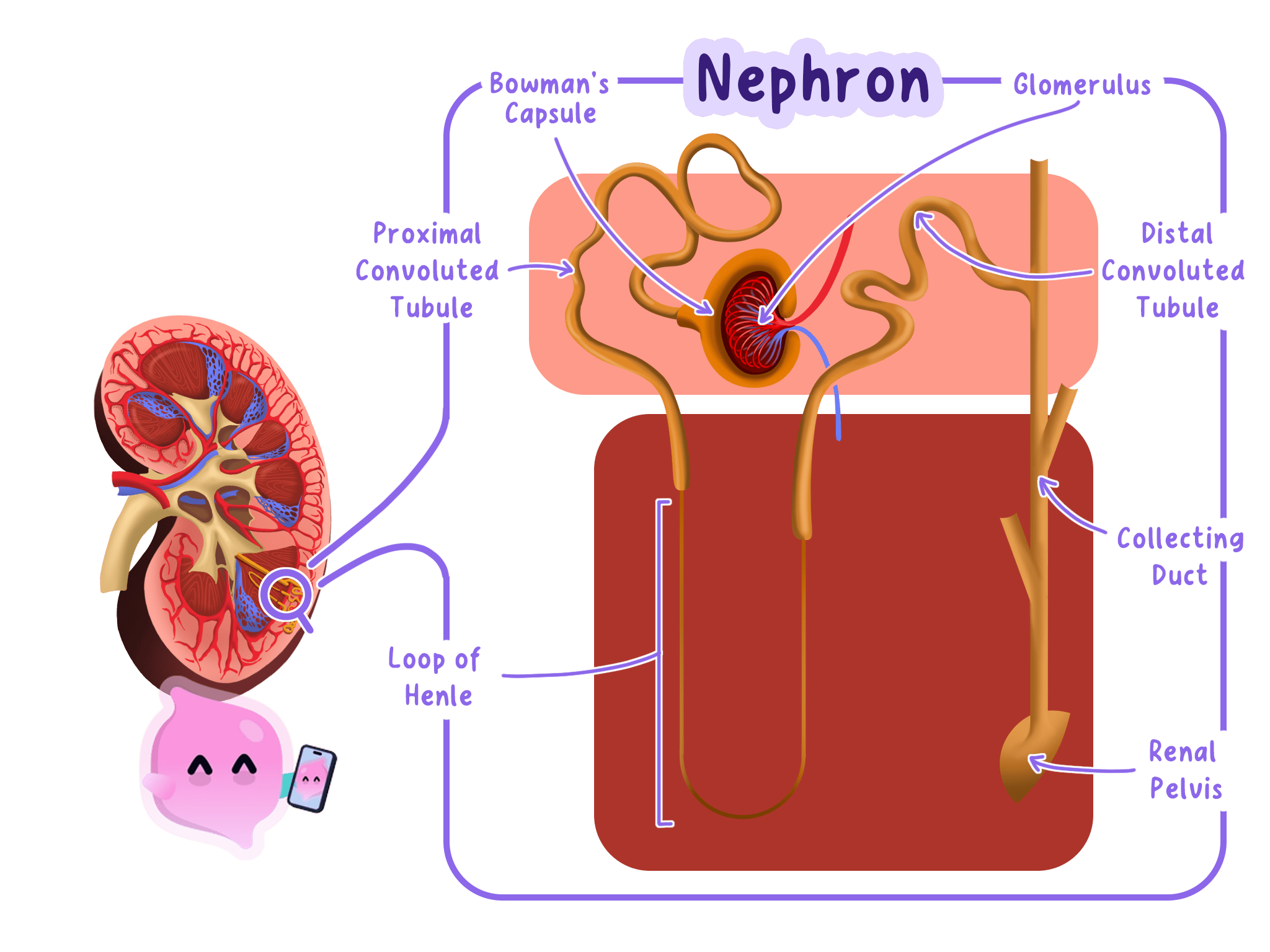
Nephron
A microscopic kidney tubule in which blood is filtered and useful substances are reabsorbed to form urine.
- A nephron is a microscopic kidney tubule that filters the blood and then reabsorbs useful substances.
- The nephron begins with a glomerulus enclosed by Bowman's capsule.
- The filtrate then travels along a tubule before entering a collecting duct.
- Capillaries surround the tubule so substances can move from the filtrate back into the blood.
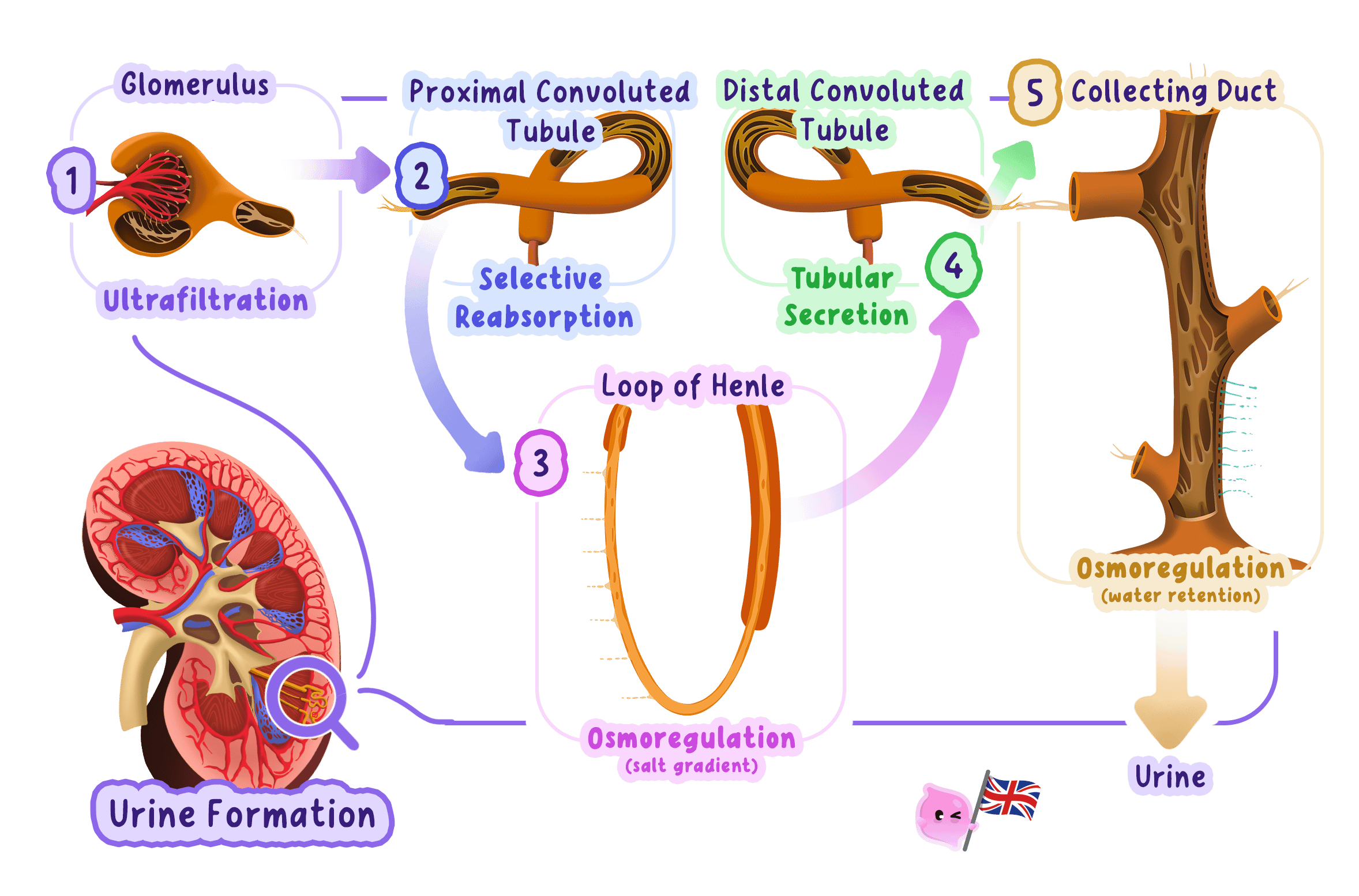
- Urine formation has two linked stages: ultrafiltration followed by selective reabsorption.
High pressure filters small molecules
Ultrafiltration
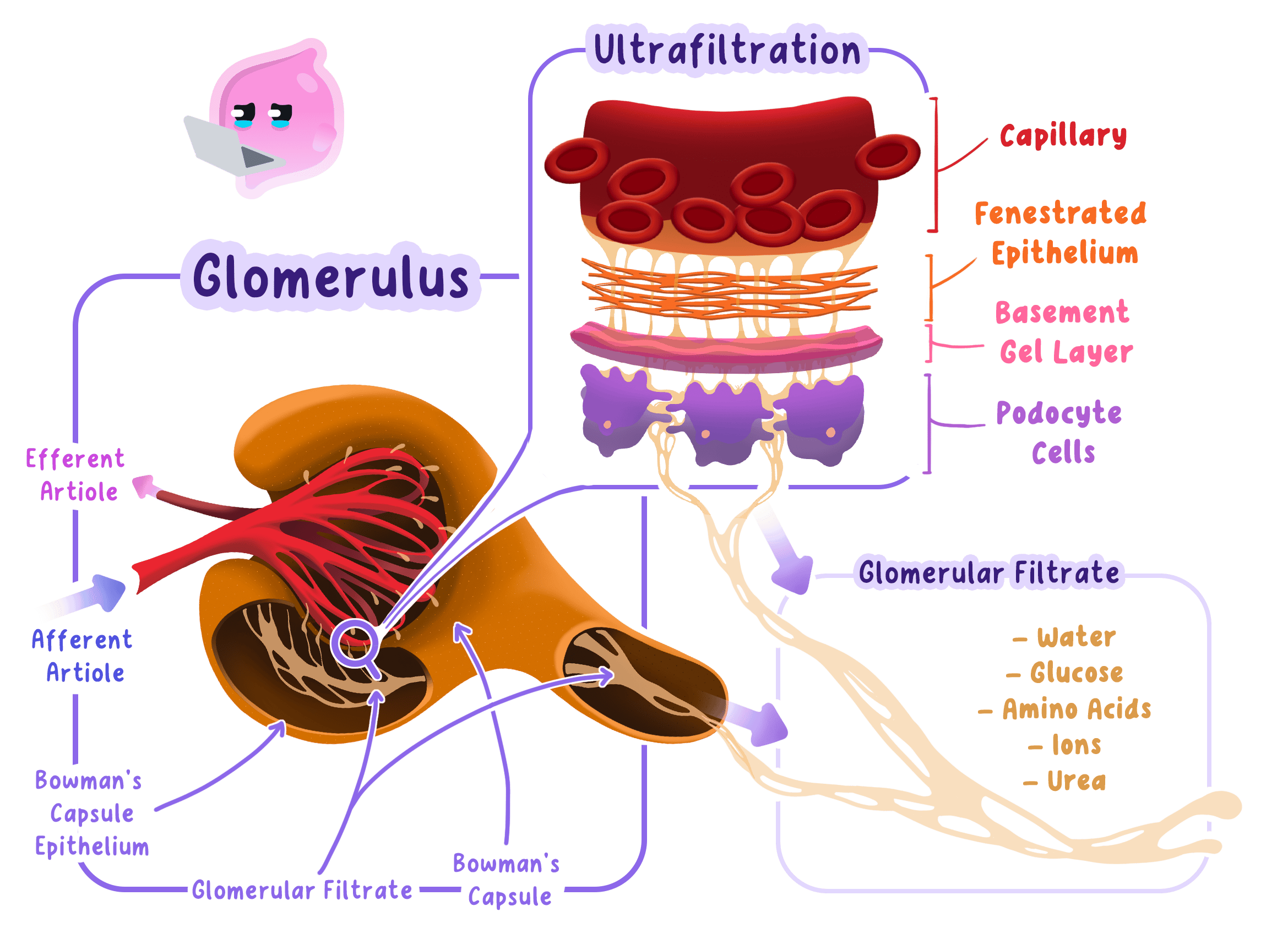
High-pressure filtration in the glomerulus that moves water and other small dissolved molecules into Bowman's capsule while blood cells and large proteins remain in the blood.
- Ultrafiltration is high-pressure filtration of the blood at the glomerulus.
- Blood pressure forces water and small dissolved molecules through the filtration barrier into Bowman's capsule.
- The filtrate contains water, glucose, urea and mineral ions because these molecules are small enough to pass.
- Blood cells remain in the capillaries because they are too large to cross the filtration barrier.
- Large plasma proteins remain in the blood because their molecules are too large to pass through the barrier.
The glomerulus produces filtrate
Glomerulus
A knot of capillaries inside Bowman's capsule where high blood pressure filters small molecules out of the blood.
- The glomerulus is a knot of capillaries inside Bowman's capsule.
- Its capillary network provides a large surface area for filtration.
- Bowman's capsule collects the liquid and small solutes that leave the glomerular blood.
- The first liquid is filtrate rather than urine because it still contains useful glucose, water and ions.
Protein or blood cells should not normally appear in the filtrate, because the filtration barrier retains them in the blood.
Selective reabsorption returns glucose
Selective reabsorption
The movement of useful substances from the nephron filtrate back into the blood.
- Selective reabsorption returns useful substances from the nephron filtrate to the blood.
- All glucose is normally reabsorbed from the first part of the tubule into the surrounding capillaries.
- Active transport moves glucose against its concentration gradient when necessary and requires energy released by respiration.
- Tubule cells contain many mitochondria to supply energy for active transport.
- Microvilli increase surface area so glucose can be reabsorbed rapidly.
Water returns to the blood
Collecting duct
A kidney tubule whose permeability to water is controlled by ADH as urine passes towards the renal pelvis.
- Water is reabsorbed from the filtrate into the blood by osmosis.
- The amount reabsorbed varies according to the water content of the blood and the permeability of the collecting duct.
- Useful quantities of ions are reabsorbed while excess ions remain in the tubule.
- Urea remains in the filtrate together with excess water and ions, forming urine.
Predicting substances in each fluid
- Blood entering the glomerulus contains blood cells, plasma proteins, glucose, urea, ions and water.
- Bowman's capsule filtrate contains glucose, urea, ions and water but normally no blood cells or large plasma proteins.
- Urine contains urea with excess water and ions but normally no glucose because glucose has been selectively reabsorbed.
- Reasoning follows molecule size during filtration and usefulness during reabsorption.
Structure explains each movement
Bowman's capsule
A cup-shaped structure around the glomerulus that collects the small molecules filtered from the blood.
- Bowman's capsule surrounds the glomerulus and receives the filtrate directly.
- A long tubule provides time and surface area for selective reabsorption.
- A close capillary supply carries reabsorbed glucose and water away and helps maintain concentration gradients.
- The collecting duct provides a final route in which water reabsorption can be adjusted before urine leaves the kidney.
Explaining nephron function
- For filtration: state that high pressure forces small molecules into Bowman's capsule while cells and proteins stay in the blood.
- For glucose: state that all glucose is selectively reabsorbed from the tubule into surrounding capillaries.
- For water: state that water returns to the blood by osmosis and that the amount varies.
- For urine: identify urea with excess water and ions as the substances left in the tubule.
- Where does ultrafiltration occur?
- Which substances enter Bowman's capsule?
- Why do blood cells and large proteins remain in the blood?
- How is glucose selectively reabsorbed?
- What remains in the tubule to form urine?
