Genes as protein codes
Codon
A sequence of three bases that codes for one amino acid.
- The order of bases in a gene is a coded instruction for making a protein.
- Each group of three bases, called a triplet or codon, codes for one amino acid.
- The order of the triplets sets the order in which amino acids are joined.
- This set of rules linking bases to amino acids is the genetic code.
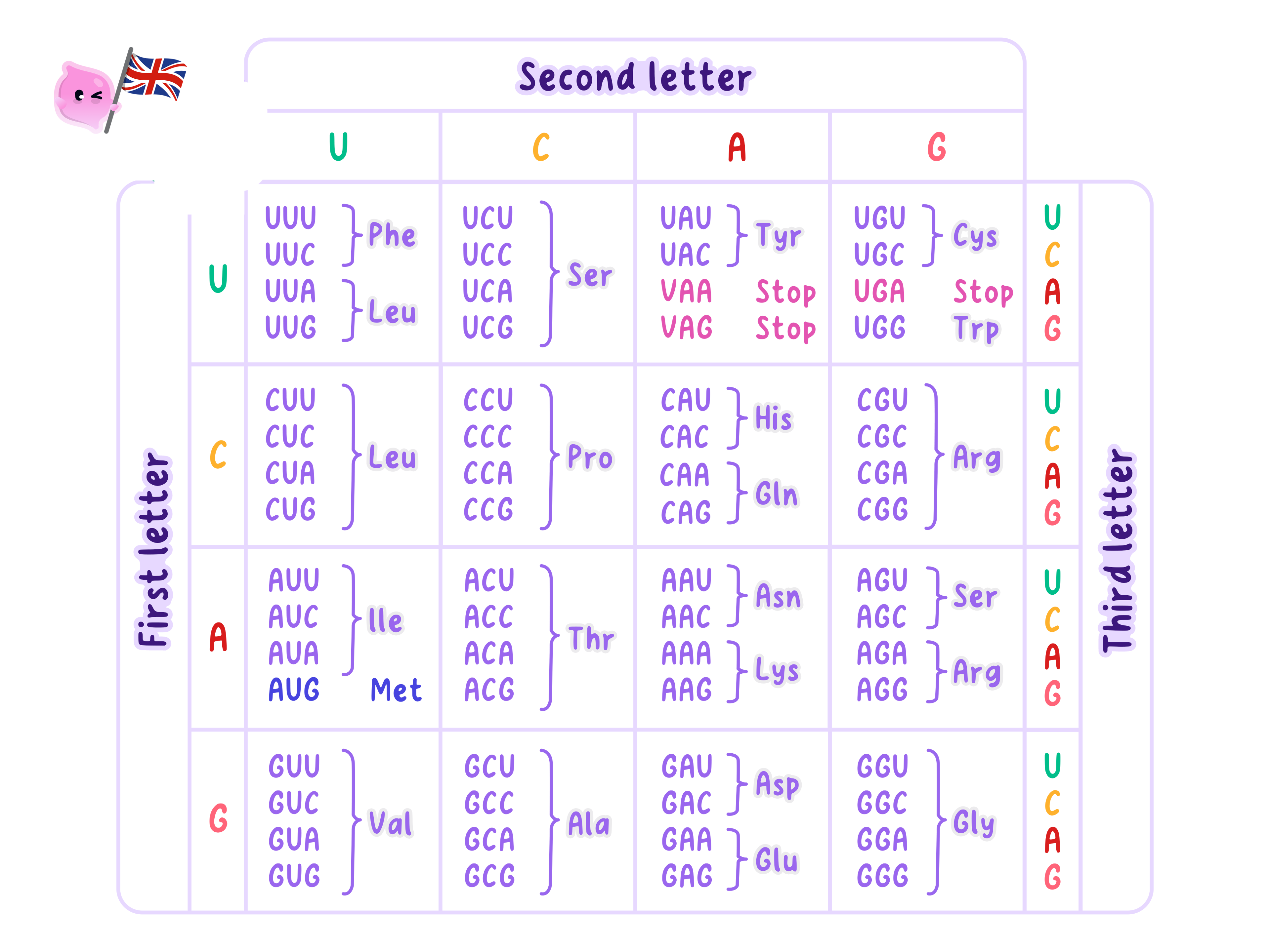
Because bases are read in threes, a gene of 303030 bases codes for a chain of 101010 amino acids.
Proteins are not made in the nucleus, so the coded message must be carried out to where proteins are built.
Transcription
Transcription
The stage of protein synthesis in which the base sequence of a gene is copied into a molecule of mRNA.
- Protein synthesis begins in the nucleus. RNA polymerase binds to a non-coding region immediately in front of the gene, positioning the enzyme at the correct starting point.
- The enzyme RNA polymerase separates the two DNA strands over the gene and builds a complementary copy.
- This copy is a molecule of mRNA (messenger RNA).
- The mRNA is a short, single strand that can leave the nucleus.
- It carries the coded instructions out into the cytoplasm.
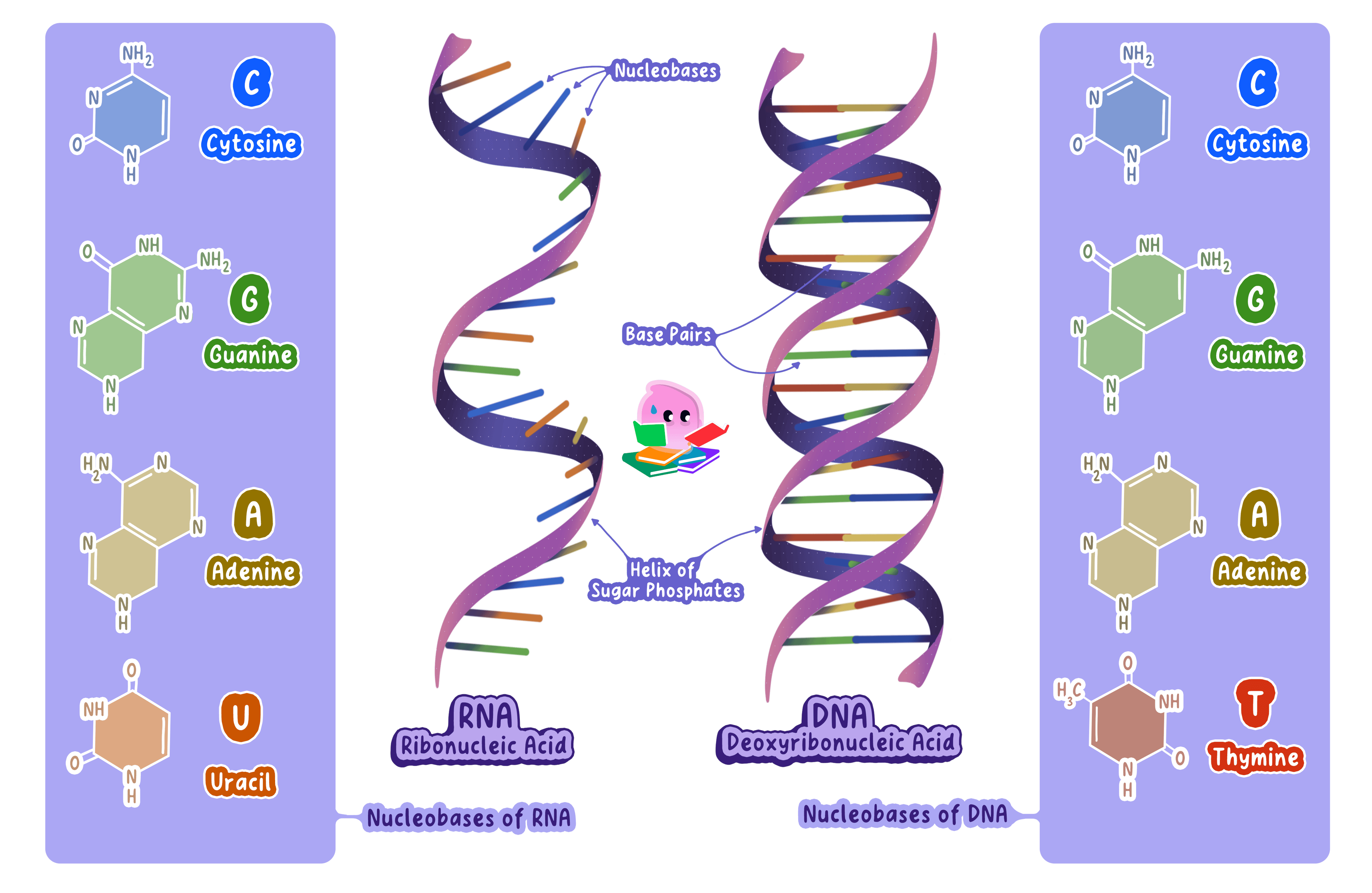
Transcription means to copy: RNA polymerase copies the gene into mRNA.
Do not say the whole chromosome is copied: only the gene being used is transcribed.
Translation
Translation
The stage of protein synthesis in which the base sequence of mRNA is used at a ribosome to join amino acids in the correct order.
- In the cytoplasm the mRNA attaches to a ribosome.
- The ribosome reads the mRNA code three bases at a time.
- Transfer RNA (tRNA) molecules carry specific amino acids to the ribosome. Each tRNA matches a particular mRNA codon, placing the amino acids in the order set by the base sequence.
- The ribosome links the amino acids with peptide bonds to form a polypeptide, which then folds into a protein with a specific three-dimensional shape.
- Whether a protein is made, and how much, can also be affected by the non-coding DNA around a gene.
The order of bases decides the order of amino acids, so the code must be read accurately.
RNA polymerase transcribes the gene into mRNA; the ribosome then translates that mRNA to join amino acids into a protein.
How DNA controls cells
DNA
The molecule that carries the genetic code, made of two strands coiled into a double helix.
- Each gene in the DNA carries the code for one protein.
- Proteins do most of the work in a cell, including enzymes, structural proteins and hormones.
- By deciding which proteins are made, the DNA controls what the cell does.
- So a cell's activities are set by the genes that are used to make proteins.
Enzymes made from genes control the chemical reactions in a cell, such as those of respiration.
Genes act by coding for proteins, and it is the proteins that carry out the cell's functions.
- What does each triplet (codon) of bases code for?
- Which enzyme copies the gene into mRNA, and where does this happen?
- What is the job of mRNA?
- At the ribosome, what decides the order in which amino acids are joined?
