Discovering medicines
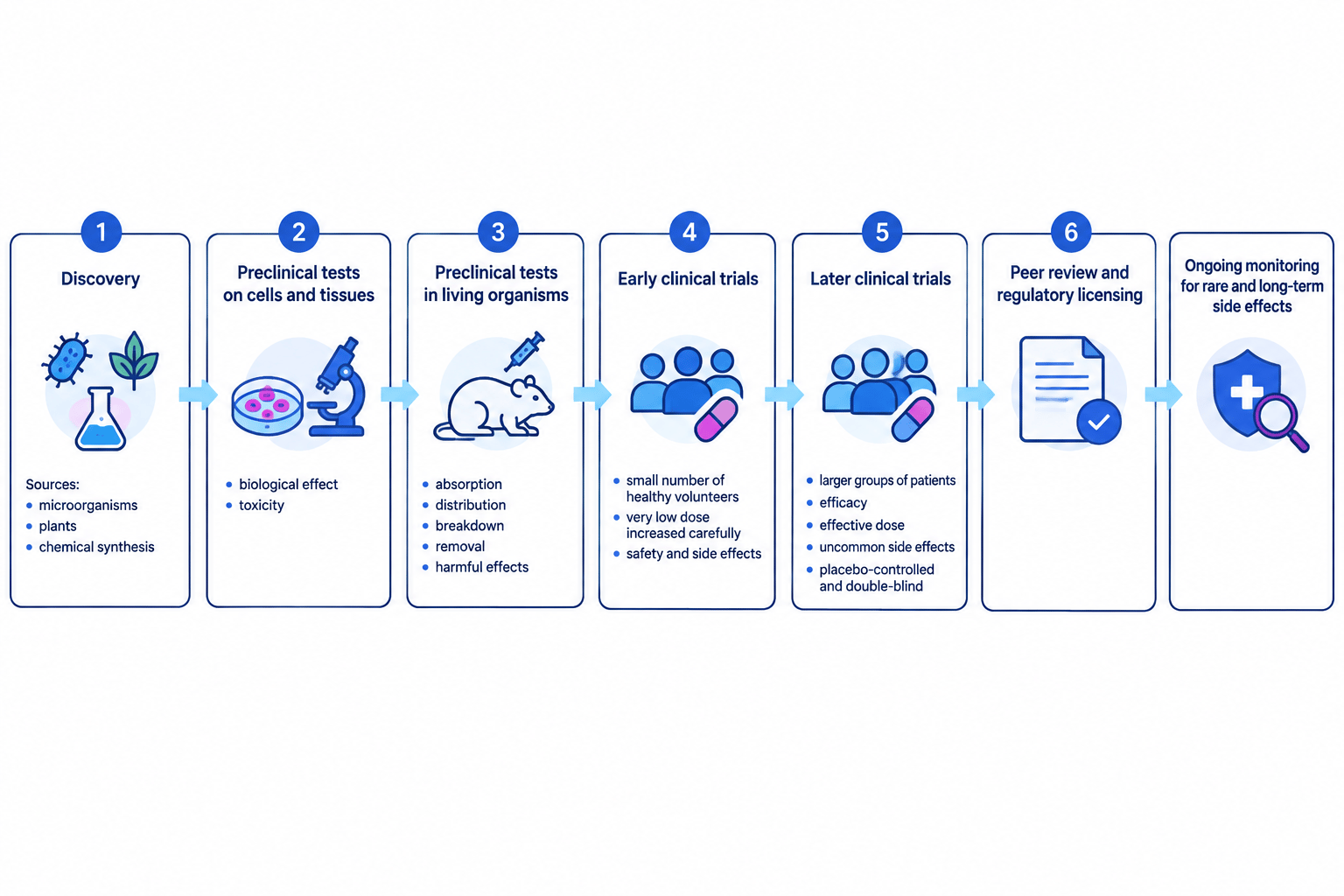
- Medicine development begins with the discovery of a substance that may prevent or treat disease. Candidates may come from microorganisms, plants or chemical synthesis.
- Scientists investigate how the candidate acts, then develop a suitable formulation and dose before testing whether it is safe and effective.
Preclinical testing
- Preclinical testing takes place before a medicine is given to human volunteers.
- The substance is tested on cells and tissues to examine its biological effect and identify obvious toxicity.
- It is then tested in living organisms to investigate how the whole body absorbs, distributes, breaks down and removes it, and to check for harmful effects.
- These tests provide evidence about toxicity, efficacy and a possible dose. A candidate that is ineffective or unacceptably harmful does not progress.
Clinical trials
Definition
Clinical trial
A stage of drug testing in which a new medicine is tested on human volunteers to check it is safe, that it works, and to find the right dose.
Definition
Placebo
A dummy treatment with no active drug, used in a trial so the real medicine's effect can be compared fairly.
- Clinical trials test the medicine in people. Early trials use a small number of healthy volunteers and a very low dose, which is increased carefully to investigate safety and side effects.
- Later trials use larger groups of patients to test whether the medicine treats the condition and to refine the effective dose.
- A placebo contains no active medicine. Comparing a treatment group with a placebo group helps show whether improvement is caused by the medicine rather than expectation or natural recovery.
- In a double-blind trial, neither the participants nor the researchers assessing them know who receives the medicine until the results are analysed. This reduces conscious and unconscious bias.
- Random allocation and large sample sizes reduce the effect of individual differences and make the groups more comparable.
Exam technique
For a question about drug testing, link each stage to its purpose: preclinical tests investigate toxicity and efficacy before human exposure; early clinical trials focus on safety and dose; later trials test effectiveness and uncommon side effects in more patients.
Review and monitoring
- Results are checked by independent scientists through peer review. Regulators examine the evidence before deciding whether the medicine can be licensed.
- After licensing, the medicine continues to be monitored because rare or long-term side effects may only appear when it is used by many people.
Self review
- Put discovery, preclinical testing and clinical testing in the correct order.
- What are the purposes of preclinical testing?
- Why are placebos and double-blind trials used?
- Why must a licensed medicine continue to be monitored?