Monoclonal antibodies
Definition
Monoclonal antibody
An antibody made in the laboratory from identical cells, so all the antibodies are the same and bind to one specific antigen.
- A monoclonal antibody is one of many identical antibodies made from a single clone of cells, so every antibody binds to the same specific antigen.
- Their specificity allows a particular molecule or type of cell to be detected, located or targeted.
Producing hybridomas
Definition
Hybridoma
A cell made by fusing a lymphocyte with a tumour cell; it divides rapidly and produces large amounts of a single type of antibody.
- A lymphocyte that makes the desired antibody is selected. It produces the correct antibody but does not divide repeatedly.
- The lymphocyte is fused with a tumour cell, which divides rapidly, to form a hybridoma.
- Hybridoma cells combine both useful properties: they divide to form a clone and each cell produces the desired antibody.
- The clone is cultured, and the identical antibodies are collected and purified.
Exam technique
A complete production explanation must state both halves of the fusion: the lymphocyte provides the ability to make the desired antibody, while the tumour cell provides the ability to divide repeatedly.
Pregnancy tests
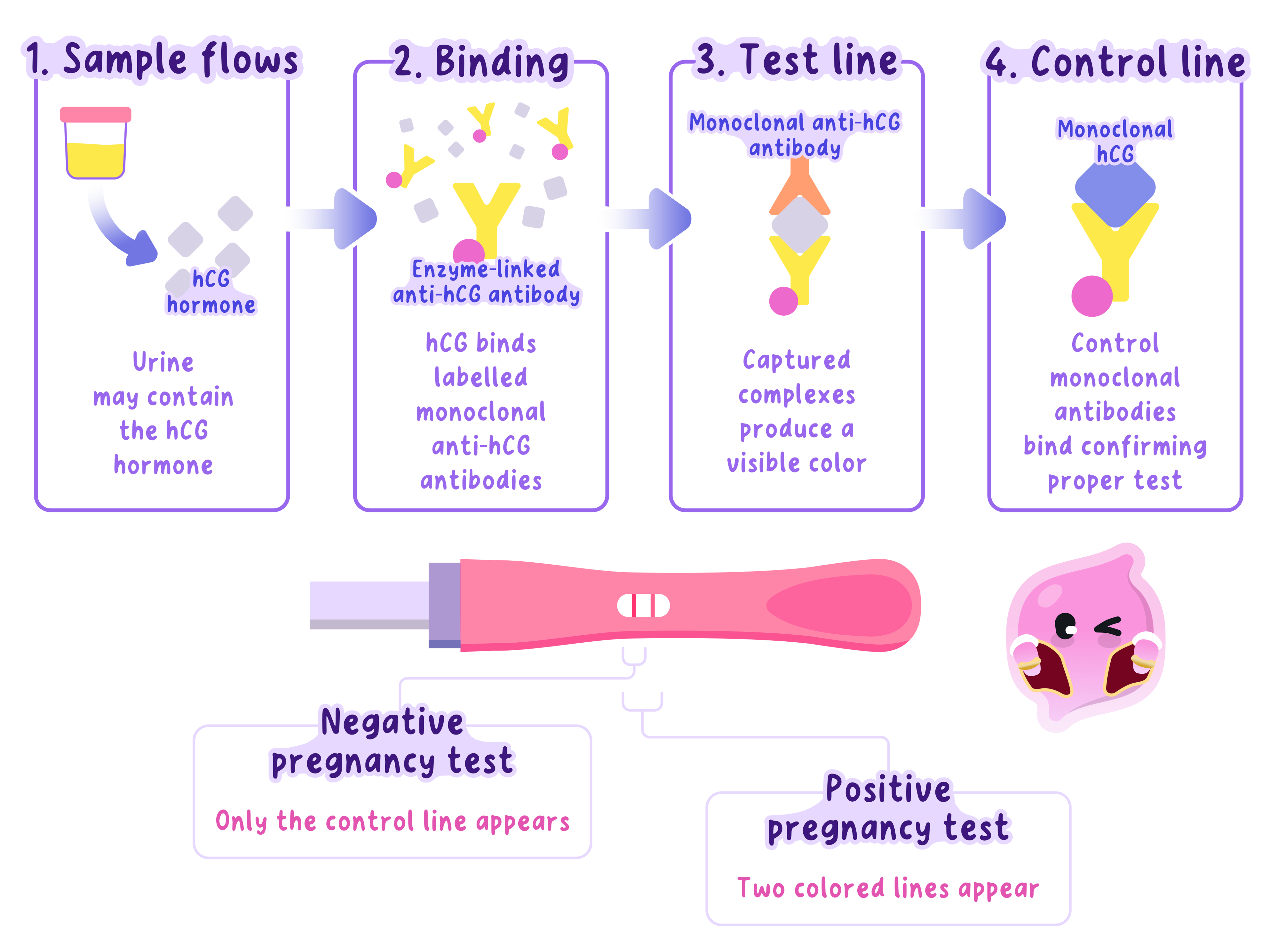
- Pregnancy tests detect the hormone hCG in urine using monoclonal antibodies that bind specifically to hCG.
- Urine carries coloured antibodies along the strip. If hCG is present, it binds to them and the complex is trapped by fixed antibodies at the test line, producing a coloured line.
- A separate control line traps excess coloured antibodies whether or not hCG is present. It shows that the liquid moved through the strip and that the test worked.
Diagnosis and treatment
- Monoclonal antibodies can be attached to fluorescent markers or radioactive substances. After binding to a target antigen, the marker reveals the position of cancer cells or a blood clot.
- For treatment, an antibody can bind to an antigen found mainly on cancer cells. It may block a growth signal or deliver a toxic drug or radioactive substance directly to the target cells.
- This targeting can damage fewer healthy cells than non-specific drug treatment or radiotherapy, so it may reduce side effects.
- Limitations include immune reactions, unexpected side effects, high production costs and the possibility that not every target cell carries the antigen.
Example
****A scan shows radioactivity concentrated in one region after a labelled monoclonal antibody is injected. The evidence suggests that cells in this region carry the antigen complementary to the antibody, so the labelled antibodies accumulated there.
Self review
- Explain how a hybridoma combines the useful properties of two different cells.
- Why does a pregnancy test need both a test line and a control line?
- How can monoclonal antibodies locate a blood clot or cancer cells?
- Give one advantage and one limitation of targeted monoclonal-antibody treatment.
