Question 2
FMost bananas grown for food are produced by asexual reproduction. The banana plants in a plantation are genetically identical.
Panama disease is caused by a fungus that kills banana plants.
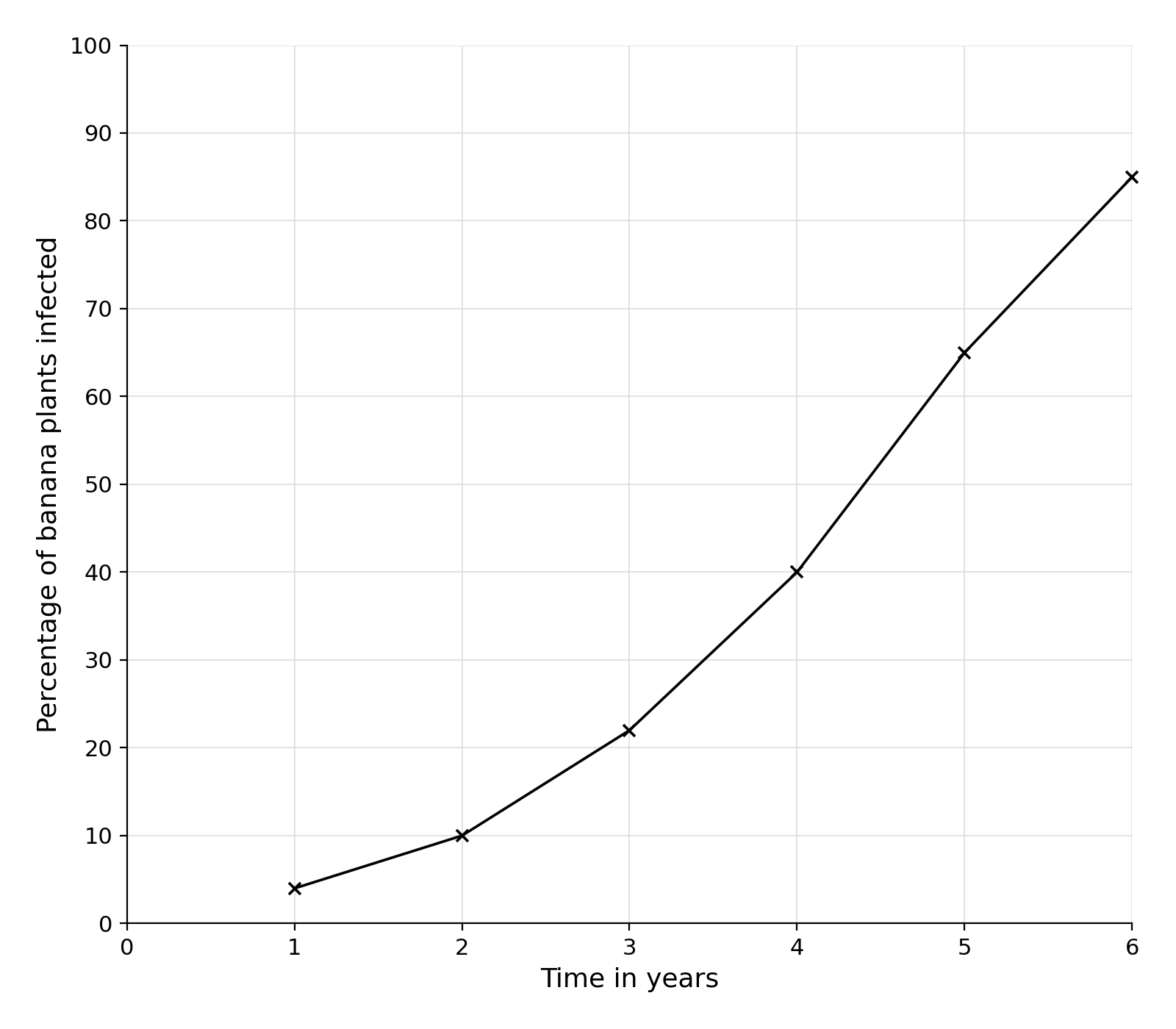
The Figure shows the percentage of banana plants infected by Panama disease in a plantation over six years.
Figure
a.[1]
Use the Figure to give the percentage of banana plants infected in year 4.
b.[1]
Calculate the increase in the percentage of banana plants infected between year 2 and year 6.
c.[2]
Explain why Panama disease was able to spread to so many plants in the plantation.
d.[2]
Scientists are using sexual reproduction to try to produce new banana plants that are resistant to Panama disease.
Explain why sexual reproduction could help the scientists.
3.1 Reproduction and meiosis Questions
40 exam-style questions on Edexcel GCSE Biology 3.1 Reproduction and meiosis, covering 3.1.1 Advantages and disadvantages of reproduction and 3.1.2 Role of meiotic cell division. Each one has a worked solution and a mark scheme showing where the marks go.