Reading a family pedigree
Definition
Family pedigree
A diagram that shows how one characteristic has been inherited through several generations of a single family.
- A pedigree is a family tree that shows how a feature is passed down the generations.
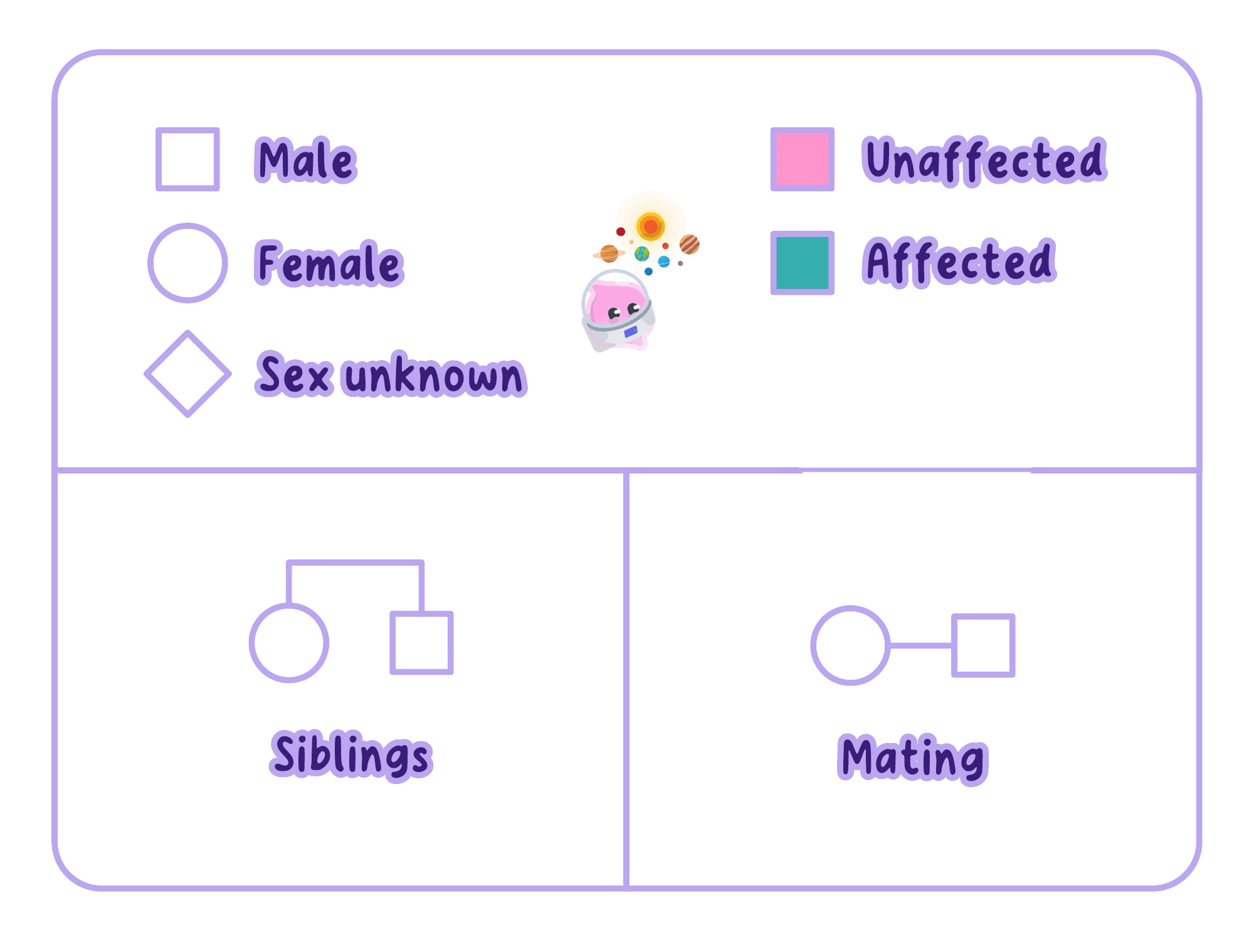
- Usually squares stand for males and circles for females, and shaded shapes show individuals with the feature.
- Lines link parents to their children, so you can follow the feature through the family.
- From the pattern you can work out whether the feature is dominant or recessive.
Note
A shaded shape shows someone who has the feature; an unshaded one shows someone who does not.
Hint
Start by asking whether the feature can skip a generation, which points to it being recessive.
Genotypes and carriers
Definition
Carrier
A person who is heterozygous for a recessive disorder, so they do not have the disorder themselves but can pass the faulty allele to their children.
- If two unaffected parents have an affected child, the feature must be recessive, and both parents must be carriers.
- A carrier is heterozygous: they have the recessive allele but do not show the feature.
- If the feature appears in every generation and affected children always have an affected parent, it is likely dominant.
- Once you know the pattern, you can give genotypes and predict the chance of future children being affected.
Example
Worked pedigree outcome
- Two unaffected parents have a child with a recessive disorder. Because the child is affected, the child's genotype must be ffffff.
- Each parent must have supplied an fff allele. Since both parents are unaffected, each must also carry the dominant normal allele, so both parents are FfFfFf.
- Cross: Ff×FfFf \times FfFf×Ff. The possible offspring are FFFFFF, FfFfFf, FfFfFf and ffffff.
- Genotype ratio: 1 FF:2 Ff:1 ff1\,FF : 2\,Ff : 1\,ff1FF:2Ff:1ff.
- The probability of an affected child is 14=25%\dfrac{1}{4}=25\%41=25%. The probability of an unaffected carrier is 24=12=50%\dfrac{2}{4}=\dfrac{1}{2}=50\%42=21=50%.
- Each pregnancy is an independent event, so a previous affected or unaffected child does not change the probability for the next child.
Common Mistake
Do not assume an unaffected person has no recessive allele: they may be a carrier.
Self review
- What is a pedigree?
- How can you tell a feature is recessive from a pedigree?
- What is a carrier?
- If a feature appears in every generation, is it more likely dominant or recessive?
