Viruses Use Host Cells to Reproduce
Definition
Virus
A non-cellular infectious particle made of a strand of genetic material enclosed in a protein coat, which can reproduce only inside a living host cell.
- A virus cannot reproduce independently because it lacks the cellular machinery needed to copy genetic material and make proteins.
- It attaches to a matching receptor on a host cell and transfers its genetic material into the cell.
Key Idea
After entry, viral genetic material follows either a lytic pathway or a lysogenic pathway.
The Lytic Pathway Destroys the Cell
Definition
Lytic cycle
The way many viruses reproduce: the virus enters a host cell, uses it to make many copies of itself, then bursts the cell open to release the new virus particles.
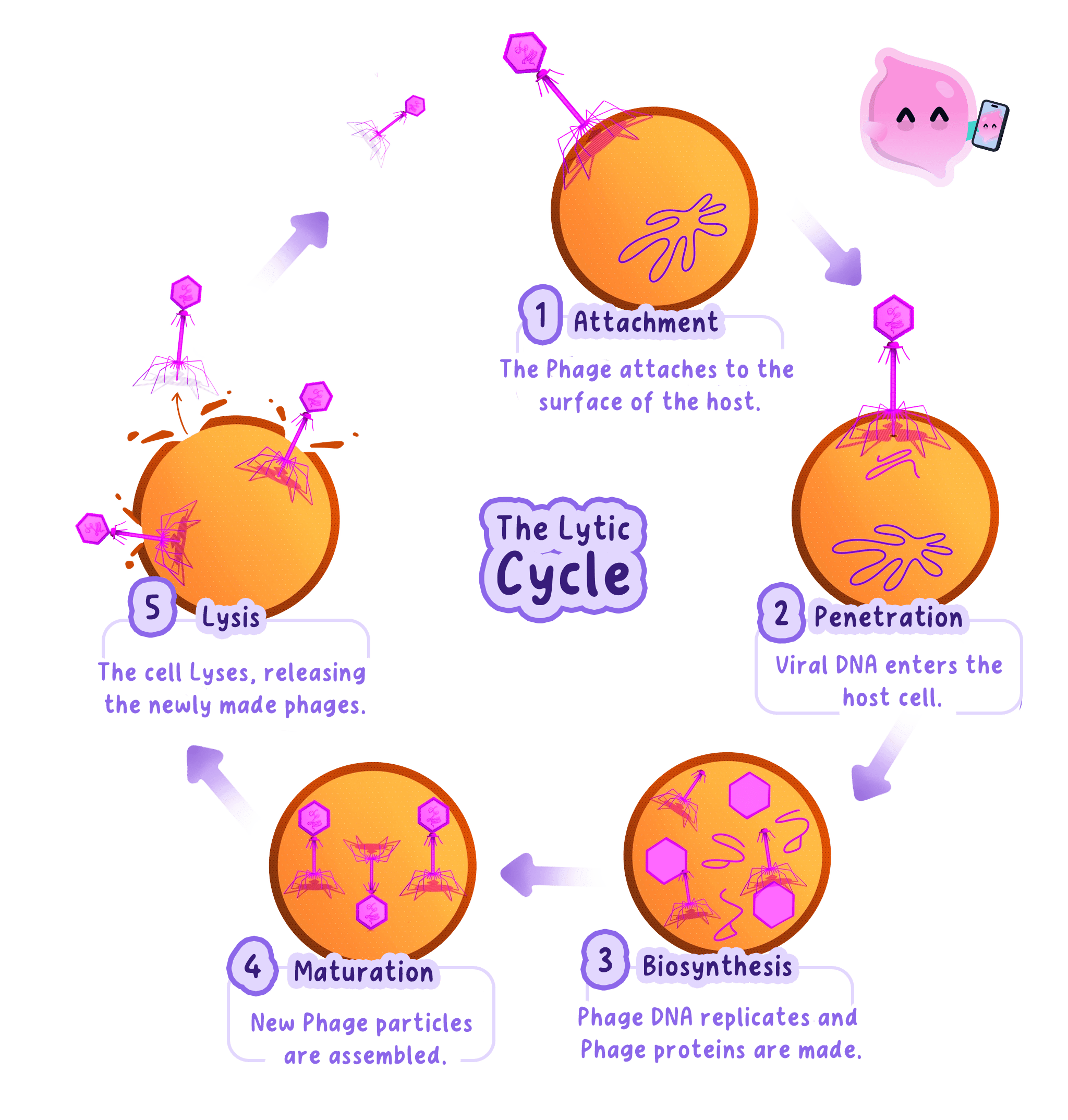
- The virus attaches to a suitable host cell and inserts or releases its genetic material.
- Viral genes take control of the cell's enzymes and ribosomes.
- The host cell copies viral genetic material and makes viral proteins.
- New virus particles assemble inside the cell.
- The host cell lyses, releasing many new viruses that can infect other cells.
- During attachment, viral surface proteins bind to complementary receptors on a suitable host cell, which determines host-cell specificity.
- After entry, viral genetic material redirects host enzymes and ribosomes to copy the genome and synthesise capsid proteins.
- During assembly, copied genetic material is packaged into new protein coats before the particles are released.
- Lysis kills the host cell as new virus particles escape, so repeated cycles damage tissue and produce symptoms.
Example
if one infected cell releases many virus particles, each particle can infect another cell, so the number of infected cells rises rapidly.
The Lysogenic Pathway Delays Lysis
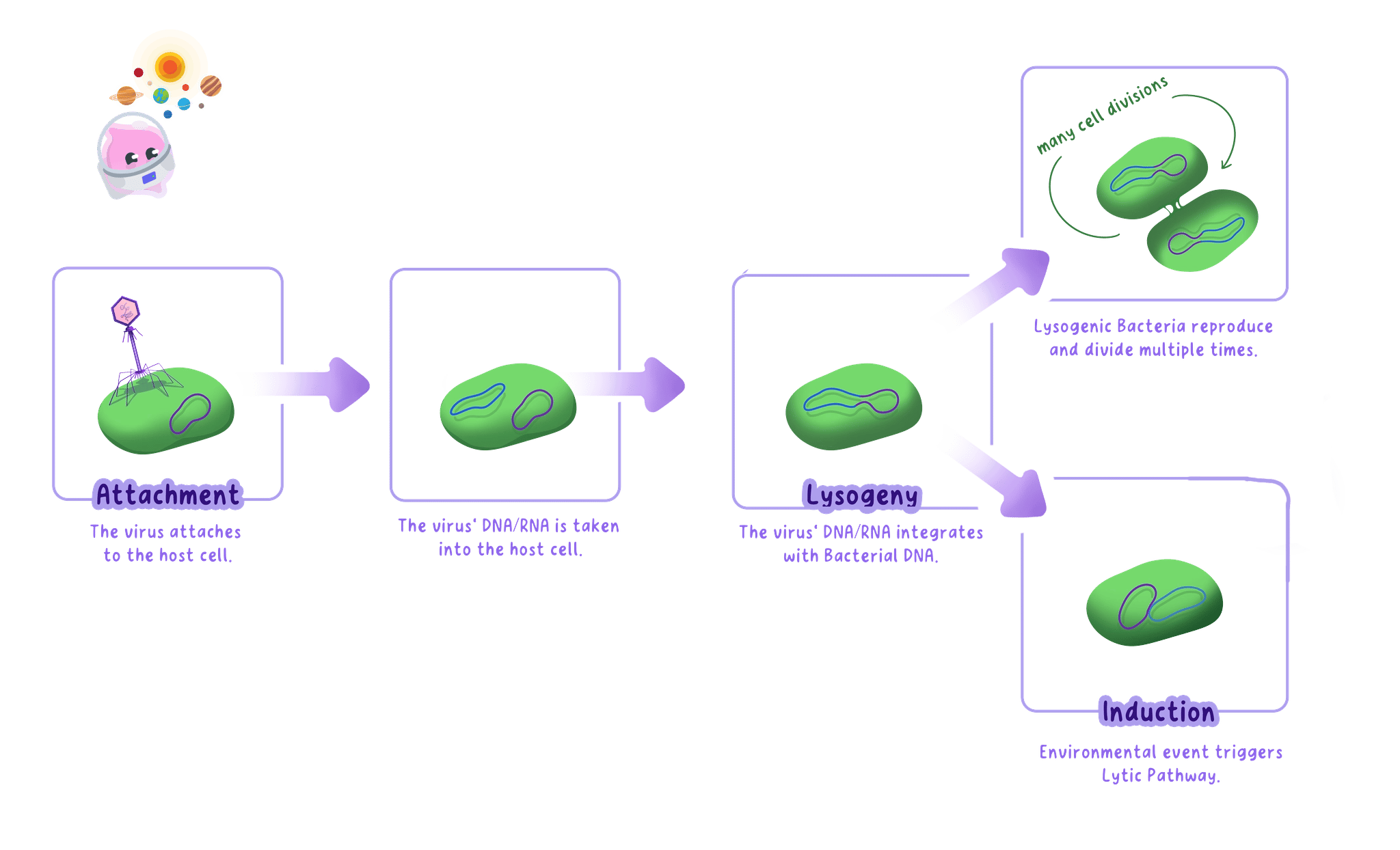
- Viral genetic material enters the host cell and becomes incorporated into the host DNA.
- The viral DNA is copied whenever the host cell copies its own DNA and divides.
- The host cell may continue functioning without producing complete virus particles.
- A trigger can activate the viral genes, causing the infection to switch to the lytic pathway.
- In the lysogenic pathway, integrated viral DNA is copied with host DNA without immediate production of complete virus particles.
- Environmental stress or another trigger can activate integrated viral genes and switch the infection into the lytic pathway.
Common Mistake
Do not say the virus is inactive during lysogeny because its genetic material is copied with the host DNA.
Compare the Two Pathways
- Both pathways begin with viral genetic material entering a host cell.
- The lytic pathway immediately makes new viruses and destroys the host cell.
- The lysogenic pathway inserts viral material into host DNA and may remain without cell lysis for many divisions.
Exam technique
- For a comparison, give paired differences about viral replication and the fate of the host cell.
- Use sequence words only when they preserve the biological order: attachment, entry, replication, assembly and release.
Explain Symptoms From Cell Damage
- Lysis damages tissues because many infected cells are destroyed.
- The immune response to infected cells can also cause inflammation and other symptoms.
Self review
- Why can a virus reproduce only inside a host cell?
- List the stages of the lytic pathway.
- What happens to viral DNA during the lysogenic pathway?
- Give one difference between lytic and lysogenic pathways.
