7.1.1 Endocrine glands and hormone transport
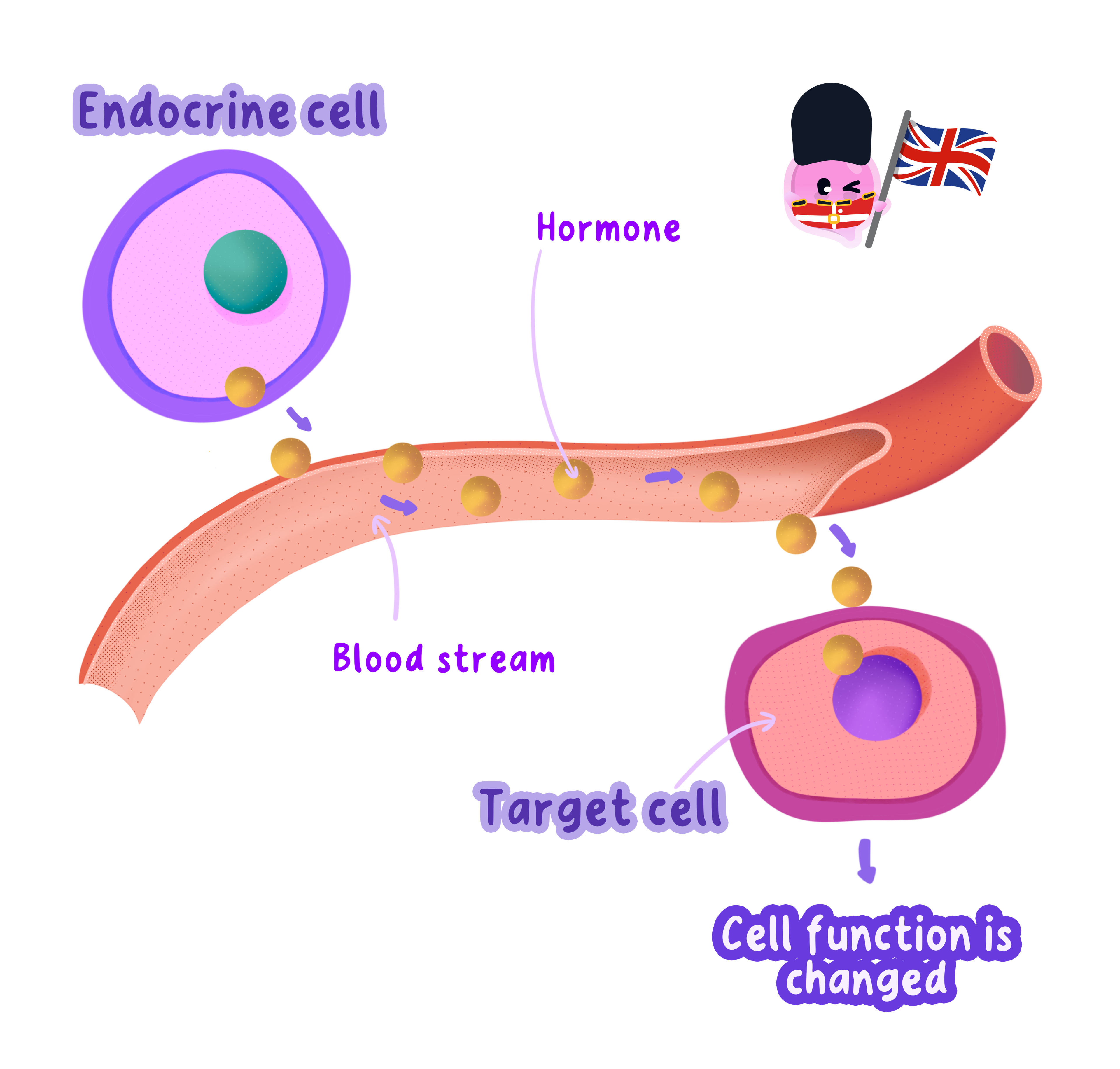
Endocrine glands release hormones
Endocrine system
The network of endocrine glands that secrete hormones directly into the blood to coordinate processes in the body.
- An endocrine gland is a gland that secretes hormones directly into the blood.
- A hormone is a chemical messenger produced by an endocrine gland and carried in the blood to a target organ, where it causes a response.
- A target organ is an organ containing cells that respond to a particular hormone.
- Endocrine glands have no ducts, so their hormones enter nearby capillaries and join the circulation.
Writing hormone transport
For a one-mark transport question, write that the hormone is carried dissolved in the blood plasma, not inside red blood cells.
Hormones reach their target organs
Hormone
A chemical messenger produced by an endocrine gland and carried in the blood to a target organ, where it causes a response.
- The bloodstream carries a hormone away from the gland and around the body.
- Hormones travel dissolved in the blood plasma, rather than inside red blood cells.
Target organs respond to hormones
Target organ
An organ containing cells that respond to a particular hormone.
- Blood delivers each hormone to its target organ, where it produces its specific effect.
- A hormone can circulate around the whole body, but only its target organs respond to it.
Following insulin through the body
- The pancreas secretes insulin directly into the blood.
- Blood plasma carries insulin to target organs such as the liver.
- The target organs respond by helping to lower the blood glucose concentration.
Nervous system vs Endocrine system
Nervous system
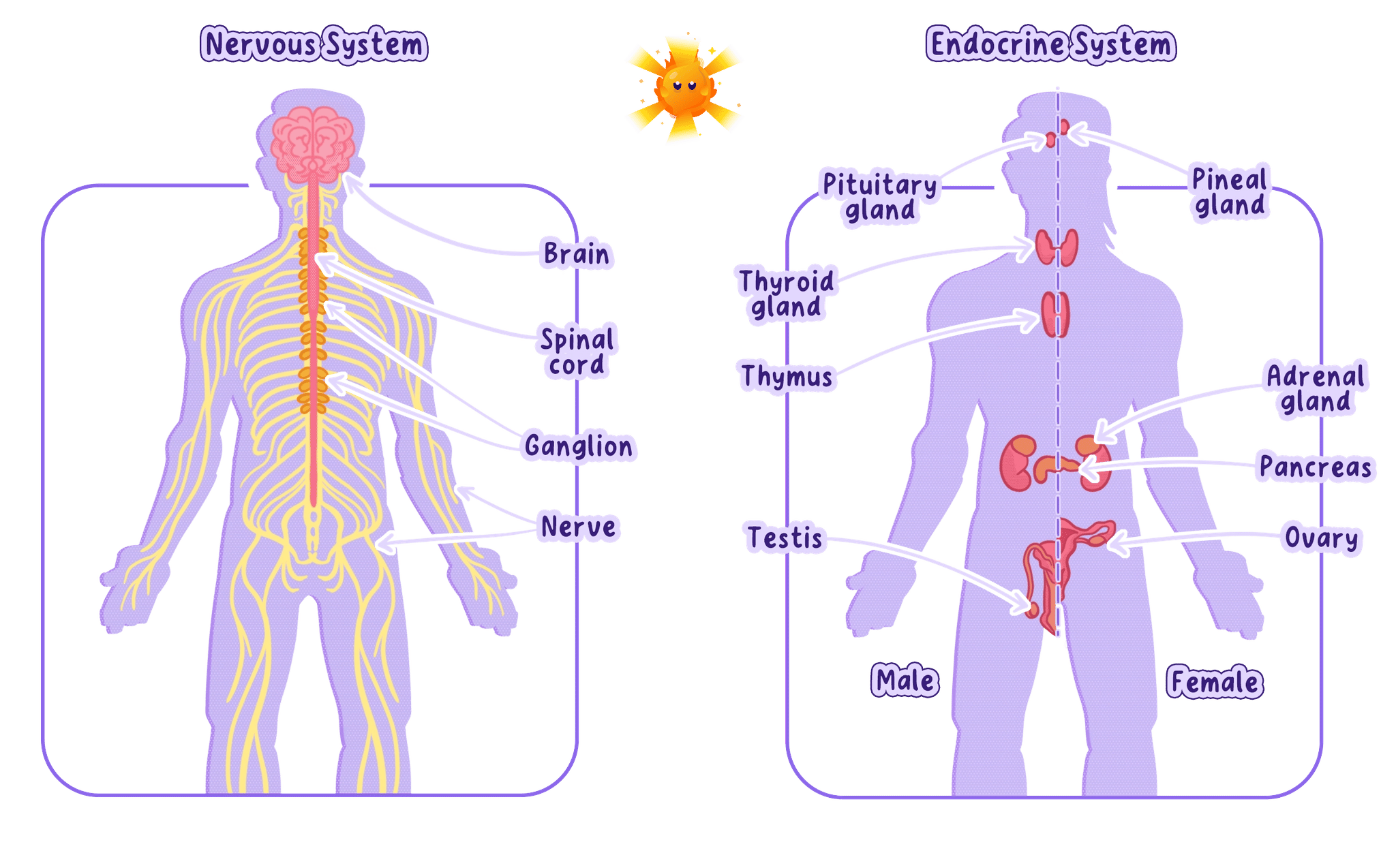
The system formed by the brain, spinal cord and nerves that detects stimuli and coordinates rapid responses using electrical impulses.
- The nervous system is formed by the brain, spinal cord and nerves, and it coordinates rapid responses using electrical impulses.
- Nervous control sends electrical impulses along neurones, whereas hormonal control sends chemical hormones through the blood.
- Nervous responses are usually very fast because impulses travel directly along neurones to an effector.
- Hormonal responses are usually slower because hormones must be secreted and carried through the circulation.
- Nervous effects are usually short-lived because the impulses stop once the response is no longer required.
- Hormonal effects can be long-lasting because hormones remain in the blood and may continue to affect target organs.
- A nervous impulse travels to a specific effector, while a hormone circulates widely but affects only organs that respond to that hormone.
- Nervous control is suited to immediate actions such as muscle contraction, while hormonal control is suited to longer processes such as growth, puberty and metabolic control.
Compare one feature at a time
Use paired statements such as 'nervous control is fast, whereas hormonal control is slower' so each difference compares the same feature.
Choose control by speed and duration
Nerve impulse
An electrical signal that travels along a neurone.
- A nerve impulse is an electrical signal that travels along a neurone.
- Touching a hot surface needs nervous control because the response must reach the arm muscles quickly and stop after the hand moves away.
- Growth during puberty needs hormonal control because it develops slowly and continues over a long period.
Choosing the control system
- A goalkeeper sees a ball change direction and dives within a fraction of a second.
- The response is controlled by the nervous system because electrical impulses reach the muscles rapidly and produce a brief, precise movement.
- A teenager develops changes during puberty over several years.
- The changes are controlled by hormones because the response is slower, widespread and long-lasting.
Main glands and their hormones
Endocrine gland
A gland that secretes hormones directly into the blood.
- The pituitary gland lies at the base of the brain and releases hormones that regulate several other endocrine glands.
- The thyroid gland lies in the neck and secretes thyroxine.
- The pancreas lies in the upper abdomen and secretes insulin and glucagon.
- The adrenal glands sit above the kidneys and secrete adrenaline.
- The ovaries lie in the pelvis and secrete oestrogen and progesterone.
- The testes lie in the scrotum and secrete testosterone.
- What is an endocrine gland?
- How is a hormone transported from a gland to a target organ?
- How do nervous and hormonal control differ in signal type and speed?
- Why are hormonal effects usually longer-lasting than nervous effects?
- Which control system is better suited to a rapid muscle response, and why?
7.1.2 Adrenalin and fight or flight
Adrenaline starts fight or flight
Adrenaline
A hormone secreted by the adrenal glands that prepares the body for the fight or flight response.
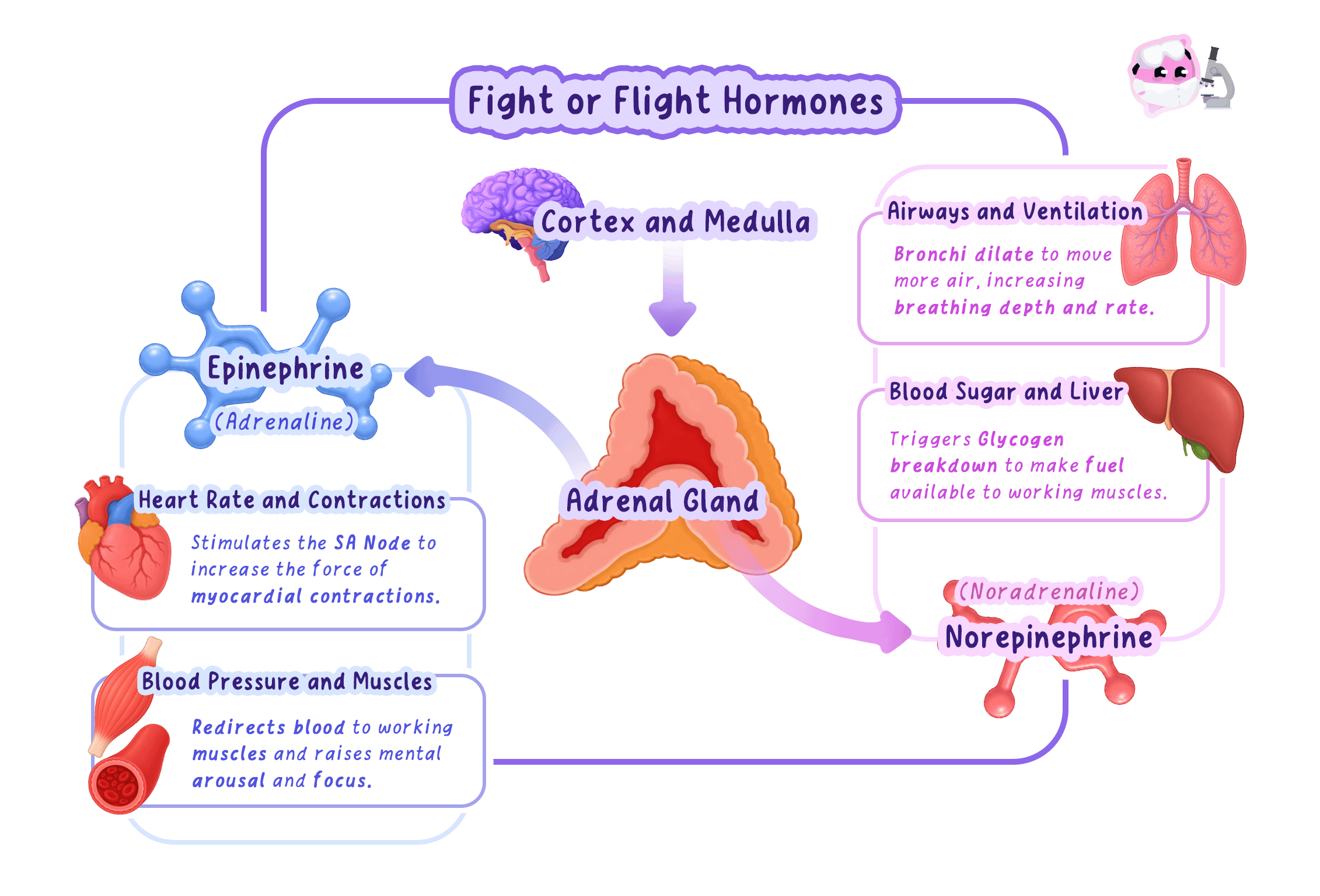
- The adrenal glands secrete adrenaline when the brain detects fear, stress or danger.
- The fight or flight response is a rapid set of body changes that prepares a person to confront danger or escape from it.
- Adrenaline travels in the blood and changes the activity of several target organs at the same time.
Link each change to respiration
Explain how each effect increases the delivery of oxygen or glucose to muscles, then link this to a higher rate of respiration and faster energy release.
Four effects supply active muscles
Fight or flight response
A rapid set of body changes that prepares a person to confront danger or escape from it.
- Adrenaline increases heart rate, so the heart pumps blood to the muscles more quickly.
- Adrenaline increases blood pressure, which helps blood reach the muscles rapidly.
- Adrenaline increases blood flow to the muscles, so muscle cells receive more oxygen and glucose.
- Adrenaline stimulates the liver to convert glycogen→glucose\mathrm{glycogen} \rightarrow \mathrm{glucose}glycogen→glucose, which raises the blood glucose concentration.
- The extra oxygen and glucose increase the rate of aerobic respiration in muscle cells, releasing energy more quickly for contraction.
Explaining the start of a sprint
- A runner becomes tense before the start, so the adrenal glands release adrenaline.
- Heart rate, blood pressure and blood flow to the leg muscles increase.
- The liver converts glycogen to glucose, so blood glucose rises.
- More oxygen and glucose reach the leg muscles, increasing respiration and releasing energy for rapid contraction.
Avoid incomplete explanations
- Do not stop after listing a change such as increased heart rate, because an explanation must state how the change helps the muscles respond.
- Do not say that adrenaline contains or supplies energy, because it causes changes that let muscle cells release energy by respiration.
- Do not replace the four assessed effects with pupil dilation or faster breathing, because those details do not cover the required causal chain.
- Which glands secrete adrenaline?
- What is the fight or flight response?
- How does adrenaline raise blood glucose?
- Why does increased blood flow to muscles help a rapid response?
- What error is made by saying that adrenaline supplies energy?
7.1.3 Thyroxine and negative feedback
Thyroxine sets metabolic rate
Thyroxine
A hormone secreted by the thyroid gland that controls metabolic rate.
- The thyroid gland is an endocrine gland in the neck that produces and secretes thyroxine.
- Thyroxine enters the blood and is carried to cells throughout the body.
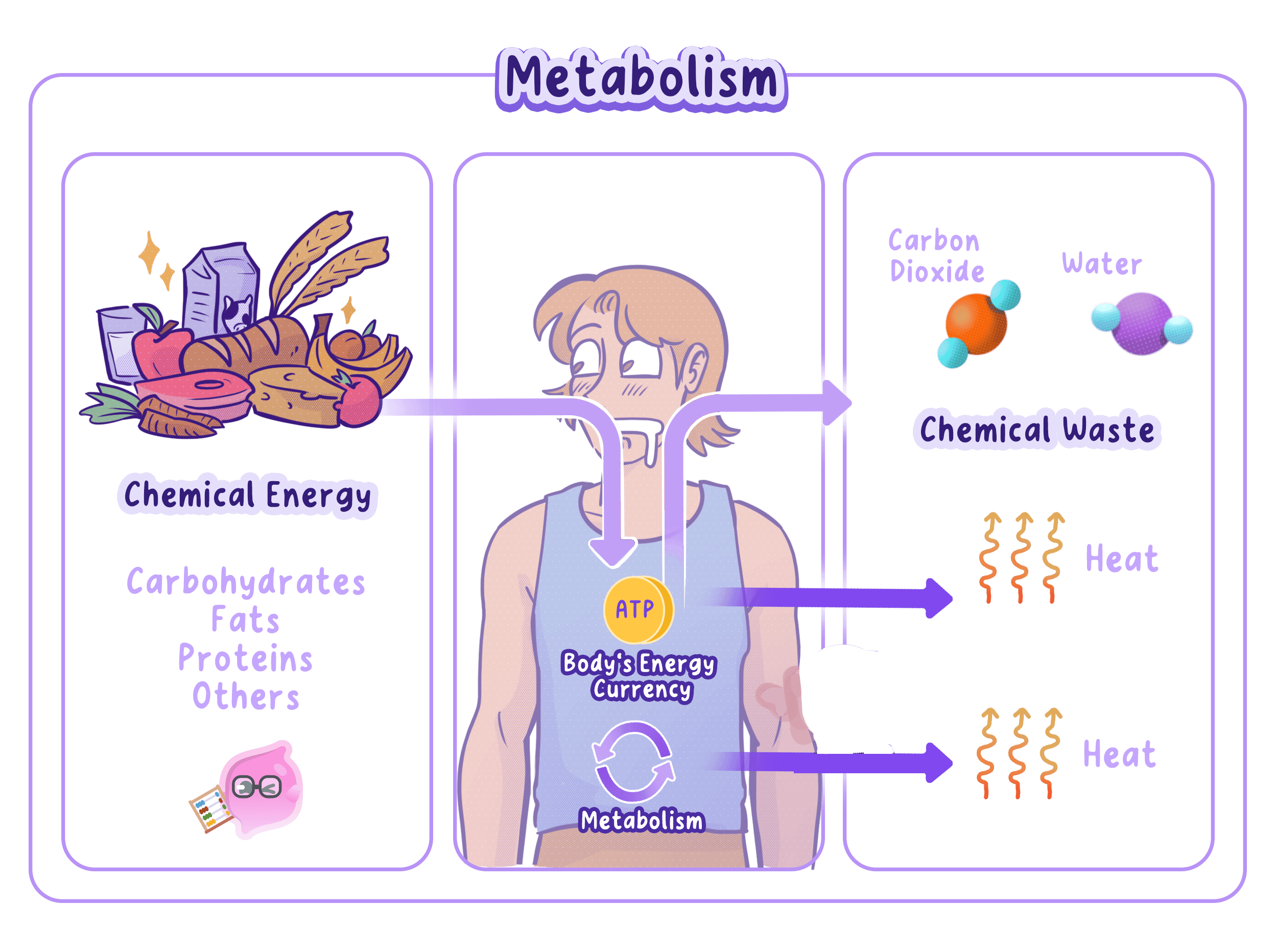
- Thyroxine changes how quickly cells carry out chemical reactions, so it controls the body's metabolic rate.
- The body needs thyroxine to remain near its normal concentration because reactions that run too slowly or too quickly disrupt normal cell function.
Metabolic rate changes energy use
Metabolic rate
The overall rate of the chemical reactions in the body.
- Metabolic rate is the overall rate of the chemical reactions in the body.
- A higher thyroxine concentration increases the rate of many cellular reactions, including reactions involved in respiration and energy transfer.
- A lower thyroxine concentration slows these reactions, so the body releases and uses less energy in a given time.
- The effect is not instant because thyroxine must be secreted, transported in the blood and act on its target cells.
Write a complete feedback chain
Keep the order low thyroxine→TRH→TSH→more thyroxine\mathrm{low\ thyroxine} \rightarrow \mathrm{TRH} \rightarrow \mathrm{TSH} \rightarrow \mathrm{more\ thyroxine}low thyroxine→TRH→TSH→more thyroxine, then state how normal thyroxine inhibits both TRH\mathrm{TRH}TRH and TSH\mathrm{TSH}TSH.
The hypothalamus detects low thyroxine
Hypothalamus
A region of the brain that monitors internal conditions and controls the pituitary gland by releasing hormones such as TRH\mathrm{TRH}TRH.
- The hypothalamus is a region of the brain that monitors internal conditions and controls hormone release from the pituitary gland.
- When the blood thyroxine concentration falls below normal, the hypothalamus responds by producing and releasing more TRH\mathrm{TRH}TRH.
- A low thyroxine concentration therefore begins a response that will increase thyroxine secretion and oppose the original fall.
TRH activates the pituitary
TRH (thyrotropin-releasing hormone)
A hormone released by the hypothalamus when the thyroxine level is low that stimulates the pituitary gland to release TSH\mathrm{TSH}TSH.
- TRH\mathrm{TRH}TRH is thyrotropin-releasing hormone produced by the hypothalamus.
- TRH\mathrm{TRH}TRH travels to the pituitary gland and stimulates it to produce and release TSH\mathrm{TSH}TSH.
- More TRH\mathrm{TRH}TRH therefore causes more TSH\mathrm{TSH}TSH to enter the blood.
The pituitary releases TSH
Pituitary gland
An endocrine gland at the base of the brain that releases hormones, including TSH\mathrm{TSH}TSH, which control other endocrine glands.
- The pituitary gland is an endocrine gland at the base of the brain that releases hormones which control other endocrine glands.
- In this pathway, the pituitary is the source of TSH\mathrm{TSH}TSH and the thyroid gland is its target.
- The pituitary does not release thyroxine, because thyroxine is produced by the thyroid gland.
TSH stimulates the thyroid
TSH (thyroid-stimulating hormone)
A hormone released by the pituitary gland that stimulates the thyroid gland to secrete thyroxine.
- TSH\mathrm{TSH}TSH is thyroid-stimulating hormone released by the pituitary gland.
- TSH\mathrm{TSH}TSH travels in the blood to the thyroid gland and stimulates it to produce and secrete more thyroxine.
- As the thyroid releases more thyroxine, the blood thyroxine concentration rises towards its normal level.
- The higher thyroxine concentration raises metabolic rate towards its normal value.
Negative feedback reduces stimulation
Negative feedback
A control mechanism in which a change away from the normal level causes responses that reverse the change and restore the normal level.
- Negative feedback is a control mechanism in which a change away from the normal level causes responses that reverse the change and restore the normal level.
- As thyroxine returns to its normal concentration, thyroxine inhibits the hypothalamus from producing and releasing more TRH\mathrm{TRH}TRH.
- Thyroxine also inhibits the pituitary gland from producing and releasing more TSH\mathrm{TSH}TSH.
- Less TSH\mathrm{TSH}TSH reaches the thyroid gland, so the thyroid receives less stimulation and secretes less thyroxine.
- This response prevents the thyroxine concentration and metabolic rate from continuing to rise above the normal level.
- If thyroxine later falls below normal, inhibition of the hypothalamus and pituitary weakens, so TRH\mathrm{TRH}TRH and TSH\mathrm{TSH}TSH secretion increase again.
- If thyroxine rises above normal, stronger inhibition reduces TRH\mathrm{TRH}TRH and TSH\mathrm{TSH}TSH secretion until thyroxine falls towards normal.
Explaining an underactive thyroid
- An underactive thyroid secretes too little thyroxine, so blood thyroxine remains below normal.
- The low thyroxine concentration stimulates the hypothalamus to release more TRH\mathrm{TRH}TRH.
- More TRH\mathrm{TRH}TRH causes the pituitary gland to release more TSH\mathrm{TSH}TSH, which stimulates the thyroid.
- If the thyroid still cannot release enough thyroxine, metabolic rate remains low and the body uses less energy.
- A continuing energy surplus can be stored as fat, so body mass may increase.
- Do not swap the sources of the hormones: the hypothalamus releases TRH\mathrm{TRH}TRH, the pituitary releases TSH\mathrm{TSH}TSH and the thyroid releases thyroxine.
- Do not say that TSH\mathrm{TSH}TSH inhibits the thyroid, because TSH\mathrm{TSH}TSH stimulates the thyroid to secrete thyroxine.
- Do not describe negative feedback as stopping all hormone release, because it adjusts secretion to keep thyroxine close to its normal level.
- For a developed explanation, link each named hormone to the gland that releases it and the gland or process it affects.
- How does thyroxine affect metabolic rate?
- What causes the hypothalamus to release more TRH\mathrm{TRH}TRH?
- Which gland releases TSH\mathrm{TSH}TSH, and which gland does it stimulate?
- How does normal thyroxine reduce further thyroxine secretion?
- Why can an underactive thyroid lead to an increase in body mass?
7.2.1 Stages of the menstrual cycle
The cycle prepares the uterus for pregnancy
Menstrual cycle
The roughly monthly cycle of hormone-controlled changes in the female reproductive system that releases an egg and prepares the uterus lining for pregnancy.
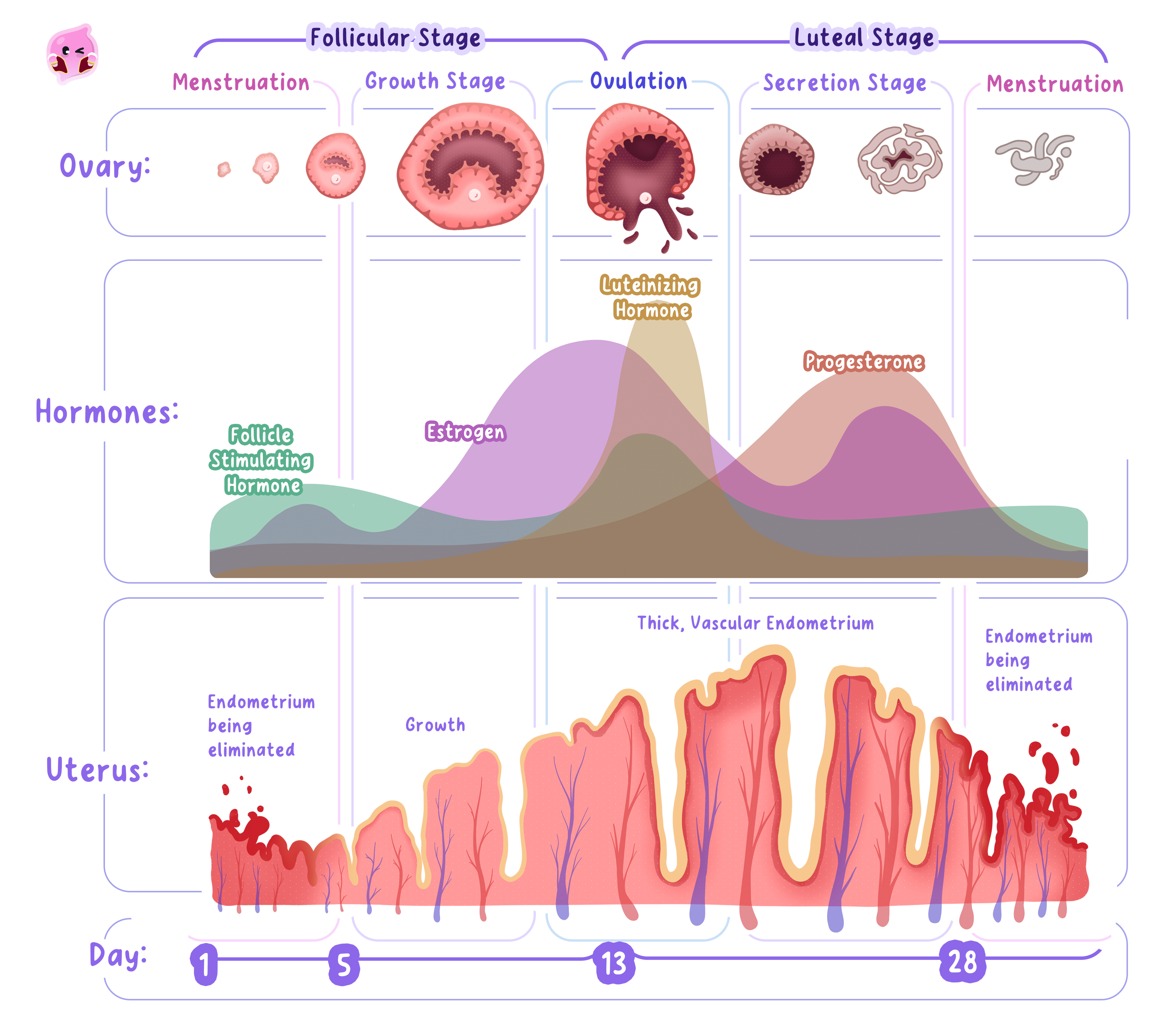
- The menstrual cycle is a repeating sequence of changes in the ovaries and uterus that releases an egg and prepares the uterus lining for possible implantation.
- Day 111 is the first day of menstruation, when the uterus lining breaks down and leaves the body through the vagina.
- A cycle is often modelled as about 282828 days, but the length varies between individuals and between cycles.
- During the first half of the cycle, an egg matures in a follicle in an ovary while the uterus lining repairs and becomes thicker.
- Around the middle of the cycle, a mature egg is released from an ovary.
- During the second half, the uterus lining is maintained so it can support an embryo if fertilisation and implantation occur.
- Sequence: menstruation is followed by repair of the uterus lining, ovulation, maintenance of the lining and then either implantation or another menstruation.
- Timing: day numbers are approximate, so use the pattern of events as well as the value shown on a graph.
Ovulation separates the two halves
Ovulation
The release of a mature egg cell from an ovary, about halfway through the menstrual cycle.
- Ovulation is the release of a mature egg from an ovary.
- In a model 282828-day cycle, ovulation occurs at about day 141414, after the egg has matured inside a follicle.
- The released egg enters an oviduct, where fertilisation may occur if a sperm cell reaches it.
- If fertilisation does not occur, the egg breaks down and the hormone changes later in the cycle lead to menstruation.
- A graph shows ovulation on day 151515 rather than day 141414.
- This is still consistent with a menstrual cycle because day 141414 is an approximate value, not a fixed date for every cycle.
Oestrogen rebuilds the uterus lining
Oestrogen
The main female sex hormone, made in the ovaries, which controls female secondary sexual characteristics and helps regulate the menstrual cycle.
- Oestrogen is a hormone made mainly by the ovaries that repairs and thickens the uterus lining after menstruation.
- Its concentration rises during the first half of the cycle as the follicle develops.
- A thicker, well-supplied lining creates suitable conditions for an embryo to implant if the egg is fertilised.
- When a question asks for the role of oestrogen, write the biological effect: it repairs and thickens the uterus lining.
- Do not write only that oestrogen controls the cycle, because that does not identify the change it causes.
Progesterone maintains the uterus lining
Progesterone
A female sex hormone that maintains the lining of the uterus during the second half of the menstrual cycle and during pregnancy.
- Progesterone is a hormone made by the ovary after ovulation that maintains the thick uterus lining.
- If pregnancy does not occur, progesterone and oestrogen concentrations fall near the end of the cycle.
- The fall in these hormones means the lining is no longer maintained, so it breaks down and a new menstruation begins.
- If pregnancy begins, progesterone remains high and helps keep the uterus lining in place.
- What event defines day 111 of the menstrual cycle?
- What is ovulation, and when does it occur in a model 282828-day cycle?
- How does oestrogen change the uterus lining?
- Why does menstruation occur when progesterone and oestrogen concentrations fall?
7.2.2 Hormonal control of the menstrual cycle
FSH matures an egg
FSH (follicle-stimulating hormone)
A hormone released by the pituitary gland that causes an egg to mature in the ovary and stimulates the ovaries to produce oestrogen.
- FSH is released by the pituitary gland and travels in the blood to the ovaries.
- FSH stimulates a follicle in an ovary to develop, so the egg inside it matures.
- FSH also stimulates the developing follicle to release oestrogen.
- Keep the source and target separate: the pituitary gland releases FSH, but FSH acts on an ovary.
- A complete FSH answer links the hormone to follicle development, egg maturation and increased oestrogen.
Oestrogen rebuilds the lining
Oestrogen
The main female sex hormone, made in the ovaries, which controls female secondary sexual characteristics and helps regulate the menstrual cycle.
- Oestrogen released by the developing follicle repairs and thickens the uterus lining after menstruation.
- As oestrogen rises, it inhibits further FSH release so several follicles do not usually continue maturing.
- A high oestrogen concentration also stimulates the pituitary gland to release a surge of LH.
- A graph shows rising oestrogen followed by a sharp LH peak.
- The correct link is that high oestrogen stimulates the LH surge, which then triggers ovulation.
LH triggers ovulation
LH (luteinising hormone)
A hormone released by the pituitary gland that triggers ovulation, the release of a mature egg from the ovary.
- LH is released by the pituitary gland and travels to the ovaries in the blood.
- The sharp LH surge causes the mature follicle to release its egg, which is ovulation.
- After ovulation, LH supports the change of the empty follicle into a structure that releases progesterone.
- Do not state that FSH causes ovulation.
- FSH matures the follicle and egg, while the LH surge releases the mature egg.
Progesterone maintains the lining
Progesterone
A female sex hormone that maintains the lining of the uterus during the second half of the menstrual cycle and during pregnancy.
- Progesterone is released by the ovary after ovulation and keeps the uterus lining thick.
- Progesterone inhibits FSH and LH, preventing another follicle from maturing and another ovulation during the same cycle.
- If the egg is not fertilised, the progesterone-producing structure breaks down and progesterone falls.
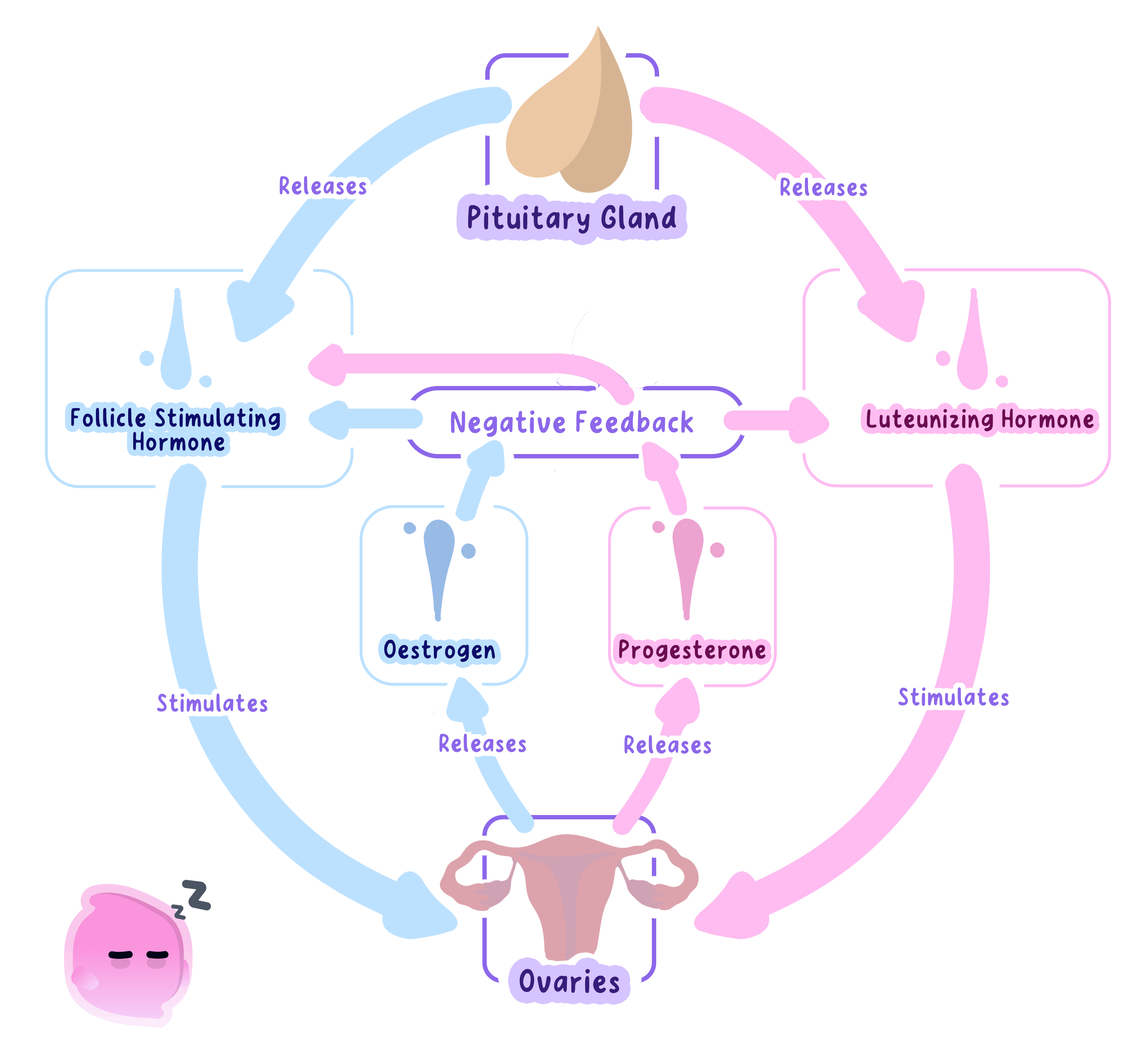
- For an explanation, build a linked chain with the hormone, its source, its target and its effect.
- Use causal words such as causes, stimulates and inhibits so each marking point follows from the previous one.
Falling hormones start menstruation
- When progesterone and oestrogen fall, the uterus lining is no longer maintained and it breaks down.
- The fall removes inhibition of FSH, allowing FSH to rise and begin the next cycle.
- On a graph, the LH peak marks ovulation, the progesterone peak follows ovulation, and the fall in progesterone matches the start of menstruation.
- Where is FSH released, and what two effects does it have?
- How does high oestrogen lead to ovulation?
- What does progesterone do to the uterus lining and to FSH and LH?
- Why do falling progesterone and oestrogen concentrations lead to menstruation?
7.2.3 Hormonal contraception
Hormonal contraception prevents ovulation
Contraception
A method used to prevent pregnancy, either by using hormones or by stopping sperm reaching an egg.
- Contraception is the deliberate prevention of pregnancy.
- The combined pill contains artificial versions of oestrogen and progesterone.
- These hormones maintain feedback inhibition of the pituitary gland, so less FSH and LH are released.
- Without enough FSH, a follicle and its egg do not mature fully.
- Without an LH surge, ovulation does not occur, so there is no egg available for fertilisation.
- The combined pill lowers FSH and LH release, so the follicle does not mature and the LH surge does not occur.
- No egg is released, so sperm cannot fertilise an egg and pregnancy is prevented.
Methods deliver hormones in different ways
Progesterone
A female sex hormone that maintains the lining of the uterus during the second half of the menstrual cycle and during pregnancy.
- Hormonal contraception can be delivered as a daily pill, skin patch, injection, implant or hormone-releasing intrauterine system.
- Long-acting methods release hormone over weeks, months or years, so their effect does not depend on remembering a tablet every day.
- A progesterone-only method mainly uses an artificial version of progesterone, while the combined pill supplies artificial oestrogen and progesterone.
- The exact pattern of bleeding can change because these methods alter the normal menstrual cycle.
- Do not say the pill destroys an egg or stops an egg from existing.
- Write that it suppresses FSH and LH, preventing follicle maturation or ovulation.
Other effects also prevent pregnancy
- Artificial progesterone can thicken the mucus at the cervix, making it harder for sperm to enter the uterus.
- Some hormonal methods also keep the uterus lining thin, reducing the chance that an embryo implants.
- These effects support the main mechanism of preventing ovulation.
- For a two-mark explanation, give a mechanism and its consequence.
- For example, state that the cervical mucus thickens, then link this to sperm being less able to reach and fertilise an egg.
Hormonal methods do not prevent infections
- Hormonal contraception reduces the chance of pregnancy but does not form a physical barrier between partners.
- It therefore does not protect against sexually transmitted infections.
- A condom may be used as well when protection from sexually transmitted infections is needed.
- How do artificial oestrogen and progesterone reduce FSH and LH release?
- Why does suppressing the LH surge prevent pregnancy?
- How can thicker cervical mucus reduce the chance of fertilisation?
- Why does hormonal contraception not protect against sexually transmitted infections?
7.2.4 Evaluating contraception methods
Evaluation needs a supported judgement
Contraception
A method used to prevent pregnancy, either by using hormones or by stopping sperm reaching an egg.
- Effectiveness is the proportion of users for whom a method prevents pregnancy over the stated time and under the stated conditions.
- A comparison should also consider side effects, ease of correct use, reversibility, medical suitability and protection from sexually transmitted infections.
- The best method depends on the needs and circumstances in the question, so a conclusion must be supported by relevant evidence.
- When data are given, compare methods over the same time period and check whether the figures describe perfect use or typical use.
- Use evidence from the table or graph rather than listing memorised advantages.
- Balance a benefit against a limitation, then make a judgement that matches the person described.
Hormonal methods have trade-offs
- Hormonal methods can be highly effective because they prevent ovulation and may also thicken cervical mucus.
- Implants and injections are less affected by forgetting than a daily pill because they release hormone for a longer period.
- Possible disadvantages include headaches, nausea, mood changes, irregular bleeding and, for some combined methods, a small increased risk of blood clots.
- Hormonal methods do not protect against sexually transmitted infections and may be unsuitable for some people after medical assessment.
- Most hormonal methods are reversible, but normal fertility may take time to return after some injections.
Barrier methods block sperm
- Barrier methods, including condoms and diaphragms, physically prevent sperm from reaching an egg.
- They do not alter hormone concentrations, so they avoid hormone-related side effects.
- Condoms reduce the transmission of sexually transmitted infections as well as reducing the chance of pregnancy.
- Their effectiveness depends on correct use every time, and a condom can tear, slip or be put on incorrectly.
- A diaphragm must be positioned correctly over the cervix and is usually used with spermicide.
- A table gives method A an effectiveness of 99%99\%99% and method B an effectiveness of 82%82\%82% under the stated conditions.
- The pregnancy percentages are 100%−99%=1%100\%-99\%=1\%100%−99%=1% for A and 100%−82%=18%100\%-82\%=18\%100%−82%=18% for B.
- If B is a condom and protection from sexually transmitted infections is required, B may still be the better choice despite its lower pregnancy prevention figure.
Data must match the person
- A person who cannot use oestrogen may need a progesterone-only or barrier method even if another method has a higher quoted effectiveness.
- A person who wants long-term contraception may prefer an implant because it does not require action at every episode of intercourse.
- A person who needs protection from sexually transmitted infections should use condoms because hormonal methods do not provide that protection.
- A strong evaluation states the choice, supports it with data, acknowledges a relevant drawback and explains why the benefit outweighs that drawback.
- Which factors should be considered besides effectiveness?
- Why are long-acting hormonal methods less affected by forgetting?
- What is one advantage and one limitation of barrier methods?
- How should a final judgement use the data and the person's circumstances?
7.2.5 Hormones in Assisted Reproductive Technology
ART uses treatment to support pregnancy
Assisted Reproductive Technology (ART)
Medical treatments that help a person become pregnant by stimulating ovulation or by handling eggs, sperm or embryos as part of fertility treatment.
- Assisted Reproductive Technology uses fertility drugs or procedures involving eggs, sperm or embryos to increase the chance of pregnancy.
- The choice of treatment depends on the cause of infertility, such as failure to ovulate, blocked oviducts or difficulty with fertilisation.
- Hormones used in treatment act on the same ovaries and follicles as the hormones of the natural menstrual cycle.
Clomifene increases FSH and LH
Clomifene
A fertility drug that stimulates the pituitary gland to release more FSH and LH, increasing the chance that an egg matures and is released.
- Clomifene is taken as a fertility drug when ovulation is absent or irregular.
- It stimulates the pituitary gland to release more FSH and LH.
- The higher FSH concentration increases follicle development and egg maturation.
- The higher LH concentration increases the chance that a mature egg is released by ovulation.
- If intercourse occurs around ovulation, the egg may then be fertilised inside the body.
- Clomifene may cause more than one follicle to mature.
- Releasing more than one egg increases the chance of twins or other multiple births.
IVF fertilises eggs outside the body
IVF (in vitro fertilisation)
A fertility treatment in which eggs are collected and fertilised by sperm outside the body, and one or more resulting embryos are placed into the uterus.
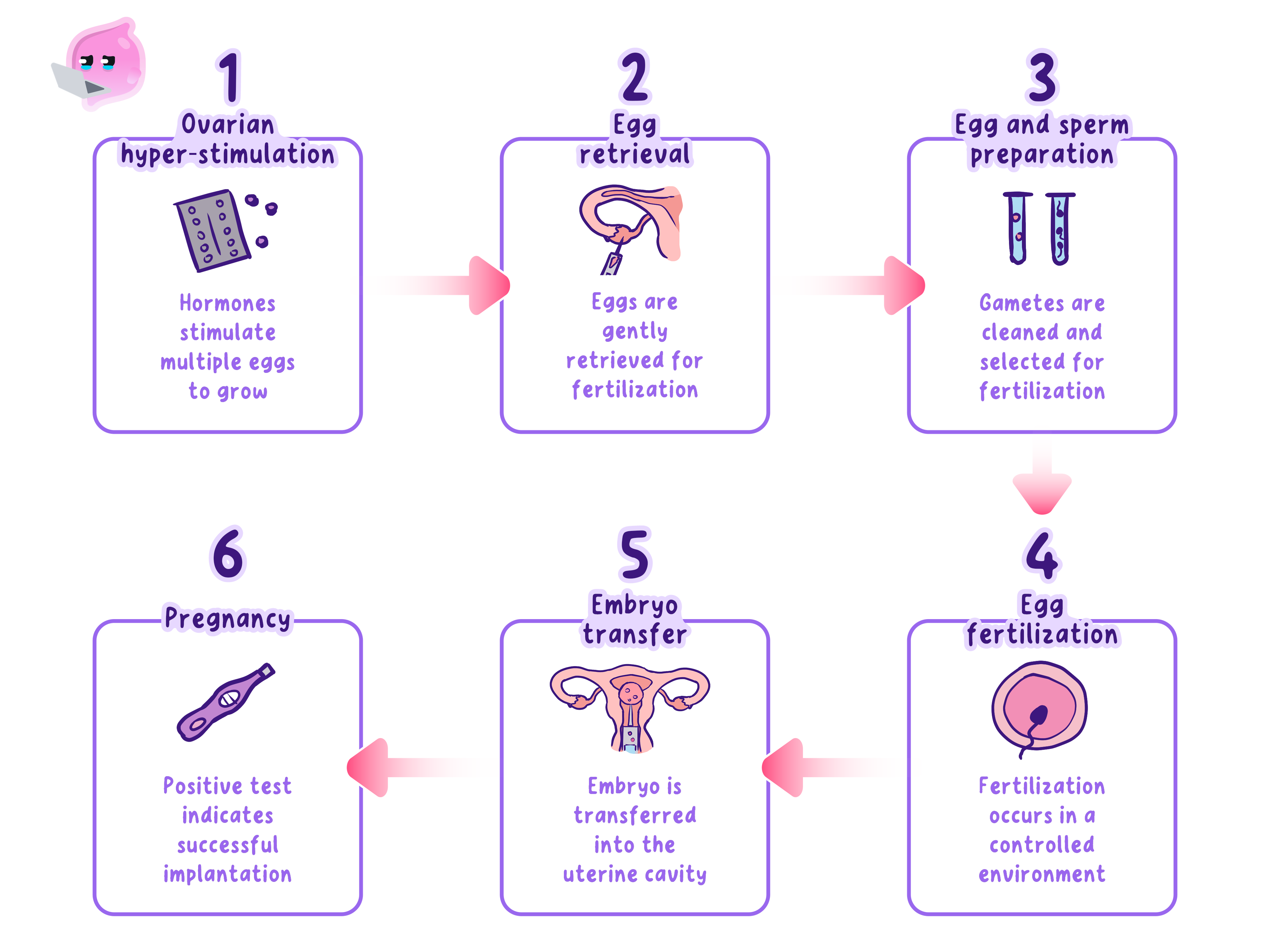
- First, FSH and LH are given so several follicles develop and several eggs mature.
- The mature eggs are collected from the ovaries, and a sperm sample is collected.
- Eggs and sperm are mixed in a laboratory dish, or one sperm is injected into an egg when needed.
- Fertilised eggs divide by mitosis and develop into embryos.
- One or more selected embryos are transferred into the uterus.
- A pregnancy begins only if an embryo implants successfully in the uterus lining.
- A woman ovulates normally but both oviducts are blocked.
- Clomifene would not remove the blockage, whereas IVF allows fertilisation outside the body and places an embryo directly into the uterus.
Clomifene and IVF solve different problems
- Clomifene mainly treats infertility caused by failure to ovulate because it increases FSH and LH release.
- IVF can help when fertilisation inside the oviduct is unlikely, including when an oviduct is blocked.
- IVF also allows several eggs to be collected, increasing the chance that at least one embryo develops for transfer.
- Keep egg, fertilised egg and embryo distinct when describing IVF.
- Write the stages in order and state that fertilisation occurs outside the body before an embryo is transferred to the uterus.
Embryo transfer does not guarantee pregnancy
- An embryo must implant in the uterus lining and continue developing for IVF to result in pregnancy.
- IVF may need more than one attempt because fertilisation, embryo development, transfer or implantation can fail.
- Transferring more than one embryo can increase the chance of a multiple pregnancy, which carries greater risks for the pregnant person and babies.
- How does clomifene increase the chance of ovulation?
- Why are FSH and LH used before eggs are collected for IVF?
- Put the main stages of IVF in order.
- Why can IVF help when an oviduct is blocked?
