Glucagon raises low blood glucose
Definition
Glucagon
A hormone released by the pancreas when blood glucose concentration is too low that causes liver cells to convert glycogen into glucose and release the glucose into the blood.
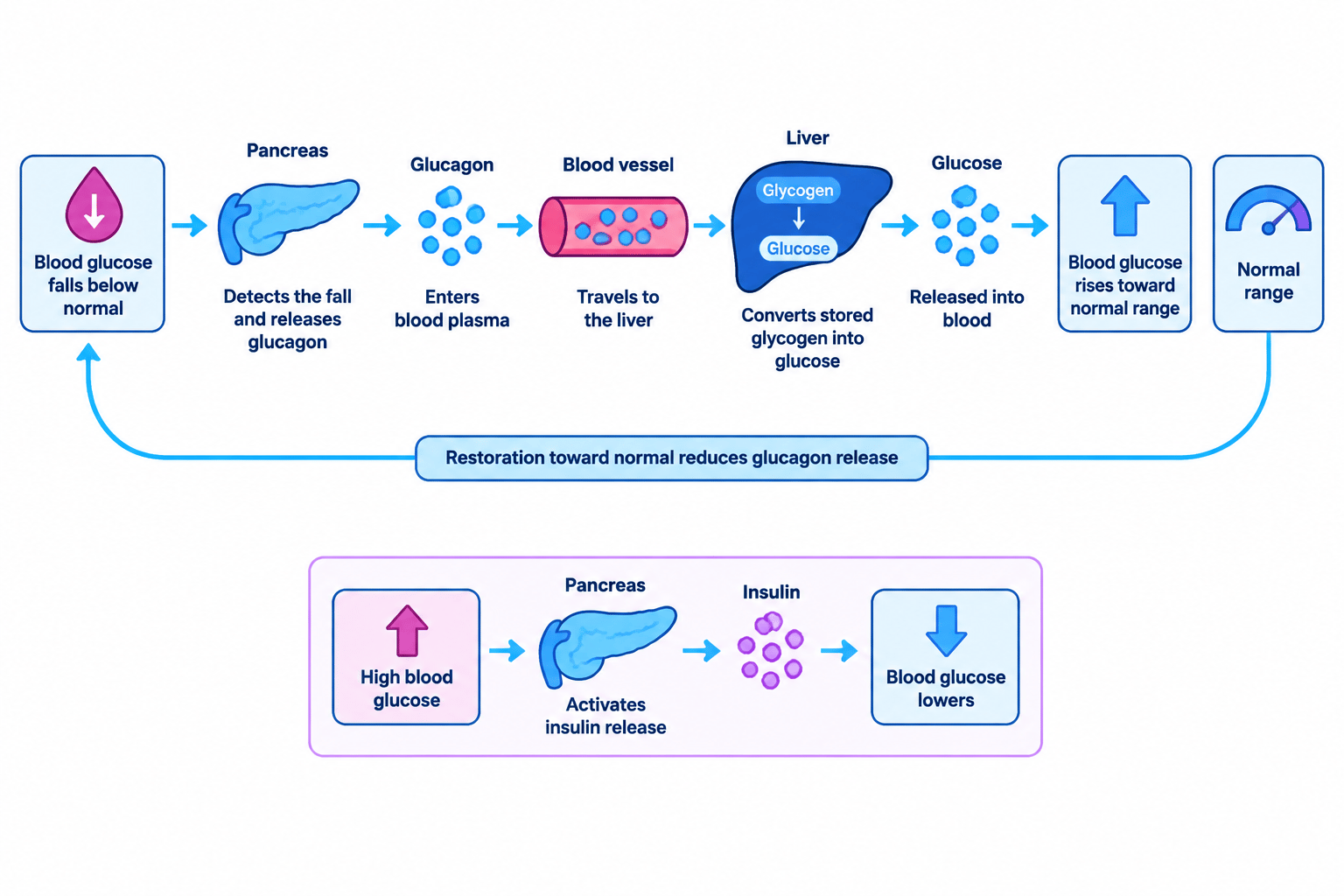
- Glucagon is a hormone released by the pancreas when blood glucose concentration is below the normal range.
- Low blood glucose can occur between meals, during prolonged exercise or when cells have used glucose in respiration.
- The pancreas responds by releasing glucagon into the blood plasma.
- The liver is the main target because glucagon causes liver cells to convert stored glycogen into glucose.
- Glucose enters the blood from the liver, so blood glucose concentration rises towards the normal range.
- The control pathway can be written as low blood glucose→glucagon release→glycogen converted to glucose→blood glucose rises\text{low blood glucose} \rightarrow \text{glucagon release} \rightarrow \text{glycogen converted to glucose} \rightarrow \text{blood glucose rises}low blood glucose→glucagon release→glycogen converted to glucose→blood glucose rises.
The liver supplies stored glucose
Definition
Glycogen
An insoluble carbohydrate made from glucose and stored mainly in liver and muscle cells.
- Glycogen stores glucose in an insoluble form inside liver and muscle cells.
- Glucagon acts mainly on liver cells because liver glycogen can be converted to glucose that is released into the bloodstream.
- Muscle cells use their glycogen locally for respiration rather than releasing the stored glucose to control the concentration in the blood.
- Conversion changes the stored carbohydrate into soluble glucose that can leave the liver and enter the plasma.
Example
Explaining a fall between meals
- Observation: a blood glucose graph falls below its usual range three hours after a meal.
- Hormonal response: the pancreas releases more glucagon into the blood.
- Liver response: glycogen is converted into glucose and the glucose is released.
- Outcome: blood glucose concentration rises back towards the normal range.
Two hormones correct opposite changes
Definition
Negative feedback
A control mechanism in which a change away from the normal level causes responses that reverse the change and restore the normal level.
- Negative feedback reverses a change away from the normal level.
- When glucose is too high insulin increases glucose uptake and glycogen formation, so the concentration falls.
- When glucose is too low glucagon increases the conversion of liver glycogen to glucose, so the concentration rises.
- The responses oppose each other and keep blood glucose within a narrow range rather than at one perfectly fixed value.
- Hormone release changes continuously because the pancreas responds to the current blood glucose concentration.
Common Mistake
Do not reverse the hormones: insulin lowers blood glucose concentration and glucagon raises it.