Question 3
FWhite-clawed crayfish are the only species of crayfish that is native to rivers in the UK.
Signal crayfish were brought to the UK from North America. Some escaped into rivers.
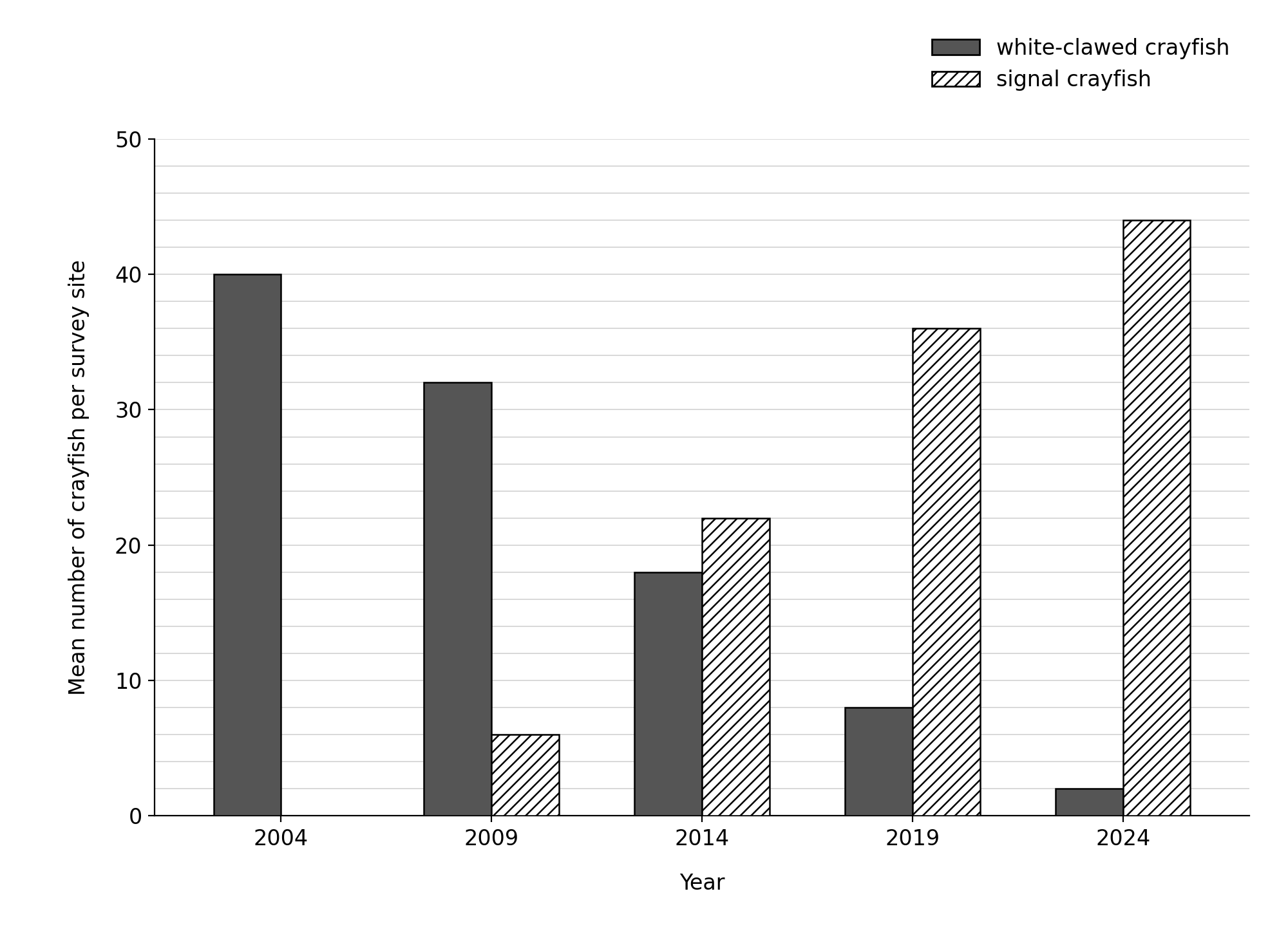
Scientists counted the mean number of each species of crayfish at survey sites in a river.
The Figure shows the results.
Figure
a.[2]
Describe the change in the number of white-clawed crayfish between 2004 and 2024.
b.[1]
Signal crayfish are a non-indigenous species.
State what is meant by a non-indigenous species.
c.[3]
Signal crayfish are larger than white-clawed crayfish and eat the same food. Signal crayfish also carry a disease that kills white-clawed crayfish.
Explain why the number of white-clawed crayfish decreased.
d.[2]
Signal crayfish also eat fish eggs, insect larvae and water plants.
Explain how the introduction of signal crayfish could reduce biodiversity in the river.
9.2 Energy transfer and biodiversity Questions
38 exam-style questions on Edexcel GCSE Biology 9.2 Energy transfer and biodiversity, covering 9.2.1 Energy transfer between trophic levels, 9.2.2 Efficiency of energy transfers, 9.2.3 Human interactions and biodiversity, 9.2.4 Benefits of maintaining biodiversity, and 9.2.5 Biological factors affecting food security. Each one has a worked solution and a mark scheme showing where the marks go.