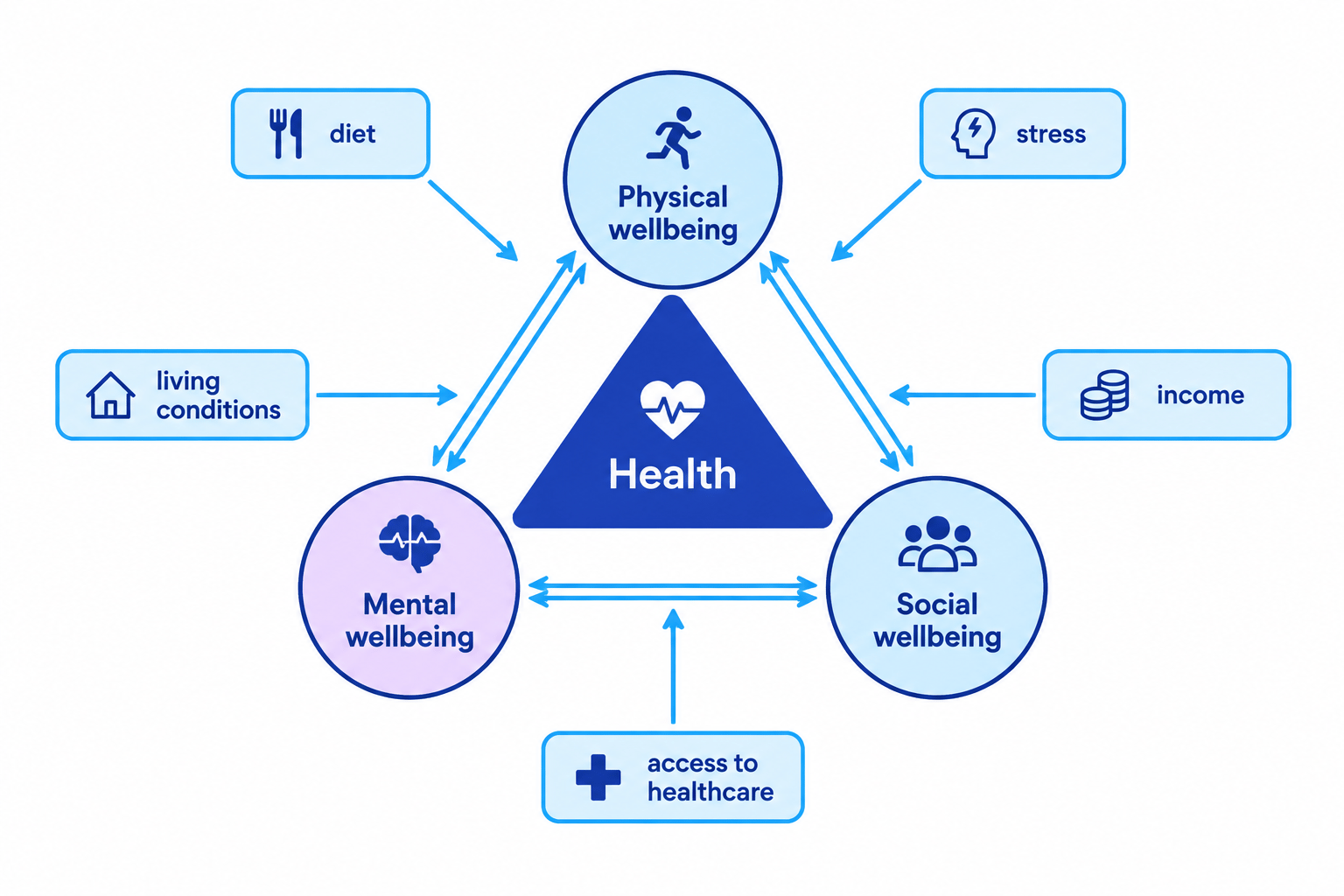
Health Includes Physical, Mental and Social Wellbeing
Definition
Health
The state of physical and mental wellbeing, not simply the absence of disease.
- Health is a state of physical, mental and social wellbeing, not only the absence of disease.
- Physical wellbeing means the body and its organs can function effectively.
- Mental wellbeing means you can think, feel and cope with ordinary demands without persistent distress.
- Social wellbeing means you can form supportive relationships and take part in your community.
- Health can be affected by diet, stress, living conditions, income and access to healthcare because these change exposure to disease and the body's ability to cope with it.
- Health is affected by interactions between physical, mental and social factors, so a change in one area can alter the others.
- Long-term physical illness may limit movement and social contact, which can worsen mental wellbeing.
- Poor mental health may reduce appetite, sleep and willingness to seek treatment, which can worsen physical health.
- Living conditions affect exposure to pathogens, while income and healthcare access affect prevention, diagnosis and treatment.
Key Idea
- A person can have no diagnosed disease but still have poor physical, mental or social wellbeing.
Diseases Are Communicable or Non-communicable
Definition
Communicable disease
A disease that can be passed from one organism to another. It is caused by a pathogen, such as a bacterium, virus, fungus or protist.
Definition
Non-communicable disease
A disease that cannot be spread between organisms. It is not caused by a pathogen and often develops slowly, for example from lifestyle, diet, genes or a nutrient deficiency.
- A communicable disease is an illness caused by a pathogen that can pass between organisms.
- Examples include influenza caused by a virus, salmonellosis caused by bacteria, and malaria caused by a protist.
- A non-communicable disease is an illness that is not caused by a pathogen and cannot pass between organisms.
- Examples include cardiovascular disease, type 2 diabetes and cancer.
- Non-communicable diseases may be linked to lifestyle, inherited alleles, environmental exposure or nutrient deficiency.
- When comparing diseases, identify both cause and transmissibility because either feature alone gives an incomplete distinction.
Common Mistake
- Do not describe a non-communicable disease as non-infectious only, because the definition must also state that it cannot be passed between organisms.
Example
- Measles is communicable because a virus causes it and infected droplets can transfer the virus between people.
- Coronary heart disease is non-communicable because no pathogen causes it and it cannot spread from one person to another.
Exam technique
- For a comparison, state both sides: communicable diseases are caused by pathogens and can spread, whereas non-communicable diseases are not caused by pathogens and cannot spread.
- Examples support a comparison but do not replace the defining differences.
Self review
- What three parts of wellbeing are included in health?
- Define a communicable disease.
- Define a non-communicable disease.
- Classify malaria and type 2 diabetes, giving one reason for each.