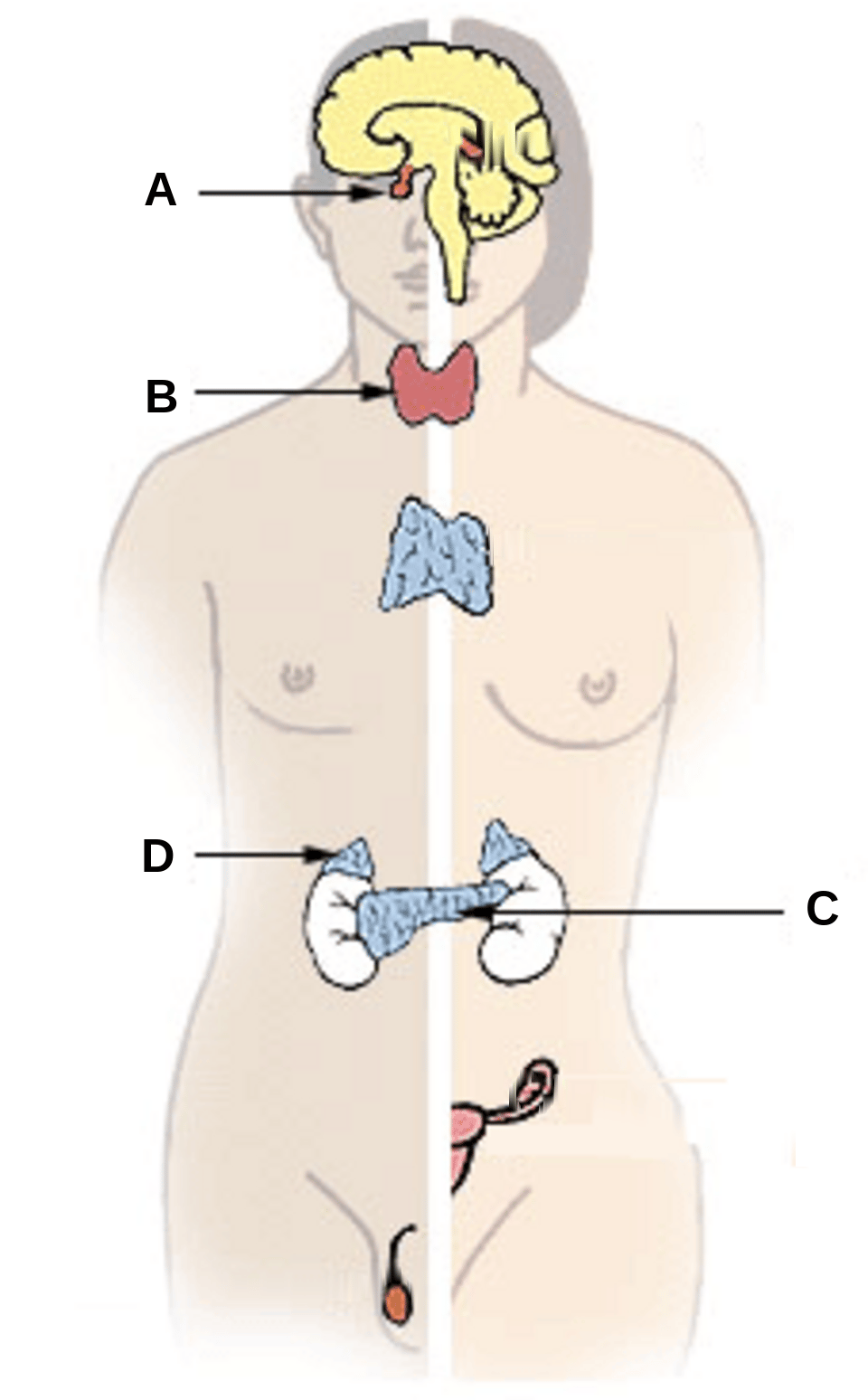
The table below shows the daily water gain and loss for a human volunteer during a metabolic study under controlled, resting conditions. Under these balanced conditions, the total volume of water taken in by the body is equal to the total volume of water lost from the body.
| Method of water gain | Volume (cm3\text{cm}^3cm3) | Method of water loss | Volume (cm3\text{cm}^3cm3) |
|---|---|---|---|
| Food | 520 | Urine | 1550 |
| Drink | 1850 | Skin | 620 |
| Metabolism | 380 | Breathing | 430 |
| Faeces | yyy |
Calculate the volume of water, yyy, lost in faeces in one day. Show your working.
Which metabolic process produces water in the body?
Explain why the volume of water lost through the skin increases significantly when the person exercises (such as running a race).
Practise AQA GCSE Biology Hormonal coordination in humans with exam-style questions for Foundation and Higher tier. 39 questions covering Human endocrine system, Control of blood glucose concentration, Maintaining water and nitrogen balance in the body (biology only), Hormones in human reproduction, Contraception, The use of hormones to treat infertility (HT only), and Negative feedback (HT only), matched to the AQA GCSE Biology (8461) specification and written in Paper 1 and Paper 2 style. Every question includes a full worked solution and mark scheme, so you can see where marks are awarded rather than just whether you got the answer right.