Two Cell Types, Split by Whether the DNA Sits in a Nucleus
Definition
Eukaryotic cell
A cell that has its DNA enclosed in a nucleus, along with membrane-bound organelles such as mitochondria; animal and plant cells are eukaryotic.
- Every living thing is built from cells, and each cell is either eukaryotic or prokaryotic.
- A eukaryotic cell keeps its DNA inside a nucleus.
- Animals, plants, fungi and protists are all eukaryotes.
- A prokaryotic cell has no nucleus, so its DNA lies free in the cytoplasm.
- Bacteria are prokaryotes.
Example
- You, an oak tree and a yeast cell are all made of eukaryotic cells.
- A bacterium, such as E. coli, is a single prokaryotic cell.
The Structure of a Prokaryotic Cell
Definition
Prokaryotic cell
A cell with no nucleus, whose DNA floats freely in the cytoplasm as a single loop; bacteria are prokaryotic and are much smaller than eukaryotic cells.
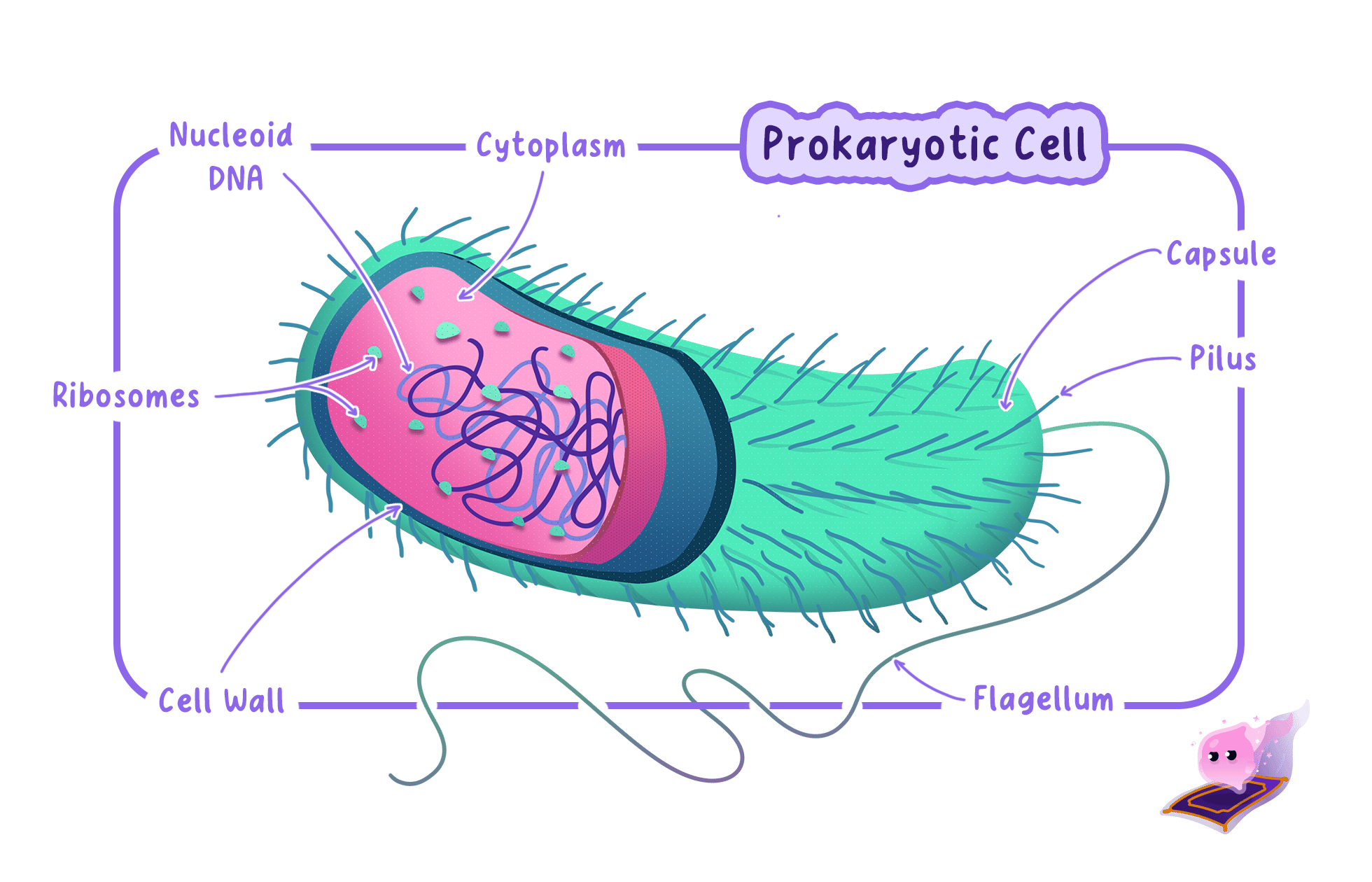
- A prokaryotic cell, such as a bacterium, has a simpler structure than a eukaryotic cell.
- The cytoplasm fills the cell and is where its chemical reactions happen.
- A cell membrane surrounds the cytoplasm and controls what passes into and out of the cell.
- A cell wall surrounds the membrane and gives the cell its shape and support.
- Ribosomes in the cytoplasm make the cell's proteins.
- A prokaryotic cell has no membrane-bound organelles, so no mitochondria and no chloroplasts.
- Some prokaryotes also have a flagellum for movement or a slime capsule for protection.
Note
A prokaryotic cell wall is not made of cellulose, so it differs from a plant cell wall.
How a Prokaryote Stores Its Genetic Material
Definition
Plasmid
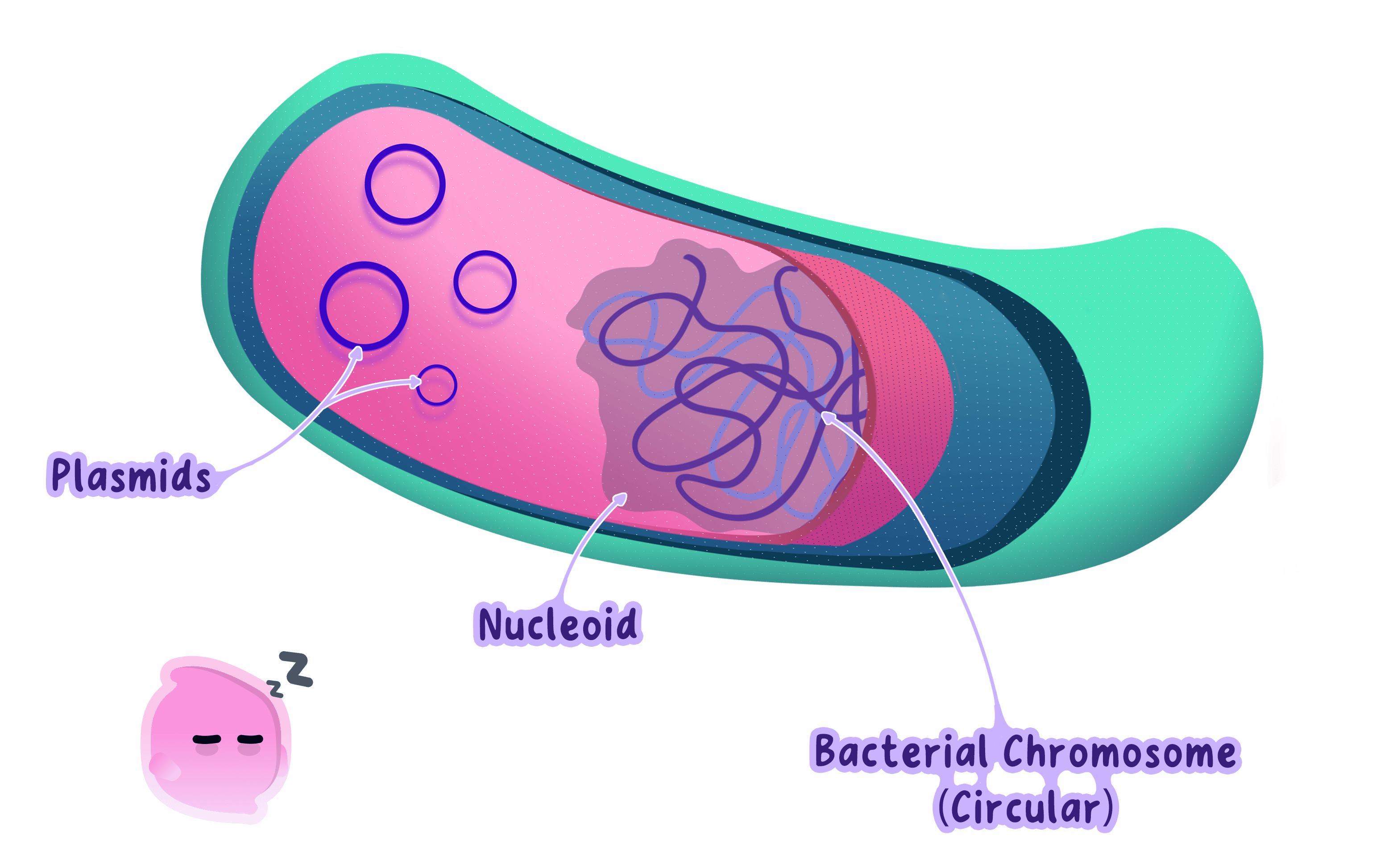
A small ring of DNA, separate from the main circular chromosome, found in the cytoplasm of a prokaryotic cell.
- A prokaryotic cell has no nucleus to enclose its DNA.
- Its main genetic material is a single loop of DNA floating free in the cytoplasm.
- Many prokaryotes also carry plasmids, small rings of extra DNA separate from the main loop.
- A plasmid can carry extra genes, such as a gene for resistance to an antibiotic.
Common Mistake
Do not write that bacteria have no genetic material; they have DNA but no nucleus to hold it.
The Scale and Size of Cells, Written in Standard Form
- Prokaryotic cells are much smaller than eukaryotic cells.
- A typical bacterium is about 1 to 5 micrometres across.
- A typical eukaryotic cell is about 10 to 100 micrometres across.
- Cell sizes are measured in micrometres (μm\mu\text{m}μm), where 1 mm=1000 μm1\ \text{mm} = 1000\ \mu\text{m}1 mm=1000 μm and 1 μm=1000 nm1\ \mu\text{m} = 1000\ \text{nm}1 μm=1000 nm.
- To change millimetres to micrometres you multiply by 1000, and to reverse it you divide by 1000.
- Very small sizes are written in standard form, a number between 1 and 10 multiplied by a power of ten.
- An order of magnitude is a difference in size of a factor of ten.
- For example, a 1.5 μm1.5\ \mu\text{m}1.5 μm bacterium is 0.0015 mm, which is 1.5×10−31.5 \times 10^{-3}1.5×10⁻³ mm in standard form.
Self review
- What is the one key difference between a eukaryotic and a prokaryotic cell?
- Name three groups of organisms made of eukaryotic cells.
- Where is the main genetic material of a prokaryotic cell found?
- What is a plasmid?
- How many micrometres are there in 1 millimetre?
