Definition
Deforestation
The large-scale removal of forests, usually to clear land for timber, farming or building.
- Deforestation is the large-scale removal of forests, and it is happening quickly in tropical areas.
- Forests are cleared for timber, to make land for farming cattle and rice, and to grow crops for biofuels.
Key Idea
Deforestation clears huge areas of forest for timber, farmland and biofuel crops, mostly in the tropics.
Consequences of deforestation
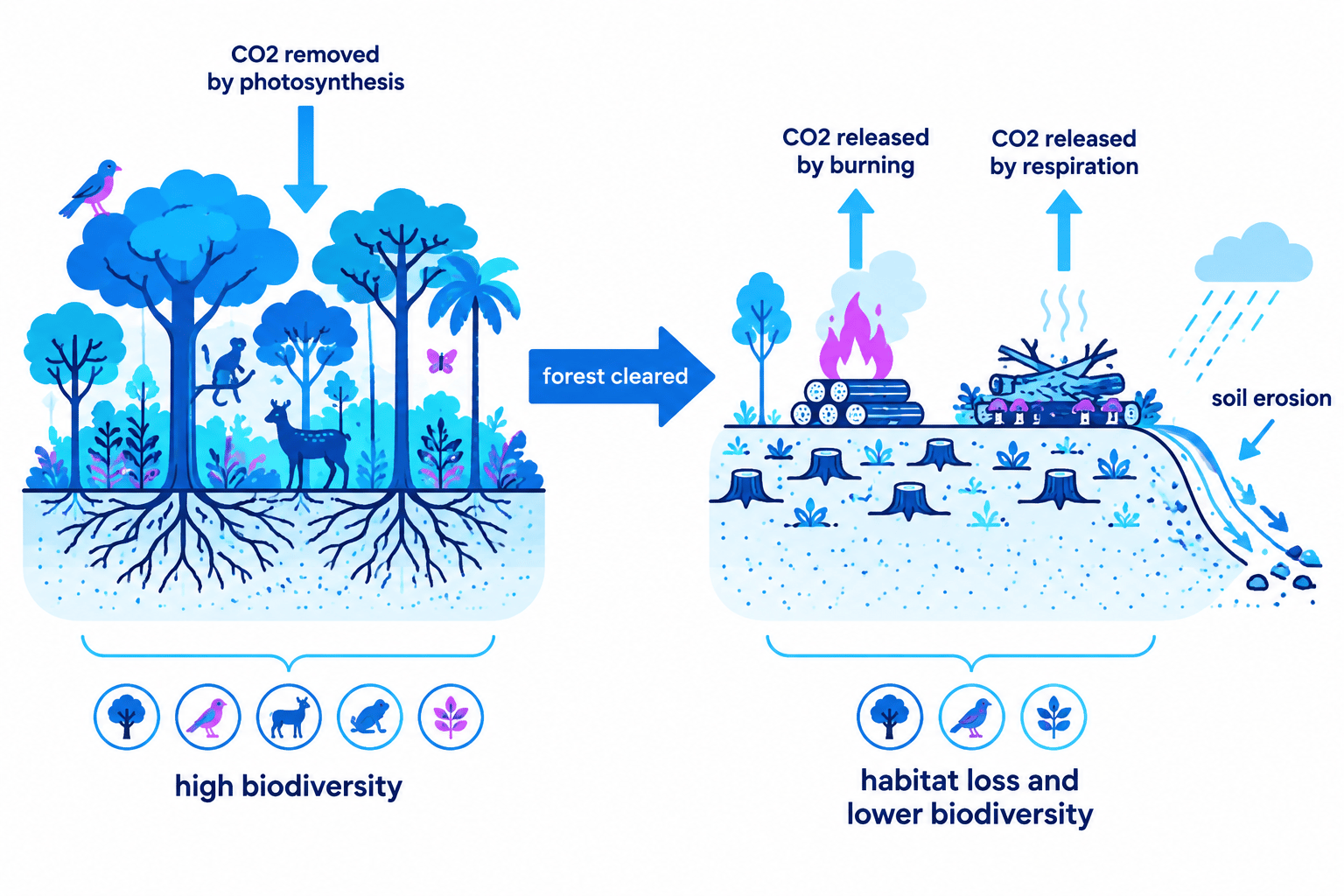
- Less carbon dioxide is removed from the air, because there are fewer trees to photosynthesise.
- More carbon dioxide is released, because trees are often burned and the dead wood is broken down by decomposers that respire.
- Biodiversity falls, because the habitats of many forest species are destroyed.
- The soil can be washed away once the tree roots that held it in place are gone.
Common Mistake
- Remember that deforestation both raises carbon dioxide and lowers biodiversity.
- It removes trees that absorb carbon dioxide and releases more when the wood is burned or decays.
Why deforestation matters
- Deforestation is serious because it adds carbon dioxide to the air and destroys habitats at the same time.
- This links it to two of the biggest environmental problems: global warming and falling biodiversity.
Self review
- Give three reasons why tropical forests are cleared.
- Explain why deforestation increases the carbon dioxide in the air in two ways.
- How does deforestation reduce biodiversity?
- Why can soil be washed away after a forest is cleared?