5.4.1a Control and coordination
Plant Hormones Coordinate Growth and Responses
Plant hormone
A chemical made in one part of a plant and carried to another part, where it coordinates and controls growth and responses.
- Plants respond to changes in their environment, and plant hormones coordinate and control these responses.
- A hormone is made in one part of the plant and carried to another part where it has an effect.
- Plants mainly need to respond to two things: light and gravity.
Plant hormones let a plant that cannot move still respond to its surroundings by controlling the direction and rate of its growth.
Tropisms: Growing Towards or Away From a Stimulus
Tropism
A growth response of a plant in which the direction of growth depends on the direction of a stimulus such as light or gravity.
- A tropism is a growth response in which the direction of growth depends on the direction of the stimulus.
- Growth towards the stimulus is a positive response; growth away from it is a negative response.
- The two you need are phototropism (response to light) and gravitropism (response to gravity, also called geotropism).
Phototropism: Responding to Light
Phototropism
A plant's growth response to light; shoots grow towards light (positive phototropism) and roots grow away from it.
- Shoots grow towards light; this is positive phototropism.
- Growing towards the light lets the leaves absorb as much light as possible for photosynthesis.
- Roots grow away from light; this is negative phototropism.
A houseplant left on a windowsill soon bends so its shoots grow towards the light coming through the window.
Gravitropism: Responding to Gravity
Gravitropism
A plant's growth response to gravity, also called geotropism; roots grow towards gravity (positive) and shoots grow away from it (negative).
- Roots grow towards the force of gravity (downwards); this is positive gravitropism.
- Growing down anchors the plant and lets the roots absorb water and minerals from the soil.
- Shoots grow away from gravity (upwards); this is negative gravitropism, so the plant grows the right way up whichever way the seed lands.
- Shoots
- Grow towards light (positive phototropism) and away from gravity (negative gravitropism).
- Roots
- Grow away from light (negative phototropism) and towards gravity (positive gravitropism).
Shoots and roots respond in opposite ways: shoots grow towards light and up, roots grow towards gravity and down.
Auxin Controls These Responses
Auxin
A plant hormone that controls growth responses to light and gravity by causing unequal growth rates in shoots and roots.
- The responses of plants to light and gravity are controlled by a hormone called auxin, which is made in the tips of shoots and roots.
- An uneven distribution of auxin causes an uneven growth rate, so the shoot or root bends in the right direction.
Exactly how uneven auxin makes shoots and roots bend is explained in the Higher tier article.
Investigating Light and Gravity on Seedlings
- This practical investigates the effect of light or gravity on the growth of newly germinated seedlings.
- Germinate seedlings, such as cress or mustard, on damp cotton wool in Petri dishes.
- To test light, grow one set with light from one side (for example, inside a box with a hole) and keep another in all-round light or darkness to compare.
- To test gravity, keep the seedlings in the dark so light cannot affect them, and lay dishes on their side.
- A clinostat slowly rotates a dish so gravity acts evenly on all sides, cancelling out its effect as a control.
- Record the results as both length measurements and careful, labelled biological drawings of the seedlings.
What the Results Show
- With light from one side, the shoots bend and grow towards the light.
- In the dark, the roots grow down and the shoots grow up, whichever way the seed was placed.
- On a rotating clinostat the seedlings grow straight out, because the effect of gravity has been cancelled.
- What is a plant hormone, and which hormone controls responses to light and gravity?
- Define phototropism and gravitropism.
- How do shoots respond to light and to gravity, and why is this useful to the plant?
- How do roots respond to light and to gravity, and why is this useful?
- In the required practical, how should results be recorded, and what does a clinostat do?
5.4.1b Control and coordination (Higher tier)
Unequal Auxin Distribution Causes Unequal Growth
Auxin
A plant hormone that controls growth responses to light and gravity by causing unequal growth rates in shoots and roots.
- Auxin is made in the tips of shoots and roots and diffuses to the zone just behind the tip, where growth happens.
- In shoots, auxin promotes cell elongation, so more auxin means more growth.
- In roots, auxin inhibits cell elongation, so more auxin means less growth.
- An uneven distribution of auxin therefore causes an uneven growth rate, which makes the shoot or root bend.
This topic is Higher tier only.
How a Shoot Bends Towards Light
- When light shines mainly from one side, auxin moves to the shaded side of the shoot.
- The shaded side now has more auxin, so its cells elongate more and grow faster than the lit side.
- The faster growth on the shaded side makes the shoot bend towards the light.
- Once light falls evenly on the shoot, auxin is spread evenly again and the shoot grows straight.
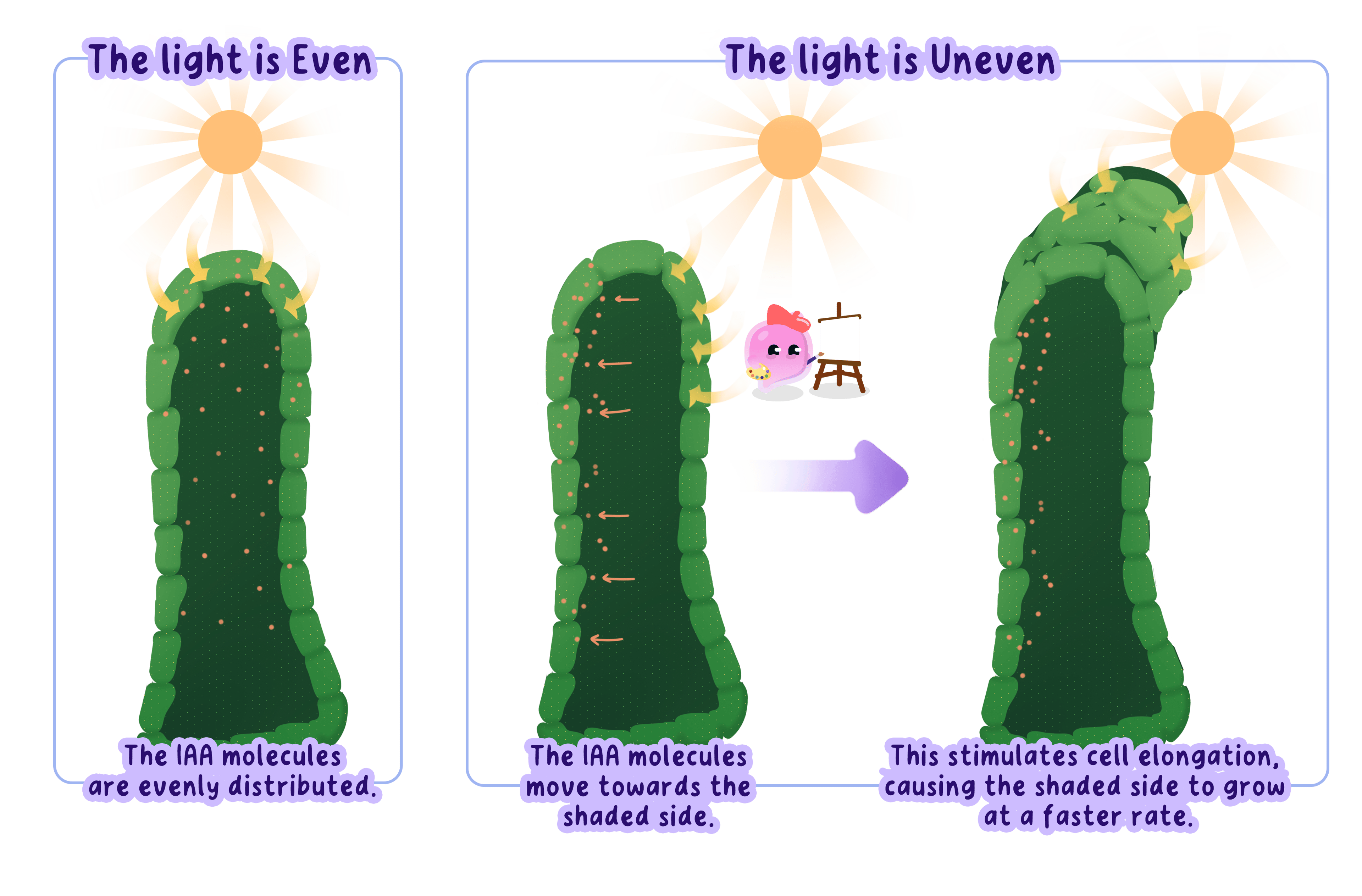
Auxin building up on the shaded side is what makes a shoot grow towards the light.
Gravitropism in Shoots and Roots
- When a shoot or root is laid on its side, gravity makes auxin gather along the lower side.
In the shoot
- More auxin on the lower side makes the lower side grow faster, so the shoot bends and grows upwards, away from gravity.
In the root
- More auxin on the lower side inhibits growth there, so the lower side grows more slowly and the root bends and grows downwards, towards gravity.
The same build-up of auxin on the lower side speeds up growth in a shoot but slows it in a root; if unsure, just say uneven auxin causes uneven growth that makes it bend.
Gibberellins Start Seed Germination
Gibberellins
Plant hormones important in starting seed germination; they are also used to end seed dormancy, promote flowering and increase fruit size.
- Auxin is not the only plant hormone; gibberellins are important in initiating seed germination.
- They also have roles in flowering and in the growth of fruit.
You are not required to know the mechanism of how gibberellins or ethene actually work.
Ethene Controls Ripening
Ethene
A plant hormone, which is a gas, that controls cell division and the ripening of fruit.
- Ethene is an unusual plant hormone because it is a gas.
- It controls cell division and the ripening of fruit.
- What opposite effects does auxin have on cell elongation in shoots and in roots?
- Explain, using auxin, how a shoot bends towards light from one side.
- Explain why a shoot laid on its side grows upwards.
- Explain why a root laid on its side grows downwards.
- Name the hormone that starts seed germination and the one that ripens fruit.
