3. Globalisation and the Changing Nature of Work
You cannot discuss work and worklessness in the modern UK without discussing globalisation—the growing integration and interdependence of countries worldwide through the movement of goods, services, capital, and people.
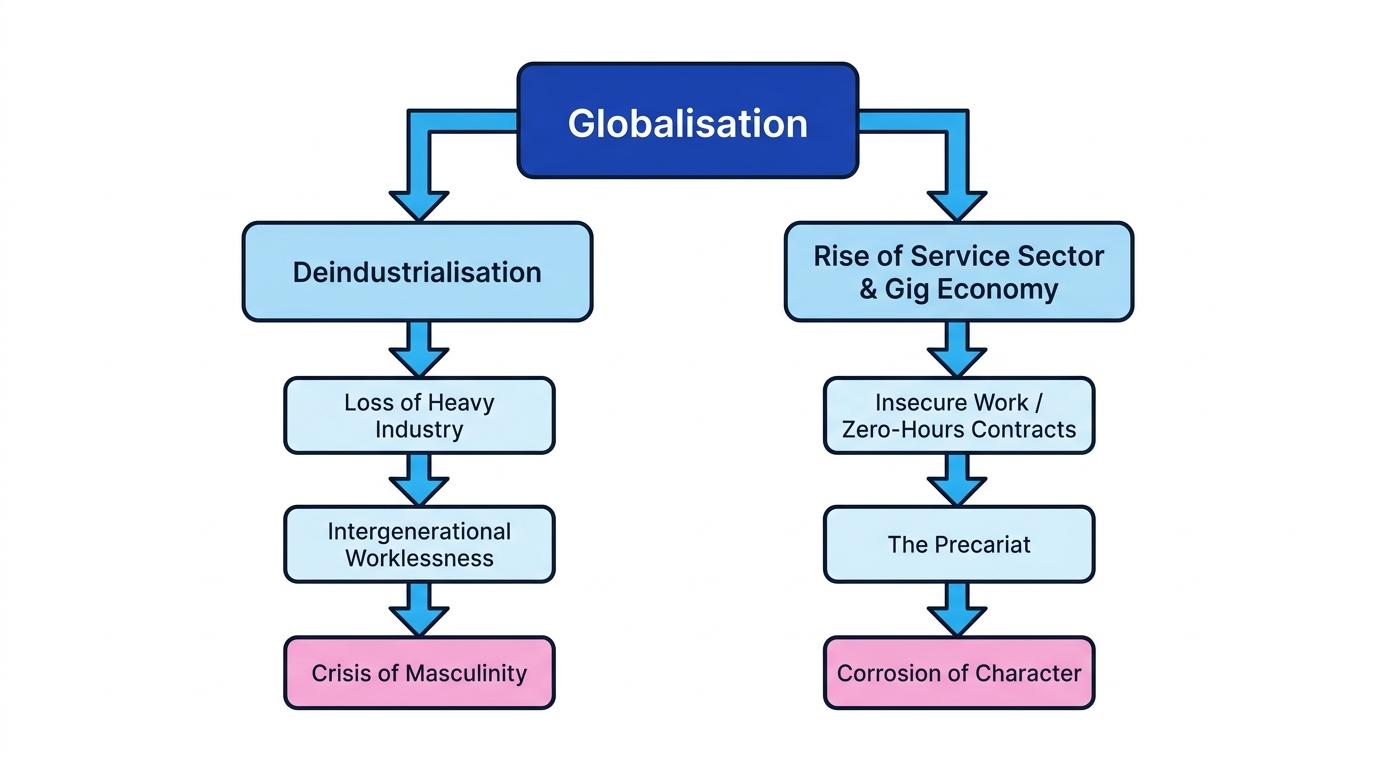
Globalisation has fundamentally restructured the UK labour market over the last forty years in two primary ways:
A. Deindustrialisation and the Rise of the Service Sector
As multinational corporations relocated manufacturing and heavy industry (coal, steel, shipbuilding) to developing countries where labour costs were lower (such as China and India), the UK experienced rapid deindustrialisation.
Traditional working-class communities—particularly in the North of England, Scotland, and Wales—lost their primary source of stable, well-paid, male employment. This shift created pockets of intergenerational worklessness, where grandfathers, fathers, and sons all struggled to find stable employment.
The UK economy pivoted toward a service-based economy (retail, finance, hospitality, and administrative services). While this created many highly paid jobs in the "knowledge economy" (e.g., tech and finance in London), it also generated millions of low-paid, insecure service roles.
B. Insecurity, "McJobs", and the Gig Economy
Sociologist Ulrich Beck (1992) argued that late-modern societies have become risk societies. In the world of work, this is visible as the "risk" of employment is shifted from the employer onto the individual worker.
- The Gig Economy and Zero-Hours Contracts: Millions of UK workers are now employed in the gig economy (e.g., driving for Uber, delivering for Deliveroo) or are on zero-hours contracts. These workers lack the traditional security of sick pay, holiday pay, pensions, and guaranteed hours.
- The Corrosion of Character: Richard Sennett (1998) argued that the flexible, short-term nature of modern work "corrodes" workers' characters. Without long-term careers, stable workplace communities, or predictable routines, workers struggle to form a coherent life narrative or stable sense of self. They live in a state of constant anxiety.
Applying sociological perspectives to deindustrialisation and identity
When writing an essay on how globalisation has impacted work and identity, you need to apply abstract theories to concrete real-world changes. Here is a step-by-step application of how to analyse the decline of traditional manufacturing.
- Identify the structural economic change: Globalisation led to the relocation of manufacturing from the UK to developing economies, causing rapid deindustrialisation in areas like South Wales or North-East England.
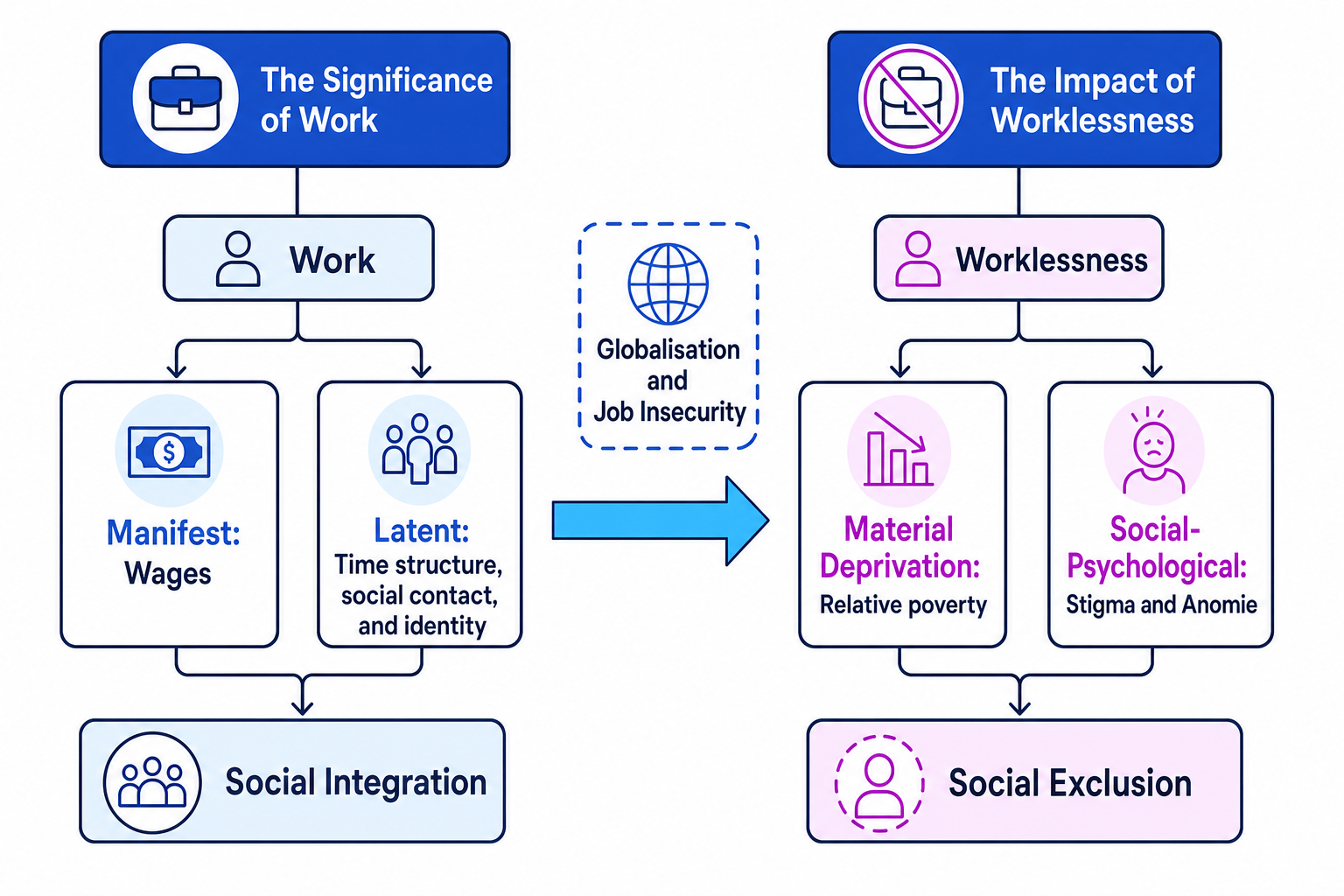
- Apply Jahoda's latent functions to the traditional working class: In these communities, heavy industrial jobs (e.g., mining) provided not just a wage, but a deep sense of "traditional working-class masculinity," solidarity, and strong community time-structures.
- Analyse the consequences of their loss using modern concepts: The replacement of these jobs with insecure, low-paid service roles (or long-term worklessness) causes a crisis of identity (Sennett's "corrosion of character") and a rise in relative poverty, illustrating that worklessness destroys both material life chances and psychological stability.
4. Evaluative Perspectives: Class, Gender, and Ethnicity
To access the highest marks (AO3), you must evaluate how the significance of work and worklessness varies according to social division:
Gender
- The Feminist View: Feminists point out that the traditional concept of "work" has historically been highly androcentric (male-centred). Sylvia Walby (1990) notes that women's unpaid domestic labour and caregiving are critical to the economy but are systematically devalued.
- The "Double Burden" and "Triple Shift": When women do enter paid work, they are often concentrated in low-paid, part-time service work (the "pink-collar ghetto"), and still perform the majority of unpaid housework and emotional care (Arlie Hochschild's "triple shift"). Thus, the "significance of work" is experienced differently; for many women, it represents a dual burden of exploitation.
Class and Ethnicity
- The Dual Labour Market Theory: Sociologists argue the UK labour market is split into a primary sector (high pay, high security, career progression) and a secondary sector (low pay, high insecurity, zero-hours contracts).
- Working-class individuals, young people, and ethnic minority groups (particularly Pakistani and Bangladeshi communities in the UK) are disproportionately concentrated in the insecure secondary sector. Therefore, globalisation has not affected everyone equally; it has widened the gap in life chances between the professional middle class and the precarious working class (often termed the "precariat").
Confusing worklessness with laziness
In your exams, do not adopt a moralistic tone or blame individuals for their worklessness (a view often associated with the New Right perspective of Charles Murray). Always maintain sociological objectivity. Explain worklessness as a structural issue driven by globalisation, deindustrialisation, and economic policy, rather than an individual moral failure.
Remember 'the precariat'
Sociologist Guy Standing (2011) coined the term "the precariat" to describe a new social class of people who live in a state of permanent economic insecurity, moving in and out of temporary, low-paid, gig-economy jobs. This is an excellent contemporary concept to use in an essay on globalisation and work.
In the exam
- Define your terms immediately: If the question is about work or worklessness, make sure you define the key terms (including Jahoda's distinction between manifest and latent functions) in your introduction.
- Explicitly link globalisation to local life chances: Always bridge the global and the local. Show how global economic shifts (e.g., transnational corporations shifting production) lead directly to local issues in the UK (e.g., zero-hours contracts, mental health crises, geographic wealth divides).
- Use contrasting theories to evaluate: Contrast structural theories (Marxism and Functionalism, which see work as central to society) with Postmodernist theories (which argue that consumption and lifestyle have replaced work as the key source of identity).
Check yourself
- Can you list and explain the five latent functions of work identified by Marie Jahoda?
- How does Richard Sennett's concept of the "corrosion of character" explain the psychological impact of flexible, short-term work?
- Why do postmodernists like Zygmunt Bauman argue that worklessness carries a different kind of social stigma today than it did in the mid-20th century?