What you'll learn
- How sociologists define the labour process and why employers try to organise and control it.
- How the division of labour can increase efficiency but also create hierarchy and alienation.
- How technology can both empower workers and intensify surveillance.
- Why debates about skill, up-skilling and de-skilling are central to work, poverty and welfare.
Starting point: what is the labour process?
The labour process means the way work is organised to turn human effort into goods or services. It includes the tasks workers do, the tools and technologies they use, the rules they follow, and the relationships between workers and managers.
Labour process
The labour process is the organisation of work: how workers’ labour is directed, monitored and transformed into products or services.
For A-Level Sociology, this topic is mainly about power. Employers usually own or control the workplace, while workers sell their labour for wages. This creates a tension: employers want productivity, predictability and profit; workers may want autonomy, dignity, security and fair pay.
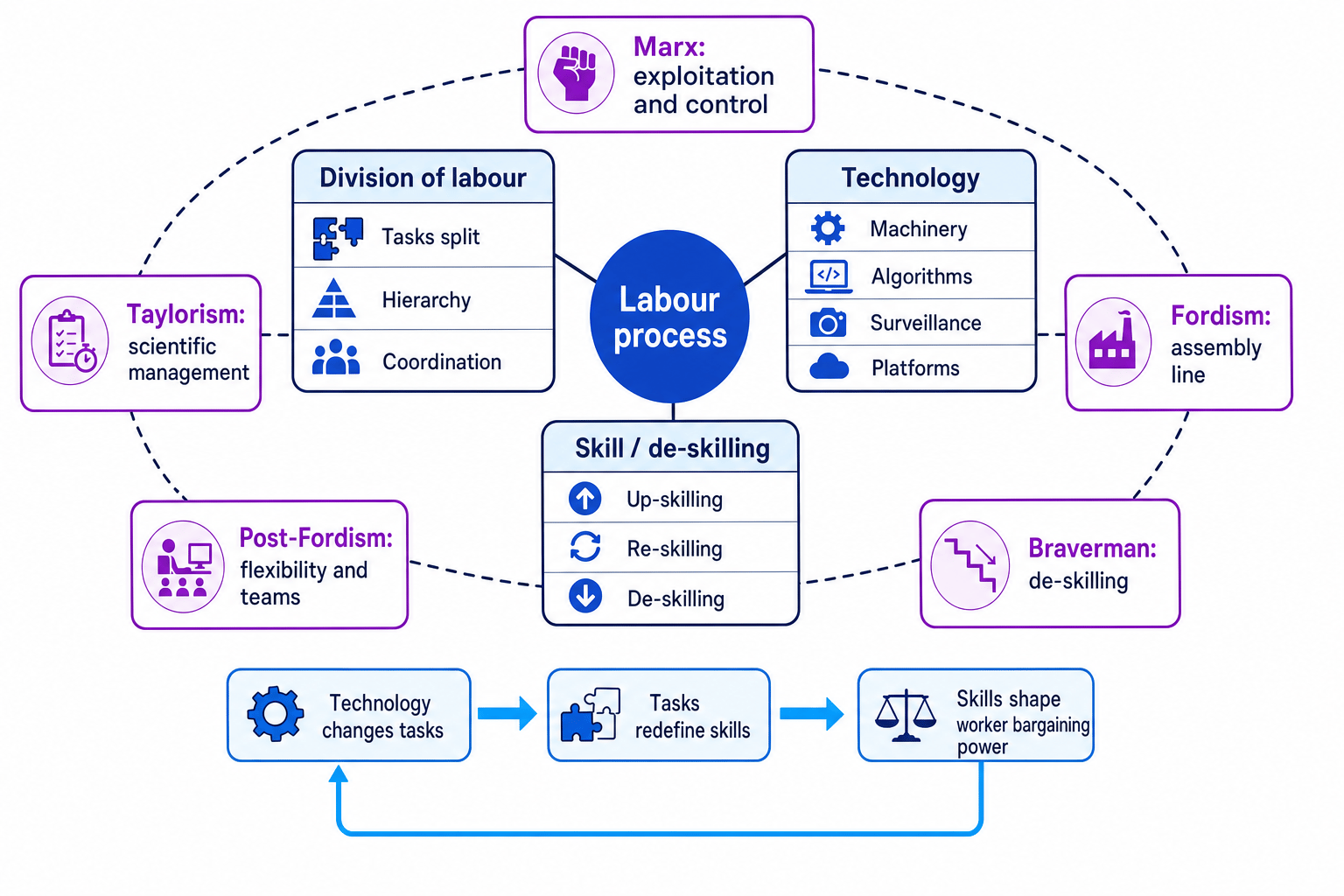
This diagram gives you the big picture: the organisation of work is shaped by the division of labour, technology and changing ideas about skill.
Marx: control, exploitation and alienation
Marx argued that in capitalist societies, the bourgeoisie own the means of production, while the proletariat sell their labour. Because employers control production, they can extract surplus value: the value created by workers beyond what they receive in wages.
Alienation
Alienation means workers becoming disconnected from the product of their labour, the process of work, other workers, and their own creativity or “species-being”.
In highly controlled workplaces, workers may have little say over what they produce, how they work, or the pace of production. For Marxists, this is not just poor management — it is built into capitalism.
AO2 application: in a warehouse, workers may not see the final customer or have control over targets, routes or break patterns. Their work can become repetitive and closely monitored.
Marxist view
Marxists see workplace organisation as a system of class power: control over the labour process helps employers maximise profit.
The division of labour
The division of labour means breaking work into specialised tasks. Instead of one person making a whole product or delivering a whole service, different workers perform different parts of the process.
Division of labour
The division of labour is the splitting of work into specialised roles or tasks, often arranged through hierarchy and coordination.
This can make work faster and more efficient. Durkheim saw the division of labour as part of modern societies’ move towards organic solidarity, where people depend on each other because they perform different roles.
However, Marxists argue that a detailed division of labour can reduce workers’ control. If each worker only does a small task, management can more easily replace them, measure their output and set the pace of work.
Taylorism: scientific management
Taylorism, named after Frederick Taylor, is a system of scientific management. Managers study tasks, break them into simple movements, time workers, and set “one best way” to complete the job.
In Taylorism, knowledge moves from the worker to management. The worker becomes easier to monitor because the task is standardised.
Applying Taylorism to a call centre
- A manager breaks the call centre job into measurable parts: greeting the customer, verifying identity, following a script, resolving the issue and logging the call.
- Each part is timed and compared across workers, so management can identify who completes calls fastest or slowest.
- The worker’s autonomy is reduced because scripts and targets define what counts as “good” work.
- A Marxist analysis would argue this increases managerial control, while a functionalist might argue it improves efficiency and consistency for customers.
Efficiency is not the whole answer
Do not only say the division of labour is “efficient”. In essays, link efficiency to power: who benefits, who loses autonomy, and how this affects inequality.
Fordism: mass production and the assembly line
Fordism refers to mass production using assembly lines, associated with Henry Ford’s car factories. Workers perform repetitive tasks while the product moves along the line.
Fordism combines the division of labour with machinery and strong managerial control. It can produce goods cheaply and in large quantities, but it may also create boredom, alienation and conflict.
In the UK today, classic Fordist factories are less dominant than in the mid-20th century, but similar principles can still be seen in food processing, logistics warehouses and fast-food chains.
Post-Fordism: flexibility and teamwork
Post-Fordism describes a shift away from rigid mass production towards more flexible production, service work, teamworking and niche markets.
Post-Fordist workplaces may use multi-skilled teams, flexible contracts and new technologies. Supporters argue this can create more interesting work and more worker participation. Critics argue that “flexibility” often means insecurity for workers: zero-hours contracts, unpredictable shifts, agency work and weaker trade union power.
Flexibility has two sides
Post-Fordism may mean flexible skills and teamwork, but it can also mean flexible labour for employers and insecure work for employees.
This connects directly to poverty and welfare. Workers in insecure jobs may move in and out of low pay, rely on Universal Credit top-ups, or struggle to plan childcare and housing costs.
Technology and control
Technology means the tools, machines, software and digital systems used in work. It can change both the pace of work and the balance of power between workers and managers.
Algorithmic management
Algorithmic management means using software systems to allocate tasks, monitor performance, rank workers or trigger decisions such as warnings and deactivation.
Examples include delivery apps assigning orders, warehouse scanners setting picking routes, supermarket self-checkouts changing cashier roles, or remote-work software tracking activity.
Technology can support workers by removing dangerous tasks, improving communication, or enabling flexible home working. But it can also intensify surveillance. Foucault’s idea of surveillance is useful here: when people know they may be watched, they may discipline themselves.
Analysing technology in platform work
- A delivery platform allocates jobs through an app, so the worker does not negotiate directly with a human manager.
- The app tracks location, acceptance rates and customer ratings, turning behaviour into data.
- Control appears indirect because the worker may be labelled “self-employed”, but the platform still shapes pay, pace and access to future work.
- This supports a conflict view: technology can disguise managerial control as neutral software.
Use both sides of technology
For AO3, avoid saying technology is simply “good” or “bad”. Strong answers explain that it can create up-skilling for some workers and surveillance or de-skilling for others.
Skill, up-skilling and de-skilling
A skill is a socially valued ability needed to perform work. Skills can be technical, physical, emotional, communicative or organisational.
De-skilling
De-skilling is the process where workers lose control, knowledge or autonomy because tasks are simplified, standardised or transferred to machines and managers.
Harry Braverman’s Labour and Monopoly Capital (1974) is central here. He argued that capitalism tends towards de-skilling because employers want to reduce dependence on skilled workers. If a task is broken down and simplified, workers become cheaper, easier to replace and easier to control.
For example, a craft worker may once have designed and made a whole product. Under factory production, their knowledge may be broken into smaller tasks, with planning controlled by managers and machines.
But de-skilling is not universal. Some jobs involve up-skilling, where workers need more advanced abilities, such as coding, data analysis, digital communication or specialist healthcare knowledge. Others involve re-skilling, where workers learn new skills after technological or organisational change.
Social differentiation: who is most affected?
The labour process does not affect everyone equally. Patterns of class, gender, ethnicity, age and disability shape who gets secure, skilled, well-paid work and who is concentrated in low-paid or tightly controlled jobs.
For example, women are over-represented in some forms of part-time care and service work, where emotional labour is expected but not always well paid. Racialised minority workers and migrants may be over-represented in insecure sectors such as cleaning, delivery, social care and hospitality. Young workers may be more likely to experience platform work or zero-hours contracts.
This links to the core theme of socialisation, culture and identity. Work shapes how people see themselves: as professionals, carers, “grafters”, entrepreneurs, team members or replaceable labour. Workplace culture can build pride and solidarity, but it can also normalise long hours, constant availability and competition.
Evaluation: how far do labour process theories explain work today?
Marxist and labour process approaches are powerful because they focus on inequality and control. They are useful for analysing warehouses, platform work, call centres and other workplaces where targets, monitoring and insecure contracts are common.
However, they can be criticised for over-emphasising employer control. Michael Burawoy argued that workers may give consent to workplace systems, not just experience coercion. Workers may compete for bonuses, take pride in targets, or develop informal cultures that make work meaningful.
Feminist sociologists add that labour process theory can ignore unpaid and emotional labour. For example, caring, customer service and domestic labour involve skills that are often undervalued because they are associated with femininity.
Interpretivists would also ask how workers experience control subjectively. Two workers in the same workplace may interpret targets differently: one may see them as motivating, another as stressful and exploitative.
Do not treat all workplaces as factories
Modern work includes offices, homes, hospitals, schools, apps and care settings. Apply labour process ideas flexibly rather than assuming every job looks like an assembly line.
Methods: how could sociologists study labour control?
Researchers might use interviews to explore workers’ experiences of surveillance, stress or identity. This can give high validity because workers explain meanings in their own words.
They might use workplace ethnography, observing how control operates informally. This can reveal hidden practices, such as workers finding ways around targets. However, access can be difficult because employers may not want researchers observing managerial control.
Surveys can compare experiences across sectors, such as remote working, job satisfaction or insecurity. Surveys may be more representative, but they can miss the detail of how control feels in everyday working life.
Methods link
Studying the labour process raises practical issues of access, ethical issues around confidentiality, and theoretical debates about whether we should measure work objectively or interpret workers’ meanings.
In the exam
- Define the key concept early: labour process, division of labour, technology, skill or de-skilling.
- Use named theorists accurately: Marx for exploitation and alienation, Taylor for scientific management, Fordism for assembly-line production, Braverman for de-skilling.
- Apply to contemporary UK examples such as warehouses, delivery platforms, call centres, care work, supermarkets or remote-work monitoring.
- Evaluate by showing complexity: technology can control workers but also up-skill them; flexibility can increase choice but also insecurity.
- Link back to power and stratification: ask who controls the work, who benefits, and how this affects class, gender, ethnicity and poverty.
Check yourself
- How does the division of labour help employers control workers?
- Why does Braverman argue that capitalism tends to de-skill labour?
- How might technology both increase worker autonomy and intensify surveillance?
