Welcome to one of the most dynamic and heavily debated areas of A-Level Sociology! Educational policies are the plans and actions implemented by governments to run and reform the education system. These policies do not just dictate what happens in classrooms; they actively shape life chances, dictate social mobility, and can either challenge or reproduce wider social inequalities of class, gender, and ethnicity.
What you'll learn
- How educational policy shifted from selection (the Tripartite System) to a comprehensive model, and the sociological debates surrounding both.
- How marketisation and privatisation have turned schools into businesses and parents into consumers, and who benefits most from this.
- The various compensatory education policies designed to bridge the achievement gap for disadvantaged students.
- How the forces of globalisation have reshaped the goals, curricula, and structures of the UK education system.
1. Selection and the Tripartite System (Post-1944)
Before the mid-20th century, secondary education was a luxury largely reserved for those who could pay. The 1944 Education Act (also known as the Butler Act) aimed to change this by introducing free secondary education for all, guided by the social democratic idea of "parity of esteem"—the belief that different types of schools should have equal status and resources.
To achieve this, the government introduced the Tripartite System.
Tripartite System
The Tripartite System was a structure established by the 1944 Education Act that selected and allocated pupils into three different types of secondary school (Grammar, Technical, or Secondary Modern) based on their performance in the 11-Plus (11+) exam.
- Grammar Schools: Highly academic schools for pupils who passed the 11+. Students were taught an academic curriculum designed to lead to university and professional careers.
- Secondary Modern Schools: Offered a non-academic, practical curriculum for the 80% of pupils who did not pass the 11+. Students were prepared for manual or routine clerical work.
- Technical Schools: Intended to focus on vocational and technical skills, though very few of these were actually built due to a lack of funding.
Sociological Evaluation of the Tripartite System
While the system was promoted as meritocratic, sociologists argue that it deeply entrenched social class division:
- Class reproduction (AO3): Rather than offering equal opportunities, the 11+ exam was culturally biased. It favoured middle-class pupils who possessed the cultural capital (as conceptualised by Pierre Bourdieu) to decode the complex language and logic used in the test. Working-class children were disproportionately channeled into Secondary Moderns, effectively labeling them "failures" at age 11.
- Gender bias (AO3): Girls often had to score higher than boys on the 11+ to secure a grammar school place because local authorities capped the number of girls' places to maintain an even gender balance.
The Move to the Comprehensive System (1965)
Frustration with the Tripartite System led the Labour government to issue Circular 10/65 in 1965, which instructed local education authorities to phase out the 11+ and replace selective schools with Comprehensive Schools. Comprehensives are non-selective state schools that admit all children from the local catchment area, regardless of academic ability.
Perspectives on the Comprehensive System
- Functionalists support comprehensives because they promote social integration by bringing children of different social classes together. They argue it is more meritocratic, giving pupils longer to develop their abilities without being written off at age 11.
- Marxists argue that comprehensives are an illusion of equality. While they appear fair on the surface, class inequality is simply reproduced inside the school gates through streaming, banding, and labelling, where working-class pupils are systematically placed in lower sets.
2. Neoliberalism and the Marketisation of Education (1988 onwards)
From 1979, the Conservative government, heavily influenced by Neoliberalism and New Right ideology, radically changed the direction of education. They argued that state-run education was inefficient, unresponsive to parents, and produced poor standards because schools faced no competition.
To fix this, they introduced the policy of marketisation through the landmark 1988 Education Reform Act (ERA).
Marketisation
Marketisation is the process of introducing market forces of consumer choice and business-style competition into areas run by the state, such as education and healthcare.
To create an "education market," the government had to establish parentocracy.
Parentocracy
Literally meaning "rule by parents," parentocracy (coined by Miriam David) is a system where the power shifts away from the producers (schools and teachers) to the consumers (parents), giving parents choice over which school their child attends.
The 1988 ERA introduced several key policies to construct this market:
- League Tables and Ofsted: Schools were forced to publish their exam results and undergo inspections. This gave parents the information they needed to shop around for the "best" school.
- Formula Funding: Schools began to receive funding based on the exact number of pupils they attracted. More pupils meant more money; fewer pupils meant budget cuts and potential closure.
- Open Enrolment: Parents were allowed to apply to any school of their choice, rather than being restricted to their closest local catchment area.
Education as a supermarket
Think of marketisation as turning schools into rival supermarkets. Instead of everyone being forced to buy their groceries at their local corner shop (their catchment school), parents can browse different supermarkets (schools) using reviews (league tables/Ofsted). The schools must compete for your custom because every customer (pupil) who walks through the door brings a cash voucher (formula funding). If a school provides a poor product, it goes out of business.
The Sociological Critique of Marketisation
While New Right sociologists argue that marketisation raises standards by forcing schools to improve, critical sociologists (particularly Marxists and feminists) argue that it has widened the gap between middle-class and working-class pupils.
1. Cream-Skimming and Silt-Shifting (Will Bartlett)
Because schools are desperate to perform well in league tables to attract funding, oversubscribed, successful schools can afford to be highly selective in who they admit. Bartlett argues this leads to two processes:
- Cream-skimming: High-achieving, mostly middle-class pupils are selected ("skimmed") by popular schools. These students are easier to teach and highly likely to maintain the school’s league table position.
- Silt-shifting: Popular schools can avoid taking harder-to-teach, lower-achieving pupils (often working-class or those with special educational needs), who are "shifted" into less popular, struggling schools.
2. Class Differences in Parental Choice (Sharon Gerwitz)
Gerwitz studied parents in London and found that marketisation does not benefit everyone equally. She identified three types of "choosers":
- Privileged-skilled choosers: Highly educated, middle-class parents who possess the cultural and economic capital to navigate the school admissions system. They can afford to pay travel costs to send their children to distant, better schools, or even move house into a desirable catchment area.
- Disconnected-local choosers: Working-class parents who lack the cultural capital to understand school league tables or admissions procedures. They are realistic about transport costs and simply send their children to the nearest local school, regardless of its performance.
- Semi-skilled choosers: Mainly working-class parents who are ambitious for their children but lack the capital to fully exploit the system, often feeling frustrated by their inability to secure preferred choices.
3. The Myth of Parentocracy (Stephen Ball)
Stephen Ball argues that parentocracy is a myth. While the system appears to give all parents choice, it is an illusion. In reality, middle-class parents are far more equipped to exercise choice, while working-class parents are left with whatever places remain. This legitimises inequality by making it look as though working-class parents simply chose poorly, when in fact they had very little choice at all.
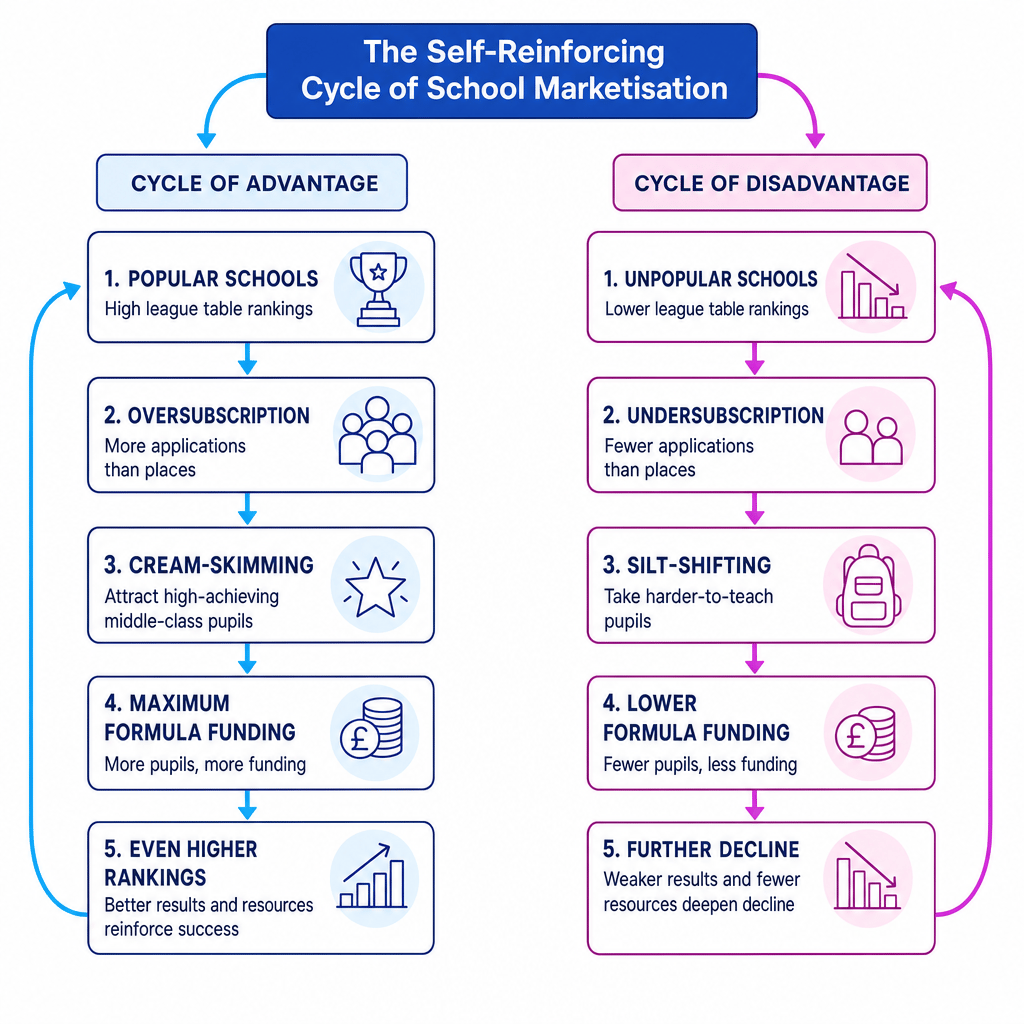
Analyzing the impact of formula funding on working-class students
Let's walk through how to apply sociological concepts to show how a marketisation mechanism reproduces social class inequality.
- Identify the core mechanism of the policy: Under the formula funding guidelines introduced by the 1988 Education Reform Act, schools receive a set allocation of funding per pupil. This means school budgets are directly tied to student enrollment numbers (NNN).
- Apply school-level strategic responses: To maximize funding, schools must attract as many high-achieving pupils as possible to boost their league table positions. This incentivises cream-skimming (selecting academic, middle-class students) and silt-shifting (rejecting students with behavioral or learning needs, who are disproportionately working-class).
- Connect to home-level resource disparities: Working-class parents often lack the economic capital to cover travel costs to highly funded, oversubscribed schools outside their immediate area (acting as disconnected-local choosers). Consequently, working-class students are concentrated in undersubscribed, underfunded local schools, creating a self-reinforcing cycle of educational deprivation.
Confusing marketisation with privatisation
These two terms sound similar but mean different things. Marketisation is about making state schools act like businesses by competing against each other. Privatisation is the actual transfer of ownership, assets, or services of state schools to private, profit-making businesses.
3. Privatisation and Globalisation
In recent decades, educational policy has moved beyond simple marketisation to embrace privatisation and respond to the forces of globalisation.
Privatisation of Education
Sociologists like Stephen Ball distinguish between two forms of privatisation:
- Endogenous privatisation (privatisation in education): Importing business-like techniques from the private sector into state schools. Examples include performance-related pay for teachers, targeting systems, and treating students as "customers."
- Exogenous privatisation (privatisation of education): Opening up the UK's state education assets directly to private company ownership and profit-making.
The rapid rise of Academies and Free Schools (heavily expanded by the Conservative-Liberal Democrat Coalition government from 2010 onwards) is a prime example of privatisation. Academies are funded directly by the central government (rather than local authorities) and are often run by private Multi-Academy Trusts (MATs) or backed by private business sponsors.
Cola-isation of schools
Janice Molnar coined the term "cola-isation" to describe how the private sector penetrates schools through vending machines, brand logos, sponsorships, and educational vouchers (e.g., Tesco computers for schools). Schools often accept this because of underfunding, but critics argue it turns children into captive targets for corporate advertising.
The Impact of Globalisation on Policy
Globalisation is the increasing interconnectedness of societies across international boundaries. It has profoundly influenced UK educational policy in several ways:
- The Influence of PISA League Tables: The OECD publishes the Program for International Student Assessment (PISA) league tables, comparing reading, maths, and science skills across countries. If the UK drops down the tables, it triggers "moral panics" about national competitiveness. This has directly led to policies like the introduction of the English Baccalaureate (EBacc) and a greater curricular focus on traditional STEM subjects (Science, Technology, Engineering, Maths).
- International Comparisons in Teaching Methods: UK governments have imported successful methods from abroad. For instance, "Mastery Maths" approaches were introduced to UK primary schools after studying the high performance of students in Shanghai and Singapore.
- Global Edtech and Privatisation: Many educational services in the UK (such as exam boards like Pearson, virtual learning platforms, and online assessment tools) are owned by massive transnational corporations operating on a global scale.
4. Policies to Promote Equality of Opportunity
While marketisation and privatisation have dominated since 1988, various governments have also introduced policies explicitly designed to reduce social class, gender, and ethnic inequalities. These are often categorized as compensatory education policies—efforts to provide extra resources to schools and communities in deprived areas to make up for cultural and material deprivation at home.
| Era / Government | Key Policy | Objective & Sociological Intention (AO1/AO2) | Evaluation & Critique (AO3) |
|---|---|---|---|
| New Labour (1997–2010) | Sure Start | Integrated centres offering early-years education, health advice, and parenting support in deprived communities to tackle cultural deprivation. | Very popular, but evaluations showed mixed long-term academic impacts. Many centres were shut down during 2010s austerity. |
| New Labour (1997–2010) | EMA (Education Maintenance Allowance) | Weekly cash payments (up to £30) given to low-income students who stayed in post-16 education to combat material deprivation. | Proven to increase retention rates among working-class students. Highly criticised when the Coalition government abolished it in 2011. |
| Coalition (2010–2015) | Pupil Premium | Extra funding given directly to schools for every student they register who is eligible for Free School Meals (FSM). | A targeted material policy, but Ofsted found that in many schools, the funding was used to plug general budget deficits rather than supporting FSM pupils directly. |
Gender-Targeted Policies
Educational policies have also responded to the changing landscape of gender achievement. Historically, policies focused on helping girls access male-dominated subjects:
- GIST and WISE: Initiatives such as Girls into Science and Technology (GIST) and Women into Science and Engineering (WISE) successfully encouraged girls to pursue non-traditional career paths.
- The National Curriculum (1988): By making core subjects like science and maths compulsory for all students up to age 16, it removed the gender option barriers that previously saw girls opt out of these disciplines.
Conversely, contemporary concerns about the "underachievement of boys" have led to policies promoting boy-friendly active learning, phonics-based reading schemes, and recruitment drives for male primary school teachers.
In the exam
If you are writing an essay on educational policy (such as a 20-mark question evaluating the impact of marketisation or policies to promote equality), make sure you cover the following structure:
- Compare policy eras: Do not just write a list of historical policies. Group them chronologically and contrast their underlying ideologies—e.g., the Social Democratic focus of comprehensives (equality) versus the Neoliberal focus of the 1988 Reform Act (marketisation/efficiency).
- Weave in the core sociological perspectives: Use New Right arguments to defend marketisation, but dismantle them using Marxist (class reproduction), Feminist (gender inequality), and interactionist (labelling and streaming) critiques.
- Use precise terminology: Distinguish clearly between selection, marketisation, privatisation, and compensatory education. Use theorists like Ball, Gerwitz, and Bartlett to elevate your analysis to an A/A* standard.
- Evaluate the contemporary picture: Link your points to recent developments, such as the rapid growth of Multi-Academy Trusts, the rise of free schools, and the abolition of policies like the EMA.
Check yourself
- Why did critics argue that the 11-Plus exam in the Tripartite System was culturally biased against working-class children?
- What are the three main features introduced by the 1988 Education Reform Act that constructed an "education market"?
- How does Will Bartlett's concept of "cream-skimming" explain how popular schools maintain high positions on league tables?
