In Clinical Psychology, you must study treatments for two mental health disorders. The first mandatory disorder is Schizophrenia. The second is a disorder of your choice; in these notes, we will cover Unipolar Depression (Clinical Depression).
For both disorders, you must learn one biological treatment and one psychological treatment. This allows you to compare the biological approach (which views mental illness as a physical dysfunction of the brain) with the psychological approach (which views it as a result of learned patterns, cognitive distortions, or environmental stressors).
What you'll learn
- How typical and atypical antipsychotic drugs address dopamine imbalances in schizophrenia.
- How Cognitive Behavioural Therapy for psychosis (CBTp) helps patients manage hallucinations and delusions.
- The biochemical mechanism of SSRIs in treating unipolar depression.
- How Beck's cognitive restructuring is used in CBT to challenge the negative triad.
1. Schizophrenia: Biological Treatment (Antipsychotics)
Biological treatments for schizophrenia rely on the biochemical explanation of the disorder, specifically the dopamine hypothesis. This hypothesis suggests that an excess of dopamine in subcortical areas of the brain (hyperdopaminergia) causes positive symptoms like hallucinations, while a deficit of dopamine in the prefrontal cortex (hypodopaminergia) causes negative symptoms like avolition.
Antipsychotics
Antipsychotics are psychotropic medications used to reduce the intensity and frequency of psychotic symptoms in disorders like schizophrenia. They are broadly divided into first-generation (typical) and second-generation (atypical) drugs.
Typical Antipsychotics (First-Generation)
Developed in the 1950s (e.g., Chlorpromazine), typical antipsychotics act as dopamine antagonists in the mesolimbic pathway.
- Mechanism: They bind to dopamine D2D_2D2 receptors on post-synaptic membranes without activating them. This physically blocks dopamine from binding, reducing neurotransmission in the brain's reward and sensory pathways.
- Effect: This reduction in dopamine activity significantly decreases positive symptoms, such as auditory hallucinations and persecutory delusions.
Atypical Antipsychotics (Second-Generation)
Developed in the 1970s and 80s (e.g., Clozapine), atypical antipsychotics were designed to improve efficacy and reduce side effects.
- Mechanism: They temporarily bind to D2D_2D2 receptors, dissociating rapidly to allow normal dopamine transmission when needed. Crucially, they also block serotonin receptors (5-HT2A5\text{-HT}_{2\text{A}}5-HT2A) and glutamate receptors.
- Effect: By acting on both dopamine and serotonin pathways, they improve both positive and negative symptoms (like flattened affect) and reduce depressive symptoms or anxiety in patients.
Confusing receptor actions
Do not say that antipsychotics "destroy" dopamine. They act as antagonists, which means they bind to and block the receptors, preventing the neurotransmitter itself from binding and transmitting a signal.
Evaluation of Antipsychotics (AO3)
- Strength (Supporting Evidence): There is vast empirical support for their effectiveness. Large-scale reviews (e.g., Thornley et al., 2003) compared Chlorpromazine to a placebo across 13 trials with over 1,000 participants. They found Chlorpromazine was associated with better overall functioning and reduced symptom severity.
- Weakness (Severe Side Effects): Typical antipsychotics can cause severe motor side effects, such as tardive dyskinesia (uncontrollable grimacing and blinking caused by long-term dopamine blockade). Atypical drugs like Clozapine do not cause this as frequently, but can lead to agranulocytosis (a life-threatening drop in white blood cells), requiring patients to undergo regular blood tests.
- Weakness (The "Chemical Straitjacket" Ethic): Critics argue that antipsychotic drugs are sometimes used in hospital settings simply to calm patients down and make them easier for staff to manage, rather than for the direct benefit of the patient. This raises serious ethical concerns regarding patient autonomy and consent.
2. Schizophrenia: Psychological Treatment (CBTp)
Cognitive Behavioural Therapy for psychosis (CBTp) is based on the assumption that schizophrenia symptoms (especially delusions and hallucinations) are caused by dysfunctional thought processing, such as faulty attributions or cognitive biases.
CBTp
CBTp is a structured psychological therapy (usually taking 5 to 20 sessions) designed to help patients identify and modify dysfunctional, irrational beliefs (delusions) and develop coping mechanisms to manage hallucinatory voices.
How CBTp works
Rather than eliminating the voices or delusions, CBTp aims to help the patient live with them by reducing the distress they cause.
- Formulation: The therapist and patient draw up a collaborative picture of the patient’s experiences (e.g., when the voices started, what triggers them, and how they make the patient feel).
- Normalisation: The therapist normalises the experience of hallucinations by explaining that many people hear voices under extreme stress. This reduces the patient's feeling of alienation.
- Cognitive Restructuring / Challenging: The therapist gently challenges the reality of the patient’s delusions. This is done through Socratic questioning (asking open questions to encourage the patient to evaluate their own logic).
- Developing Coping Strategies: The patient learns practical cognitive and behavioural strategies (e.g., wearing headphones to distract from auditory hallucinations, or using positive self-talk).
Evaluation of CBTp (AO3)
- Strength (No Side Effects): Unlike drug therapies, CBTp is completely non-invasive and presents no risk of physical side effects or toxicity. This makes it a highly acceptable treatment option for patients who cannot tolerate medication.
- Weakness (Requires Active Engagement): CBTp requires significant cognitive effort, insight, and motivation. A patient experiencing severe negative symptoms (such as avolition) or highly disorganised speech may find it impossible to engage in the sessions, meaning it is often unsuitable during an acute psychotic episode.
- Strength (Long-term Coping): Research suggests that CBTp provides patients with permanent cognitive tools to manage their illness, reducing relapse rates long after the therapy sessions have concluded.
3. Depression: Biological Treatment (SSRIs)
Unipolar depression is linked to low levels of monoamine neurotransmitters, particularly serotonin, in the brain's neural networks regulating mood.
SSRIs
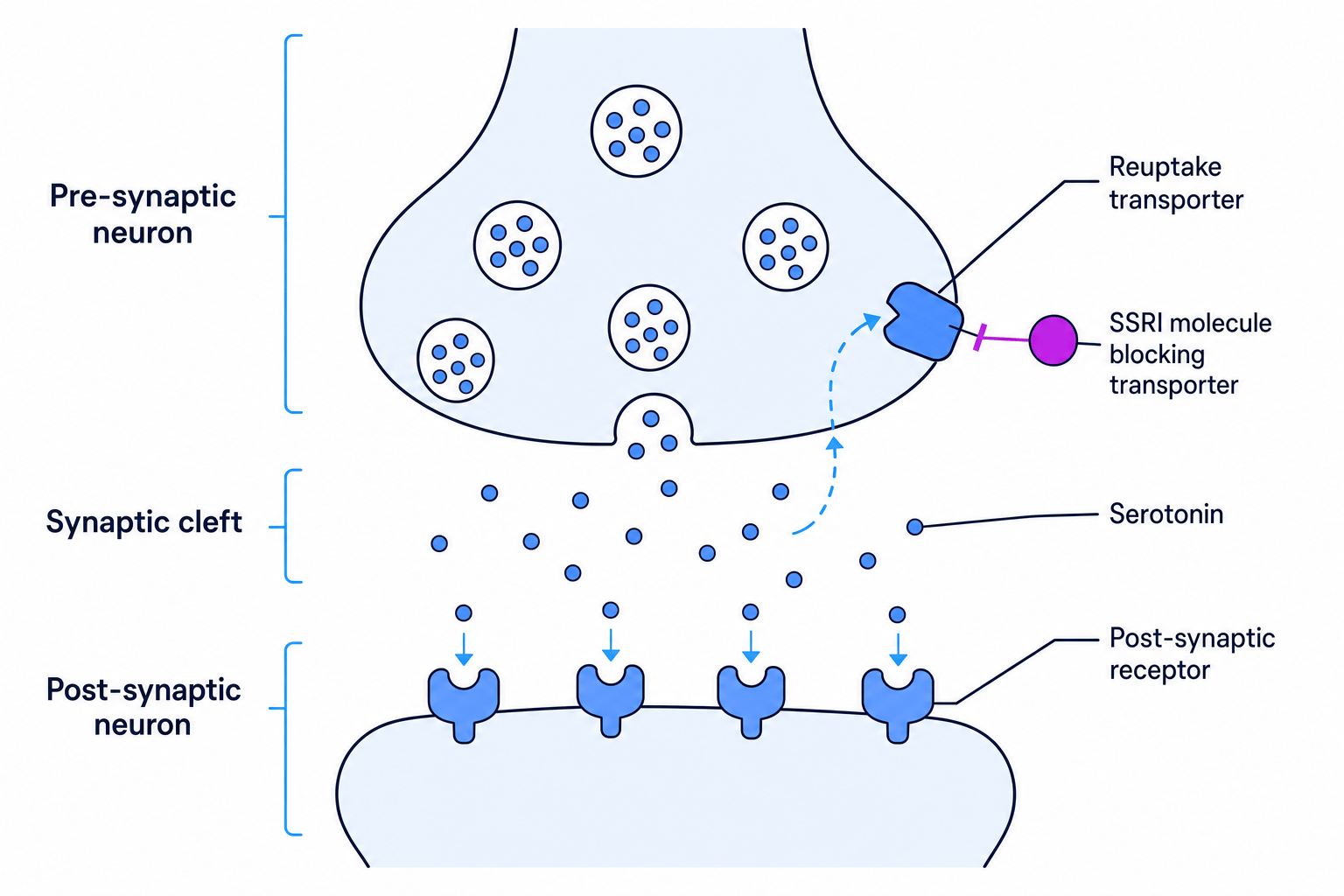
Selective Serotonin Reuptake Inhibitors (SSRIs) are a class of antidepressant drugs that selectively prevent the reabsorption (reuptake) of serotonin in the brain, thereby increasing its concentration in the synaptic cleft.
Mechanism of Action
In a normal synapse, serotonin is released by the pre-synaptic neuron, crosses the synaptic cleft, and binds to receptors on the post-synaptic neuron. Any excess serotonin is reabsorbed back into the pre-synaptic neuron via reuptake pumps (transporters) to be recycled.
SSRIs (such as Fluoxetine / Prozac) selectively block these reuptake transporters. Because the serotonin cannot go back into the pre-synaptic neuron, it remains in the synaptic cleft longer, repeatedly binding to and activating the post-synaptic receptors. This boosts the activity of the serotonin-controlled mood pathways.
Evaluation of SSRIs (AO3)
- Strength (Efficacy): There is strong evidence that SSRIs are effective. A meta-analysis by Cipriani et al. (2018) compared 21 antidepressants and found that all of them, including SSRIs, were significantly more effective than placebos at reducing acute depressive symptoms.
- Weakness (The Treatment-Etiology Fallacy): Just because blocking serotonin reuptake reduces depressive symptoms, it does not mean that low serotonin was the cause of the depression in the first place. This logical leap is known as the treatment-etiology fallacy (similar to assuming a headache is caused by a lack of aspirin).
- Weakness (Side Effects and Discontinuation): SSRIs can cause side effects like nausea, insomnia, sexual dysfunction, and increased suicidal ideation in some children and young adults. If stopped abruptly, patients can experience "discontinuation syndrome," which includes dizziness, flu-like symptoms, and anxiety.
4. Depression: Psychological Treatment (CBT)
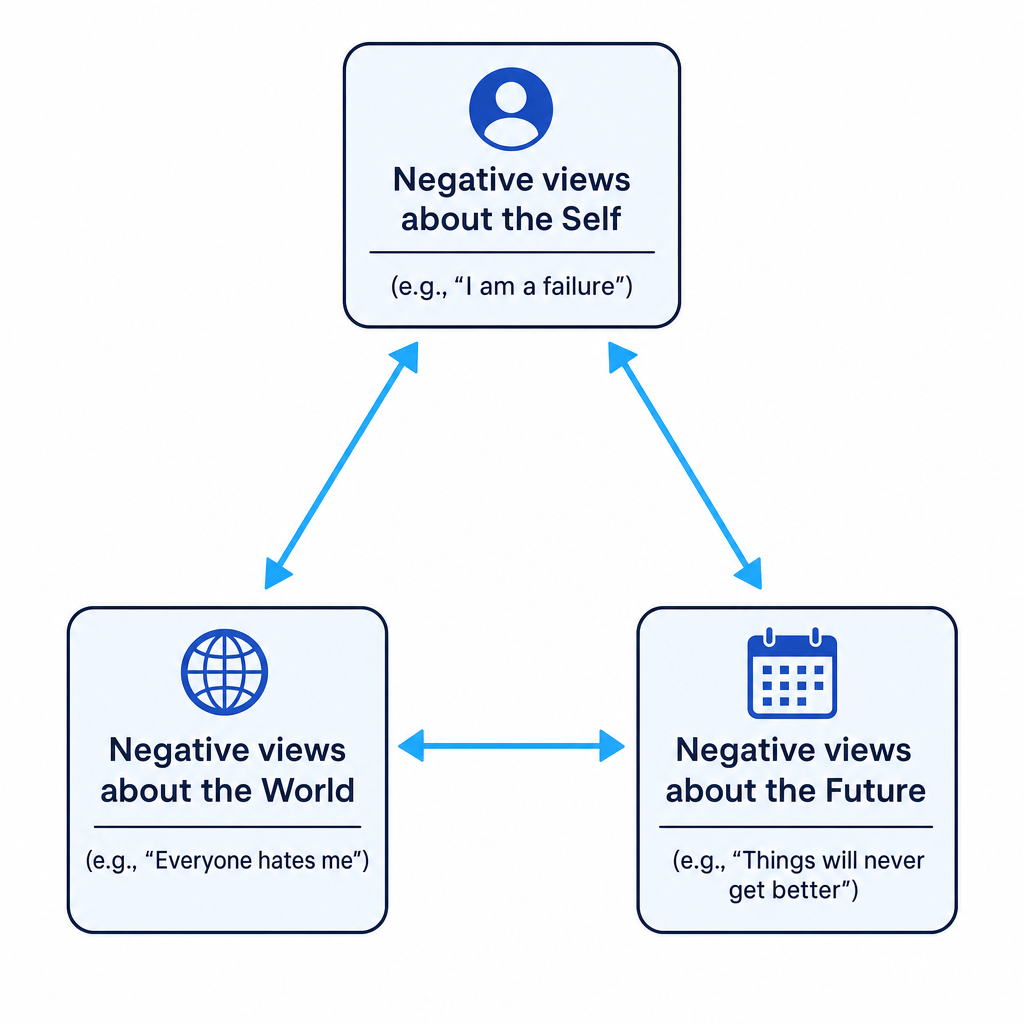
Psychological therapy for depression is primarily based on Beck’s Cognitive Theory of Depression. Beck argued that depressed individuals possess negative self-schemas and cognitive distortions that trap them in a self-reinforcing loop called the Negative Triad.
Core Components of Cognitive Therapy for Depression
The goal of Beck’s Cognitive Therapy is to identify and challenge these irrational patterns of thought.
- Identifying Negative Thoughts: The patient and therapist work together to map out the negative thoughts that occur before or during depressive episodes.
- "Patient as Scientist" (Reality Testing): The therapist encourages the patient to gather evidence to test their negative beliefs. If a patient believes "everyone hates me," the therapist might set a homework task for the patient to record every time someone smiles at them or says something friendly. This objective evidence is used to dispute the irrational belief.
- Behavioural Activation: Depression often causes people to withdraw from enjoyable activities, which worsens their mood. The therapist works with the patient to schedule pleasant, active behaviors (e.g., going for a walk, meeting a friend) to disrupt this cycle of avoidance.
The Cognitive Assumption
The underlying philosophy of CBT is: "It is not events themselves that upset us, but the view we take of them." Change the thoughts (cognitions), and the emotions (feelings) and actions (behaviours) will follow.
Evaluation of CBT for Depression (AO3)
- Strength (Empowerment and Relapse Prevention): CBT gives patients active, lifelong strategies to manage their mental health. Research shows that patients treated with CBT have significantly lower relapse rates compared to those treated with drugs alone, as they have learned how to intercept negative thoughts before they spiral.
- Weakness (Time and Cost): CBT is expensive to deliver because it requires one-to-one sessions with a highly trained therapist over several months. This makes it less accessible than drug therapies, which simply require a GP prescription and are highly cost-effective for health systems like the NHS.
- Weakness (Ethical concerns over blame): By focusing heavily on the patient's internal thoughts, CBT risks over-emphasising cognitive control. This can lead to the implication that the patient is responsible for their own illness, ignoring real-world social stressors (e.g., poverty, abusive relationships, unemployment) that may be the primary cause of their depression.
Worked Example
Research in clinical psychology often requires deciding which statistical test to use when analyzing the effectiveness of different treatments. Let's work through how you would determine the correct test for a clinical trial comparing CBT and Drug Therapy.
Selecting the correct statistical test for treatment efficacy
A clinical psychologist wants to see if Cognitive Behavioural Therapy (CBT) or Antidepressants (SSRIs) are more effective at reducing depression.
She randomly assigns 40 depressed patients to two groups:
- Group A (20 patients): Receive 12 weeks of CBT.
- Group B (20 patients): Receive 12 weeks of SSRIs.
At the end of the 12 weeks, both groups complete the Beck Depression Inventory (BDI), which yields a score out of 63. These scores are treated as ordinal data because while a higher score indicates more severe depression, the intervals between points on the scale are not mathematically equal (i.e., a score of 30 is not exactly "twice as depressed" as a score of 15).
Determine which statistical test the psychologist should use to see if there is a significant difference between the two treatments, and justify your choice.
-
Identify the clinical design goal (Difference or Correlation?): The psychologist is comparing two separate treatments (CBT vs SSRIs) to see if one is more effective than the other. This means she is looking for a difference between two conditions, not a correlation or association.
-
Identify the experimental design (Independent or Repeated?): There are two distinct groups of patients: Group A (CBT) and Group B (SSRIs). Each participant takes part in only one condition. Therefore, this is an independent groups design (unrelated data).
-
Identify the level of measurement: The dependent variable is measured using the BDI score. The question explicitly states that BDI scores are treated as ordinal data (data that can be ordered/ranked, but does not have equal intervals).
-
Select the correct statistical test: Using the criteria of testing for a difference, using an independent groups design, with ordinal data, the correct test is the Mann-Whitney U test.
In the exam
- Never evaluate a drug treatment in isolation: Always make sure your evaluation contrasts it with psychological alternatives (and vice versa). For example, state that while drugs have physical side effects, therapies like CBT have none, but require much higher patient motivation.
- Remember the "Other Disorder" rule: In Paper 2, read the prompts carefully. If the question asks for a biological treatment of your other chosen disorder, make sure you write about depression (or your school's chosen disorder) and not schizophrenia. Mixing up the treatments between the two disorders is a common way to lose all marks.
- Be specific with neurotransmitters: Do not just write "brain chemicals." Use the terms Dopamine when discussing schizophrenia and Serotonin when discussing depression.
Check yourself
- Why are atypical antipsychotics generally preferred over typical antipsychotics by modern clinicians?
- What are the three components of Beck's Negative Triad?
- Why might a patient experiencing severe negative symptoms of schizophrenia struggle to benefit from CBTp?
