What you'll learn
- How culture can shape individual differences in mental health disorders.
- How cultural explanations can be used as a non-biological explanation for schizophrenia.
- Why culture may affect diagnosis, reducing reliability and validity.
- How to evaluate cultural explanations using AO1, AO2 and AO3.
Starting point: what are “individual differences”?
In Clinical Psychology, individual differences means that people do not all experience, express, explain or respond to mental health difficulties in the same way.
Some differences are biological, such as genes or neurotransmitters. Others are psychological or social. In this section, the focus is on culture.
Culture
Culture refers to the shared values, beliefs, norms, customs, language and ways of interpreting the world that are learned by members of a social group.
Culture is not the same as nationality or ethnicity. Two people from the same country may have very different cultural experiences, and people can belong to several cultures at once, such as family, religion, peer group and wider society.
Treating culture as fixed
Avoid writing as if “Western culture” or “collectivist culture” explains everyone in that group. Culture is a useful concept, but individuals still vary within cultures.
Culture and mental health disorders
Mental health disorders are usually diagnosed using classification systems such as the DSM-5 or ICD-11. These list patterns of symptoms, such as hallucinations, delusions, low mood or disorganised behaviour.
Diagnosis
A diagnosis is the identification of a disorder based on symptoms, behaviour and clinical judgement, often using a classification system such as DSM-5 or ICD-11.
Culture can affect mental health in several ways:
- what counts as “normal” or “abnormal” behaviour
- how distress is expressed, for example emotionally, physically or spiritually
- whether a person seeks professional help
- the language used to describe symptoms
- how clinicians interpret behaviour
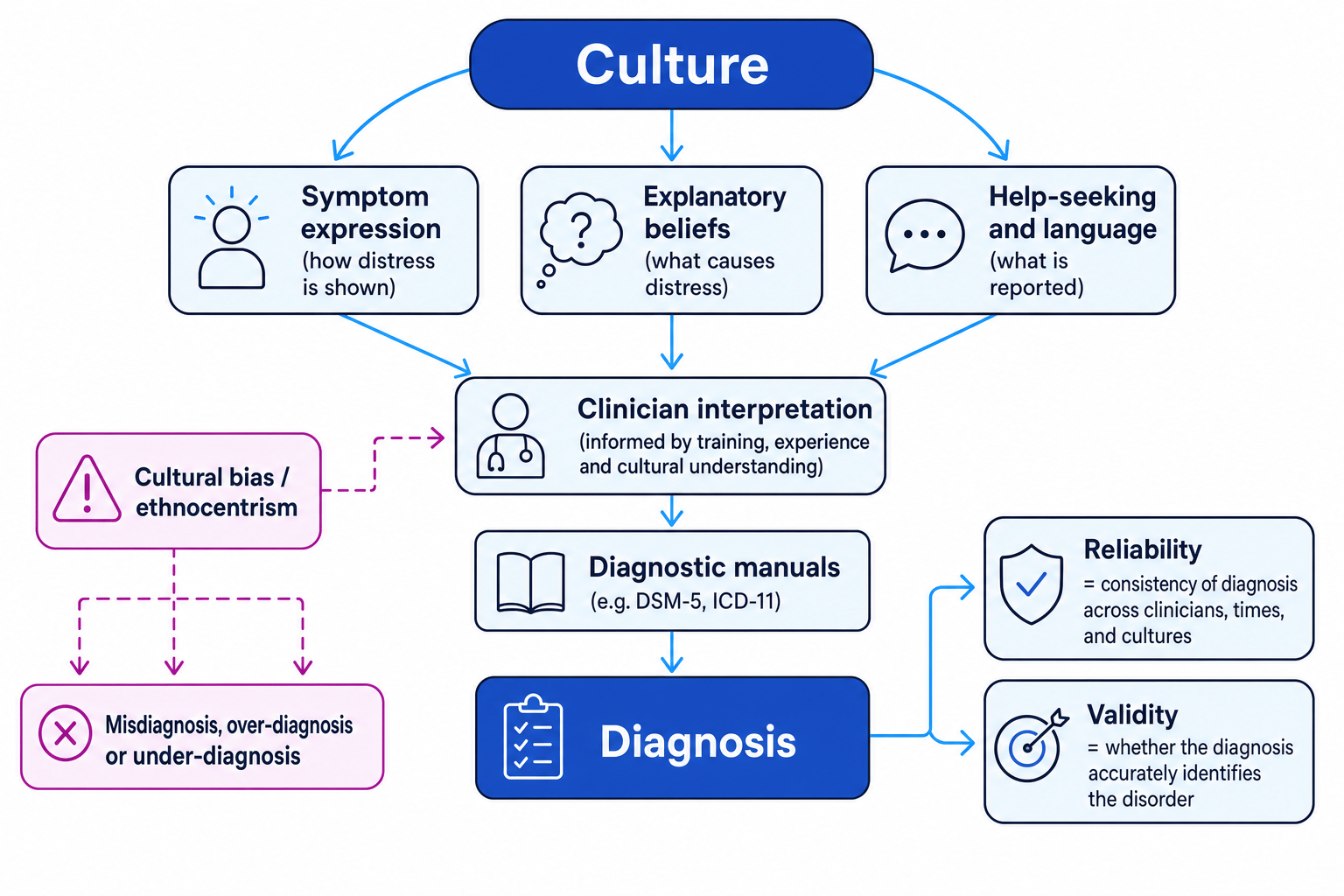
Culture affects both experience and interpretation
Culture can shape the person’s experience of symptoms and the clinician’s interpretation of those symptoms. This means culture can affect both the disorder itself and the diagnosis given.
Cultural effects as a non-biological explanation for schizophrenia
Schizophrenia
Schizophrenia is a severe mental health disorder involving symptoms such as hallucinations, delusions, disorganised speech, disorganised behaviour and negative symptoms such as reduced motivation or emotional expression.
A biological explanation of schizophrenia might focus on genes, dopamine or brain structure. A non-biological explanation looks at psychological or social causes. Cultural effects are one example of a non-biological explanation.
The specification uses “e.g.” here, so schizophrenia is an important example rather than the only possible disorder affected by culture.
How culture may influence schizophrenia
Culture may influence schizophrenia through:
-
Symptom content
A person may experience hallucinations or delusions using ideas available in their culture. For example, voices might be interpreted as spiritual, technological, threatening or ancestral depending on cultural beliefs. -
Expression of distress
Some cultures may encourage open emotional expression; others may encourage restraint. This can affect what symptoms are reported to doctors. -
Explanatory beliefs
A person may explain symptoms as illness, stress, spirit possession, family conflict or moral failure. These explanations influence help-seeking. -
Social stressors
Migration, racism, discrimination, poverty and social exclusion may increase stress. These factors may contribute to vulnerability to mental health difficulties, including psychosis. -
Family and community responses
Supportive communities may reduce isolation, while stigma may worsen distress and delay treatment.
Applying a cultural explanation to schizophrenia
A student is asked why a person hearing voices might not receive the same diagnosis in two cultural settings.
-
Link the symptom to cultural meaning. Hearing voices may be interpreted as a hallucination in one setting, but as a spiritual or religious experience in another, especially if it fits accepted cultural beliefs.
-
Apply this to clinician judgement. A clinician who does not understand the person’s cultural background may judge the voice-hearing as more abnormal or threatening than a culturally informed clinician would.
-
Draw the diagnostic conclusion. The same behaviour could lead to a schizophrenia diagnosis in one context but not in another, showing how culture can affect diagnosis.
Evidence that culture shapes symptoms
Research supports the idea that culture can affect how symptoms are experienced and reported.
Luhrmann et al. (2015) compared voice-hearing experiences in the USA, India and Ghana. Many American participants described voices as intrusive and violent, while some Indian and Ghanaian participants described voices as more relational, playful or spiritual. This suggests hallucinations are not experienced in exactly the same way across cultures.
The World Health Organization studies of schizophrenia, including the International Pilot Study of Schizophrenia and later cross-cultural work such as Jablensky et al. (1992), found differences in course and outcome across countries. Some findings suggested better outcomes in some lower-income countries, possibly because of stronger community support or different expectations around recovery.
Using evidence well
For AO3, do not just name a study. Explain what it shows: cultural variation in symptoms supports the idea that schizophrenia cannot be understood only through biology.
Culture and diagnostic reliability
Reliability
Reliability means consistency. A diagnosis is reliable if different clinicians, or the same clinician at different times, would reach the same diagnosis for the same person.
Culture can reduce diagnostic reliability if clinicians interpret the same symptoms differently. This may happen because:
- clinicians are trained in different diagnostic traditions
- symptoms are described in culturally specific language
- cultural behaviours are mistaken for symptoms
- clinicians disagree over whether a belief is a delusion or a culturally accepted belief
A classic example is Cooper et al. (1972) and the US-UK diagnostic project. American psychiatrists were more likely than British psychiatrists to diagnose schizophrenia in similar patients, while British psychiatrists were more likely to diagnose mood disorders. This suggests diagnosis was influenced by professional and cultural context, reducing reliability.
Inter-rater reliability
Inter-rater reliability
Inter-rater reliability is the extent to which different clinicians agree when diagnosing the same patient.
If two clinicians from different cultural or professional backgrounds assess the same patient but give different diagnoses, inter-rater reliability is low.
Judging diagnostic reliability
Two psychiatrists assess the same patient. Psychiatrist A diagnoses schizophrenia. Psychiatrist B diagnoses bipolar disorder with psychotic features.
-
Compare the diagnoses. The clinicians have reached different conclusions about the same person.
-
Identify the reliability issue. Because the disagreement is between clinicians, the issue is inter-rater reliability.
-
Link to culture if relevant. If the disagreement comes from different cultural interpretations of the patient’s beliefs or behaviour, culture has reduced diagnostic reliability.
Culture and diagnostic validity
Validity
Validity means accuracy. A diagnosis is valid if it identifies a real disorder and distinguishes it from other disorders or from normal cultural behaviour.
A diagnosis can be reliable but not valid. For example, clinicians might consistently diagnose a culturally unfamiliar spiritual belief as delusional, but if the belief is normal in that person’s culture, the diagnosis may be inaccurate.
Culture can reduce validity through:
- over-diagnosis, where people are diagnosed when they do not have the disorder
- under-diagnosis, where symptoms are missed because they are expressed in unfamiliar ways
- misdiagnosis, where one disorder is mistaken for another
- ethnocentrism, where one culture’s norms are treated as the universal standard
Ethnocentrism
Ethnocentrism means judging other cultures using the standards and assumptions of one’s own culture.
For example, if a clinician assumes that direct eye contact is always a sign of confidence and lack of eye contact is always suspicious or abnormal, they may misread behaviour that has a different meaning in another culture.
Reliability and validity are different
Reliability is about consistency. Validity is about accuracy. Cultural bias can damage both, but in different ways.
Cultural bias in schizophrenia diagnosis
There is evidence that some minority ethnic groups have been diagnosed with schizophrenia at higher rates in Western countries, including the UK. Researchers such as Fernando (1991) argued that psychiatric diagnosis can be affected by cultural bias, especially when clinicians misunderstand the meaning of behaviour, beliefs or communication style.
However, this needs careful evaluation. Higher diagnosis rates may not only be due to clinician bias. They may also reflect real social risk factors, such as discrimination, migration stress, urban living, poverty or reduced access to early support.
Assuming bias is the only explanation
If one group has higher diagnosis rates, do not automatically conclude “doctors are biased”. A strong AO3 answer considers alternative explanations, including social adversity and access to services.
AO3 evaluation
Strength: explains real-world variation
Cultural explanations are useful because they explain why symptoms and diagnoses vary across societies. Evidence such as Luhrmann et al. (2015) supports the view that psychotic symptoms are shaped by cultural meaning, not just brain chemistry.
Strength: improves clinical practice
Understanding culture can improve diagnosis and treatment. Clinicians can use culturally sensitive interviews, interpreters, and questions about religious or spiritual beliefs. This may reduce misdiagnosis and improve trust.
Weakness: culture is difficult to measure
Culture is broad and complex. It includes language, religion, family expectations, social class, migration history and personal identity. This makes it hard to isolate culture as a single cause of schizophrenia or diagnostic difference.
Weakness: risk of stereotyping
Cultural explanations can accidentally become stereotyped. For example, saying “this group expresses distress like this” ignores individual variation. Good clinical assessment should ask about the individual, not assume based on group membership.
Methodological issue: classification systems improve but do not remove bias
Modern systems such as DSM-5 and ICD-11 include more guidance on cultural context than older systems. This should improve reliability and validity. However, classification still depends on clinician interpretation, so cultural misunderstanding can still occur.
Ethics and cultural sensitivity
Diagnosis has ethical consequences. A label such as schizophrenia can affect self-esteem, employment, relationships and treatment. Therefore, clinicians and researchers should follow principles linked to the BPS Code of Ethics and Conduct (2009).
Relevant ethical issues include:
- informed consent, so people understand assessment and treatment
- confidentiality, because diagnostic information is sensitive
- protection from harm, including avoiding stigma and distress
- right to withdraw, especially in research interviews
- debriefing, so participants understand the purpose of research
- respectful use of interpreters and culturally informed assessment
Diagnosis can help and harm
A diagnosis can give access to treatment and support, but it can also create stigma. Evaluation should consider both sides.
Bringing it together for essays
For AO1, describe how culture can shape symptoms, beliefs, help-seeking and diagnosis. Use key terms such as reliability, validity, ethnocentrism and misdiagnosis.
For AO2, apply culture to a scenario. If a person reports hearing ancestral voices, ask whether this is distressing, culturally accepted, impairing daily life, and how a clinician interprets it.
For AO3, evaluate using evidence and balance. Cultural explanations are valuable because they challenge purely biological views, but they can be vague, hard to measure and at risk of stereotyping.
In the exam
-
Separate reliability from validity. Reliability means consistent diagnosis; validity means accurate diagnosis.
-
Use culture carefully. Explain how culture affects symptoms or interpretation without stereotyping whole groups.
-
Balance your evaluation. Mention cultural bias, but also consider alternative explanations such as social adversity, migration stress and improved diagnostic manuals.
Check yourself
- How can culture affect the content or meaning of hallucinations in schizophrenia?
- What is the difference between diagnostic reliability and diagnostic validity?
- Why might cultural bias lead to over-diagnosis, under-diagnosis or misdiagnosis?
