When we think about learning, we often picture direct experience—like getting a treat for doing your homework or being grounded for breaking a rule. But what happens when you simply watch someone else receive a reward or a punishment?
In 1965, Albert Bandura set out to answer this question. This study is a cornerstone of Learning Theories and Development (Topic 4) in your Edexcel A-Level Psychology specification. It refined his earlier work on Social Learning Theory (SLT) by introducing the concept of vicarious learning.
What you'll learn:
- The distinction between the acquisition (learning) and performance of a behaviour.
- The precise methodology, results, and conclusions of Bandura's (1965) classic study.
- How to apply the findings to real-world scenarios, such as media influence.
- How to evaluate the study's strengths, limitations, and ethical issues for your exam essays.
1. Prerequisites: What is Vicarious Reinforcement?
Before diving into the 1965 study, we must define the fundamental mechanism Bandura was testing. In his earlier studies (Bandura, Ross, & Ross, 1961, 1963), Bandura demonstrated that children would readily imitate an adult model who acted aggressively. However, those studies focused on simple observation.
In 1965, Bandura wanted to see how the consequences of the model's actions affected the observer's subsequent behaviour.
Vicarious Reinforcement
Vicarious reinforcement occurs when an observer copies a model's behaviour because they saw the model being rewarded for that behaviour. The observer expects to receive the same positive consequence.
Conversely, we also have vicarious punishment:
Vicarious Punishment
Vicarious punishment occurs when an observer avoids copying a model's behaviour because they saw the model being punished for it. The observer learns to avoid the behaviour to escape negative consequences.
Acquisition vs. Performance
Bandura's core argument was that learning (acquisition) and doing (performance) are two entirely different cognitive events. We can learn a behaviour simply by watching it, but whether we choose to perform it depends on the expected consequences.
2. Bandura (1965): Method and Procedure
Bandura wanted to investigate whether children would spontaneously imitate film-mediated aggressive models if they saw those models rewarded, punished, or experience no consequences. He also wanted to see if introducing an incentive later would reveal that children had learned the behaviours even if they didn’t initially perform them.
The Sample
- 66 children (33 boys and 33 girls) from the Stanford University Nursery School.
- Aged between 3.5 and 6 years (mean age of 4 years and 3 months).
The Experimental Conditions (Independent Variable)
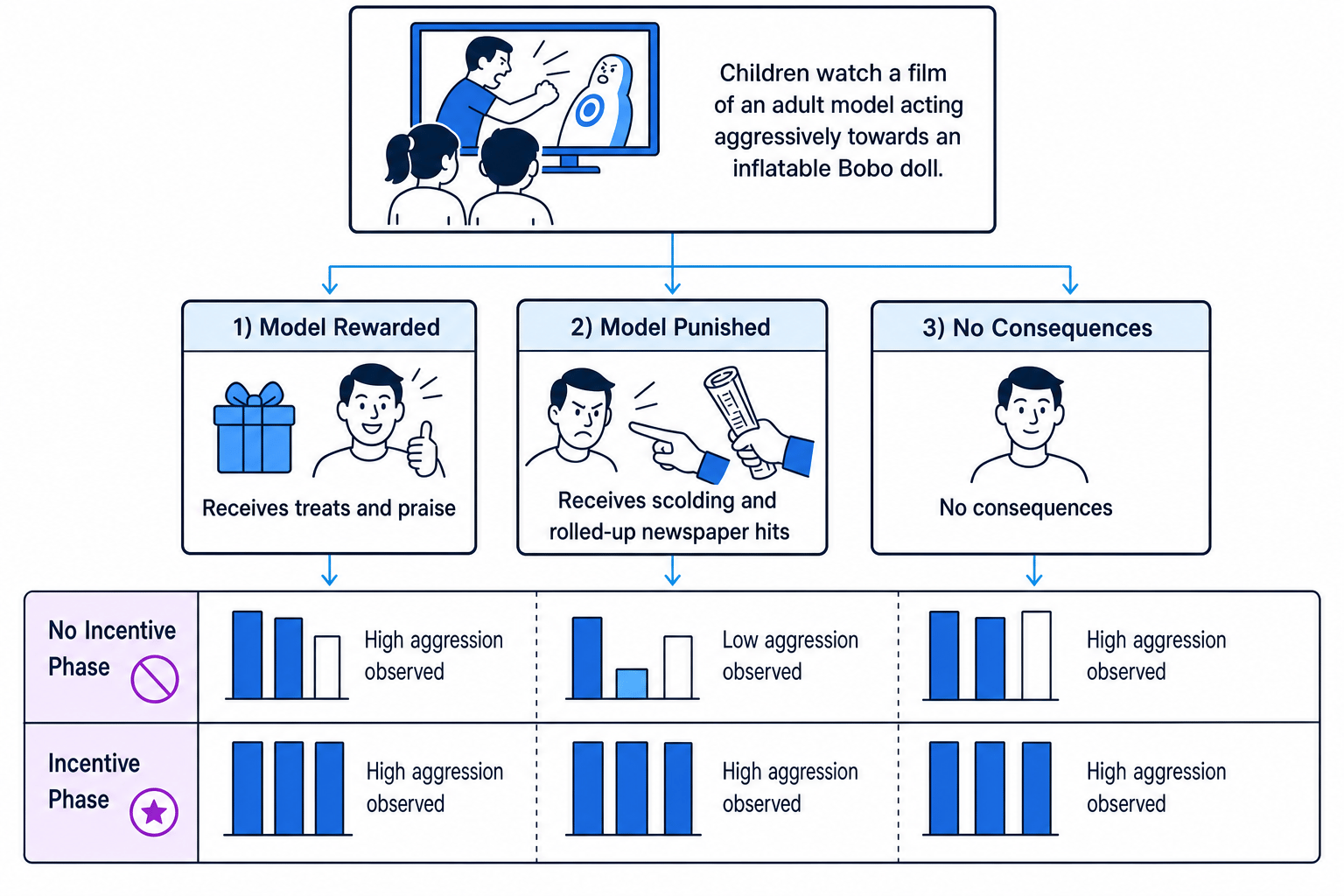
The children were randomly allocated to one of three experimental groups (22 children per group), where they watched a 5-minute television program of a male model behaving aggressively towards an inflatable Bobo doll (e.g., hitting it with a mallet, kicking it, throwing it in the air, and sitting on it while punching it in the nose).
The film ended differently for each group:
- Model-Reward Condition: A second adult entered the room and praised the model for their "superb performance," calling them a "strong champion" and handing them a bottle of soda, sweets, and potato chips.
- Model-Punished Condition: The second adult shook their finger at the model, called them a "clear channel bully," and hit them with a rolled-up newspaper while scolding them.
- No-Consequences Condition: The film simply ended after the aggressive sequence; the model received neither reward nor punishment.
The Two Evaluation Phases (Dependent Variable)
After watching the film, each child was taken individually into a playroom containing a Bobo doll, plastic mallets, darts, and other toys. The child's behaviour was observed through a one-way mirror for 10 minutes across two distinct experimental phases:
- Phase 1: No-Incentive (Performance) Phase The child was left alone with the toys. The observers recorded how many imitative aggressive acts the child spontaneously performed without any external encouragement.
- Phase 2: Incentive (Acquisition) Phase The experimenter returned to the room and offered the child attractive stickers and fruit juices if they could reproduce the physical and verbal aggressive actions they had seen the model perform on the screen. This was a test of what the child had actually learned (acquisition).
3. Findings and Conclusions
The results of the study provided crucial evidence for Social Learning Theory.
Phase 1 (No-Incentive) Results
- Children in the Model-Punished condition performed significantly fewer imitative aggressive acts than children in the Model-Reward and No-Consequences conditions.
- Across all groups, boys generally showed higher spontaneous aggression than girls.
Phase 2 (Incentive) Results
- Once an incentive (reward) was offered directly to the children, the differences between the three groups virtually disappeared.
- Children in the Model-Punished condition suddenly reproduced just as many aggressive acts as the children in the other two conditions.
- The differences between boys and girls also narrowed dramatically.
Confusing Acquisition with Performance
Students often write that children in the "Model-Punished" condition did not learn the aggressive behaviour. This is incorrect! The incentive phase proved they had learned it perfectly; they simply chose not to perform it initially because they expected to be punished. Make sure you distinguish between learning and performance in your exam answers.
Summary of Conclusions
- Vicarious punishment reduces the performance of observed behaviour, but does not prevent its acquisition.
- Direct positive reinforcement (incentives) can completely override the inhibitory effects of vicarious punishment.
- Observational learning occurs cognitively, regardless of whether the model is rewarded or punished.
4. Worked Example: Scenario Application (AO2)
In the Edexcel exam, you are frequently asked to apply theories and studies to novel scenarios. Let's work through how to apply Bandura's (1965) findings to a typical exam scenario.
Analyzing vicarious reinforcement in a media scenario
Scenario: Leo (aged 5) is watching his older brother, Sam, play a video game. Sam uses an aggressive shortcut to steal virtual coins from another player. The game screen flashes with bright lights, playing a celebratory tune, and displays the text: "BONUS COINS GAINED!". Later that day, their mother leaves Leo in the playroom with the same game. Initially, Leo plays the game cooperatively. However, when his mother promises him an extra dessert if he can show her how to get the highest score quickly, Leo immediately uses the aggressive shortcut to steal coins.
Task: Use your knowledge of Bandura (1965) to explain Leo's behaviour.
- Identify the model and the observer.
- Explain the type of vicarious learning that occurred initially.
- Explain the difference between Leo's initial performance and his subsequent performance using the acquisition-performance distinction.
- Conclude how the incentive influenced Leo's behavior.
Worked Solution:
- Identify the roles: The model in this scenario is the older brother, Sam, and the observer is the younger child, Leo. This matches Bandura's use of young children observing an older model.
- Apply vicarious reinforcement: Leo witnesses Sam receiving positive consequences (celebratory music, bonus coins) for aggressive game play. This acts as vicarious reinforcement. Because the model was rewarded, Leo cognitively registers that the behaviour is desirable and likely to yield rewards.
- Analyze Phase 1 (No-Incentive/Performance): Initially, when left alone, Leo plays cooperatively. According to Bandura (1965), even though Leo has acquired (learned) the shortcut behavior, he does not spontaneously perform it. This demonstrates that learning can occur silently without immediate execution.
- Analyze Phase 2 (Incentive/Acquisition): When the mother introduces a direct positive incentive (the promise of an extra dessert), Leo's behavior changes. Just like the children in Bandura's incentive phase, the introduction of a direct reward motivates Leo to perform the aggressive shortcut he had previously observed and stored in his memory.
5. Evaluation of Bandura (1965) (AO3)
When evaluating Bandura (1965) for an 8- or 12-mark essay, you must structure your points around methodological strengths, limitations, and ethical considerations.
Strengths
- High Level of Control (Internal Validity): Because this was a laboratory experiment, Bandura could control many potential extraneous variables. For example, he pre-screened children for their baseline aggression levels to ensure the groups were balanced. The television video, toys, and room layout were standardized, meaning we can be confident that the variation in the model's consequences caused the difference in spontaneous aggression.
- Scientific Credibility: The study used structured observation with two independent observers scoring the children's behaviour through a one-way mirror. Bandura reported high inter-rater reliability, meaning the measurement of aggressive acts was highly objective and replicable.
- Practical Real-World Application: The study has huge implications for media violence and child-rearing. It explains why children might learn aggressive behaviours from TV or video games but not display them until they are in an environment where they believe they won't be caught or punished (or where they are rewarded by peers). This has influenced age-restriction certifications on media.
Weaknesses
- Lack of Ecological Validity: The laboratory environment and the Bobo doll are highly artificial. A Bobo doll is specifically designed to be knocked down and bounce back up; it is an "invitation to aggression." Hitting an inflatable doll does not carry the same moral weight or physical consequence as hitting a real person. Therefore, the findings may not accurately represent real-life interpersonal violence.
- Demand Characteristics: Some critics argue that the children may have worked out what the experimenter wanted them to do. A nursery school child placed in a room with a toy they just saw a video about might logically assume: "That is the toy I am supposed to play with in that exact way."
Evaluating the Ethics of Bandura's Studies
In learning theories, ethics is a major talking point. Always link your ethical evaluations to the BPS Code of Ethics and Conduct.
Ethical Considerations
- Protection from Harm: By deliberately showing children aggressive films and encouraging them to reproduce aggressive acts, Bandura may have taught them new antisocial behaviours. There was no attempt to de-sensitise the children afterwards, meaning they may have left the study more aggressive than when they arrived.
- Informed Consent: While nursery teachers and parents likely gave consent, the children themselves were too young to truly understand what they were participating in, meaning informed consent and the right to withdraw were compromised.
In the exam
- Never confuse Bandura (1961) and Bandura (1965): If a question specifically asks about vicarious reinforcement, you must write about the 1965 study (with the reward, punishment, and no-consequence conditions followed by the incentive phase). Writing about the 1961 study instead will severely limit your marks.
- Structure your AO3 points using PEEL:
- Point: State the strength/weakness (e.g., high control over variables).
- Explanation: Explain what this means in the context of the study (e.g., standardizing the film and toys, pre-screening for baseline aggression).
- Effect: Explain why this is a good or bad thing for the study (e.g., increases internal validity, allowing a firm cause-and-effect link to be established).
- Link: Connect back to the essay question or overall theory (e.g., making the findings highly credible for supporting Social Learning Theory).
- Remember the statistical aspect: If asked about research methods in learning theories, recall that Bandura used nominal/ordinal tally data of aggressive acts. If comparing differences between independent groups (e.g., Reward vs. Punished condition), researchers today would use a Mann-Whitney U test.
Check yourself
- Can you explain the difference between the 'performance' of a behavior and the 'acquisition' of a behavior, using the results of Bandura (1965)?
- What happened to the difference in aggression scores between boys and girls when the positive incentive was introduced in Phase 2?
- Identify two key ethical guidelines breached in Bandura's (1965) study and explain why they were breached.
