How do we acquire new behaviours? While early behaviorists argued that we only learn through direct, hands-on experience (like classical and operant conditioning), Albert Bandura proposed a different pathway. He suggested that we learn by watching others.
These study notes cover Bandura’s groundbreaking classic studies from 1961 and 1963, which tested how children imitate aggressive behaviour.
What you'll learn
- The difference between direct learning and observational learning.
- The precise methodology, procedures, and findings of the classic Bandura, Ross and Ross (1961) study.
- How the Bandura (1963) study extended this research to media and cartoon models.
- How to evaluate these studies (AO3) regarding their methodology, ethics, and real-world applications.
Foundations: Social Learning Theory (SLT)
Before looking at the experiments, we must define the core mechanism Bandura was testing: observational learning.
Observational learning
Observational learning is learning that occurs through watching the behaviour of others (known as models) and noting the consequences of those actions.
Bandura argued that children are surrounded by many influential models (parents, teachers, TV characters). When a child copies a model's behaviour, this is called imitation.
Imitation is more likely to occur if the child feels a connection to the model—a process called identification. Children often identify with models who are of the same gender, possess high status, or are friendly.
The Classic Study: Bandura, Ross and Ross (1961)
The first experiment aimed to see if children would imitate aggressive behavior modeled by an adult, and whether they were more likely to imitate same-sex models.
Methodology & Sample
- Sample: 72 children (36 boys and 36 girls) from the Stanford University Nursery School, aged between 3 and 6 years.
- Experimental Design: A laboratory experiment using a matched pairs design. Before the study, the children were observed in their nursery and rated on a 5-point scale for their pre-existing aggression levels. Children with similar aggression levels were paired together and then randomly assigned to different experimental groups. This controlled for individual differences in baseline aggression.
The Independent Variables (IVs)
Bandura manipulated three independent variables:
- Condition of the model: Aggressive model, non-aggressive model, or control group (no model).
- Sex of the model: Male or Female.
- Sex of the child: Male or Female.
The Dependent Variable (DV) was the level of aggression displayed by the child in a subsequent, individual play session, measured via structured observation.
The Three-Phase Procedure
The experiment took place in three distinct phases:
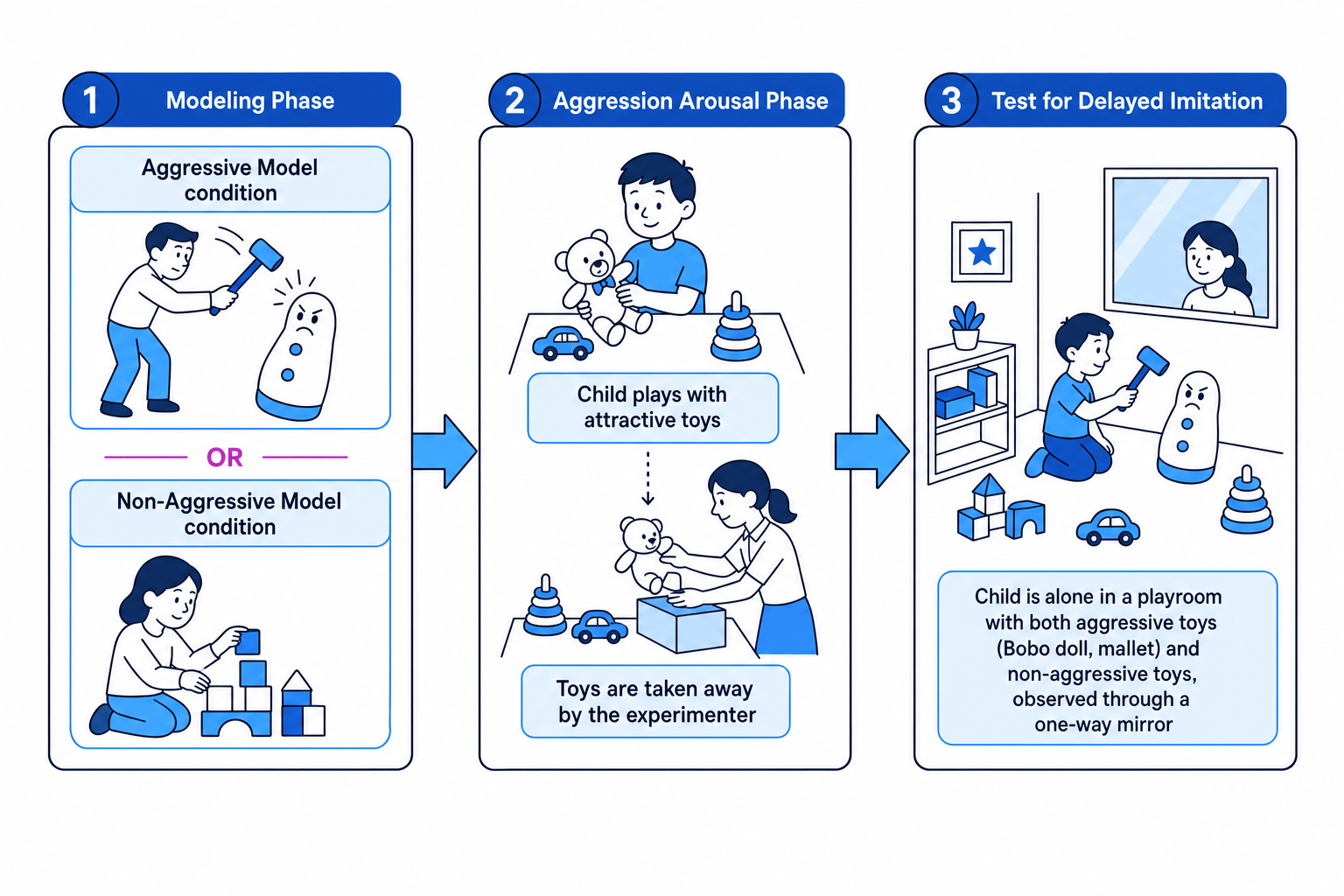
Phase 1: Modeling
Each child was brought individually into a playroom to play with potato prints and stickers.
- In the aggressive condition, an adult model was escorted to the opposite corner of the room containing a tinker toy set, a mallet, and a 5-foot inflatable Bobo doll. After playing quietly for a minute, the model spent the rest of the 10-minute session violently attacking the Bobo doll. They laid it on its side, sat on it, punched it in the nose, kicked it, hit it with the mallet, and tossed it in the air. This physical aggression was accompanied by distinctive verbal statements, such as "Sock him in the nose", "Throw him in the air", and "Pow!".
- In the non-aggressive condition, the model played quietly and peacefully with the toys, ignoring the Bobo doll entirely.
- In the control condition, the children did not see any model.
Phase 2: Aggression Arousal
To ensure the children had the motivation to behave aggressively, all children (including the controls) went through a "mild frustration" phase.
The child was taken to a room with highly attractive toys (like a fire engine and a baby doll set) and allowed to play with them for two minutes. The experimenter then told the child that these were her very best toys, that she was saving them for other children, and that they had to stop playing with them.
Phase 3: Test for Delayed Imitation
The child was taken into a third playroom containing a variety of both aggressive and non-aggressive toys. Aggressive toys included a 3-foot Bobo doll, a mallet, dart guns, and a pegboard. Non-aggressive toys included tea sets, crayons, plastic farm animals, and cars.
The child played for 20 minutes while being observed through a one-way mirror. Observers recorded the child's behaviour every 5 seconds (time sampling).
The One-Way Mirror
The observers did not know which condition the child had been in (this is a blind observation). This prevented observer bias, ensuring the results were objective. The inter-rater reliability was exceptionally high, with a correlation of r=0.89r = 0.89r=0.89 between observers.
Key Findings of the 1961 Study
- The Power of Imitation: Children in the aggressive model condition showed significantly more imitative physical and verbal aggression than children in the non-aggressive or control conditions.
- The Influence of Gender:
- Boys showed significantly more imitative physical aggression than girls.
- Girls showed more imitative verbal aggression when observing a female model.
- Children were more likely to imitate a same-sex model (boys imitated the male aggressive model more than the female; girls imitated the female aggressive model more than the male).
- The Non-Aggressive Effect: Children who watched the non-aggressive model showed very little aggression, often even less than the control group.
The Extension Study: Bandura (1963)
By 1963, television was becoming a staple in family homes. Bandura wanted to know if film-mediated (screen) violence would have the same effect as real-life violence.
Methodology & Conditions
Using a sample of 96 nursery school children, Bandura set up four conditions to compare real-life models against televised models:
- Real-life Aggressive Model: Children watched a live adult model attack the Bobo doll (same as the 1961 study).
- Human Film-Mediated Model: Children watched a movie of the same adult model performing the same aggressive acts on a television screen.
- Cartoon Film-Mediated Model: Children watched a cartoon of a female model dressed as "Herman the Cat" performing the identical aggressive acts in a fantasy cartoon setting.
- Control Group: Children saw no model.
All children went through the same Phase 2 (frustration) and Phase 3 (observation) as the 1961 experiment.
Key Findings of the 1963 Study
- All three aggressive-model conditions (real-life, film, and cartoon) produced significantly higher levels of aggressive behavior than the control group.
- Surprisingly, the children who watched the film-mediated human model and the cartoon model showed just as much (and in some measures, slightly more) imitation of aggression as those who saw the real-life model.
Key Takeaway of the 1963 Study
Exposure to screen violence (even unrealistic cartoon violence) is just as effective at teaching aggressive physical and verbal behaviours to young children as real-life adult modeling.
Applying the Research
In your exam, you will frequently be asked to apply the findings of Bandura's research to real-world scenarios (AO2).
Applying experimental findings to behavioral scenarios
Scenario: Four-year-old Leo watches his older brother, Oscar, aggressively kick and throw a toy dinosaur while shouting "Smash it!". Later that afternoon, Leo is playing in his room with the same dinosaur and begins kicking it and shouting "Smash it!".
Use your knowledge of Bandura (1961, 1963) to explain Leo's behaviour.
Step-by-step application:
-
Identify the social learning process taking place: Leo is engaging in observational learning and delayed imitation. He observed a model (his older brother Oscar) act aggressively, and reproduced the behavior later when the model was no longer present.
-
Apply the role of identification: Oscar is Leo's older brother and is of the same sex. According to Bandura (1961), children identify strongly with same-sex models. This high level of identification increased the likelihood that Leo would imitate Oscar's specific physical and verbal actions.
-
Analyze the exact behavior copied: Leo imitated both the physical actions (kicking/throwing) and the specific verbal phrases ("Smash it!"). This mirrors Bandura's 1961 findings, where children did not just show general aggression, but copied the exact physical and verbal novel aggression modeled to them.
Evaluation (AO3)
To secure top marks in 8-mark or 12-mark essay questions, you must critically evaluate Bandura's studies.
Methodological Strengths
- High Internal Validity: Laboratory settings allowed for absolute control over extraneous variables. The environment, the toys, the actions of the model, and the timing were highly standardised, ensuring that the IV directly caused the changes in the DV.
- Controlled Participant Variables: By using a matched-pairs design, Bandura controlled for individual differences in baseline aggression. If one group had simply been naturally more aggressive, it would have skewed the results; matching prevented this.
- Reliability: The use of structured observations with a clear 5-second time-sampling checklist allowed for objective recording. The high inter-rater reliability correlation (r=0.89r = 0.89r=0.89) means the findings are highly replicable.
Methodological Weaknesses
- Low Ecological Validity: Playing in an artificial lab nursery with a stranger is not representative of real-life play.
- Demand Characteristics: A Bobo doll is a novel toy designed to be hit; it springs back up when struck. Some psychologists argue that the children were not showing true social aggression, but were simply playing with the toy in the way they thought was expected of them. One child was recorded saying, "Look, Mummy, there's the doll we have to hit!"
- Short-term Measurement: The observation took place immediately after exposure. Bandura’s design does not tell us whether the aggressive behavior had long-term, permanent effects on the children's personalities.
Confusing the Bobo doll with a real person
Do not write that the children showed "violence towards others." The children imitated aggression on an inanimate plastic doll. We cannot assume from this study alone that they would strike another human child in the same way.
Ethical Considerations
Evaluating Bandura's work through the BPS Code of Ethics highlights several serious issues:
- Protection from Harm: Children were intentionally frustrated in Phase 2, which may have caused temporary psychological distress. Furthermore, they were encouraged to learn and perform aggressive acts, which could lead to lasting behavioral issues.
- Right to Withdraw: It is highly unlikely that three-to-six-year-old children understood their right to withdraw from the research, nor is there record of them being actively reminded of it.
- Consent: Although parental/school consent was obtained, the children themselves could not give fully informed consent due to their age.
Weighing up ethics in essays
When writing about ethics, balance your critique by mentioning the immense scientific value of the work. Bandura's studies provided the first empirical proof of the risks of media violence, which ultimately led to societal changes like the television "watershed" and age ratings on video games.
In the exam
- Differentiate the years: Keep 1961 (real-life models) and 1963 (film/cartoon models) separate. If an exam question asks generally about "Bandura's Bobo doll studies", you can use both, but make sure you specify which study you are referencing.
- Know the details: Examiners love precise details. Memorise the sample size (72 in 1961; 96 in 1963), the age range (3-6), the matching process, and the specific verbal phrases used ("Pow!", "Sock him in the nose").
- Link to AO3: When evaluating, always link your point back to the study's overall validity. For example, don't just say "it was a lab experiment". Say: "Because it was a lab experiment, the study lacked ecological validity because..."
Check yourself
- Why did Bandura use a matched pairs design instead of an independent groups design?
- What were the three conditions in the 1963 film-mediated aggression study, and what did the findings reveal about cartoon models?
- What ethical guidelines did Bandura potentially breach during the aggression arousal phase?
