What you'll learn
- How to distinguish quantitative data from qualitative data.
- The main data collection techniques that tend to produce each type.
- Why the same method, such as a questionnaire or observation, can produce either type.
- How to evaluate quantitative and qualitative data for AO3 exam answers.
The starting point: what is “data”?
In psychology, researchers collect data so they can answer a research question. Data might be a score on a memory test, a reaction time, a transcript of an interview, or notes from an observation.
Data
Data are the information or evidence collected during research. In psychology, data are usually collected from participants’ behaviour, thoughts, feelings, biology, or self-reports.
Before collecting data, psychologists often need to operationalise what they are studying. This means turning an abstract idea into something measurable or recordable.
Operationalisation
Operationalisation means defining a variable clearly so it can be measured or recorded consistently. For example, “aggression” could be operationalised as “the number of shouted insults in a 10-minute observation”.
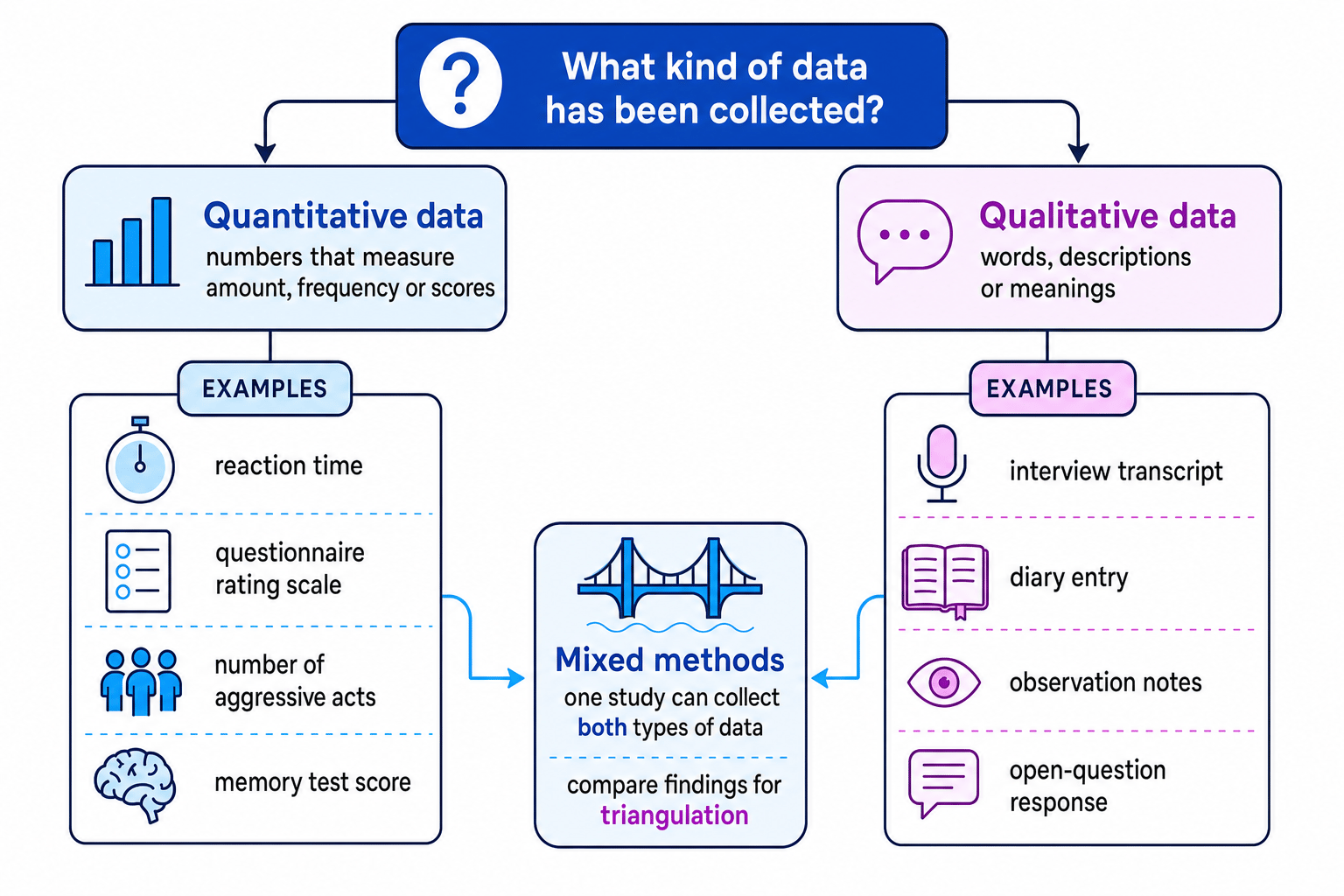
The key distinction in this topic is the form the data take: are they mainly numbers, or are they mainly words and meanings?
Quantitative data: numbers and measurement
Quantitative data
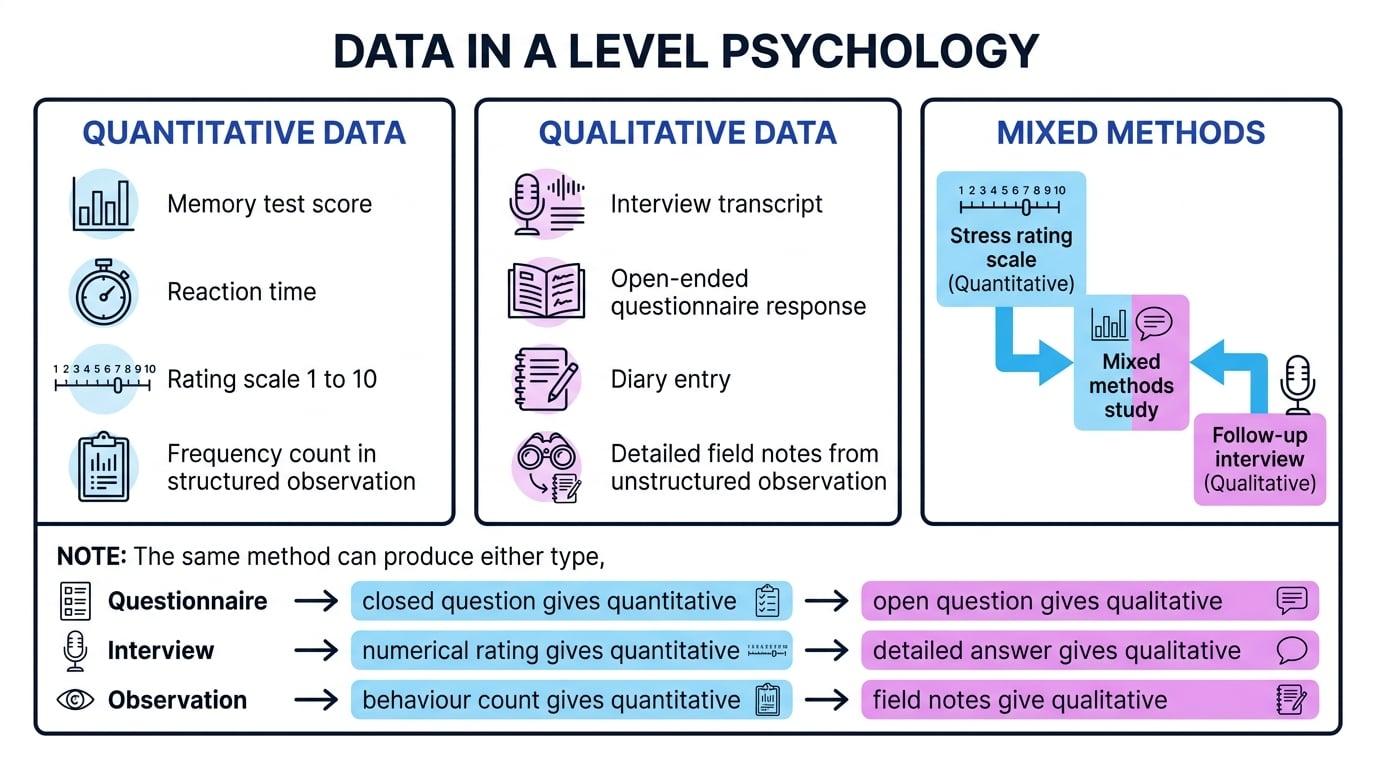
Quantitative data are numerical data. They involve amounts, scores, frequencies, ratings, times, or other measurable values.
Quantitative data answer questions like:
- “How many?”
- “How much?”
- “How often?”
- “What score?”
- “Is one condition higher than another?”
Examples include:
- the number of words recalled in a memory test
- a rating of anxiety from 1 to 10
- the number of aggressive acts observed
- reaction time in a cognitive task
- the percentage of participants who obeyed in Milgram’s research
Quantitative data are often analysed using descriptive statistics, such as means, medians, ranges and graphs. They can also be analysed using inferential statistics, such as Mann-Whitney U, Wilcoxon signed-ranks, Chi-square, Spearman’s rho, Pearson’s r, or t-tests, depending on the design and level of measurement. Researchers often use p<0.05p < 0.05p<0.05 as the default level for statistical significance.
Quantitative data collection techniques
A data collection technique is the method used to gather data from participants.
Quantitative techniques often include:
- Closed questions: participants choose from fixed answers, such as “yes/no” or rating scales.
- Rating scales: participants give a numerical judgement, such as rating stress from 1 to 10.
- Structured observations: researchers count behaviours using pre-set behavioural categories.
- Experiments: researchers measure scores, times, errors, or performance under controlled conditions.
- Psychometric tests: standardised tests or questionnaires that produce numerical scores.
Quantitative headline
Quantitative data are useful when psychologists want to measure behaviour precisely, compare groups or conditions, and test whether findings are statistically significant.
Evaluating quantitative data
Quantitative data have clear strengths. They are usually easier to compare across participants because everyone produces the same kind of response, such as a score or frequency. This can make research more objective, meaning less dependent on the researcher’s personal interpretation.
They are also useful for identifying patterns. For example, Loftus and Palmer (1974) collected quantitative estimates of vehicle speed after participants heard different verbs, such as “smashed” or “contacted”. This allowed the researchers to compare conditions and show how leading questions can affect eyewitness testimony. Ethical issues in this kind of study include the use of deception about the true aim, so valid consent and debriefing are important.
However, quantitative data can be reductionist. This means they may oversimplify complex experiences by reducing them to a number. A rating of “8 out of 10” for anxiety tells you intensity, but not necessarily why the person feels anxious or what that anxiety means to them.
Thinking every number is quantitative
A number is only useful as quantitative data if it represents an amount, score, order, frequency, or measurement. A participant ID number, such as “Participant 17”, is just a label.
Qualitative data: words, meaning and detail
Qualitative data
Qualitative data are non-numerical data. They usually involve words, descriptions, images, meanings, experiences, or interpretations.
Qualitative data answer questions like:
- “What was the experience like?”
- “How did the participant explain their behaviour?”
- “What themes appear in the interview?”
- “What meaning does the behaviour have in context?”
Examples include:
- interview transcripts
- diary entries
- open-ended questionnaire responses
- detailed observation notes
- case study descriptions
- quotations from participants
Qualitative data collection techniques
Qualitative techniques often include:
- Open questions: participants answer in their own words.
- Unstructured interviews: the interviewer explores participants’ experiences flexibly.
- Semi-structured interviews: the interviewer has some planned questions but can ask follow-ups.
- Case studies: detailed investigations of an individual, group, or institution.
- Unstructured observations: researchers record detailed behaviour without fixed categories.
- Focus groups: a group discussion used to explore opinions or experiences.
Qualitative data are usually analysed by looking for themes, which are repeated ideas or patterns of meaning. Researchers may also use content analysis, where qualitative material is coded into categories, and sometimes counted.
Content analysis
Content analysis is a systematic way of analysing qualitative material by identifying categories, themes, or codes. It can produce qualitative interpretations and, if categories are counted, quantitative summaries.
Evaluating qualitative data
Qualitative data are valuable because they provide depth and rich detail. They can reveal thoughts and feelings that a rating scale would miss. This is especially useful when studying sensitive topics such as mental health, attachment experiences, or obedience to authority.
For example, Rosenhan (1973) used detailed observations and notes during the “sane in insane places” study, which helped show how psychiatric labels affected staff interpretations of behaviour. However, this study also raises ethical issues, including deception, lack of informed consent from hospital staff, and confidentiality concerns.
Qualitative data can also improve ecological validity, meaning the findings may better reflect real-life experience. Participants can explain themselves in their own words rather than being forced into fixed response options.
The main weakness is that qualitative analysis can be more subjective. Different researchers might interpret the same interview differently. To improve reliability, researchers may use clear coding systems and check inter-rater reliability, where more than one researcher codes the same data and their agreement is compared.
Assuming qualitative means less scientific
Qualitative data can be rigorous if researchers use systematic methods, clear coding, transparency, and checks on interpretation. The issue is not whether the data are “scientific”, but whether they are collected and analysed carefully.
Data type is not the same as research method
This is a very important exam point: the same general method can produce different types of data.
| Research method | Quantitative version | Qualitative version |
|---|---|---|
| Questionnaire | Rating scale or closed question | Open-ended written response |
| Interview | Fixed questions with numerical ratings | Participant explains experiences in detail |
| Observation | Count behaviours in categories | Write detailed field notes |
| Experiment | Measure recall score or reaction time | Ask participants to describe their strategy |
| Case study | Record test scores over time | Describe life history and personal experiences |
Technique versus data type
Do not identify the data type just from the method name. Ask what the researcher actually recorded: numbers usually indicate quantitative data; words, meanings and descriptions usually indicate qualitative data.
Classifying data in a research scenario
A researcher investigates social media use and self-esteem. Participants complete a self-esteem rating from 1 to 10, then answer the question: “How does social media make you feel about yourself?” The researcher also counts how many participants mention appearance concerns.
- The self-esteem rating is quantitative because it produces a numerical score that can be compared across participants.
- The written answer is qualitative because participants explain their feelings in their own words, giving meaning and detail.
- The count of participants mentioning appearance concerns is quantitative because the researcher has turned responses into a frequency.
- The original written responses still matter because they provide qualitative evidence, such as quotations showing how participants describe appearance pressure.
Mixed methods and triangulation
Some studies collect both quantitative and qualitative data. This is called a mixed methods approach.
Mixed methods
Mixed methods research combines quantitative and qualitative data within the same study or research programme.
For example, a psychologist studying exam stress might ask students to rate their stress from 1 to 10, then interview them about what causes the stress. The rating gives numerical comparison; the interview gives depth and context.
A key advantage of mixed methods is triangulation.
Triangulation
Triangulation means using more than one method or data source to see whether findings support each other.
If questionnaire scores show high stress and interviews also reveal detailed accounts of anxiety, the findings may be more convincing. But mixed methods can be time-consuming, and sometimes the two types of data may not agree. That is not automatically a problem, but it does require careful interpretation.
Ethical issues linked to data collection
Ethics matter for both quantitative and qualitative data.
With quantitative data, researchers should still protect participants from harm, gain consent, respect the right to withdraw, maintain confidentiality, and debrief participants. For example, if a stress scale reveals high anxiety, the researcher may need to provide support information.
With qualitative data, confidentiality can be especially important because detailed quotes may make participants identifiable. If interviews are recorded, participants should know how recordings will be stored, who will hear them, and whether quotations may be used.
Ethics shortcut
For qualitative data, always think: “Could this person be identified from the detail they gave?” If yes, confidentiality and anonymisation are especially important.
How to choose between quantitative and qualitative data
Use quantitative data when the research aim is to measure, compare, count, or test a hypothesis. This is useful for experiments and correlations where statistical analysis is needed.
Use qualitative data when the research aim is to explore meaning, experience, or context. This is useful when the topic is complex, personal, or not yet well understood.
Choosing a data collection technique
A psychologist wants to investigate whether mindfulness reduces exam anxiety, but also wants to understand students’ personal experiences of mindfulness.
- To test whether anxiety changes, the psychologist could use a numerical anxiety scale before and after mindfulness training. This produces quantitative data suitable for comparison.
- To understand students’ experiences, the psychologist could use semi-structured interviews after the training. This produces qualitative data about thoughts, feelings and perceived usefulness.
- A mixed methods design would be appropriate because the study has two aims: measuring change and exploring personal meaning.
In the exam
- If asked to identify the data type, focus on what is recorded: numbers suggest quantitative data; words and meanings suggest qualitative data.
- If asked to evaluate, balance your answer: quantitative data are easier to compare and analyse statistically, but may lack depth; qualitative data provide richness, but may be harder to analyse objectively.
- In application questions, be precise: say “a closed questionnaire using rating scales produces quantitative data” or “an unstructured interview transcript produces qualitative data”, rather than just naming the method.
Check yourself
- Why could an observation produce either quantitative or qualitative data?
- What is one strength and one limitation of using qualitative interviews?
- How could a researcher use both quantitative and qualitative data to study obedience?