

What you'll learn
- How sine, cosine and tangent connect angles to side lengths.
- When to use the sine rule, cosine rule and area formula.
- How to handle exact values and the “two possible angles” situation.
- How to sketch simple sine and cosine graphs from 0° to 360°.
1. Starting point: right-angled triangle ratios
A ratio compares two quantities by division. In trigonometry, the main ratios compare side lengths in a right-angled triangle.
For an angle θ\thetaθ:
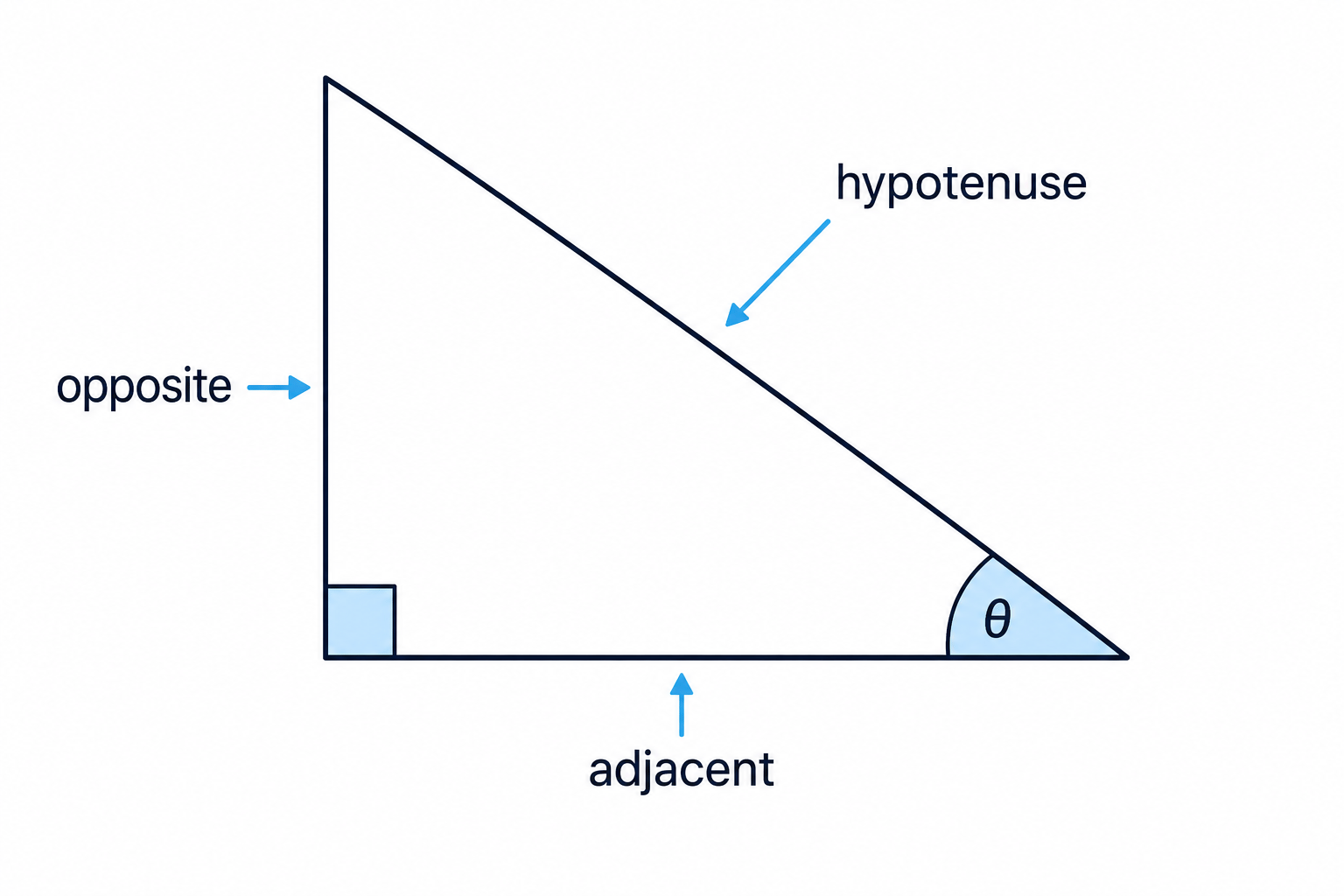
- The hypotenuse is the longest side, opposite the right angle.
- The opposite side is opposite θ\thetaθ.
- The adjacent side touches θ\thetaθ, but is not the hypotenuse.
SOH CAH TOA
In a right-angled triangle,
sinθ=oppositehypotenuse,cosθ=adjacenthypotenuse,tanθ=oppositeadjacent\sin \theta = \frac{\text{opposite}}{\text{hypotenuse}}, \qquad \cos \theta = \frac{\text{adjacent}}{\text{hypotenuse}}, \qquad \tan \theta = \frac{\text{opposite}}{\text{adjacent}}sinθ=hypotenuseopposite,cosθ=hypotenuseadjacent,tanθ=adjacentoppositeCalculator mode
For these notes, angles are in degrees. Make sure your calculator is in degree mode before using sin\sinsin, cos\coscos, tan\tantan or their inverse functions.
Using a basic trigonometric ratio
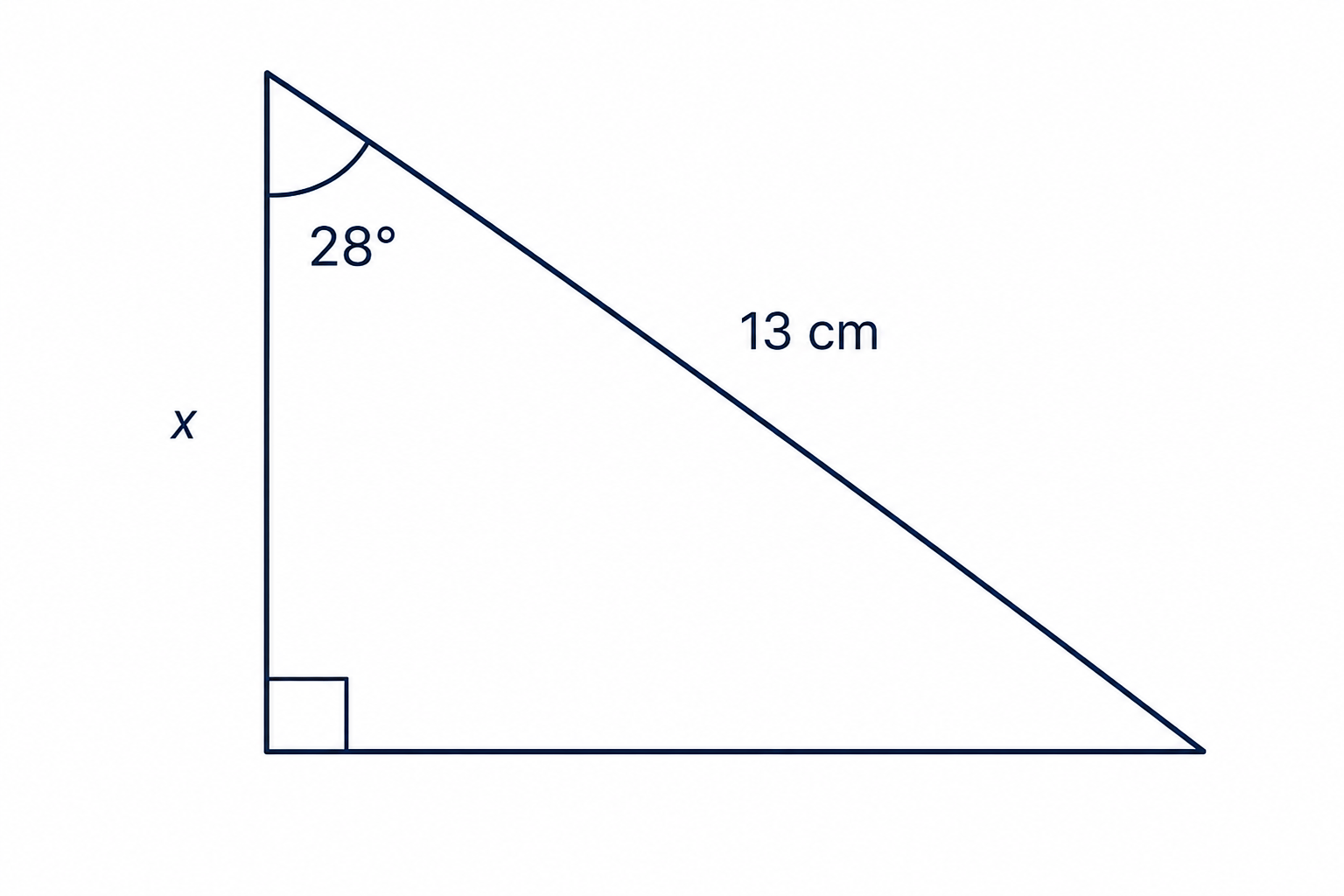
A right-angled triangle has hypotenuse 13 cm and an angle of 28°. Find the side opposite the 28° angle.
-
Choose the ratio involving opposite and hypotenuse: sinθ\sin \thetasinθ.
-
Substitute the values:
sin28∘=x13\sin 28^\circ = \frac{x}{13}sin28∘=13x -
Rearrange to find the side length:
x=13sin28∘≈6.10x = 13\sin 28^\circ \approx 6.10x=13sin28∘≈6.10
2. Labelling non-right-angled triangles
At AS Level, you often work with triangles that are not right-angled. We use a standard labelling convention:
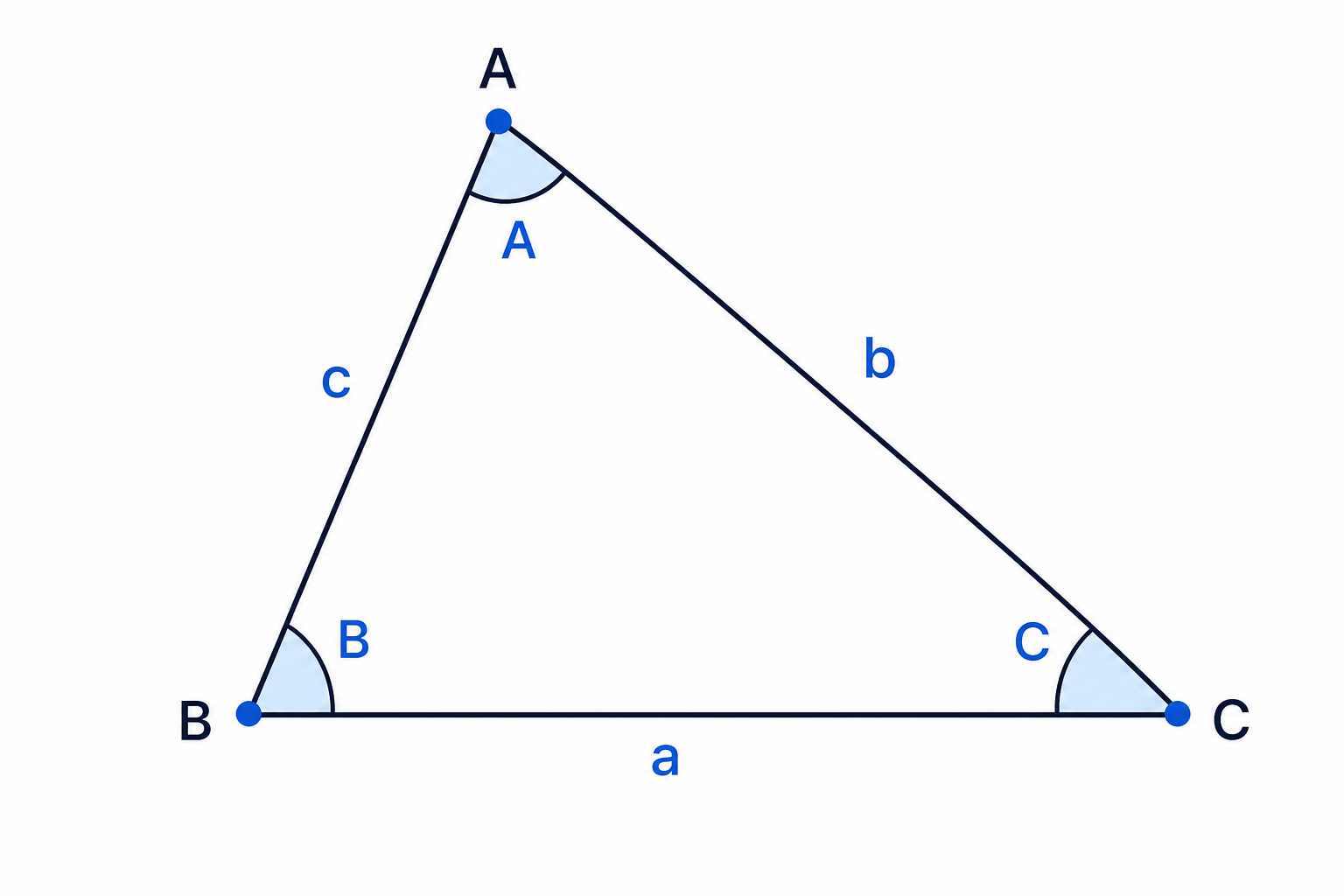
- Angle AAA is opposite side aaa.
- Angle BBB is opposite side bbb.
- Angle CCC is opposite side ccc.
This matters because the sine rule and cosine rule are built around opposite angle-side pairs.
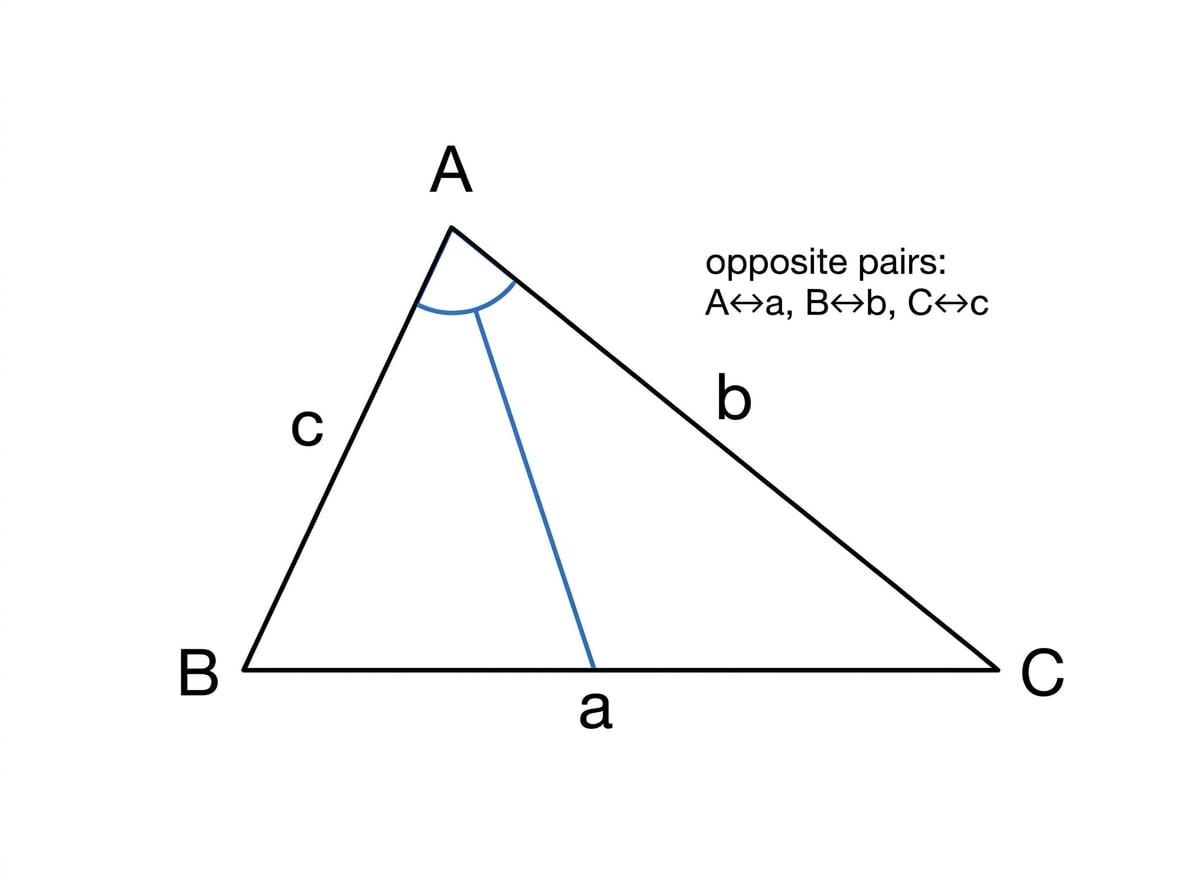
Label before calculating
Before choosing a formula, mark the angle you know and the side opposite it. Most mistakes in this topic come from using the wrong opposite pair.
3. Area of a triangle using sine
You already know:
Area of a triangle=12×base×height\text{Area of a triangle} = \frac{1}{2} \times \text{base} \times \text{height}Area of a triangle=21×base×heightFor a non-right-angled triangle, the height may not be given directly. If you know two sides and the included angle between them, use:
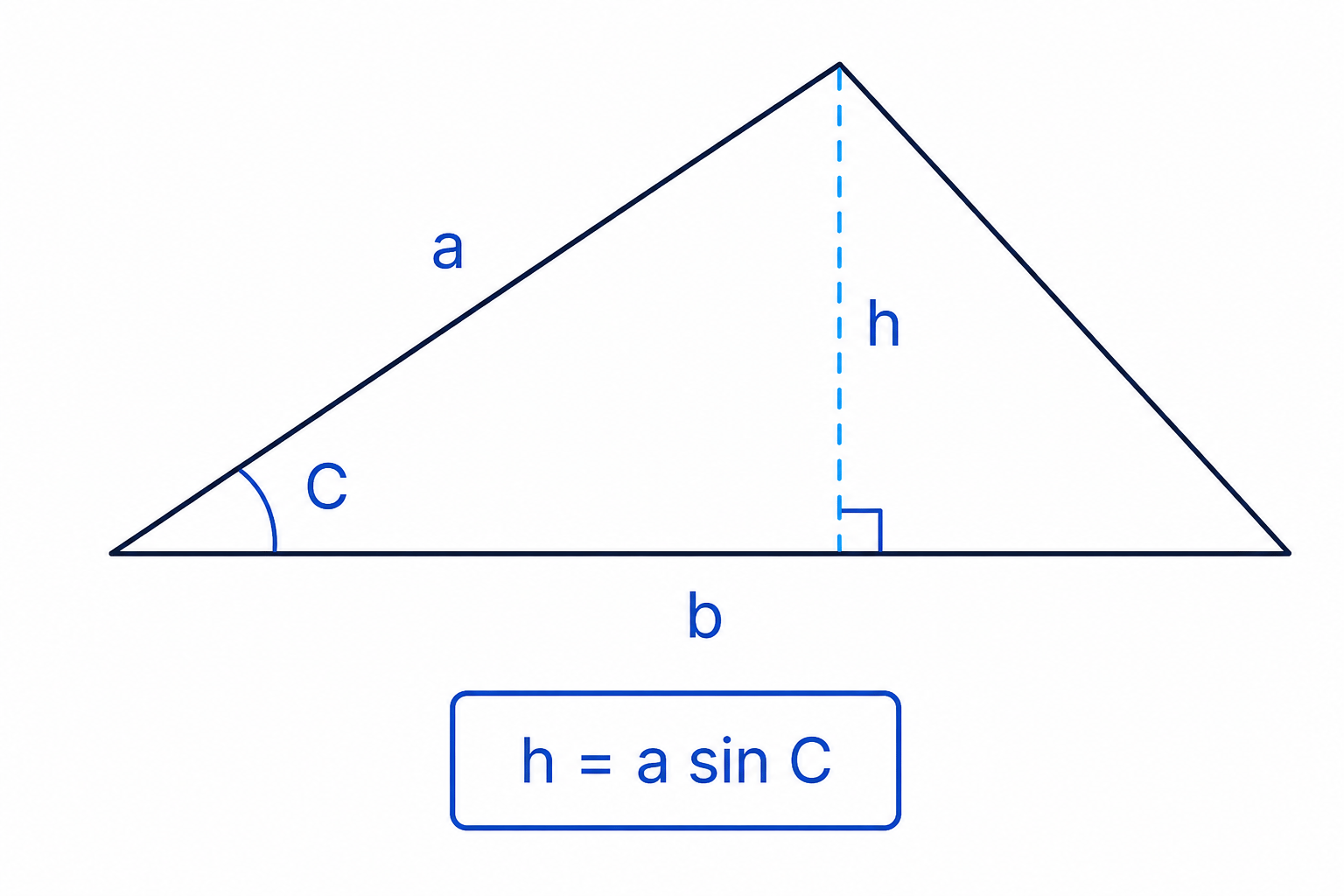
Here, aaa and bbb are the two known sides, and CCC is the angle between them.
Included angle
The included angle is the angle between two given sides. For example, if you know sides ABABAB and ACACAC, the included angle is angle BACBACBAC.
Finding an area from two sides and an included angle
In triangle ABCABCABC, AB=14 cmAB = 14\text{ cm}AB=14 cm, AC=9 cmAC = 9\text{ cm}AC=9 cm and angle BAC=35∘BAC = 35^\circBAC=35∘. Find the area.
-
The known sides meet at AAA, so the included angle is 35°.
-
Substitute into the area formula:
Area=12×14×9×sin35∘\text{Area} = \frac{1}{2} \times 14 \times 9 \times \sin 35^\circArea=21×14×9×sin35∘ -
Simplify and calculate:
Area=63sin35∘≈36.1 cm2\text{Area} = 63\sin 35^\circ \approx 36.1\text{ cm}^2Area=63sin35∘≈36.1 cm2
Using the wrong angle in the area formula
The angle in 12absinC\frac{1}{2}ab\sin C21absinC must be between the two sides you are multiplying. If the angle is not included, do not use this formula directly.
4. The cosine rule
Use the cosine rule when you know:
- two sides and the included angle, and want the third side; or
- all three sides, and want an angle.
The main form is:
a2=b2+c2−2bccosAa^2 = b^2 + c^2 - 2bc\cos Aa2=b2+c2−2bccosAThis finds side aaa, which is opposite angle AAA.
To find an angle, rearrange it:
cosA=b2+c2−a22bc\cos A = \frac{b^2 + c^2 - a^2}{2bc}cosA=2bcb2+c2−a2Finding a side using the cosine rule
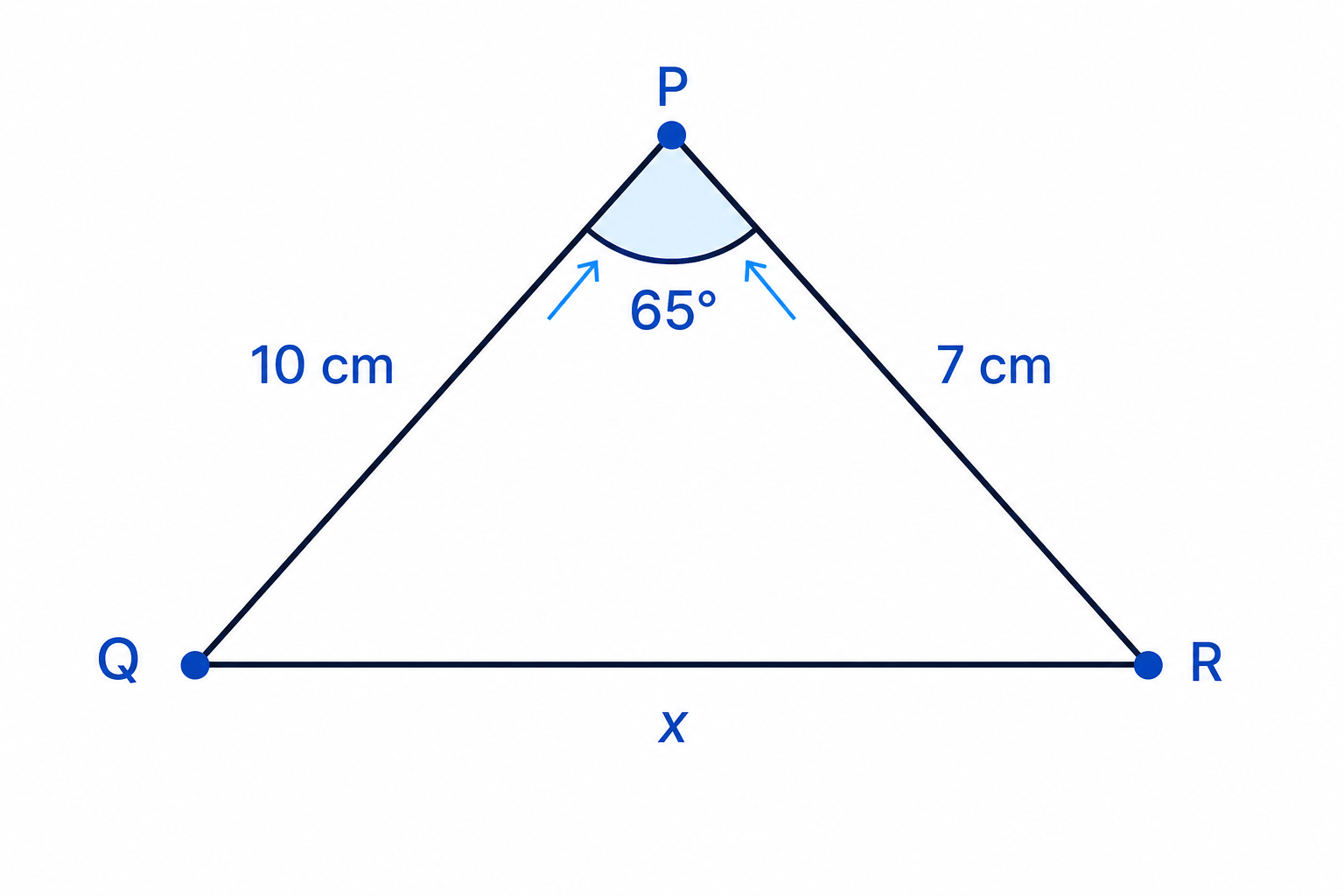
In triangle PQRPQRPQR, PQ=10 cmPQ = 10\text{ cm}PQ=10 cm, PR=7 cmPR = 7\text{ cm}PR=7 cm and angle QPR=65∘QPR = 65^\circQPR=65∘. Find QRQRQR to 3 significant figures.
-
The side opposite angle PPP is QRQRQR, so use the cosine rule with QRQRQR as the unknown side.
-
Substitute carefully:
QR2=102+72−2×10×7×cos65∘QR^2 = 10^2 + 7^2 - 2 \times 10 \times 7 \times \cos 65^\circQR2=102+72−2×10×7×cos65∘ -
Calculate QR2QR^2QR2 first:
QR2≈89.83QR^2 \approx 89.83QR2≈89.83 -
Square root to find the length:
QR≈9.48 cmQR \approx 9.48\text{ cm}QR≈9.48 cm
Finding an angle and then an exact area
In triangle XYZXYZXYZ, XY=5 cmXY = 5\text{ cm}XY=5 cm, YZ=8 cmYZ = 8\text{ cm}YZ=8 cm and XZ=7 cmXZ = 7\text{ cm}XZ=7 cm. Find cosY\cos YcosY, then find the exact area.
-
Angle YYY is between sides XYXYXY and YZYZYZ. The side opposite angle YYY is XZXZXZ.
-
Use the rearranged cosine rule:
cosY=52+82−722×5×8\cos Y = \frac{5^2 + 8^2 - 7^2}{2 \times 5 \times 8}cosY=2×5×852+82−72 -
Simplify:
cosY=25+64−4980=12\cos Y = \frac{25 + 64 - 49}{80} = \frac{1}{2}cosY=8025+64−49=21 -
Since cosY=12\cos Y = \frac{1}{2}cosY=21, we have Y=60∘Y = 60^\circY=60∘, so use the area formula:
Area=12×5×8×sin60∘=103 cm2\text{Area} = \frac{1}{2} \times 5 \times 8 \times \sin 60^\circ = 10\sqrt{3}\text{ cm}^2Area=21×5×8×sin60∘=103 cm2
5. Algebra with the cosine rule
Sometimes the side lengths contain an unknown, such as xxx. The method is the same: substitute, expand, simplify and solve.
Solving for an unknown side expression
In triangle ABCABCABC, AB=(x+5) cmAB = (x+5)\text{ cm}AB=(x+5) cm, AC=x cmAC = x\text{ cm}AC=x cm, BC=(x+3) cmBC = (x+3)\text{ cm}BC=(x+3) cm and angle BAC=60∘BAC = 60^\circBAC=60∘. Find xxx.
-
The side opposite angle AAA is BCBCBC, so BC=x+3BC = x+3BC=x+3 goes on the left of the cosine rule.
-
Substitute into a2=b2+c2−2bccosAa^2 = b^2 + c^2 - 2bc\cos Aa2=b2+c2−2bccosA:
(x+3)2=(x+5)2+x2−2(x+5)xcos60∘(x+3)^2 = (x+5)^2 + x^2 - 2(x+5)x\cos 60^\circ(x+3)2=(x+5)2+x2−2(x+5)xcos60∘ -
Use cos60∘=12\cos 60^\circ = \frac{1}{2}cos60∘=21 and simplify:
(x+3)2=(x+5)2+x2−(x+5)x(x+3)^2 = (x+5)^2 + x^2 - (x+5)x(x+3)2=(x+5)2+x2−(x+5)x -
Expand both sides:
x2+6x+9=x2+5x+25x^2 + 6x + 9 = x^2 + 5x + 25x2+6x+9=x2+5x+25 -
Solve:
x=16x = 16x=16
6. The sine rule and the ambiguous case
Use the sine rule when you know an opposite angle-side pair and another side or angle.
asinA=bsinB=csinC\frac{a}{\sin A} = \frac{b}{\sin B} = \frac{c}{\sin C}sinAa=sinBb=sinCcEquivalently,
sinAa=sinBb=sinCc\frac{\sin A}{a} = \frac{\sin B}{b} = \frac{\sin C}{c}asinA=bsinB=csinCThe second version is often neater when finding an angle.
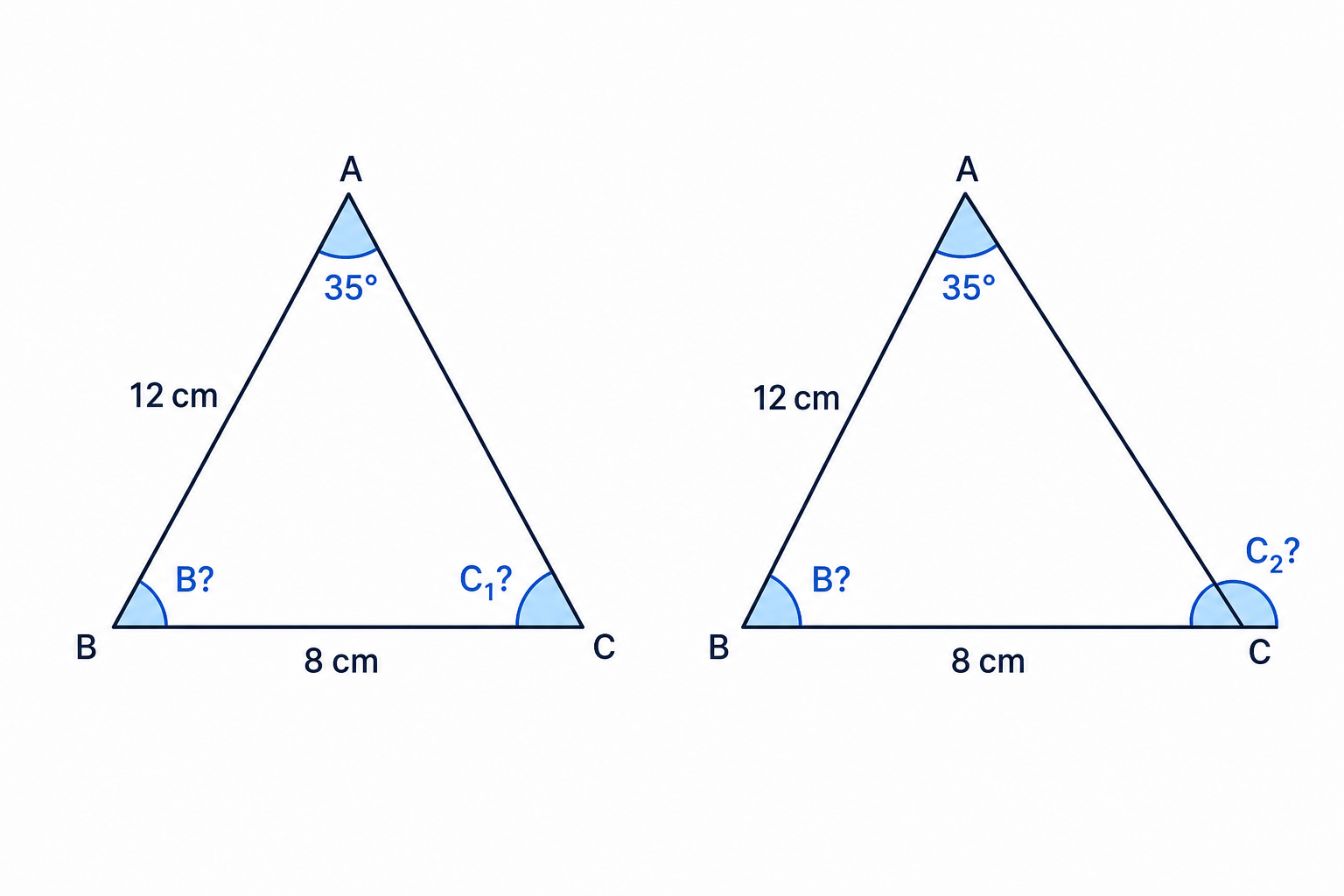
Finding two possible angles
In triangle ABCABCABC, AB=12 cmAB = 12\text{ cm}AB=12 cm, BC=8 cmBC = 8\text{ cm}BC=8 cm and angle BAC=35∘BAC = 35^\circBAC=35∘. Find the two possible values of angle ABCABCABC to one decimal place.
-
Match opposite pairs: BCBCBC is opposite angle AAA, and ABABAB is opposite angle CCC.
-
Use the sine rule to find angle CCC:
sinC12=sin35∘8\frac{\sin C}{12} = \frac{\sin 35^\circ}{8}12sinC=8sin35∘ -
Rearrange:
sinC=12sin35∘8≈0.8604\sin C = \frac{12\sin 35^\circ}{8} \approx 0.8604sinC=812sin35∘≈0.8604 -
Find the two possible values of CCC:
C≈59.4∘orC≈120.6∘C \approx 59.4^\circ \quad \text{or} \quad C \approx 120.6^\circC≈59.4∘orC≈120.6∘ -
Use angles in a triangle to find angle BBB:
B=180∘−35∘−CB = 180^\circ - 35^\circ - CB=180∘−35∘−C -
Therefore the two possible values are:
B≈85.6∘orB≈24.4∘B \approx 85.6^\circ \quad \text{or} \quad B \approx 24.4^\circB≈85.6∘orB≈24.4∘
Forgetting the second sine angle
If sinθ=k\sin \theta = ksinθ=k, your calculator gives one angle. In a triangle, the other possible angle is 180∘−θ180^\circ - \theta180∘−θ, as long as the angle sum still works.
7. Exact values from sin2θ+cos2θ=1\sin^2 \theta + \cos^2 \theta = 1sin2θ+cos2θ=1
The identity
sin2θ+cos2θ=1\sin^2 \theta + \cos^2 \theta = 1sin2θ+cos2θ=1is useful when you are given one trigonometric ratio and need another.
If the angle is acute, then both sine and cosine are positive.
Finding an exact cosine value
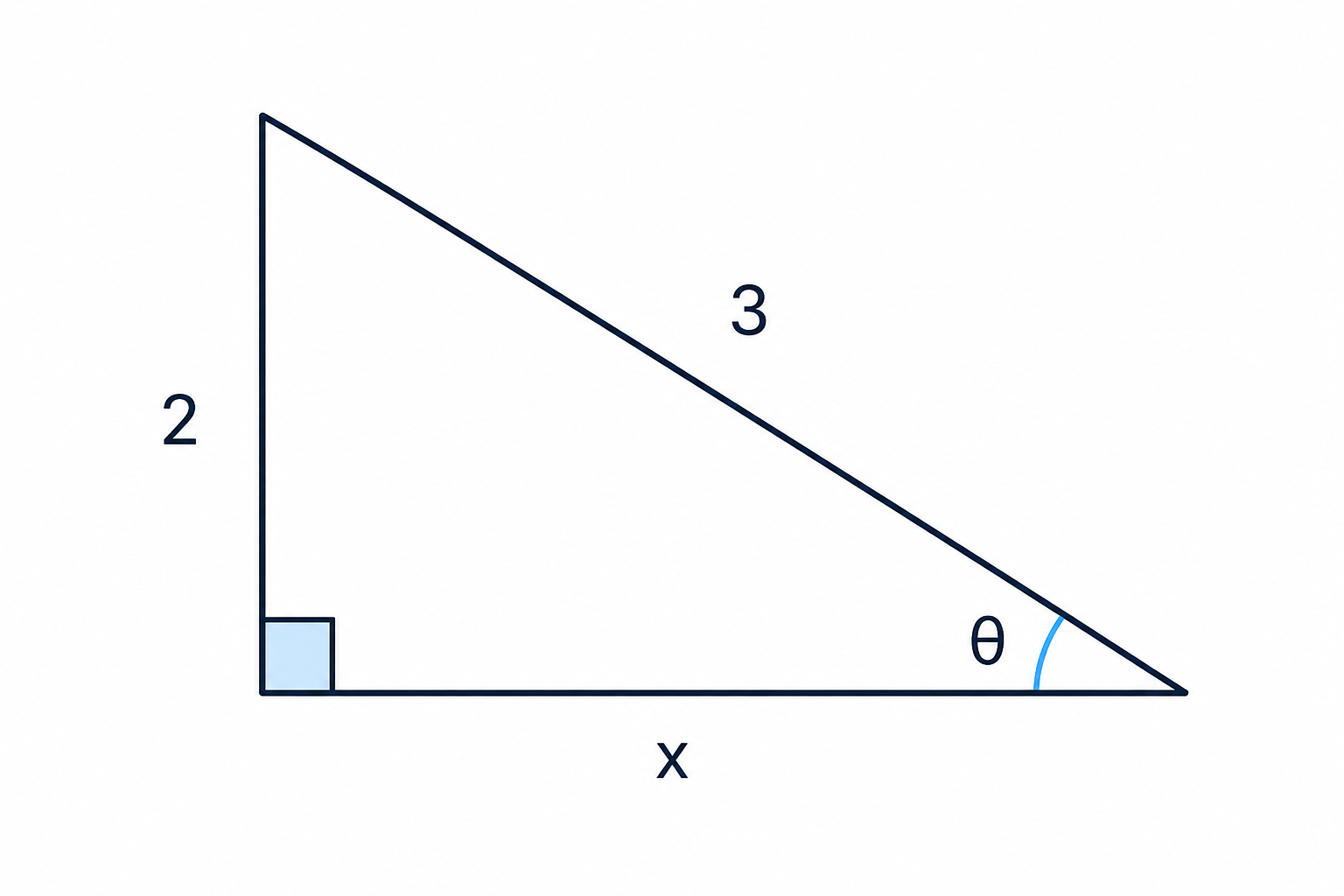
Angle θ\thetaθ is acute and sinθ=23\sin \theta = \frac{2}{3}sinθ=32. Find the exact value of cosθ\cos \thetacosθ.
-
Start with the identity:
sin2θ+cos2θ=1\sin^2 \theta + \cos^2 \theta = 1sin2θ+cos2θ=1 -
Substitute sinθ=23\sin \theta = \frac{2}{3}sinθ=32:
(23)2+cos2θ=1\left(\frac{2}{3}\right)^2 + \cos^2 \theta = 1(32)2+cos2θ=1 -
Rearrange:
cos2θ=1−49=59\cos^2 \theta = 1 - \frac{4}{9} = \frac{5}{9}cos2θ=1−94=95 -
Since θ\thetaθ is acute, choose the positive square root:
cosθ=53\cos \theta = \frac{\sqrt{5}}{3}cosθ=35
8. Sketching sine and cosine graphs
For 0≤x≤360∘0 \le x \le 360^\circ0≤x≤360∘, remember the key values:
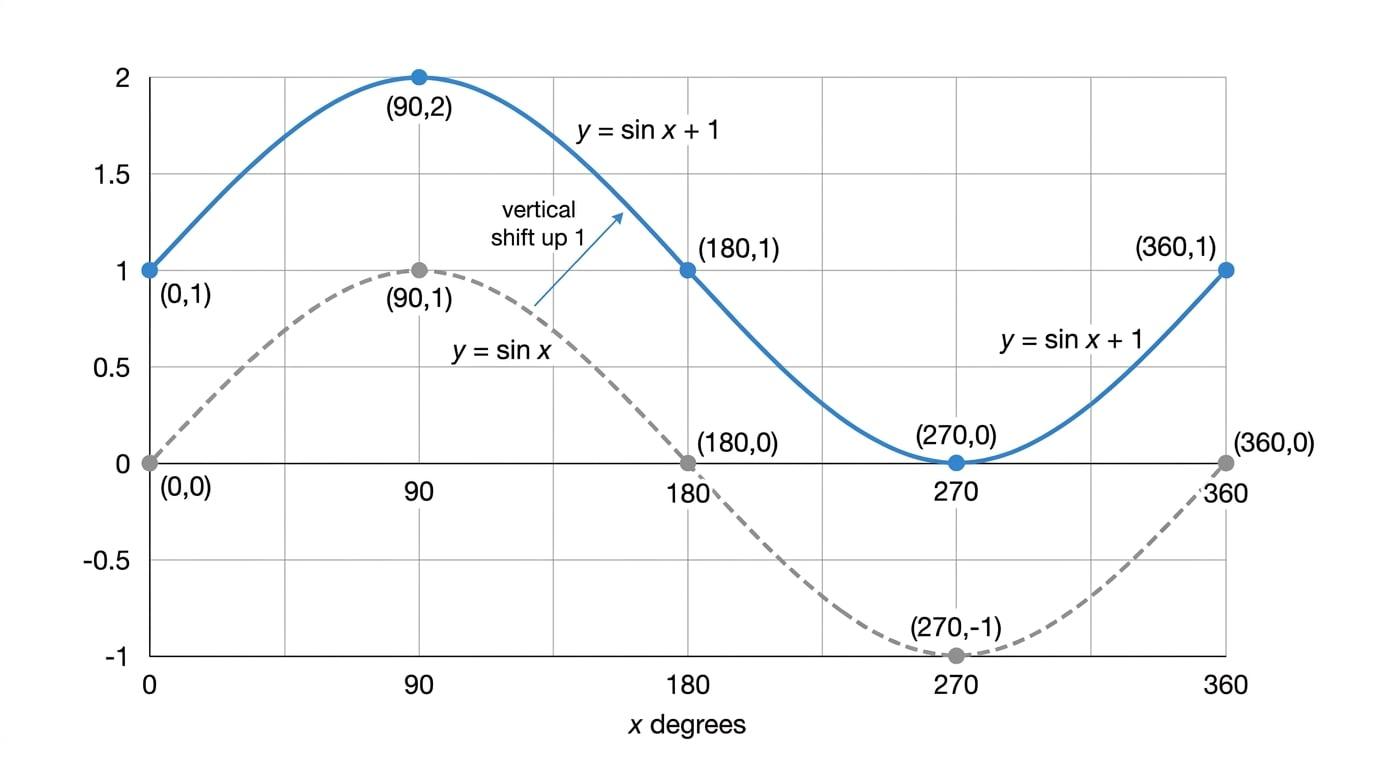
- y=sinxy = \sin xy=sinx starts at 0, reaches 1 at 90°, returns to 0 at 180°, reaches -1 at 270°, then returns to 0 at 360°.
- y=cosxy = \cos xy=cosx starts at 1, reaches 0 at 90°, reaches -1 at 180°, returns to 0 at 270°, then reaches 1 at 360°.
A vertical shift moves the graph up or down. For example, y=sinx+1y = \sin x + 1y=sinx+1 is the sine graph shifted up by 1.
Sketching a transformed cosine graph
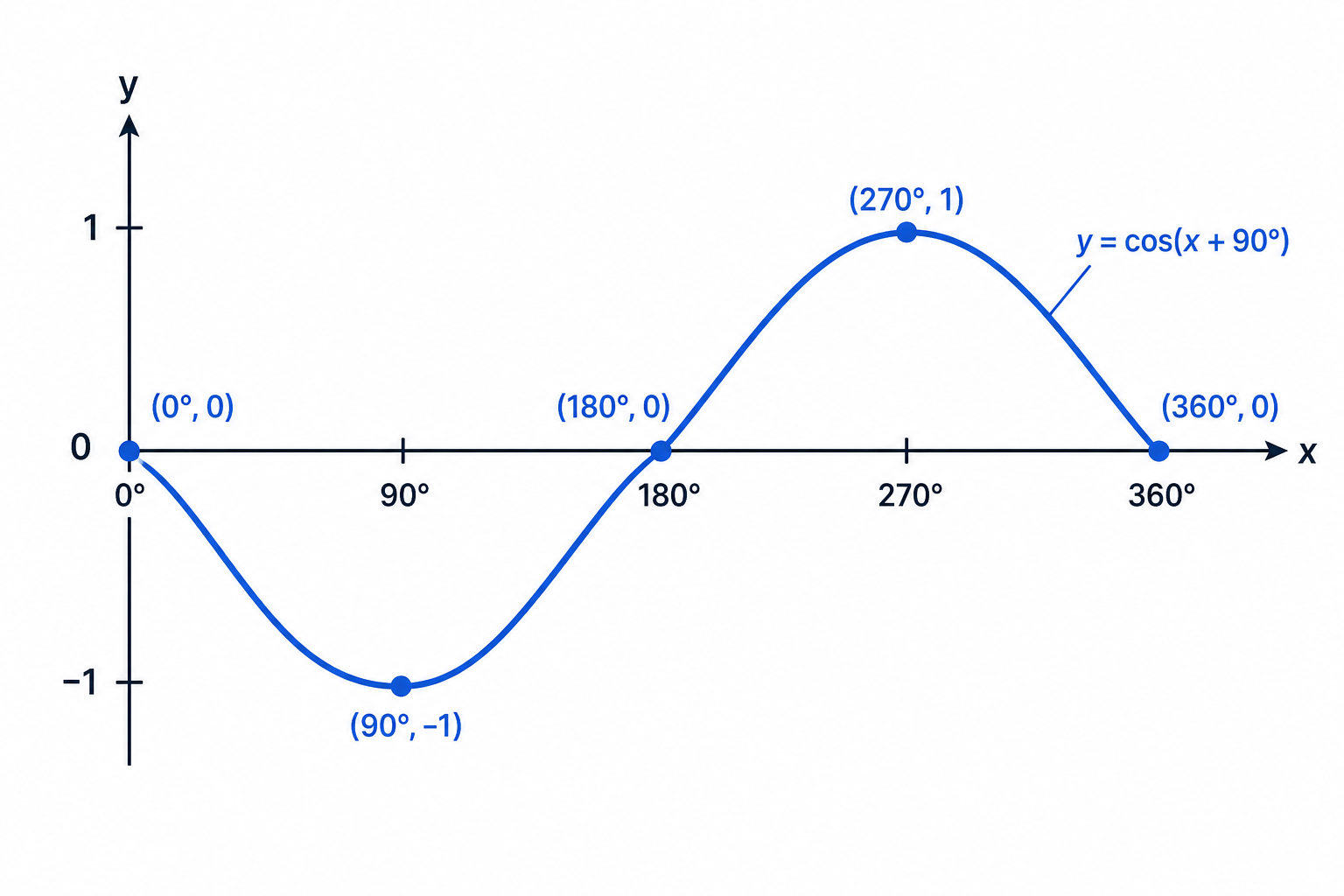
Sketch y=cos(x+90∘)y = \cos(x+90^\circ)y=cos(x+90∘) for 0≤x≤360∘0 \le x \le 360^\circ0≤x≤360∘.
-
Work out the value of the expression inside cosine at key values of xxx:
x=0∘:y=cos90∘=0x=90∘:y=cos180∘=−1x=180∘:y=cos270∘=0x=270∘:y=cos360∘=1x=360∘:y=cos450∘=0\begin{aligned} x = 0^\circ &: \quad y = \cos 90^\circ = 0 \\ x = 90^\circ &: \quad y = \cos 180^\circ = -1 \\ x = 180^\circ &: \quad y = \cos 270^\circ = 0 \\ x = 270^\circ &: \quad y = \cos 360^\circ = 1 \\ x = 360^\circ &: \quad y = \cos 450^\circ = 0 \end{aligned}x=0∘x=90∘x=180∘x=270∘x=360∘:y=cos90∘=0:y=cos180∘=−1:y=cos270∘=0:y=cos360∘=1:y=cos450∘=0 -
Plot the points (0,0)(0,0)(0,0), (90,−1)(90,-1)(90,−1), (180,0)(180,0)(180,0), (270,1)(270,1)(270,1) and (360,0)(360,0)(360,0).
-
Join the points with a smooth wave-shaped curve.
-
Notice that y=cos(x+90∘)y = \cos(x+90^\circ)y=cos(x+90∘) has the same shape as y=−sinxy = -\sin xy=−sinx.
In the exam
-
Label opposite angle-side pairs before choosing a formula.
-
Use the cosine rule for two sides with the included angle, or for all three sides.
-
Use the sine rule when you have an opposite pair, and always check for a second possible angle.
-
For graph sketches, plot the five key x-values: 0°, 90°, 180°, 270° and 360°.
Check yourself
-
Which formula would you use if you knew two sides and the angle between them?
-
Why can sinθ=0.6\sin \theta = 0.6sinθ=0.6 lead to two possible angles in a triangle?
-
What are the key points of y=sinx+1y = \sin x + 1y=sinx+1 between 0° and 360°?
