What you'll learn
- How to expand powers such as (2+x2)6\left(2+\frac{x}{2}\right)^6(2+2x)6 without multiplying out six brackets.
- How to write terms in ascending powers of xxx.
- How to use an expansion to estimate values like 1.0481.04^81.048.
- How to find unknown constants by comparing coefficients.
1. Brackets, terms, and coefficients
When you multiply out brackets, you are expanding them. For example, expanding (a+b)3(a+b)^3(a+b)3 means multiplying (a+b)(a+b)(a+b)(a+b)(a+b)(a+b)(a+b)(a+b)(a+b) and collecting like terms.
Key vocabulary
- A binomial is an expression with two terms, such as a+ba+ba+b or 2−5x2-5x2−5x.
- A term is one separate part of an expression, such as 12x212x^212x2.
- The coefficient of a term is the number multiplying the variable part. In 12x212x^212x2, the coefficient of x2x^2x2 is 12.
- Ascending powers of xxx means writing terms in the order constant, xxx, x2x^2x2, x3x^3x3, and so on.
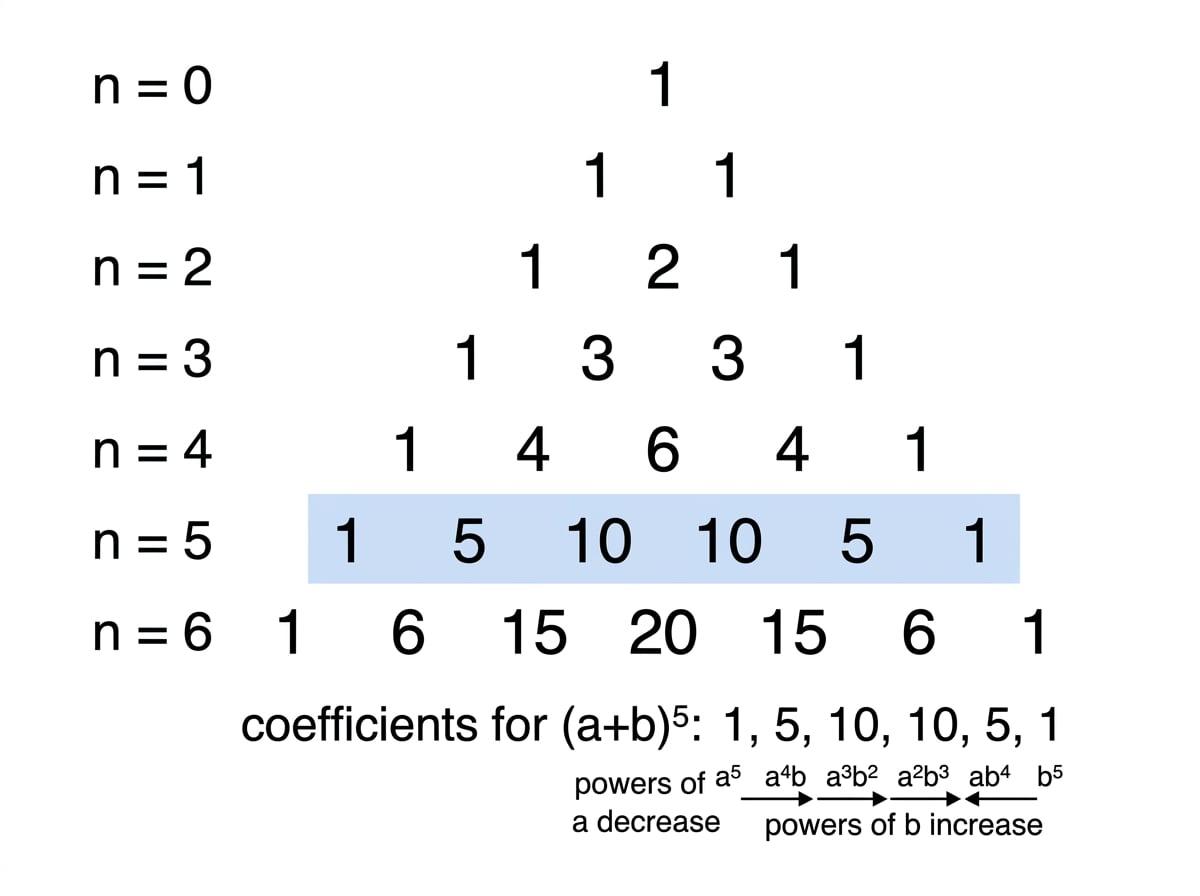
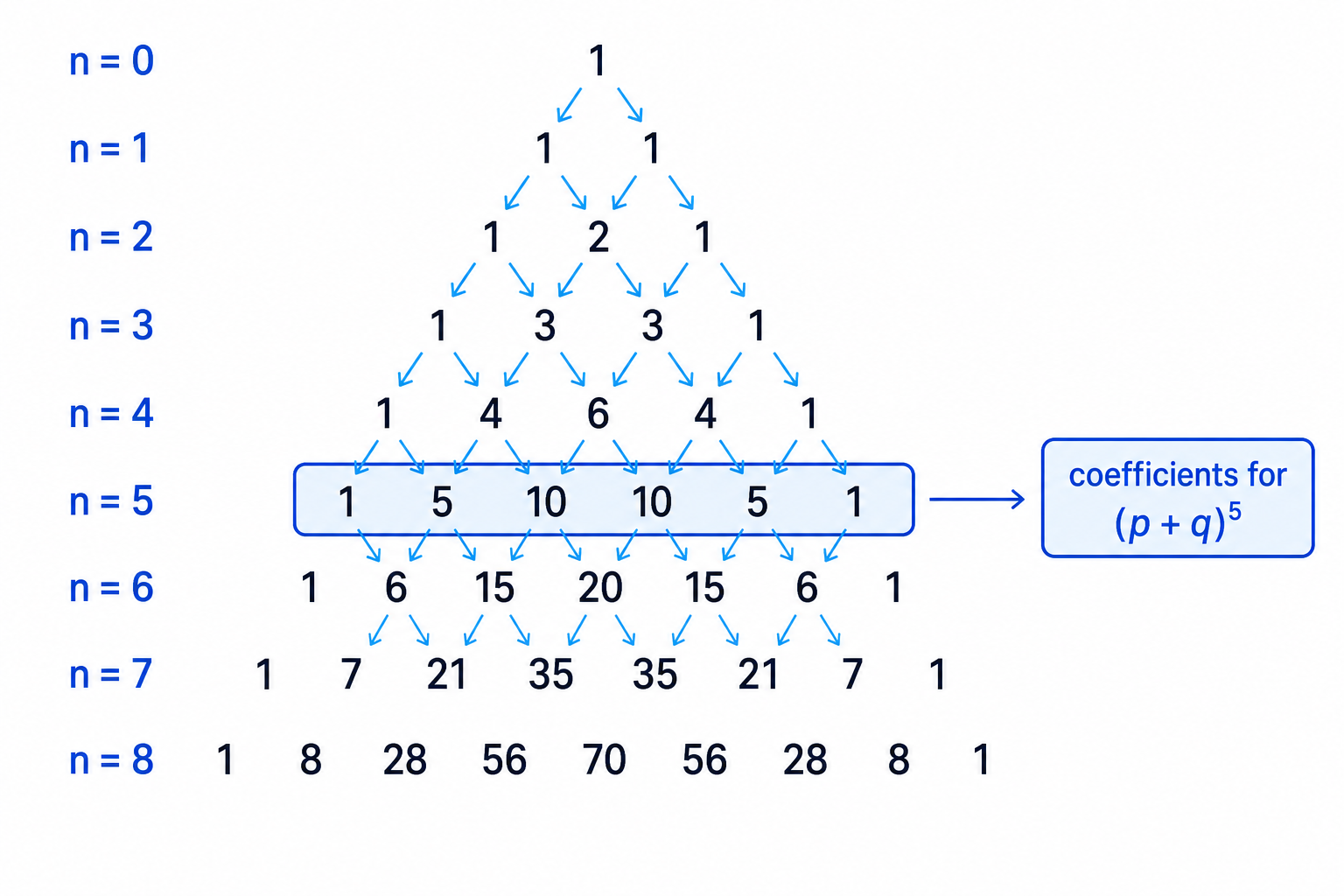
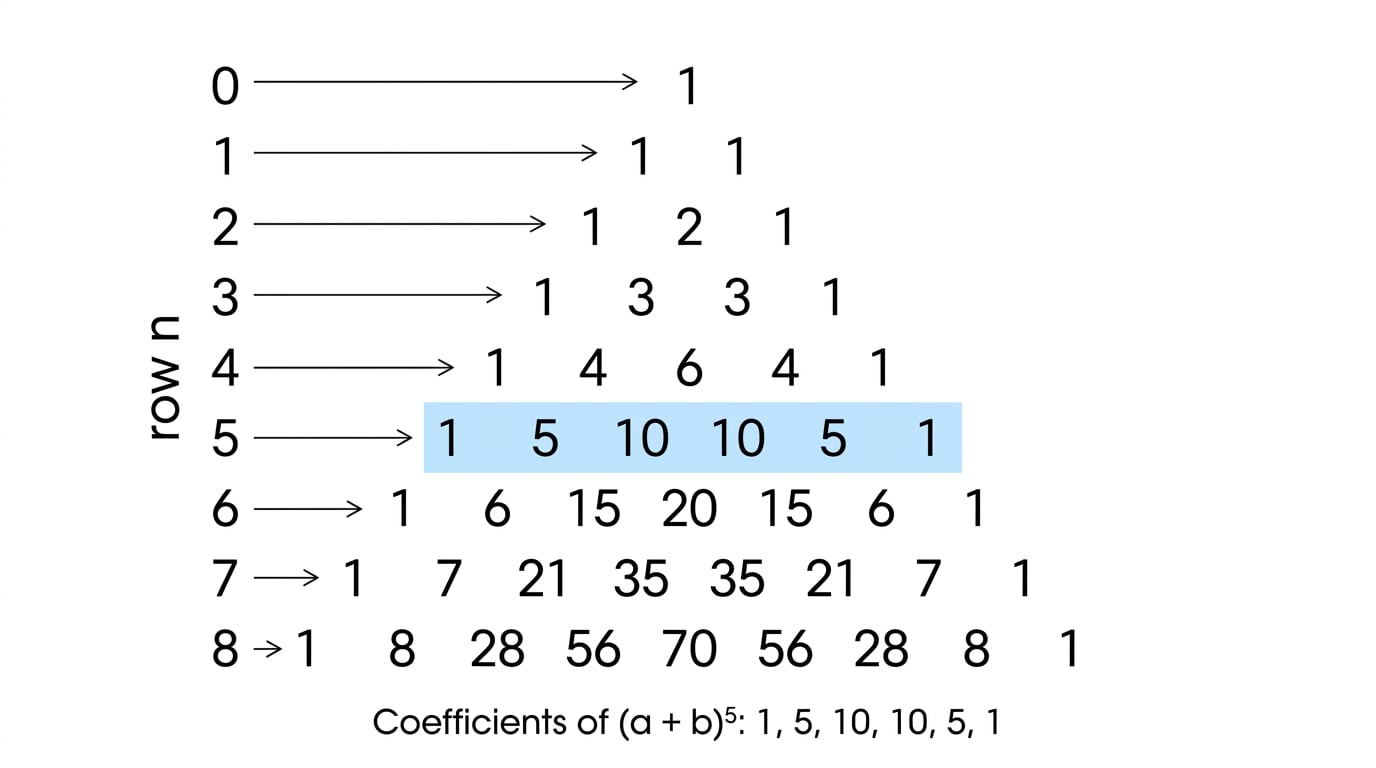
A helpful way to remember the coefficients is Pascal’s triangle. Each row gives the coefficients for a power of a binomial.
Fully expanding a fifth power
Expand (p+q)5(p+q)^5(p+q)5.
-
Use row 5 of Pascal’s triangle:
1, 5, 10, 10, 5, 11,\ 5,\ 10,\ 10,\ 5,\ 11, 5, 10, 10, 5, 1 -
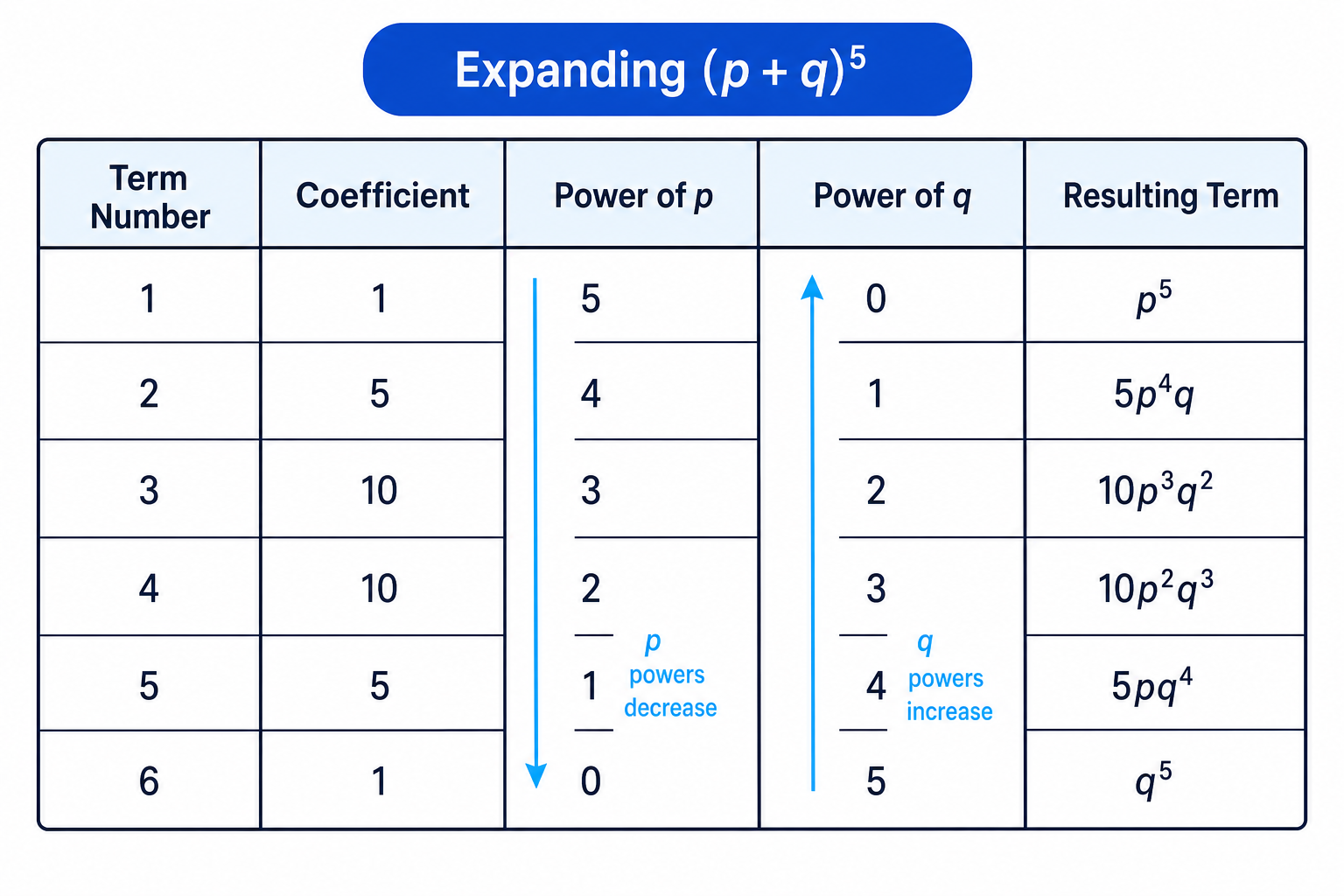
The powers of ppp go down from 5 to 0, while the powers of qqq go up from 0 to 5.
-
Combine the coefficients with the powers:
(p+q)5=p5+5p4q+10p3q2+10p2q3+5pq4+q5(p+q)^5=p^5+5p^4q+10p^3q^2+10p^2q^3+5pq^4+q^5(p+q)5=p5+5p4q+10p3q2+10p2q3+5pq4+q5
2. The binomial theorem
For AS-Level binomial expansion, you usually work with positive whole-number powers.
The finite binomial theorem
For a positive integer nnn,
(a+b)n=∑r=0n(nr)an−rbr(a+b)^n=\sum_{r=0}^{n}\binom{n}{r}a^{n-r}b^r(a+b)n=r=0∑n(rn)an−rbrHere, (nr)\binom{n}{r}(rn) is a binomial coefficient, read as “n choose r”.
You do not always need the full expansion. If the question asks for the first three terms in ascending powers of xxx, you only need the terms with x0x^0x0, x1x^1x1, and x2x^2x2.
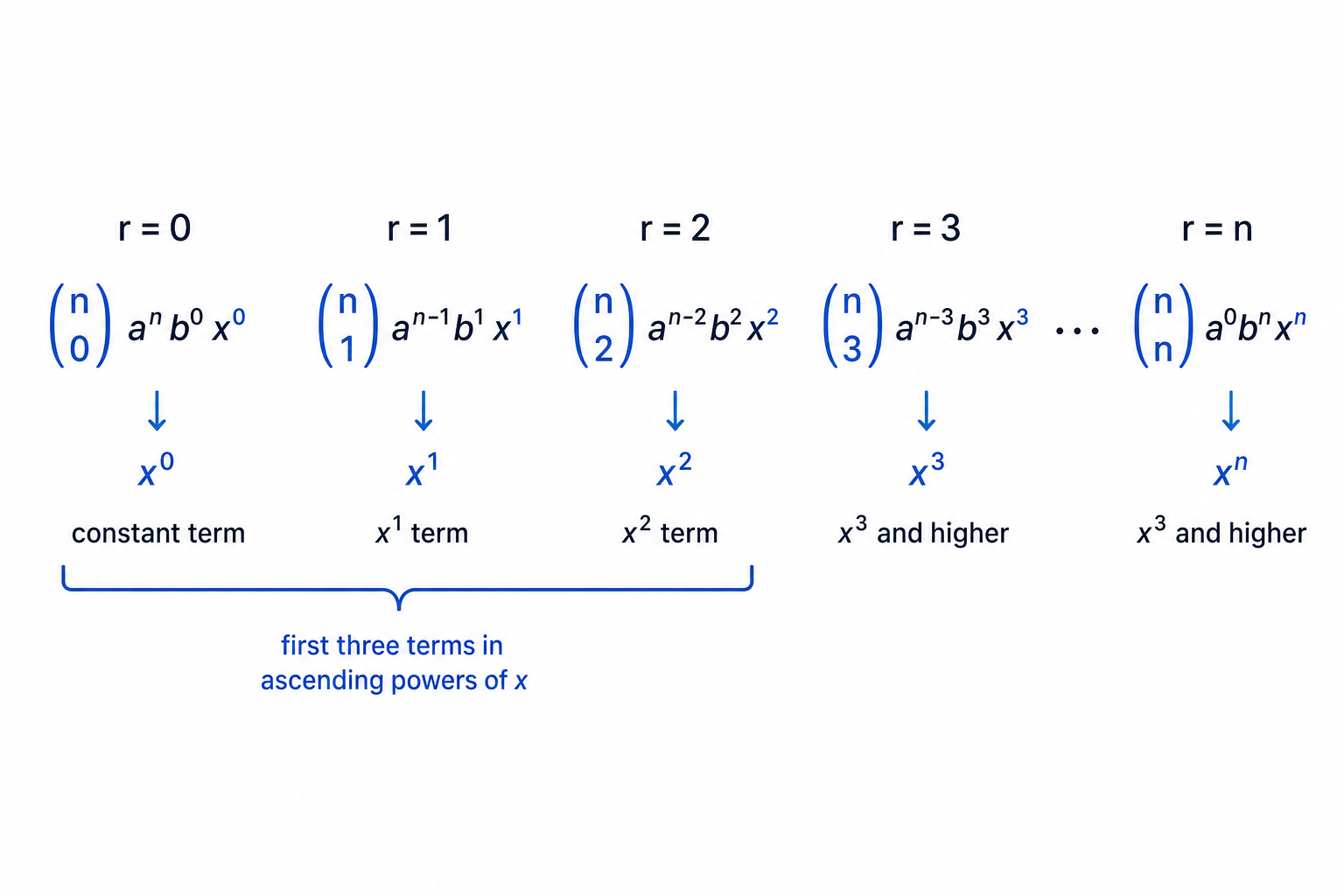
First three terms
Find the first three terms in ascending powers of xxx of (2+x2)6\left(2+\frac{x}{2}\right)^6(2+2x)6.
-
Identify the parts of the binomial:
a=2,b=x2,n=6a=2,\qquad b=\frac{x}{2},\qquad n=6a=2,b=2x,n=6 -
Use the terms for r=0r=0r=0, r=1r=1r=1, and r=2r=2r=2:
r=0:(60)26=64r=1:(61)25(x2)=96xr=2:(62)24(x2)2=60x2\begin{aligned} r=0 &: \binom{6}{0}2^6=64\\ r=1 &: \binom{6}{1}2^5\left(\frac{x}{2}\right)=96x\\ r=2 &: \binom{6}{2}2^4\left(\frac{x}{2}\right)^2=60x^2 \end{aligned}r=0r=1r=2:(06)26=64:(16)25(2x)=96x:(26)24(2x)2=60x2 -
Write the first three terms:
(2+x2)6=64+96x+60x2+⋯\left(2+\frac{x}{2}\right)^6=64+96x+60x^2+\cdots(2+2x)6=64+96x+60x2+⋯
Forgetting the constant powers
In (2+x2)6\left(2+\frac{x}{2}\right)^6(2+2x)6, the xxx term includes 252^525. Do not just do 6(x2)6\left(\frac{x}{2}\right)6(2x).
3. Negative signs and ascending powers
If the binomial contains a negative term, such as (2−5x)7(2-5x)^7(2−5x)7, the signs will alternate because odd powers of a negative expression are negative.
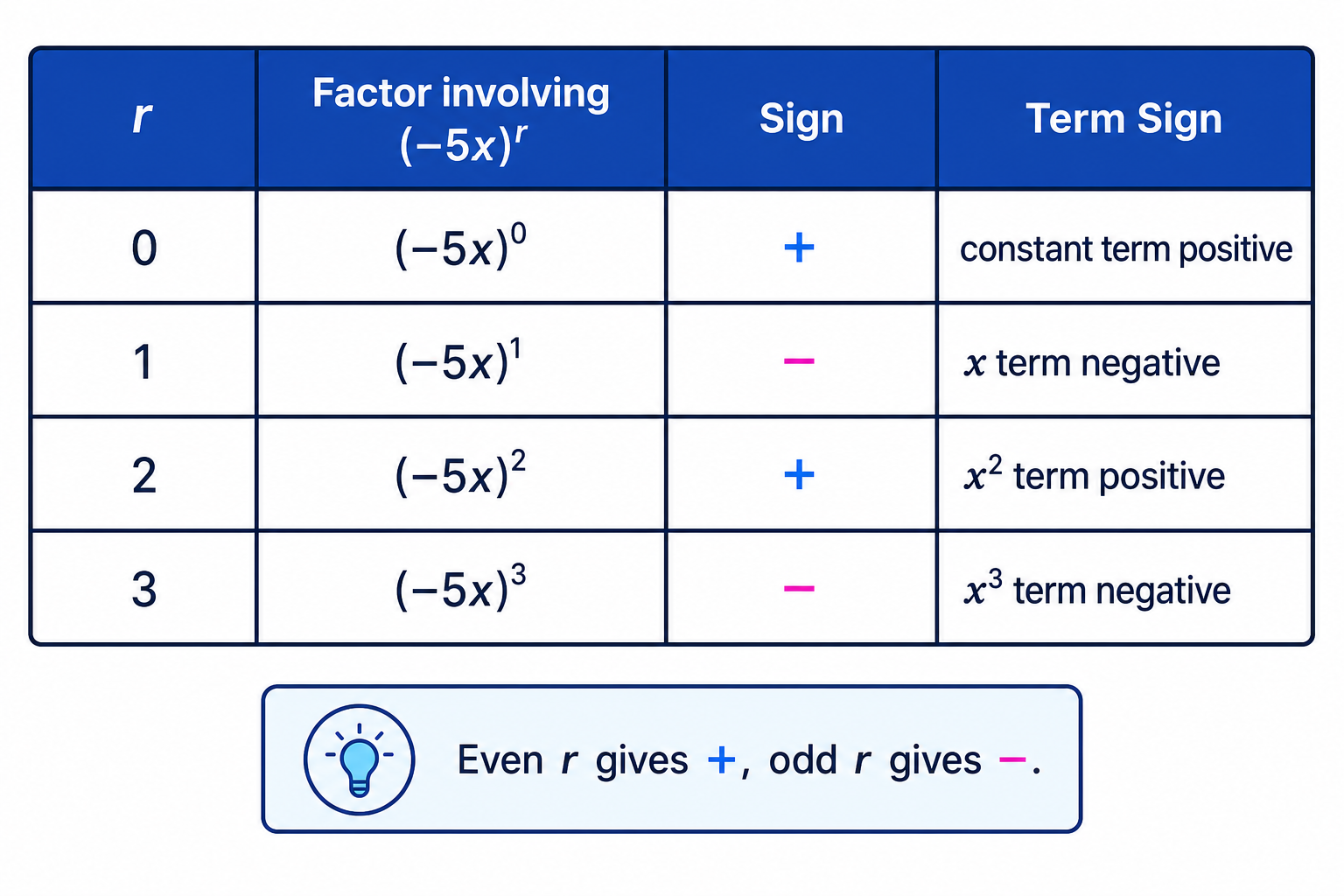
A negative binomial
Find the first four terms in ascending powers of xxx of (2−5x)7(2-5x)^7(2−5x)7.
-
Use the binomial theorem with a=2a=2a=2, b=−5xb=-5xb=−5x, and n=7n=7n=7.
-
Work out the first four terms, using r=0r=0r=0 to r=3r=3r=3:
r=0:(70)27=128r=1:(71)26(−5x)=−2240xr=2:(72)25(−5x)2=16800x2r=3:(73)24(−5x)3=−70000x3\begin{aligned} r=0 &: \binom{7}{0}2^7=128\\ r=1 &: \binom{7}{1}2^6(-5x)=-2240x\\ r=2 &: \binom{7}{2}2^5(-5x)^2=16800x^2\\ r=3 &: \binom{7}{3}2^4(-5x)^3=-70000x^3 \end{aligned}r=0r=1r=2r=3:(07)27=128:(17)26(−5x)=−2240x:(27)25(−5x)2=16800x2:(37)24(−5x)3=−70000x3 -
Write the answer in ascending powers of xxx:
(2−5x)7=128−2240x+16800x2−70000x3+⋯(2-5x)^7=128-2240x+16800x^2-70000x^3+\cdots(2−5x)7=128−2240x+16800x2−70000x3+⋯
Sign check
If the xxx part is negative, even powers give positive terms and odd powers give negative terms.
4. Using an expansion as an approximation
You can use the first few terms of an expansion to estimate powers of numbers close to a convenient value.
For example, 1.0481.04^81.048 is close to 181^818, so an expansion of (1+4x)8(1+4x)^8(1+4x)8 is useful because 1+4x=1.041+4x=1.041+4x=1.04 when x=0.01x=0.01x=0.01.
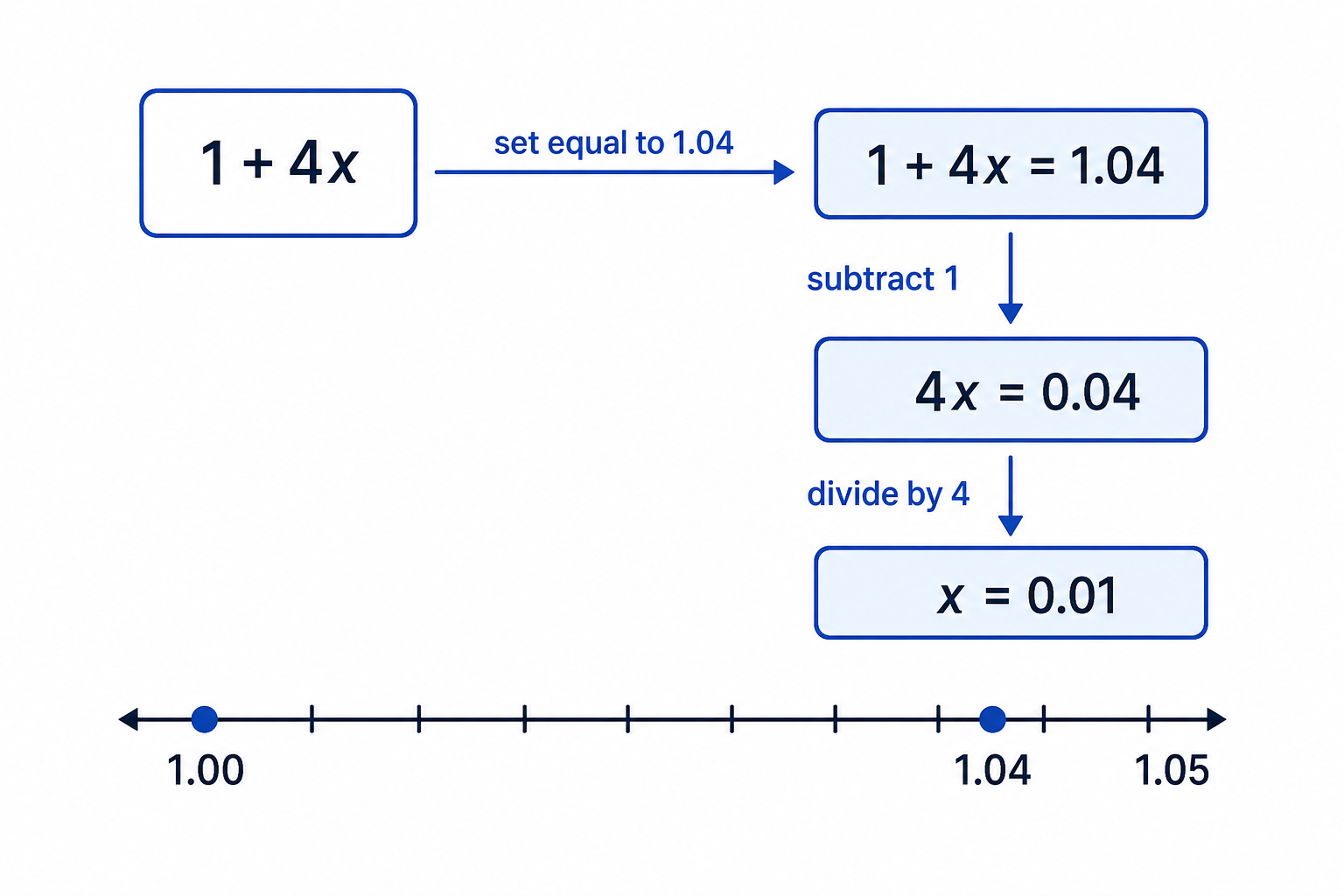
Approximating a power
Use the expansion of (1+4x)8(1+4x)^8(1+4x)8 up to the x3x^3x3 term to estimate 1.0481.04^81.048.
-
Expand up to and including the x3x^3x3 term:
(1+4x)8=1+8(4x)+(82)(4x)2+(83)(4x)3+⋯=1+32x+448x2+3584x3+⋯\begin{aligned} (1+4x)^8 &=1+8(4x)+\binom{8}{2}(4x)^2+\binom{8}{3}(4x)^3+\cdots\\ &=1+32x+448x^2+3584x^3+\cdots \end{aligned}(1+4x)8=1+8(4x)+(28)(4x)2+(38)(4x)3+⋯=1+32x+448x2+3584x3+⋯ -
Match the bracket to 1.041.041.04:
1+4x=1.041+4x=1.041+4x=1.04 -
Solve for xxx:
x=0.01x=0.01x=0.01 -
Substitute x=0.01x=0.01x=0.01 into the truncated expansion:
1+32(0.01)+448(0.01)2+3584(0.01)3=1.3683841+32(0.01)+448(0.01)^2+3584(0.01)^3=1.3683841+32(0.01)+448(0.01)2+3584(0.01)3=1.368384 -
Give the estimate to 5 significant figures:
1.048≈1.36841.04^8\approx 1.36841.048≈1.3684
Match before substituting
Always solve the inside of the bracket first. For example, if you have (3+2x5)6\left(3+\frac{2x}{5}\right)^6(3+52x)6 and want 2.9262.92^62.926, solve 3+2x5=2.923+\frac{2x}{5}=2.923+52x=2.92.
5. Multiplying by another factor
Sometimes you expand a binomial and then multiply it by something like ax+bax+bax+b. If you only need the first two terms, do not expand everything.
Finding a and b from first terms
Let f(x)=(ax+b)(2+x8)8f(x)=(ax+b)\left(2+\frac{x}{8}\right)^8f(x)=(ax+b)(2+8x)8. Given that the first two terms of f(x)f(x)f(x) are 40+72x40+72x40+72x, find aaa and bbb.
-
First find only the constant and xxx terms of the binomial:
(2+x8)8=256+128x+⋯\left(2+\frac{x}{8}\right)^8=256+128x+\cdots(2+8x)8=256+128x+⋯ -
Multiply by ax+bax+bax+b and focus on the constant and xxx terms:
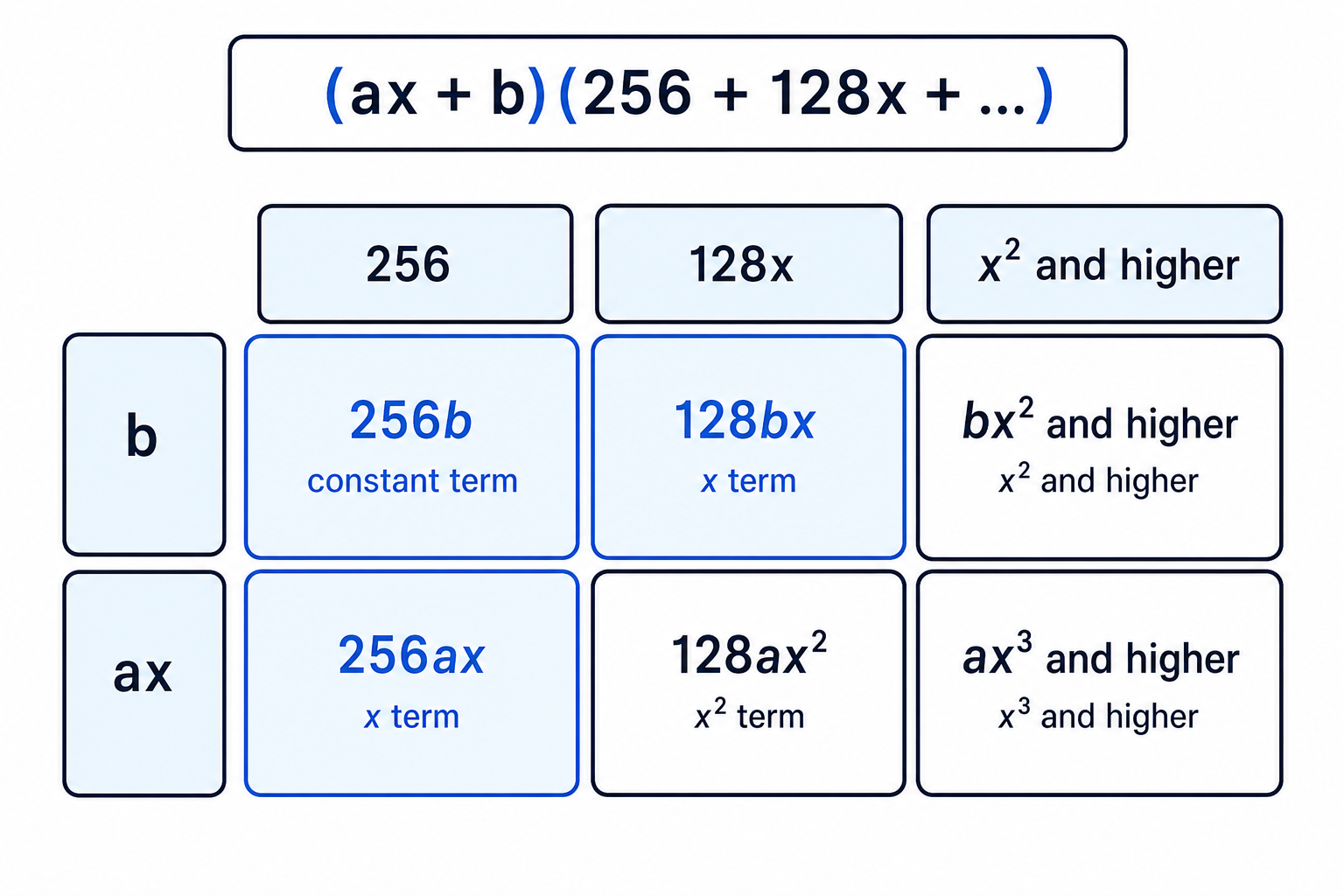
$$
(ax+b)(256+128x+\cdots)
$$
3. The constant term comes from b⋅256b\cdot 256b⋅256:
$$
256b=40
$$
4. Solve for bbb:
$$
b=\frac{5}{32}
$$
5. The coefficient of xxx comes from ax⋅256ax\cdot 256ax⋅256 and b⋅128xb\cdot 128xb⋅128x:
$$
256a+128b=72
$$
6. Substitute b=532b=\frac{5}{32}b=325:
$$
256a+20=72
$$
7. Solve for aaa:
$$
a=\frac{13}{64}
$$
Using too many terms
For the first two terms of (ax+b)(binomial)(ax+b)(\text{binomial})(ax+b)(binomial), you usually only need the constant and xxx terms of the binomial.
6. Finding unknown constants from coefficients
A common exam move is to compare coefficients. This means matching the coefficient of a particular power of xxx to the information given.
Solving for k
In the expansion of (1+kx)10(1+kx)^{10}(1+kx)10, the coefficient of x3x^3x3 is twice the coefficient of xxx. Given that k≠0k\neq 0k=0, find kkk.
-
Write the first few terms:
(1+kx)10=1+10kx+45k2x2+120k3x3+⋯(1+kx)^{10}=1+10kx+45k^2x^2+120k^3x^3+\cdots(1+kx)10=1+10kx+45k2x2+120k3x3+⋯ -
Identify the two coefficients:
coefficient of x=10k,coefficient of x3=120k3\text{coefficient of }x=10k,\qquad \text{coefficient of }x^3=120k^3coefficient of x=10k,coefficient of x3=120k3 -
Use the condition “the coefficient of x3x^3x3 is twice the coefficient of xxx”:
120k3=2(10k)120k^3=2(10k)120k3=2(10k) -
Since k≠0k\neq 0k=0, divide by kkk:
120k2=20120k^2=20120k2=20 -
Solve for kkk:
k=±16k=\pm\frac{1}{\sqrt{6}}k=±61
7. Probability and binomial expansion
Binomial expansion is also linked to repeated independent events with two outcomes, such as late/not late or success/failure.
If ppp is the probability of one outcome and qqq is the probability of the other, then (p+q)5(p+q)^5(p+q)5 lists the probabilities for 5 repeated trials, with coefficients counting the number of arrangements.
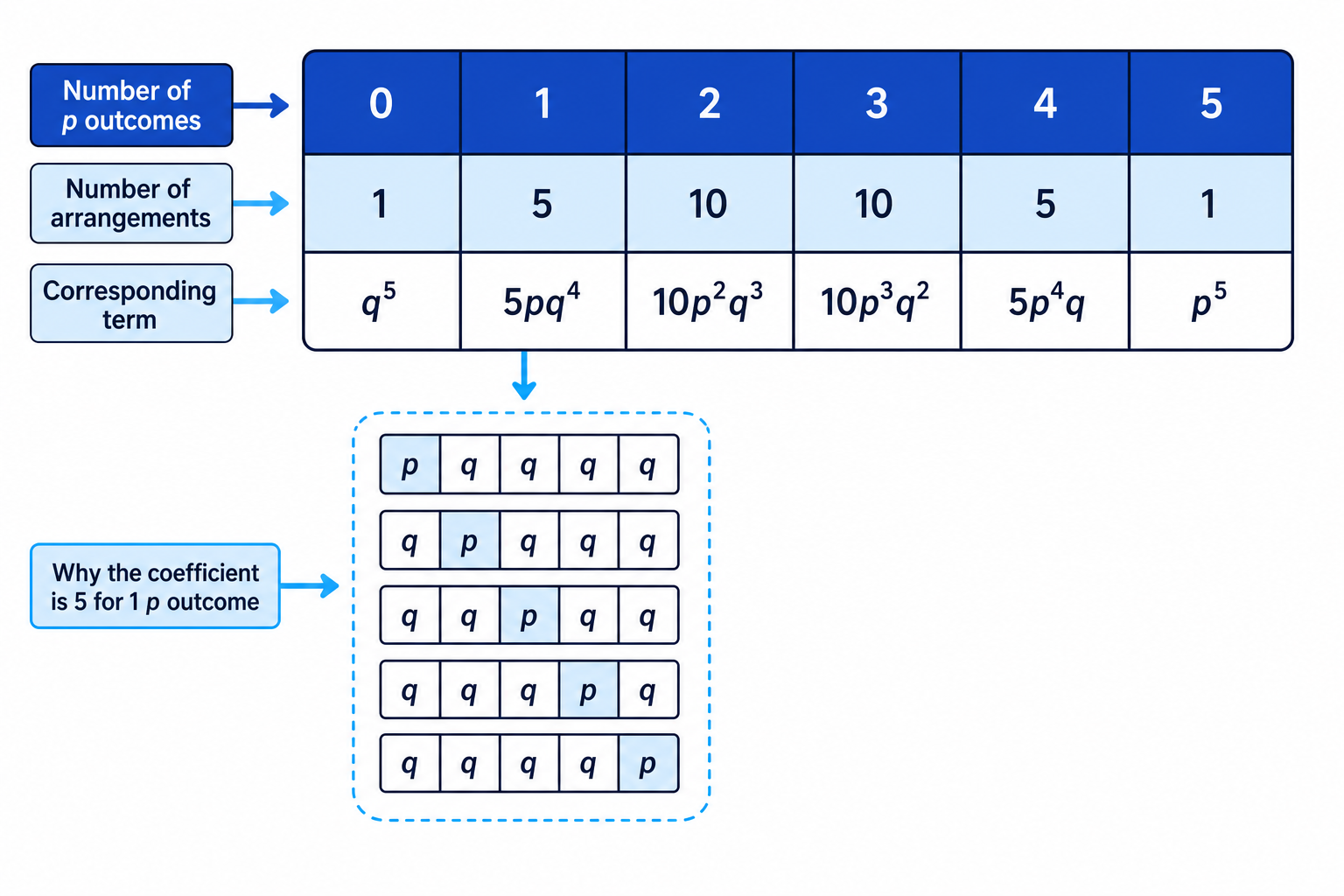
No more than once
A student has probability 0.2 of being late on any school day. Find the probability that they are late no more than once in a 5-day week.
-
Let p=0.2p=0.2p=0.2 be the probability of being late and q=0.8q=0.8q=0.8 be the probability of not being late.
-
“No more than once” means 0 times late or 1 time late.
-
Use the relevant terms from (p+q)5(p+q)^5(p+q)5:
q5+5pq4q^5+5pq^4q5+5pq4 -
Substitute p=0.2p=0.2p=0.2 and q=0.8q=0.8q=0.8:
0.85+5(0.2)(0.8)4=0.737280.8^5+5(0.2)(0.8)^4=0.737280.85+5(0.2)(0.8)4=0.73728
8. Proof-style questions
Sometimes you expand expressions to show something is always true. Look for positive even powers such as x2x^2x2 and x4x^4x4.
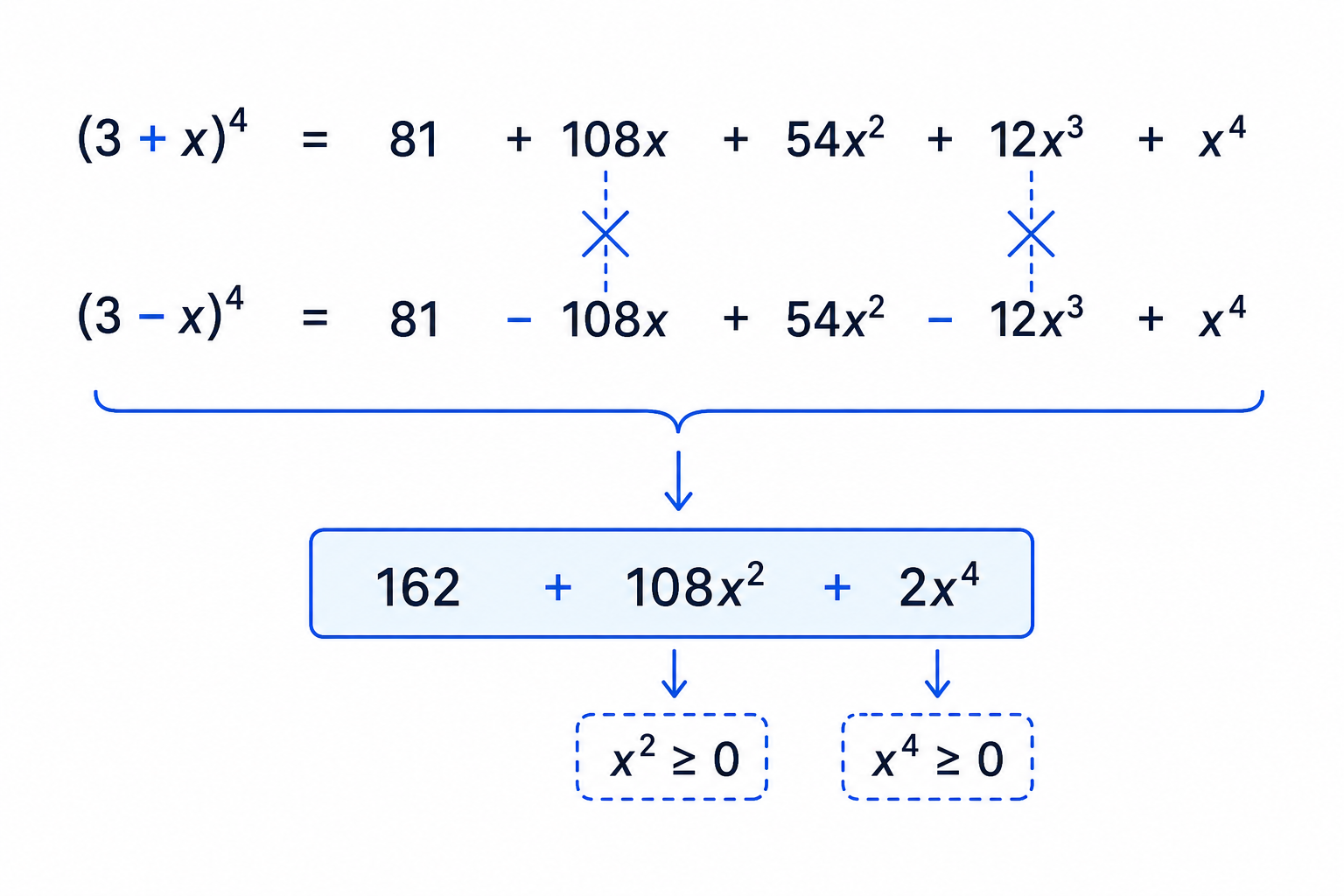
Using cancellation to prove an inequality
Prove that (3+x)4+(3−x)4≥162(3+x)^4+(3-x)^4\ge 162(3+x)4+(3−x)4≥162.
-
Expand both expressions:
(3+x)4=81+108x+54x2+12x3+x4(3−x)4=81−108x+54x2−12x3+x4\begin{aligned} (3+x)^4&=81+108x+54x^2+12x^3+x^4\\ (3-x)^4&=81-108x+54x^2-12x^3+x^4 \end{aligned}(3+x)4(3−x)4=81+108x+54x2+12x3+x4=81−108x+54x2−12x3+x4 -
Add them together:
(3+x)4+(3−x)4=162+108x2+2x4(3+x)^4+(3-x)^4=162+108x^2+2x^4(3+x)4+(3−x)4=162+108x2+2x4 -
Since x2≥0x^2\ge 0x2≥0 and x4≥0x^4\ge 0x4≥0, the extra part is never negative:
108x2+2x4≥0108x^2+2x^4\ge 0108x2+2x4≥0 -
Therefore:
(3+x)4+(3−x)4≥162(3+x)^4+(3-x)^4\ge 162(3+x)4+(3−x)4≥162
In the exam
- Identify the binomial parts carefully: the constant part, the xxx part, and the power.
- If the question asks for “first three terms”, only use r=0r=0r=0, r=1r=1r=1, and r=2r=2r=2.
- For coefficient questions, write the relevant terms clearly, then equate coefficients of the same power of xxx.
Check yourself
- What are the first three terms of (1−3x)6(1-3x)^6(1−3x)6 in ascending powers of xxx?
- How would you choose xxx to use an expansion of (2+x4)5\left(2+\frac{x}{4}\right)^5(2+4x)5 to estimate 2.0152.01^52.015?
- In (1+kx)8(1+kx)^8(1+kx)8, which term contains the coefficient of x3x^3x3?