

What you'll learn
- How to solve linear inequalities safely, including when the inequality sign changes.
- How to solve quadratic inequalities using roots and sign intervals.
- How to combine two inequalities to find a shared solution set.
- How simultaneous equations connect to intersections of lines, curves and circles.
1. The basic language
An equation says two expressions are equal. An inequality says one expression is bigger or smaller than another. Your answer is often not one value, but a whole range of values.
Solution set
-
A solution is a value that makes an equation or inequality true.
-
A solution set is the collection of all possible solutions.
-
Set notation writes this compactly. For example, {x:x>3}{x:x>3}{x:x>3} means “the set of values of xxx such that x>3x>3x>3”.
2. Linear inequalities
A linear inequality is an inequality where the highest power of the variable is one, such as 5x−2>135x-2>135x−2>13.
You solve it almost like a linear equation: collect like terms, isolate the variable, and simplify.
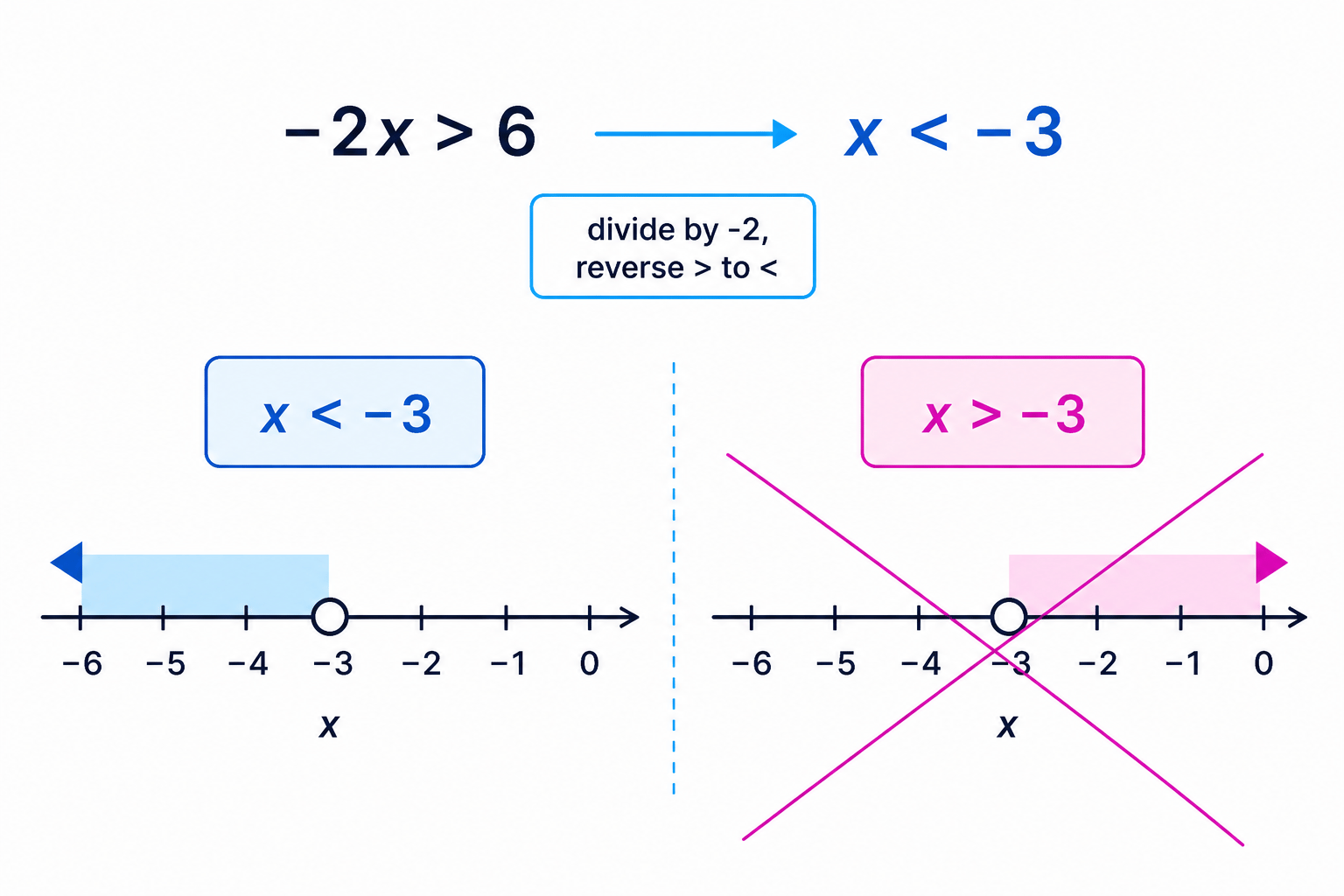
Dividing by a negative
If you multiply or divide both sides of an inequality by a negative number, the inequality sign reverses. For example, from −2x>6-2x>6−2x>6 you get x<−3x<-3x<−3, not x>−3x>-3x>−3.
Solving a linear inequality
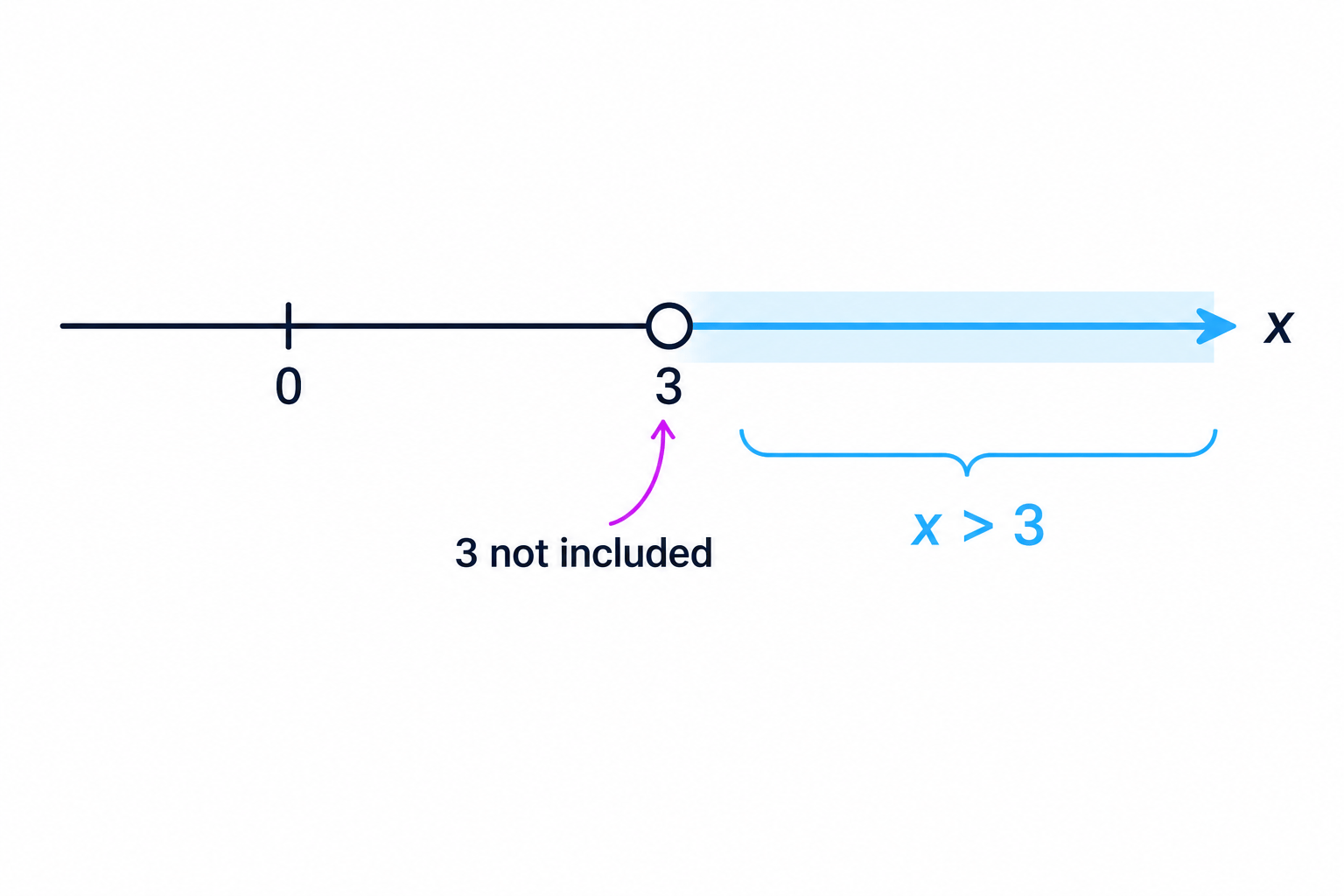
Solve 20−x<4x+520-x<4x+520−x<4x+5.
-
Subtract 5 from both sides.
15−x<4x15-x<4x15−x<4x
-
Add xxx to both sides to collect the variable terms.
15<5x15<5x15<5x
-
Divide by positive 5, so the inequality sign stays the same.
3<x3<x3<x
-
Write the answer in the usual order.
x>3x>3x>3
3. Quadratic inequalities
A quadratic inequality contains a squared term, such as x2+6x>16x^2+6x>16x2+6x>16.
The key skill is to compare the quadratic with zero. First solve the matching quadratic equation. The roots are the boundary values where the expression changes sign.
Roots split the number line
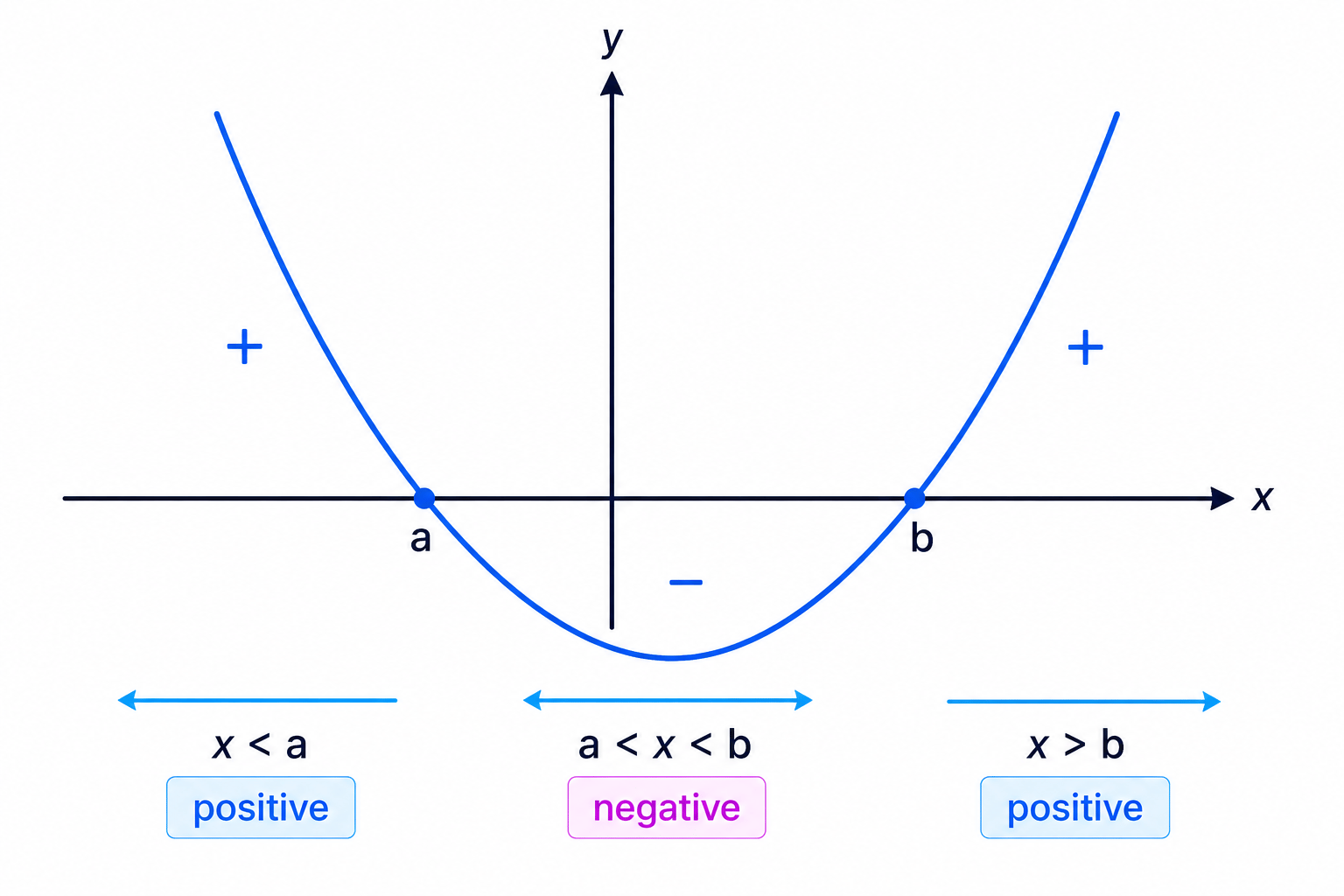
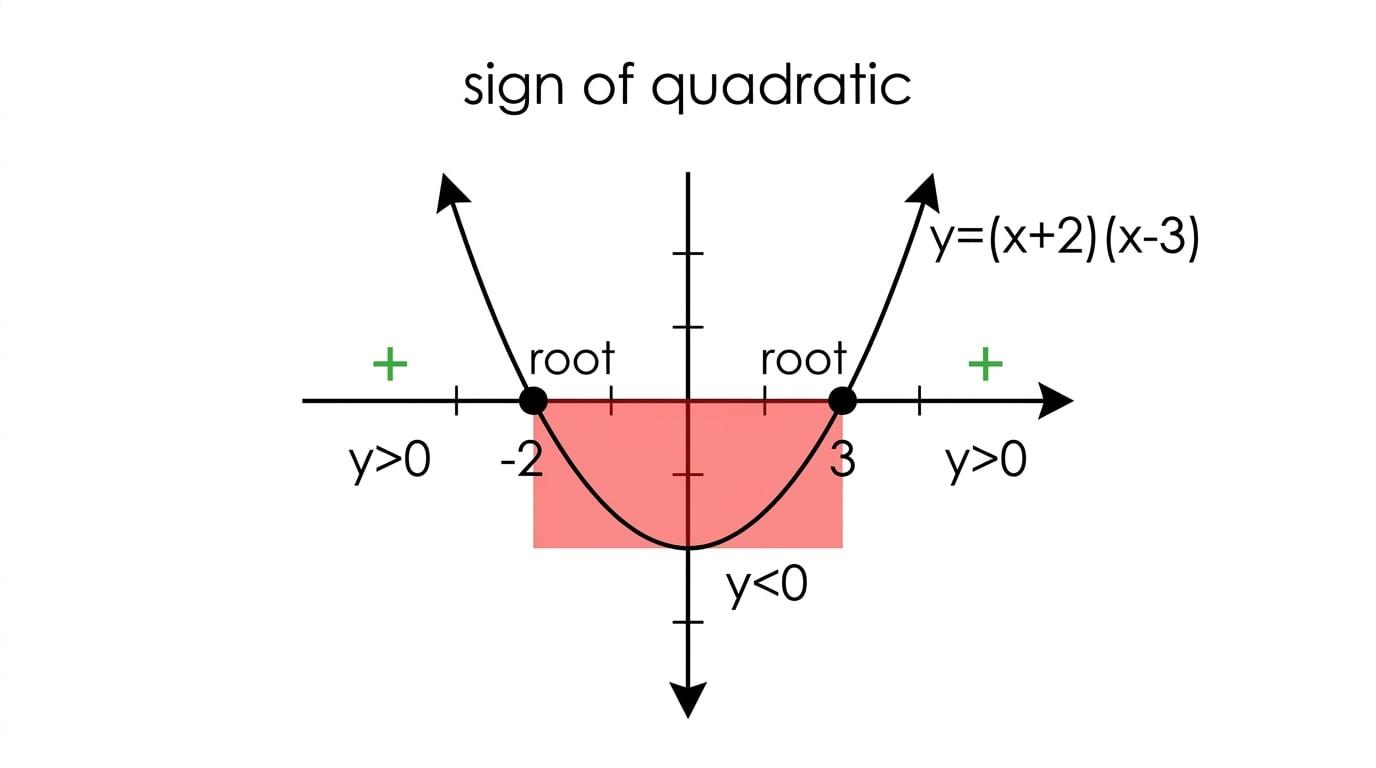
For a factorised quadratic, the roots split the number line into intervals. Test the sign on each interval, or use the shape of the parabola.
For a positive x2x^2x2 coefficient, the parabola opens upwards. It is positive outside the roots and negative between the roots.
Solving a quadratic inequality
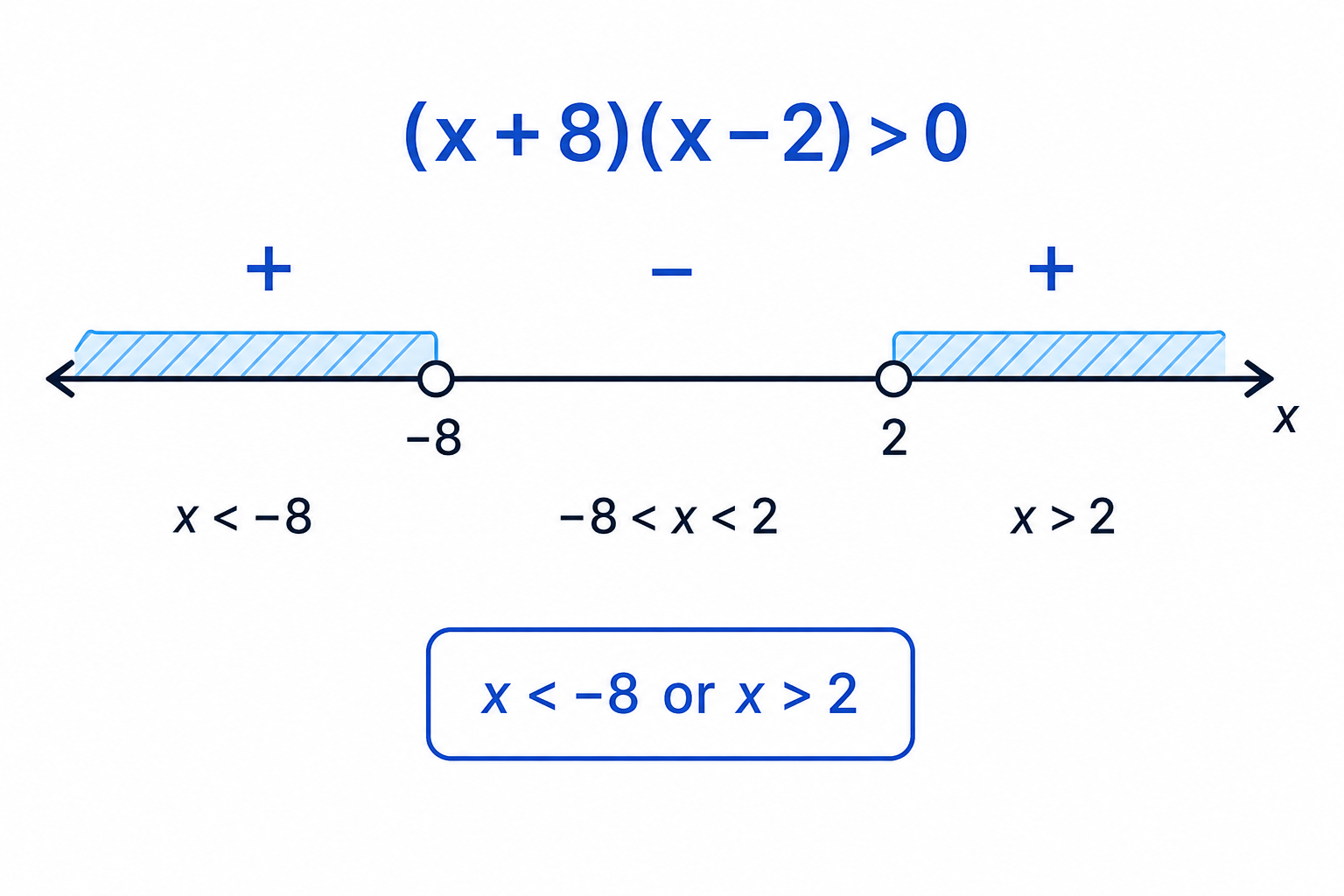
Solve x2+6x>16x^2+6x>16x2+6x>16, giving your answer in set notation.
-
Move everything to one side so you compare with zero.
x2+6x−16>0x^2+6x-16>0x2+6x−16>0
-
Factorise the quadratic.
(x+8)(x−2)>0(x+8)(x-2)>0(x+8)(x−2)>0
-
Find the boundary values by solving (x+8)(x−2)=0(x+8)(x-2)=0(x+8)(x−2)=0.
x=−8orx=2x=-8 \quad \text{or} \quad x=2x=−8orx=2
-
Since the coefficient of x2x^2x2 is positive, the quadratic is greater than zero outside the roots.
{x:x<−8 or x>2}{x:x<-8 \text{ or } x>2}{x:x<−8 or x>2}
Strict and non-strict inequalities
A strict inequality uses <<< or >>>, so the boundary values are not included.
A non-strict inequality uses ≤\le≤ or ≥\ge≥, so the boundary values are included if they satisfy the inequality.
Including the endpoints
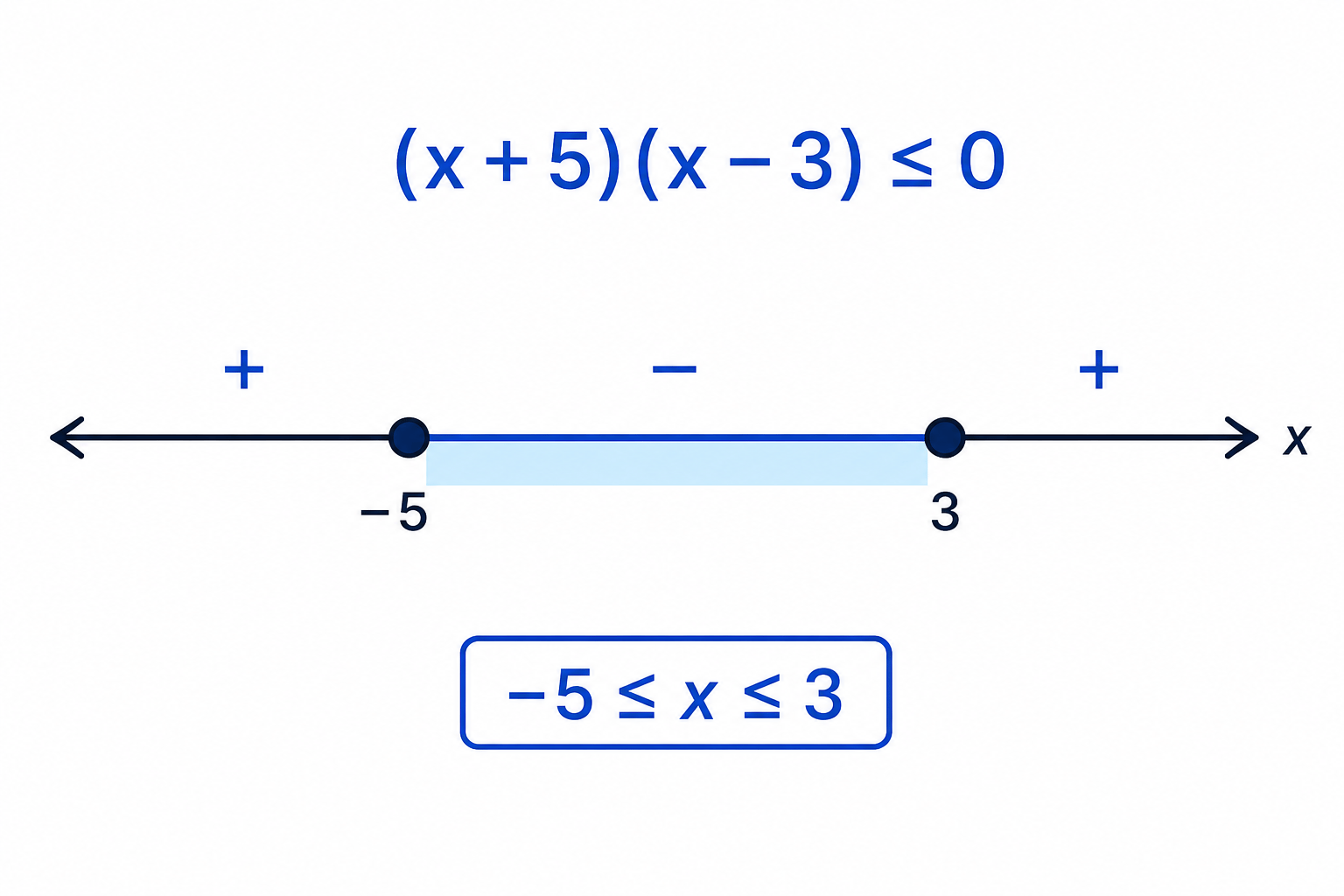
Solve x(x+2)≤15x(x+2)\le15x(x+2)≤15.
-
Expand and move everything to one side.
x2+2x−15≤0x^2+2x-15\le0x2+2x−15≤0
-
Factorise.
(x+5)(x−3)≤0(x+5)(x-3)\le0(x+5)(x−3)≤0
-
The boundary values are x=−5x=-5x=−5 and x=3x=3x=3.
-
The quadratic opens upwards, so it is less than or equal to zero between the roots, including the endpoints.
−5≤x≤3-5\le x\le3−5≤x≤3
Quick sign check
If you are unsure which interval to choose, test one easy value. For (x+5)(x−3)(x+5)(x-3)(x+5)(x−3), testing x=0x=0x=0 gives 5×(−3)5\times(-3)5×(−3), which is negative, so the middle interval works for “less than zero”.
4. Combining inequalities
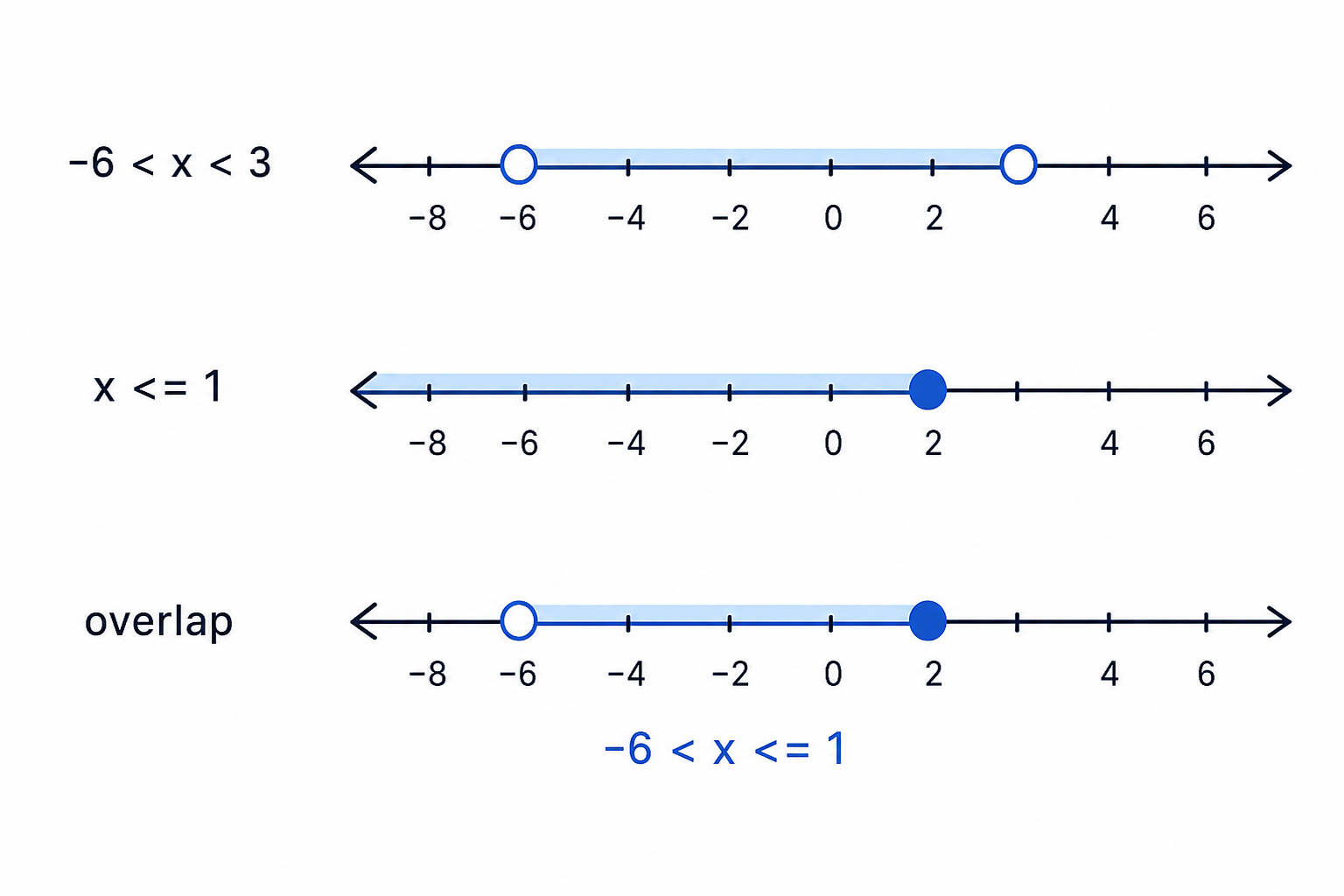
Sometimes you are asked for values that satisfy two inequalities at the same time. Solve each one separately, then take the overlap.
Finding the shared solution set
Find the values of xxx which satisfy both x2+3x−18<0x^2+3x-18<0x2+3x−18<0 and 15+3x≤17+x15+3x\le17+x15+3x≤17+x.
-
Solve the quadratic inequality first.
x2+3x−18<0x^2+3x-18<0x2+3x−18<0
-
Factorise and identify the roots.
(x+6)(x−3)<0(x+6)(x-3)<0(x+6)(x−3)<0
-
The quadratic is negative between the roots.
−6<x<3-6<x<3−6<x<3
-
Now solve the linear inequality.
15+3x≤17+x15+3x\le17+x15+3x≤17+x
-
Rearrange.
2x≤22x\le22x≤2
-
Divide by positive 2.
x≤1x\le1x≤1
-
Combine the two results by taking the overlap.
{x:−6<x≤1}{x:-6<x\le1}{x:−6<x≤1}
5. Simultaneous equations and intersections
Simultaneous equations are equations that must be true at the same time. When one equation is a line and the other is a curve, the solutions are the coordinates of their intersection points.
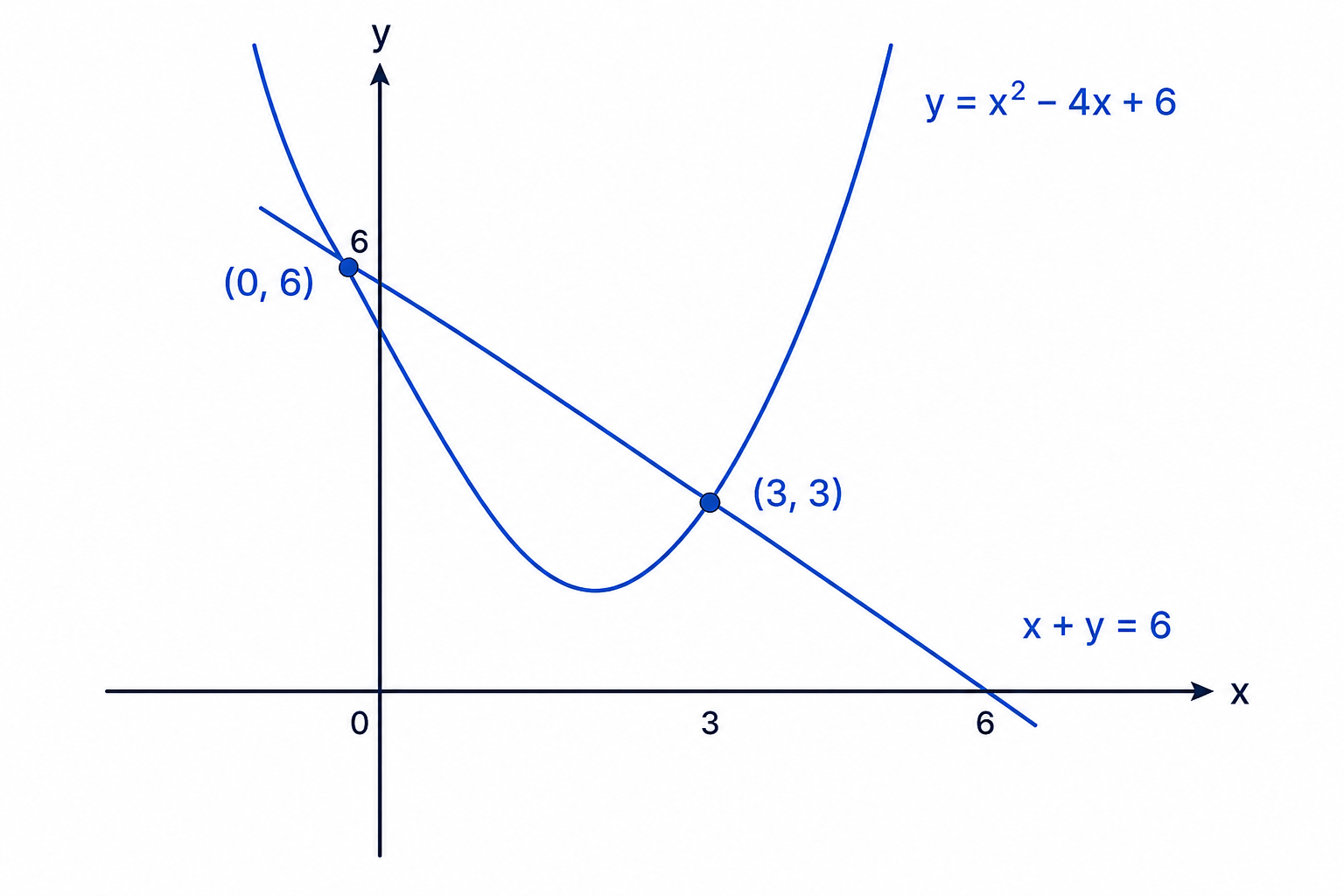
Usually, you substitute the line equation into the curve equation. This often produces a quadratic equation.
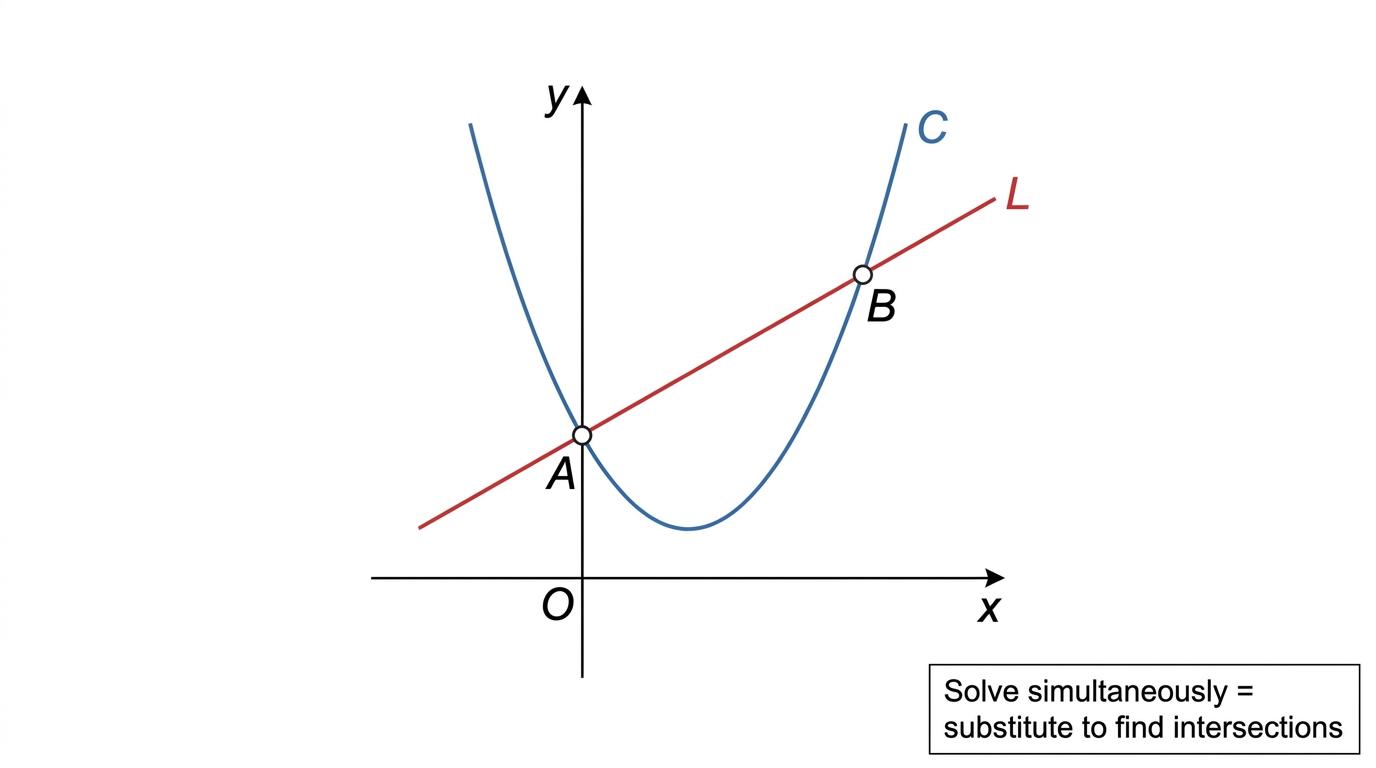
Line and curve intersection
Find the coordinates where the curve CCC with equation y=x2−4x+6y=x^2-4x+6y=x2−4x+6 meets the line LLL with equation x+y=6x+y=6x+y=6.
-
Rearrange the line to make yyy the subject.
y=6−xy=6-xy=6−x
-
Substitute this into the curve equation.
6−x=x2−4x+66-x=x^2-4x+66−x=x2−4x+6
-
Simplify to form a quadratic equation.
x2−3x=0x^2-3x=0x2−3x=0
-
Factorise and solve.
x(x−3)=0x(x-3)=0x(x−3)=0
-
So the possible xxx-values are:
x=0orx=3x=0 \quad \text{or} \quad x=3x=0orx=3
-
Substitute each value into y=6−xy=6-xy=6−x.
(0,6)and(3,3)(0,6) \quad \text{and} \quad (3,3)(0,6)and(3,3)
6. When a line does not meet a curve
The discriminant of a quadratic ax2+bx+c=0ax^2+bx+c=0ax2+bx+c=0 is b2−4acb^2-4acb2−4ac. It tells you how many real roots the quadratic has.
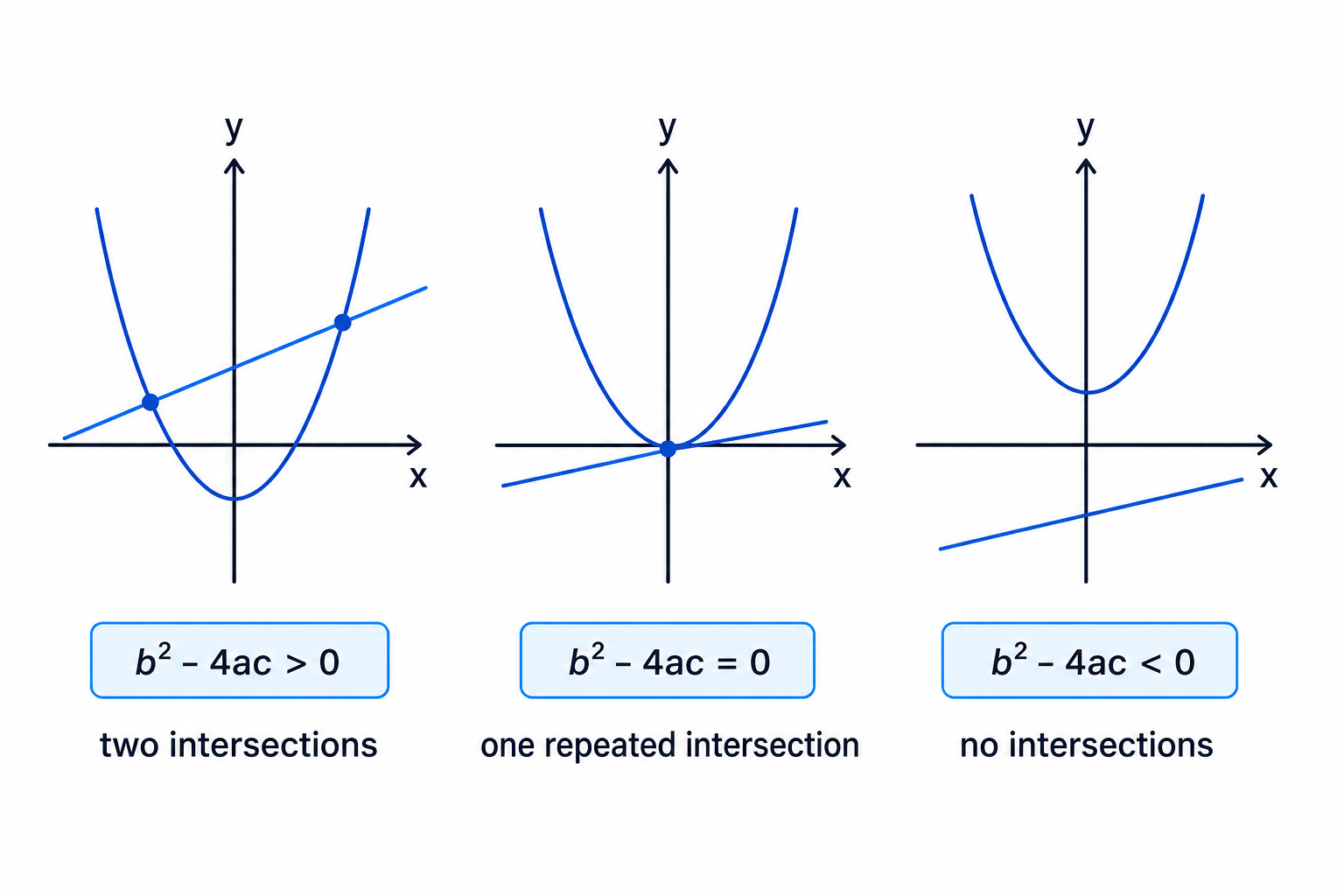
- If b2−4ac>0b^2-4ac>0b2−4ac>0, there are two real roots.
- If b2−4ac=0b^2-4ac=0b2−4ac=0, there is one repeated root.
- If b2−4ac<0b^2-4ac<0b2−4ac<0, there are no real roots.
So if a line does not intersect a curve, the quadratic formed by substitution has no real solutions.
Using the discriminant with a parameter
The curve CCC has equation y=px2−2px−2py=px^2-2px-2py=px2−2px−2p, where ppp is a constant. The line LLL has equation y=x−3y=x-3y=x−3. Find the values of ppp for which CCC and LLL do not intersect.
-
Set the two expressions for yyy equal.
px2−2px−2p=x−3px^2-2px-2p=x-3px2−2px−2p=x−3
-
Rearrange into quadratic form.
px2−(2p+1)x+(3−2p)=0px^2-(2p+1)x+(3-2p)=0px2−(2p+1)x+(3−2p)=0
-
For no intersection, the discriminant must be less than zero.
(−(2p+1))2−4p(3−2p)<0(-(2p+1))^2-4p(3-2p)<0(−(2p+1))2−4p(3−2p)<0
-
Expand and simplify.
12p2−8p+1<012p^2-8p+1<012p2−8p+1<0
-
Factorise.
(6p−1)(2p−1)<0(6p-1)(2p-1)<0(6p−1)(2p−1)<0
-
The quadratic in ppp is negative between its roots.
16<p<12\frac{1}{6}<p<\frac{1}{2}61<p<21
In the exam
-
Move all terms to one side before solving a quadratic inequality.
-
Always decide whether endpoints are included: use open intervals for <<< and >>>, closed endpoints for ≤\le≤ and ≥\ge≥.
-
For intersections, substitute the line into the curve, solve for one variable, then substitute back for the other coordinate.
Check yourself
-
When solving an inequality, what operation makes the inequality sign reverse?
-
Why does a quadratic inequality usually have an interval answer rather than one value?
-
If a line and curve do not intersect, what must be true about the discriminant?
