

What you'll learn
- How to recognise a quadratic and connect its equation to its graph.
- How the discriminant tells you whether roots are real, repeated, or absent.
- How to complete the square to find turning points and prove inequalities.
- How quadratics appear in tangency, projectile, and profit-style modelling questions.
1. Quadratic basics
Quadratic expression
A quadratic expression in xxx is an expression of the form ax2+bx+cax^2+bx+cax2+bx+c, where aaa, bbb and ccc are constants and a≠0a\neq0a=0. The number aaa is the coefficient of x2x^2x2, bbb is the coefficient of xxx, and ccc is the constant term.
A quadratic equation is made by setting a quadratic expression equal to zero, for example ax2+bx+c=0ax^2+bx+c=0ax2+bx+c=0.
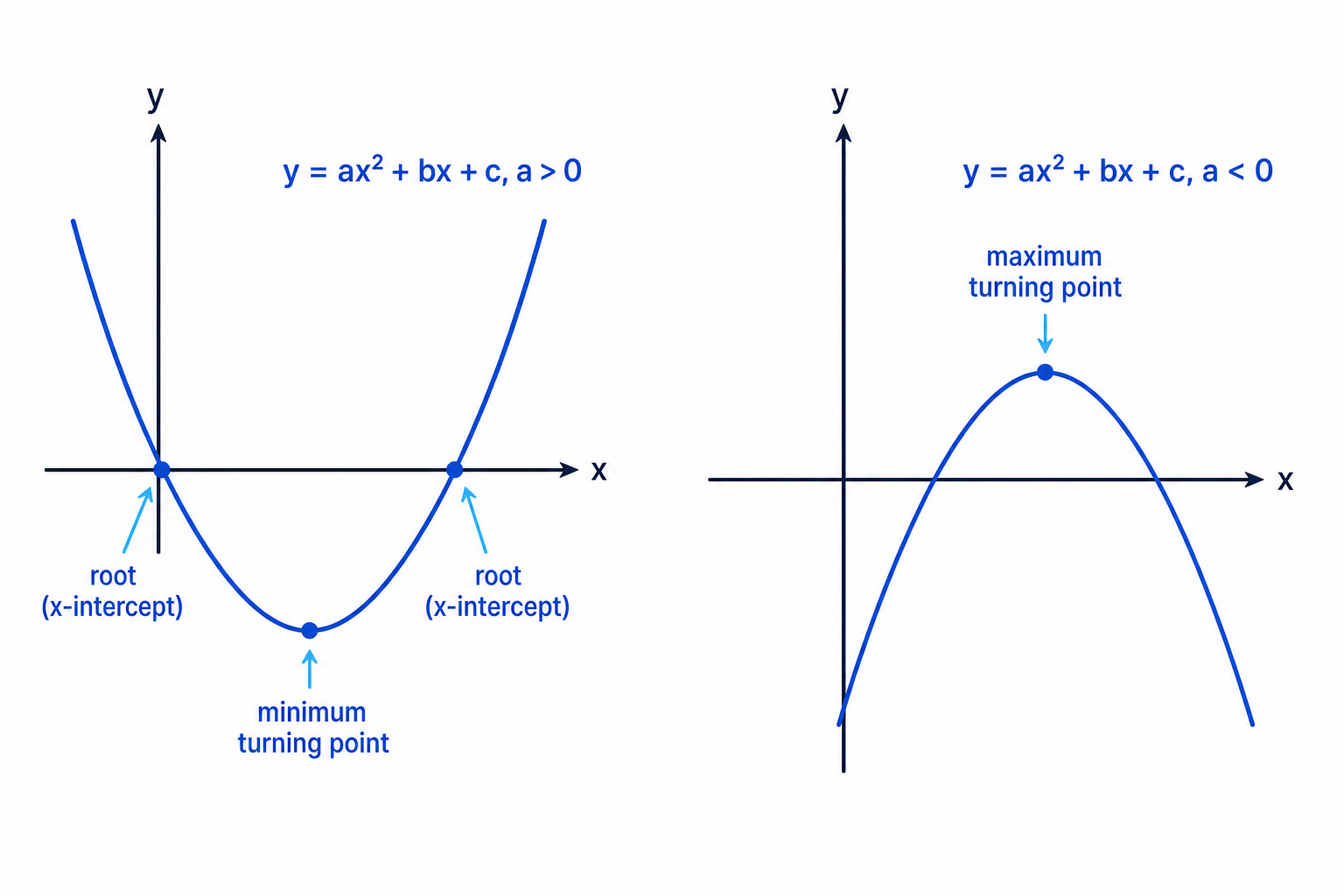
A root or solution is a value of xxx that makes the equation true. On the graph of y=ax2+bx+cy=ax^2+bx+cy=ax2+bx+c, roots are the points where the curve crosses or touches the xxx-axis.
The graph of a quadratic is called a parabola. If a>0a>0a>0, it opens upwards. If a<0a<0a<0, it opens downwards.
Putting a quadratic into standard form
Rewrite 3x2+7=2x3x^2+7=2x3x2+7=2x in the form ax2+bx+c=0ax^2+bx+c=0ax2+bx+c=0 and identify aaa, bbb and ccc.
-
Move every term to the left-hand side:
3x2−2x+7=03x^2-2x+7=03x2−2x+7=0 -
Compare this with ax2+bx+c=0ax^2+bx+c=0ax2+bx+c=0.
-
The values are a=3a=3a=3, b=−2b=-2b=−2 and c=7c=7c=7.
2. The discriminant
Discriminant
For a quadratic equation ax2+bx+c=0ax^2+bx+c=0ax2+bx+c=0, the discriminant is
Δ=b2−4ac\Delta=b^2-4acΔ=b2−4acIt tells you how many real roots the equation has.
What the discriminant tells you
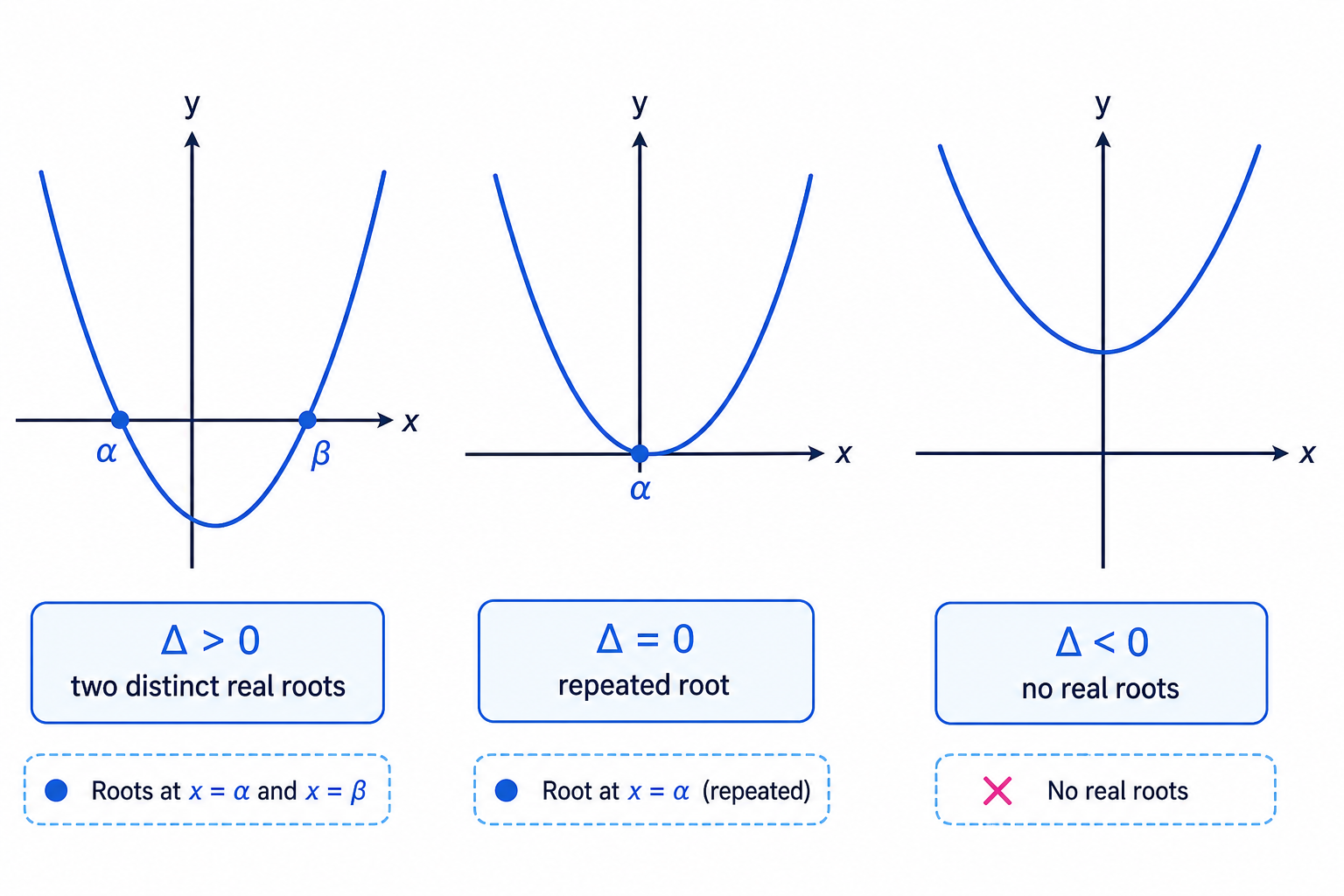
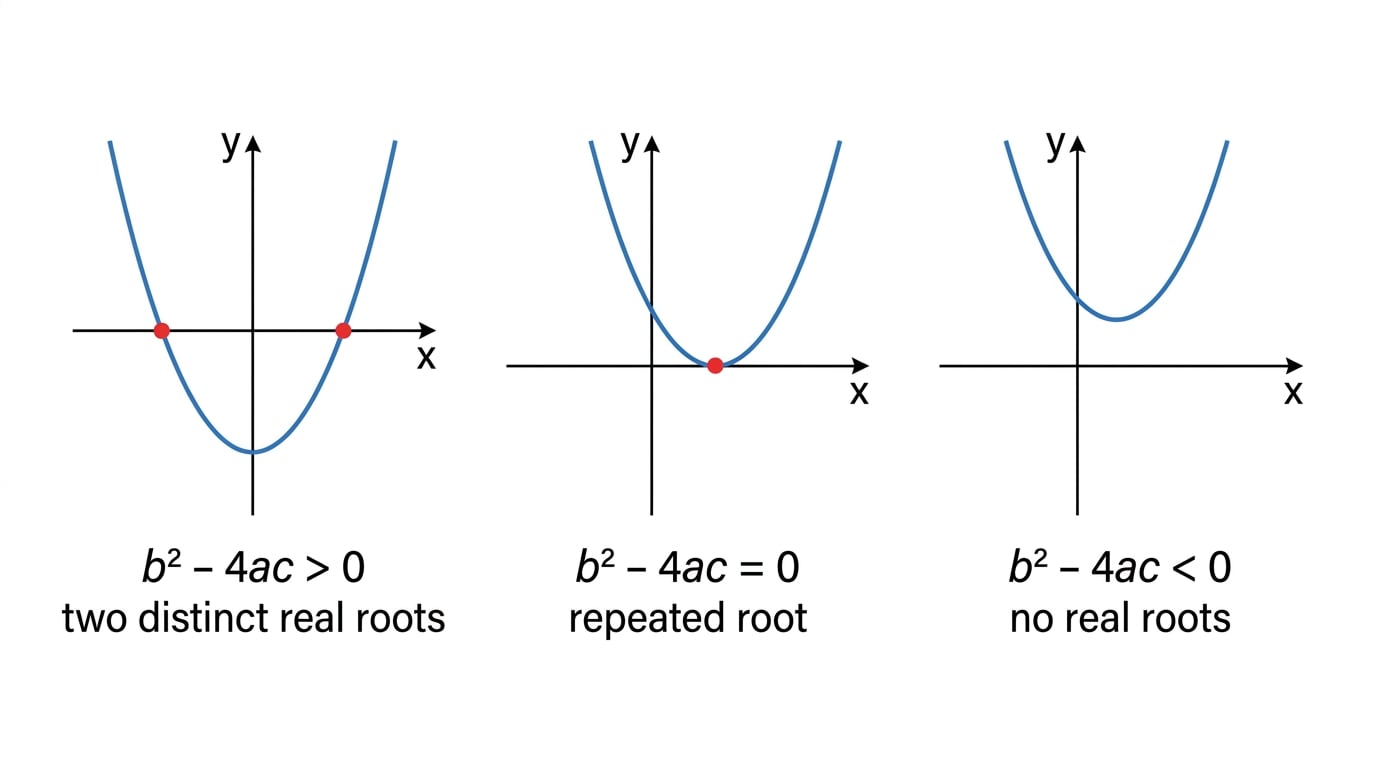
- If Δ>0\Delta>0Δ>0, there are two distinct real roots.
- If Δ=0\Delta=0Δ=0, there is one repeated root, also called equal roots.
- If Δ<0\Delta<0Δ<0, there are no real roots.
The word distinct means “different”. A repeated root means the graph just touches the xxx-axis at its turning point.
Showing there are no real roots
Show that 2x2+5=4x2x^2+5=4x2x2+5=4x has no real roots.
-
Put the equation into standard form:
2x2−4x+5=02x^2-4x+5=02x2−4x+5=0 -
Identify the coefficients: a=2a=2a=2, b=−4b=-4b=−4 and c=5c=5c=5.
-
Calculate the discriminant:
Δ=(−4)2−4(2)(5)=16−40=−24\Delta=(-4)^2-4(2)(5)=16-40=-24Δ=(−4)2−4(2)(5)=16−40=−24 -
Since Δ<0\Delta<0Δ<0, the equation has no real roots.
Equal roots with a positive parameter
The equation kx2+8x+2k=0kx^2+8x+2k=0kx2+8x+2k=0, where kkk is positive, has equal roots. Find kkk.
-
Equal roots means Δ=0\Delta=0Δ=0.
-
Substitute a=ka=ka=k, b=8b=8b=8 and c=2kc=2kc=2k:
82−4(k)(2k)=08^2-4(k)(2k)=082−4(k)(2k)=0 -
Solve for kkk:
64−8k2=0⇒k2=8⇒k=±2264-8k^2=0 \Rightarrow k^2=8 \Rightarrow k=\pm2\sqrt264−8k2=0⇒k2=8⇒k=±22 -
Since kkk is positive, k=22k=2\sqrt2k=22.
3. Parameter ranges and hidden edge cases
Many AS questions ask for a set of values of a constant. That usually means you will form an inequality using the discriminant.
Check it is still a quadratic
The discriminant rules apply to quadratics, so you need a≠0a\neq0a=0. If the coefficient of x2x^2x2 contains a parameter, check whether it could become zero.
Finding a parameter range
Find the values of kkk for which (k+1)x2+2x+k=0(k+1)x^2+2x+k=0(k+1)x2+2x+k=0 has two distinct real roots.
-
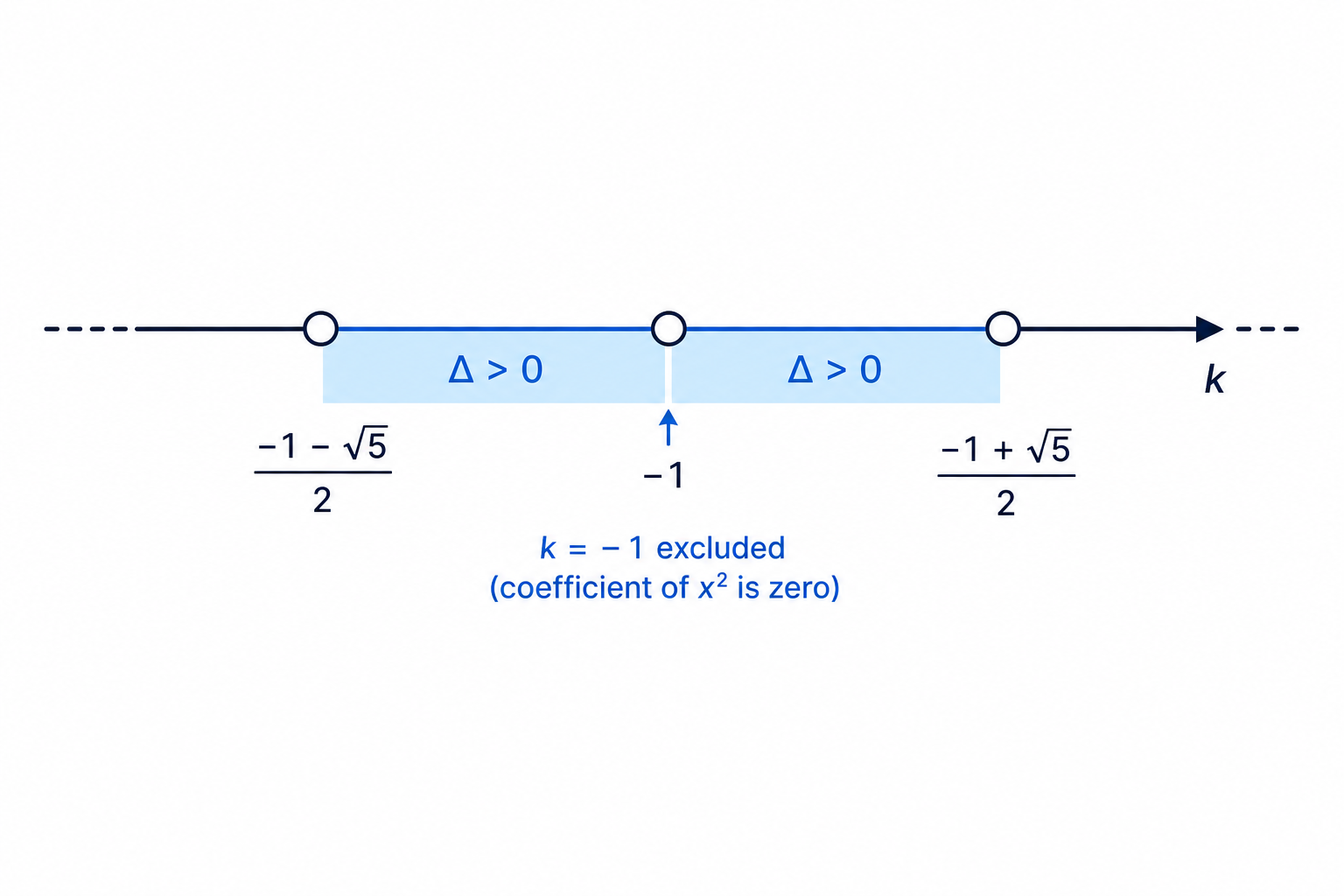
For a genuine quadratic, the coefficient of x2x^2x2 must not be zero, so k≠−1k\neq-1k=−1.
-
Two distinct real roots means Δ>0\Delta>0Δ>0:
22−4(k+1)k>02^2-4(k+1)k>022−4(k+1)k>0 -
Simplify the inequality:
4−4k2−4k>0⇒k2+k−1<04-4k^2-4k>0 \Rightarrow k^2+k-1<04−4k2−4k>0⇒k2+k−1<0 -
Find the critical values by solving k2+k−1=0k^2+k-1=0k2+k−1=0:
k=−1±52k=\frac{-1\pm\sqrt5}{2}k=2−1±5 -
Since k2+k−1k^2+k-1k2+k−1 is negative between its roots, and k=−1k=-1k=−1 must be excluded:
−1−52<k<−1or−1<k<−1+52\frac{-1-\sqrt5}{2}<k<-1 \quad \text{or} \quad -1<k<\frac{-1+\sqrt5}{2}2−1−5<k<−1or−1<k<2−1+5
Forgetting the excluded value
If aaa contains the parameter, do not just solve Δ>0\Delta>0Δ>0, Δ=0\Delta=0Δ=0 or Δ<0\Delta<0Δ<0. First check whether the equation stops being quadratic for any value of the parameter.
4. Completing the square
Completed-square form
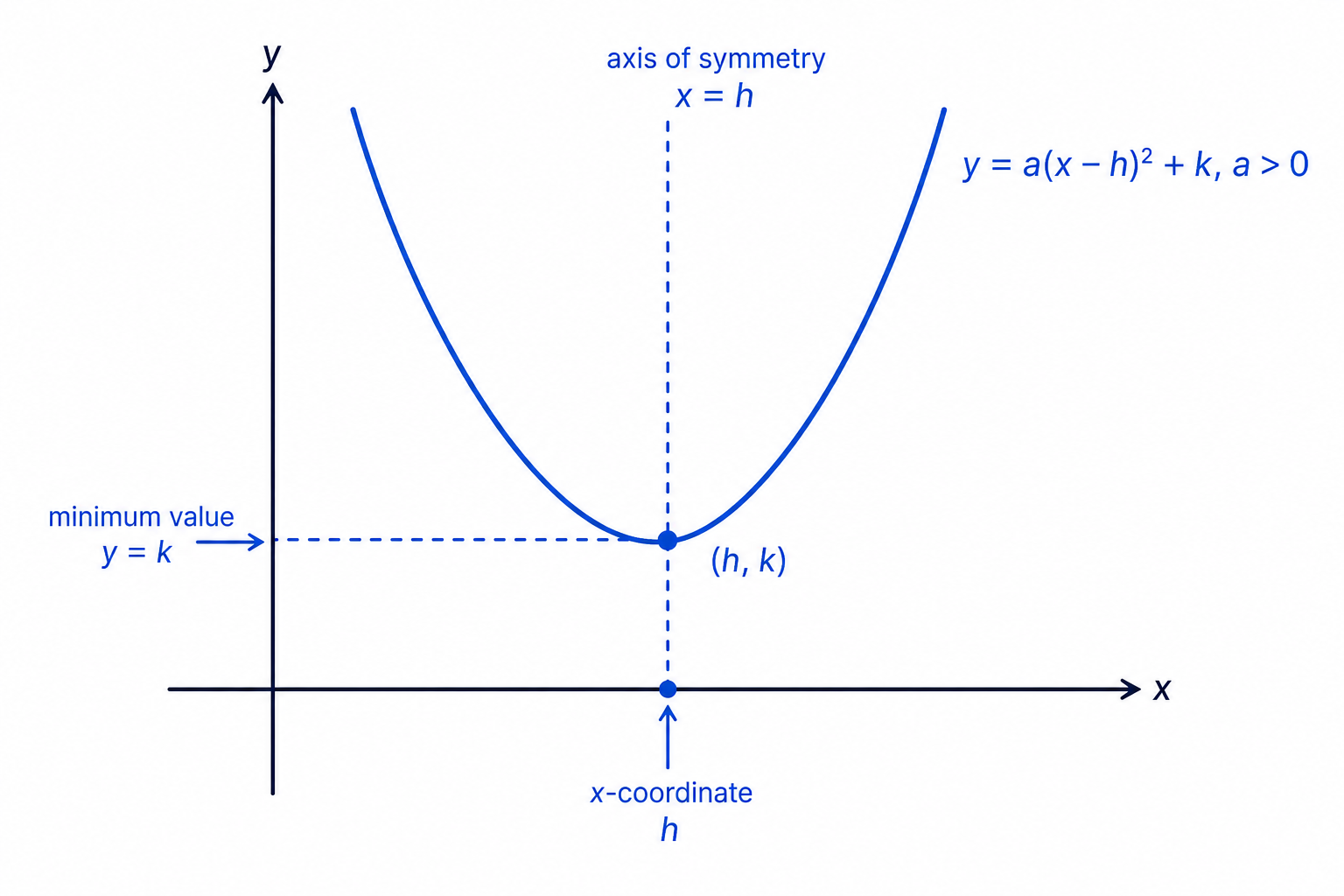
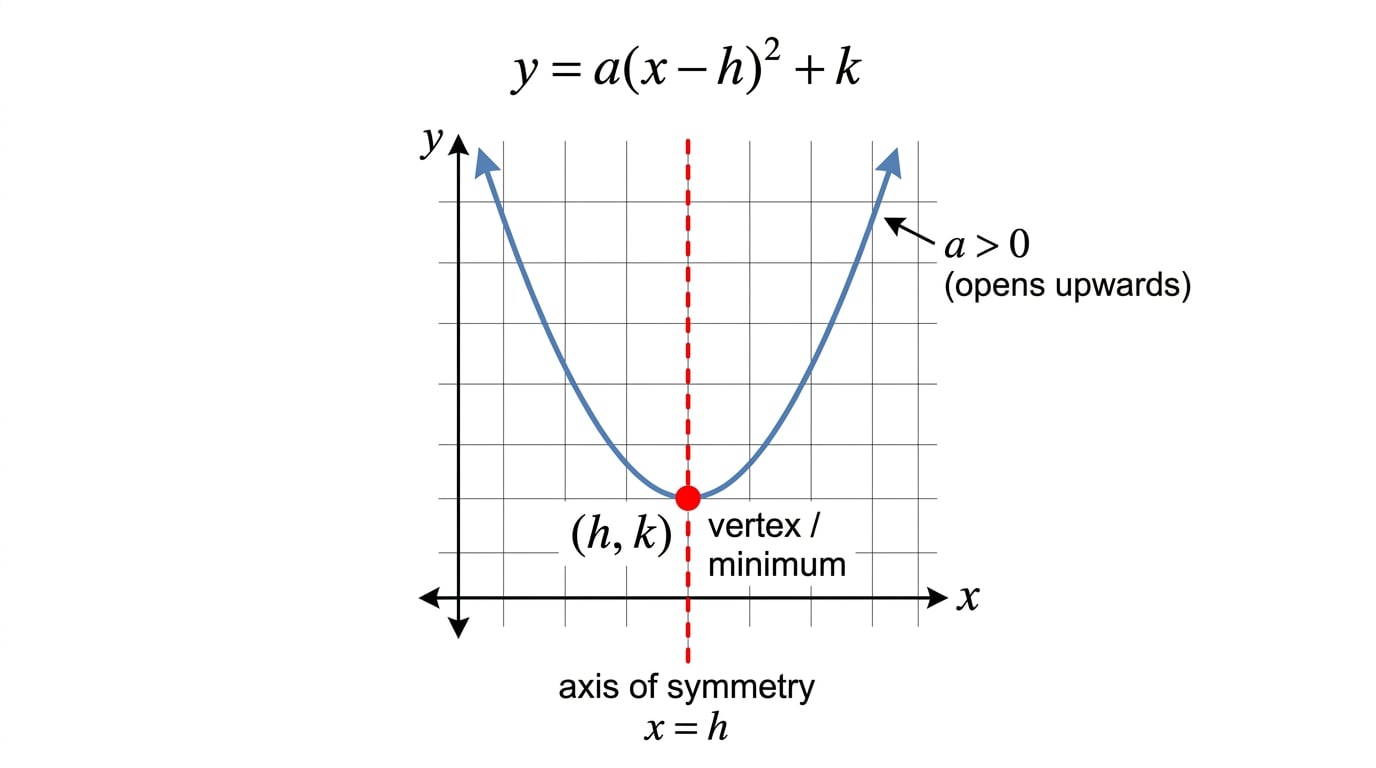
Completing the square means rewriting a quadratic in the form a(x−h)2+ka(x-h)^2+ka(x−h)2+k. This form shows the turning point clearly.
If a quadratic is written as y=a(x−h)2+ky=a(x-h)^2+ky=a(x−h)2+k, its turning point is (h,k)(h,k)(h,k). If it is written as y=a(x+b)2+c‘,itsturningpointisy=a(x+b)^2+c`, its turning point is y=a(x+b)2+c‘,itsturningpointis(-b,c)$.
The turning point is the minimum point if a>0a>0a>0, and the maximum point if a<0a<0a<0. The vertical line through the turning point is called the axis of symmetry.
Completing the square shortcut
For x2+pxx^2+pxx2+px, halve the coefficient of xxx, put it inside the bracket, then subtract the square you accidentally added.
Finding the turning point
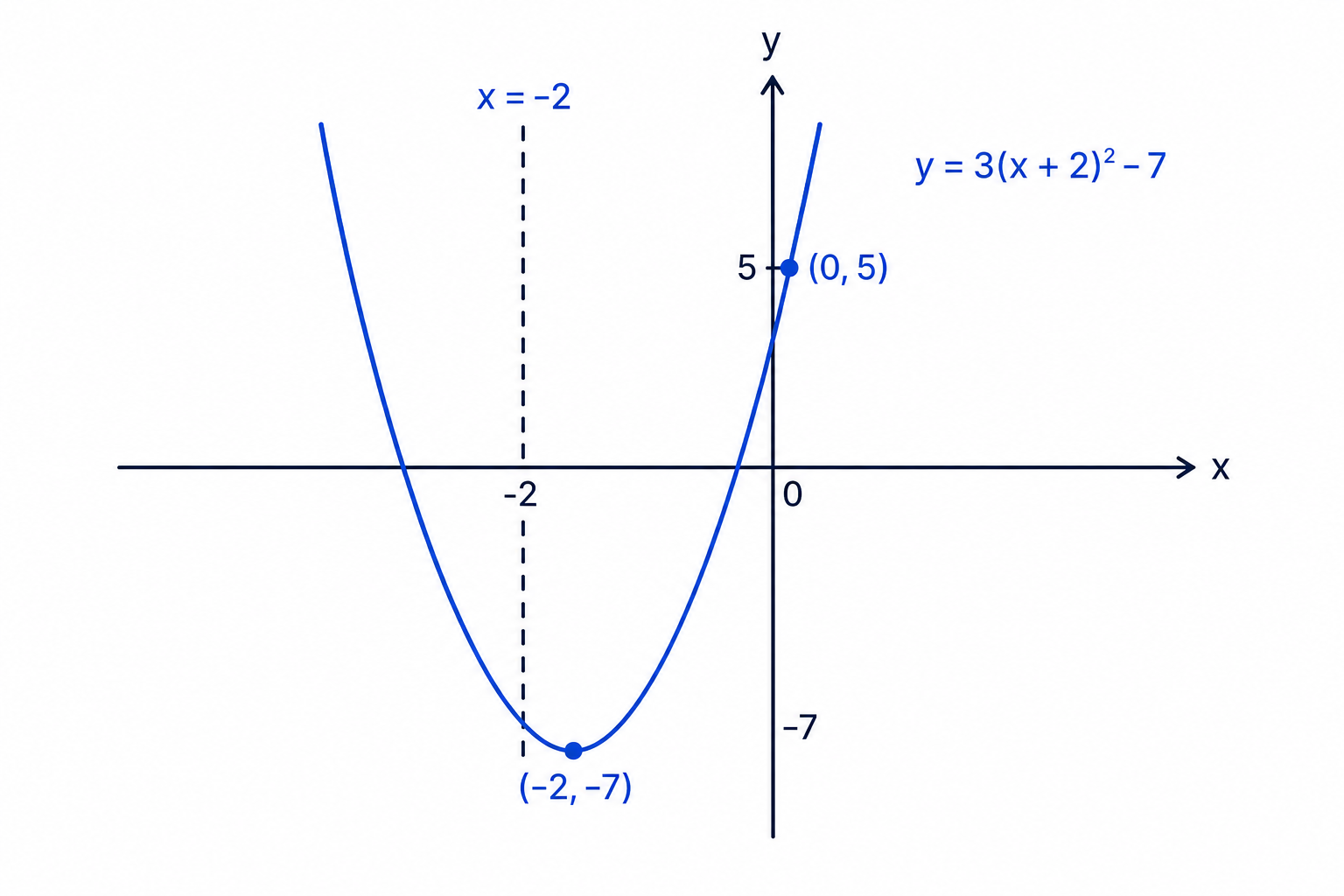
Express 3x2+12x+53x^2+12x+53x2+12x+5 in completed-square form and state the turning point.
-
Factor 3 from the x2x^2x2 and xxx terms:
3x2+12x+5=3(x2+4x)+53x^2+12x+5=3(x^2+4x)+53x2+12x+5=3(x2+4x)+5 -
Complete the square inside the bracket:
x2+4x=(x+2)2−4x^2+4x=(x+2)^2-4x2+4x=(x+2)2−4 -
Substitute this back in:
3((x+2)2−4)+5=3(x+2)2−73\left((x+2)^2-4\right)+5=3(x+2)^2-73((x+2)2−4)+5=3(x+2)2−7 -
The completed-square form is 3(x+2)2−73(x+2)^2-73(x+2)2−7, so the minimum point is (−2,−7)(-2,-7)(−2,−7).
At the minimum or maximum point of a quadratic, the tangent is horizontal. So the normal at that point is vertical, with equation x=turning point x-coordinatex=\text{turning point }x\text{-coordinate}x=turning point x-coordinate.
5. Solving by completing the square
Completing the square can also be used to solve equations exactly, especially when a question asks for roots “in terms of” a parameter.
Roots in terms of a parameter
By completing the square, find the roots of x2+px+7=0x^2+px+7=0x2+px+7=0.
-
Complete the square:
x2+px+7=(x+p2)2+7−p24x^2+px+7=\left(x+\frac{p}{2}\right)^2+7-\frac{p^2}{4}x2+px+7=(x+2p)2+7−4p2 -
Set the expression equal to zero:
(x+p2)2=p24−7\left(x+\frac{p}{2}\right)^2=\frac{p^2}{4}-7(x+2p)2=4p2−7 -
Write the right-hand side as a single fraction:
(x+p2)2=p2−284\left(x+\frac{p}{2}\right)^2=\frac{p^2-28}{4}(x+2p)2=4p2−28 -
Square root both sides:
x+p2=±p2−282x+\frac{p}{2}=\pm\frac{\sqrt{p^2-28}}{2}x+2p=±2p2−28 -
Therefore the roots are:
x=−p±p2−282x=\frac{-p\pm\sqrt{p^2-28}}{2}x=2−p±p2−28
6. Proving quadratic inequalities
A square is always non-negative: (x−h)2≥0(x-h)^2\ge0(x−h)2≥0 for all real xxx. This makes completed-square form very useful for proving that an expression is always positive.
Proving an inequality for all real values
Prove that x2+3x+10>x+1x^2+3x+10>x+1x2+3x+10>x+1 for all real xxx.
-
Move everything to the left-hand side:
x2+3x+10−(x+1)>0⇒x2+2x+9>0x^2+3x+10-(x+1)>0 \Rightarrow x^2+2x+9>0x2+3x+10−(x+1)>0⇒x2+2x+9>0 -
Complete the square:
x2+2x+9=(x+1)2+8x^2+2x+9=(x+1)^2+8x2+2x+9=(x+1)2+8 -
Since (x+1)2≥0(x+1)^2\ge0(x+1)2≥0, the expression (x+1)2+8(x+1)^2+8(x+1)2+8 is always at least 8.
-
Therefore x2+3x+10>x+1x^2+3x+10>x+1x2+3x+10>x+1 for all real xxx.
7. Intersections, tangents and models
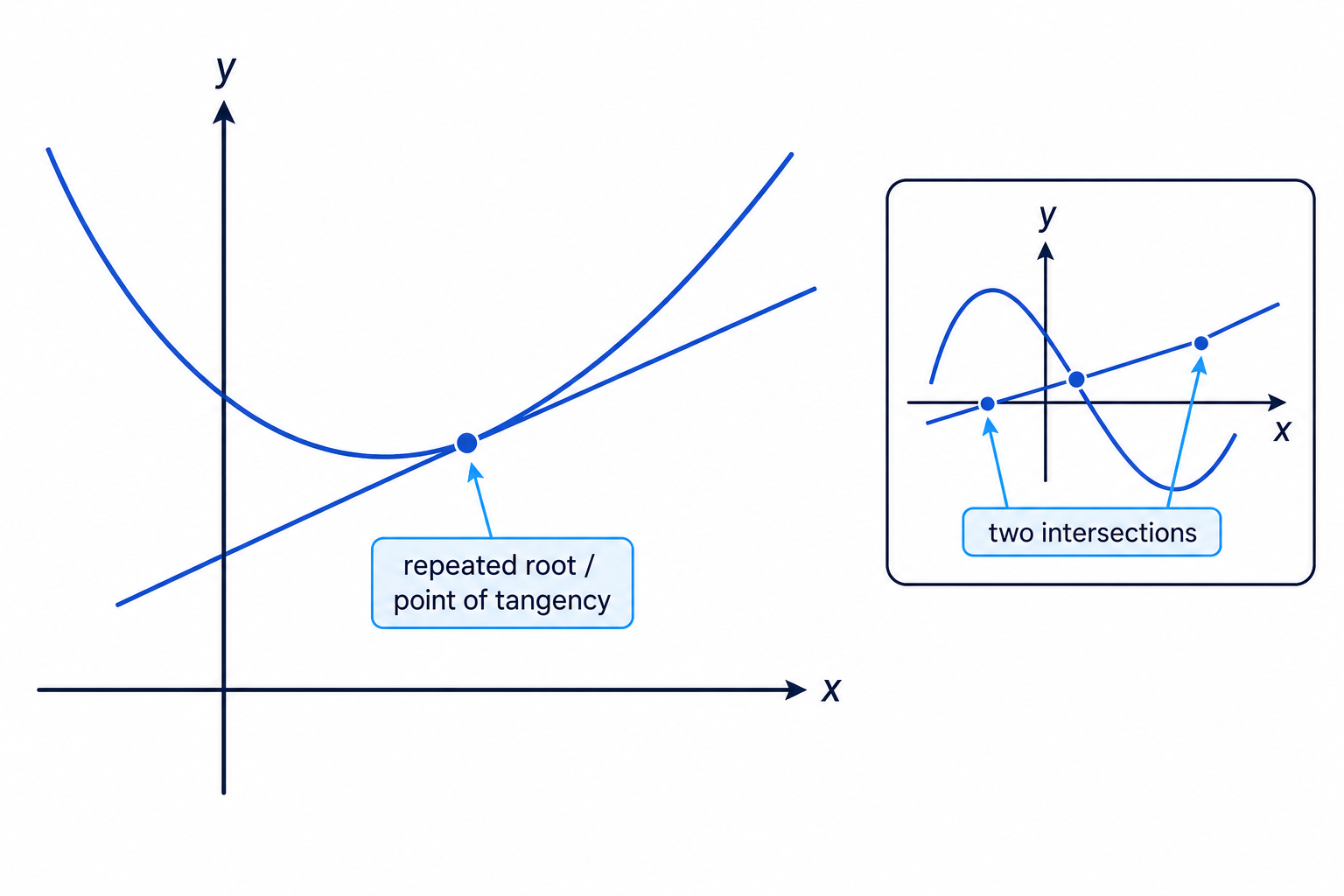
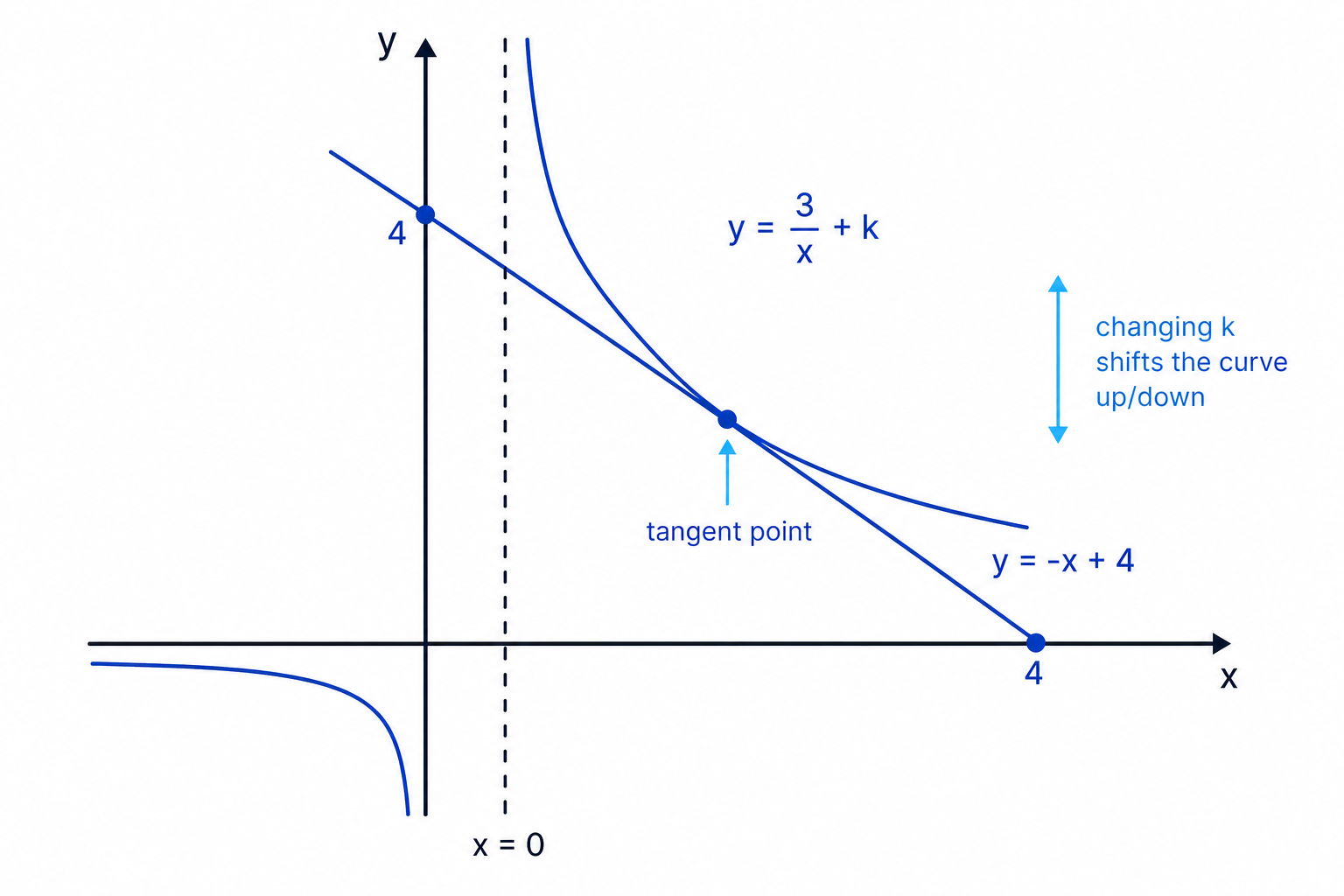
A tangent is a line that touches a curve at exactly one point locally. Algebraically, tangency often means the equation formed by setting the line and curve equal has a repeated root.
Finding tangency values
The curve y=3x+ky=\frac{3}{x}+ky=x3+k, where x≠0x\neq0x=0, meets the line y=−x+4y=-x+4y=−x+4. Find the values of kkk for which the line is a tangent to the curve.
-
Set the two expressions for yyy equal:
3x+k=−x+4\frac{3}{x}+k=-x+4x3+k=−x+4 -
Multiply by xxx:
3+kx=−x2+4x3+kx=-x^2+4x3+kx=−x2+4x -
Rearrange into quadratic form:
x2+(k−4)x+3=0x^2+(k-4)x+3=0x2+(k−4)x+3=0 -
For tangency, this quadratic has a repeated root, so Δ=0\Delta=0Δ=0:
(k−4)2−4(1)(3)=0(k-4)^2-4(1)(3)=0(k−4)2−4(1)(3)=0 -
Solve for kkk:
(k−4)2=12⇒k=4±23(k-4)^2=12 \Rightarrow k=4\pm2\sqrt3(k−4)2=12⇒k=4±23
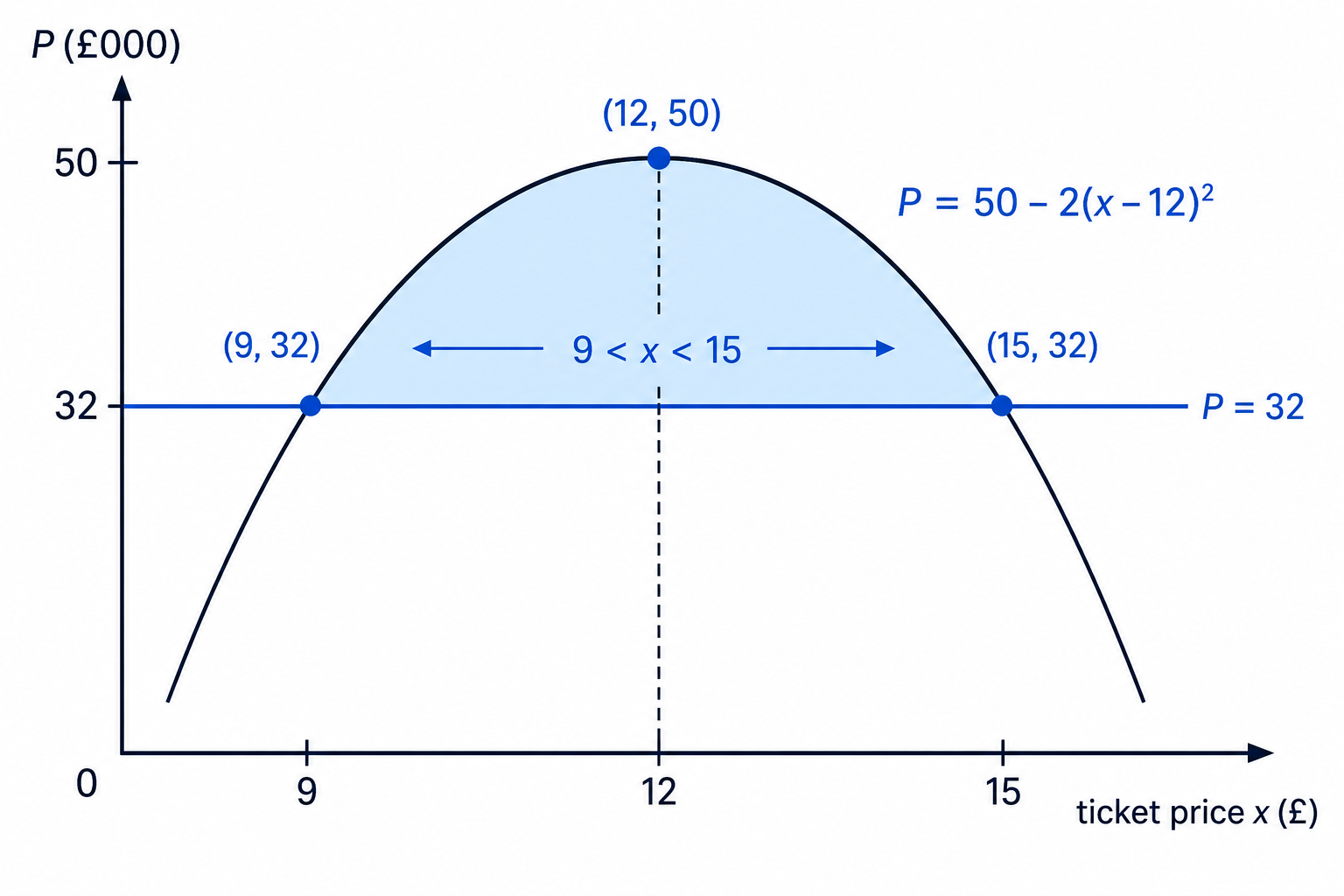
Quadratic models often use completed-square form directly. The domain is the set of input values where the model makes sense.
Using a profit model
A club models profit using P=50−2(x−12)2P=50-2(x-12)^2P=50−2(x−12)2, where PPP is profit in thousands of pounds and xxx is the ticket price in pounds. Find the maximum profit and the prices giving profit more than £32,000.
-
Since 2(x−12)2≥02(x-12)^2\ge02(x−12)2≥0 and is subtracted from 50, the maximum value is P=50P=50P=50 when x=12x=12x=12.
-
So the maximum profit is £50,000, at a ticket price of £12.
-
Profit more than £32,000 means P>32P>32P>32:
50−2(x−12)2>3250-2(x-12)^2>3250−2(x−12)2>32 -
Solve the inequality:
(x−12)2<9(x-12)^2<9(x−12)2<9 -
Convert this to a range:
−3<x−12<3⇒9<x<15-3<x-12<3 \Rightarrow 9<x<15−3<x−12<3⇒9<x<15 -
The model predicts profit above £32,000 for ticket prices between £9 and £15, not including the endpoints.
In the exam
-
Put the equation into ax2+bx+c=0ax^2+bx+c=0ax2+bx+c=0 before using the discriminant.
-
Translate the wording carefully: two distinct roots means Δ>0\Delta>0Δ>0, repeated roots or tangent means Δ=0\Delta=0Δ=0, and no real roots means $\Delta<0`.
-
If a coefficient contains a parameter, check whether the equation can stop being quadratic.
-
For completed-square form, read the turning point directly and use the sign of aaa to decide minimum or maximum.
-
In modelling questions, mention sensible restrictions such as positive speeds, positive prices, or values within the context.
Check yourself
-
Can you explain why (x−3)2+5=0(x-3)^2+5=0(x−3)2+5=0 has no real roots?
-
If (k−2)x2+4x+1=0(k-2)x^2+4x+1=0(k−2)x2+4x+1=0 has two distinct real roots, what extra value of kkk must you remember to check?
-
In 4(x+1)2−74(x+1)^2-74(x+1)2−7, where is the turning point, and is it a minimum or maximum?
