What you'll learn
- How logarithms “undo” powers, just like square roots undo squares.
- How to use log laws to simplify expressions and solve equations.
- How to work with exe^xex and lnx\ln xlnx in growth, decay and cooling models.
- How to find ranges, intercepts and tangents for exponential graphs.
1. Powers first: exponential functions
Before logs, you need to be confident with indices. For example, 252^525 means 2 multiplied by itself 5 times. The number being repeatedly multiplied is called the base.
Exponential function
An exponential function is a function where the variable appears in the power, such as y=3xy=3^xy=3x or y=exy=e^xy=ex. For AS Maths, the base is positive and not equal to 1.
If both sides of an equation can be written with the same base, you can equate the powers.
Solving when the bases match
Solve 2x+1=642^{x+1}=642x+1=64.
-
Rewrite 64 as a power of 2:
64=2664=2^664=26 -
Equate the powers because the bases are the same:
x+1=6x+1=6x+1=6 -
Solve for xxx:
x=5x=5x=5
2. Logarithms undo exponentials
Most exponential equations do not have matching bases. That is when logarithms are needed.
Logarithm
logab\log_a blogab means “the power you put on aaa to get bbb”. So logab=c\log_a b=clogab=c is equivalent to ac=ba^c=bac=b. The number aaa is the base of the logarithm.
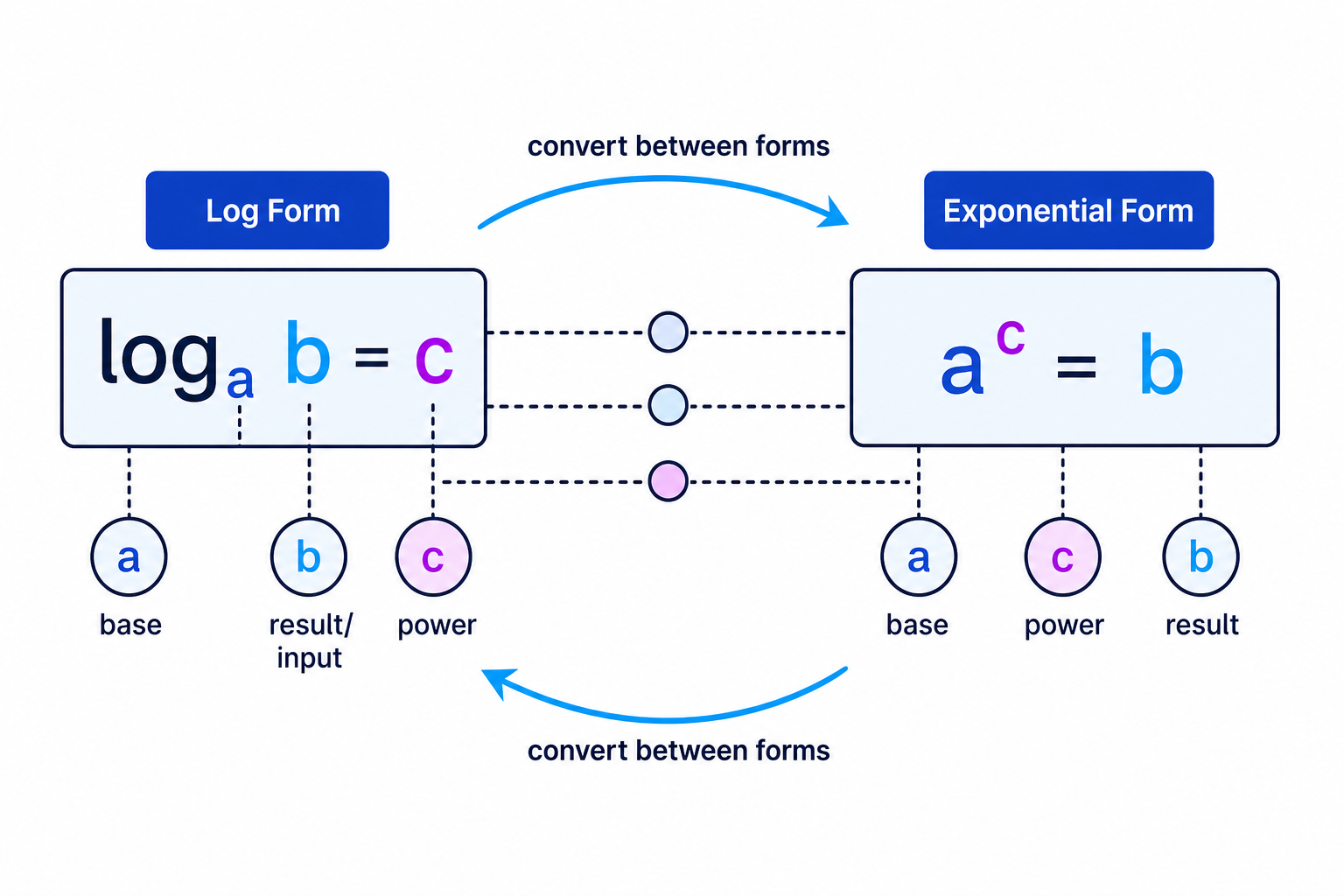
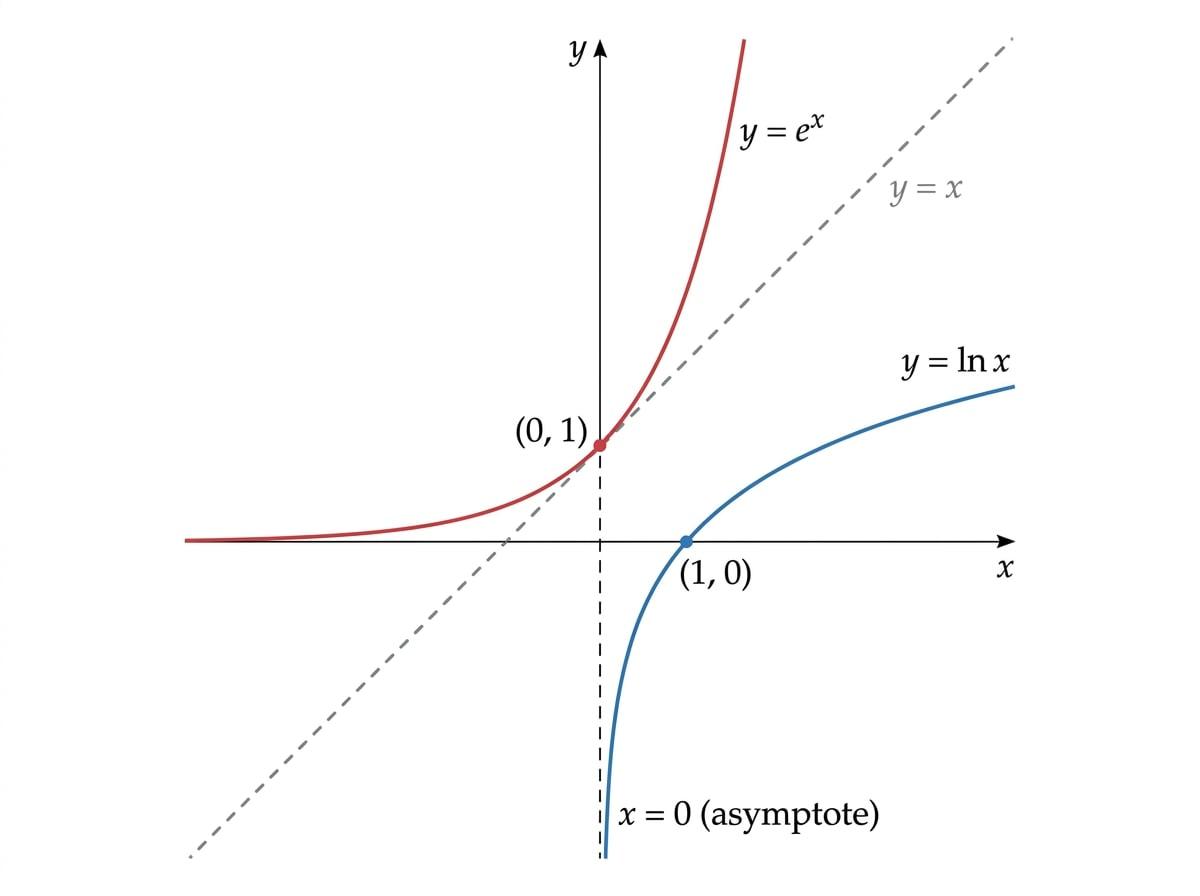
The most common logarithm in AS Pure is the natural logarithm, written lnx\ln xlnx. It means logex\log_e xlogex, where eee is the constant approximately 2.718.
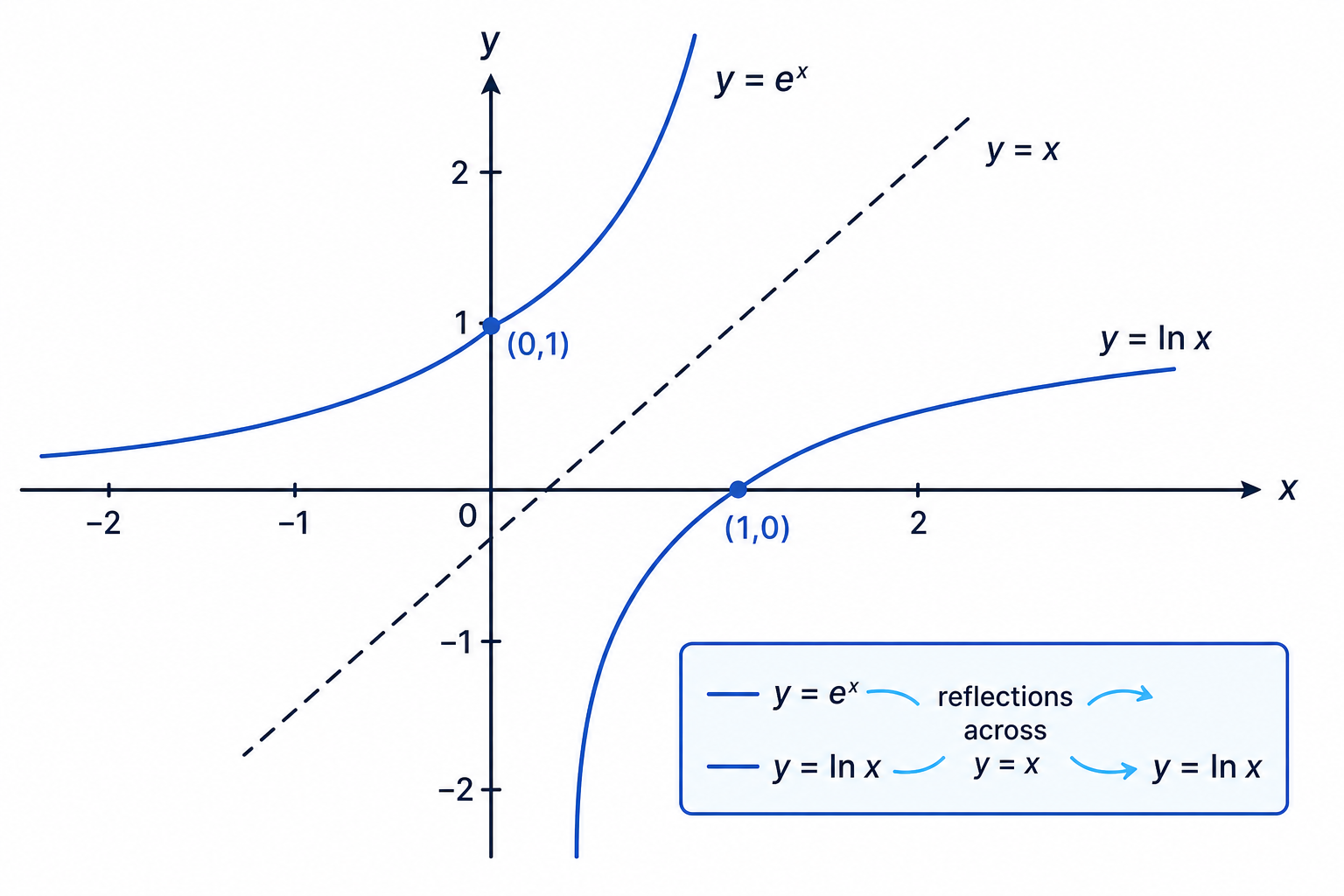
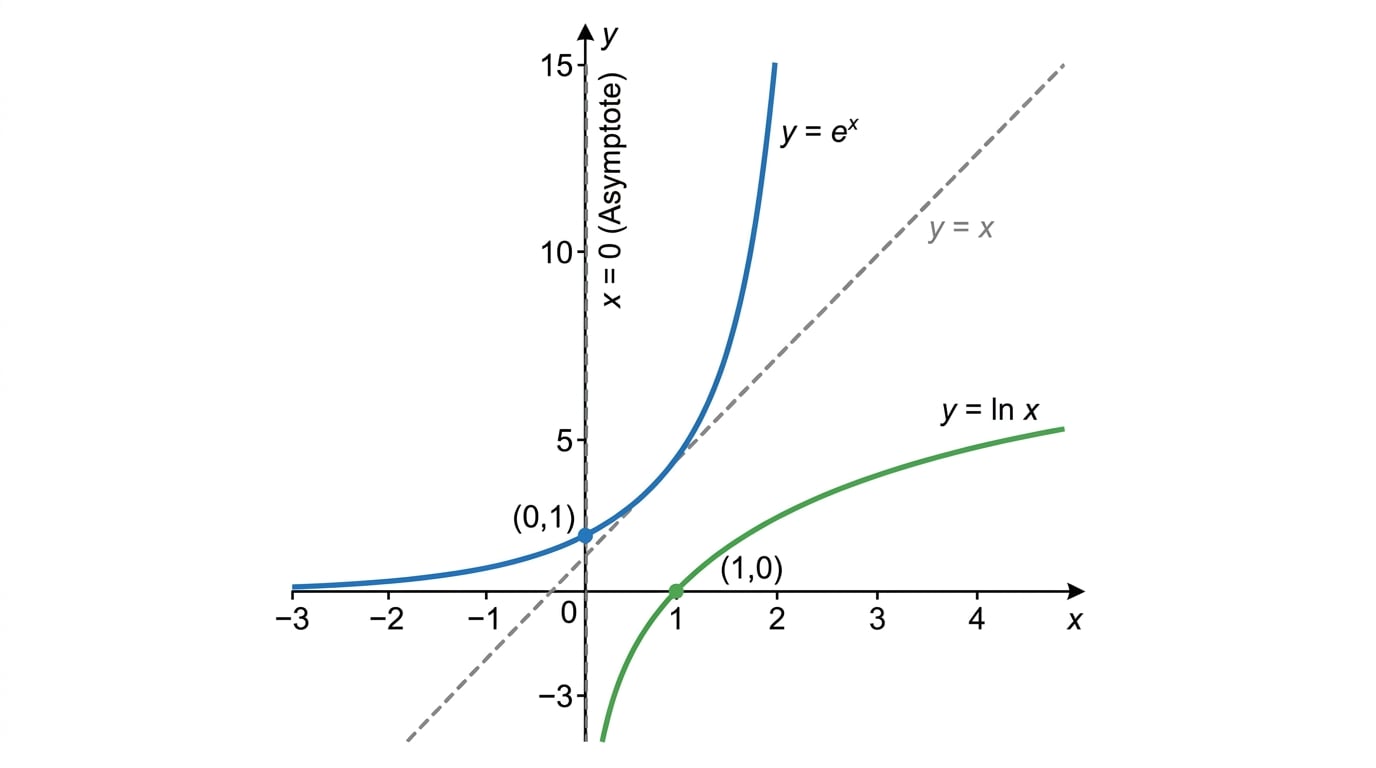
The graphs of y=exy=e^xy=ex and y=lnxy=\ln xy=lnx are inverses: they reflect in the line y=xy=xy=x.
Logs reverse powers
If ax=ba^x=bax=b, then x=logabx=\log_a bx=logab. On your calculator, it is usually easiest to use natural logs: x=lnblnax=\frac{\ln b}{\ln a}x=lnalnb.
Solving
Solve 5x=185^x=185x=18, giving your answer to 3 significant figures.
-
Take natural logs of both sides:
ln(5x)=ln18\ln(5^x)=\ln 18ln(5x)=ln18 -
Use the power law of logs to bring xxx down:
xln5=ln18x\ln 5=\ln 18xln5=ln18 -
Divide by ln5\ln 5ln5:
x=ln18ln5x=\frac{\ln 18}{\ln 5}x=ln5ln18 -
Evaluate and round:
x≈1.80x\approx 1.80x≈1.80
Dividing inside the log
From 5x=185^x=185x=18, do not write x=ln(18÷5)x=\ln(18\div 5)x=ln(18÷5). The correct method is x=ln18ln5x=\frac{\ln 18}{\ln 5}x=ln5ln18.
3. The log laws
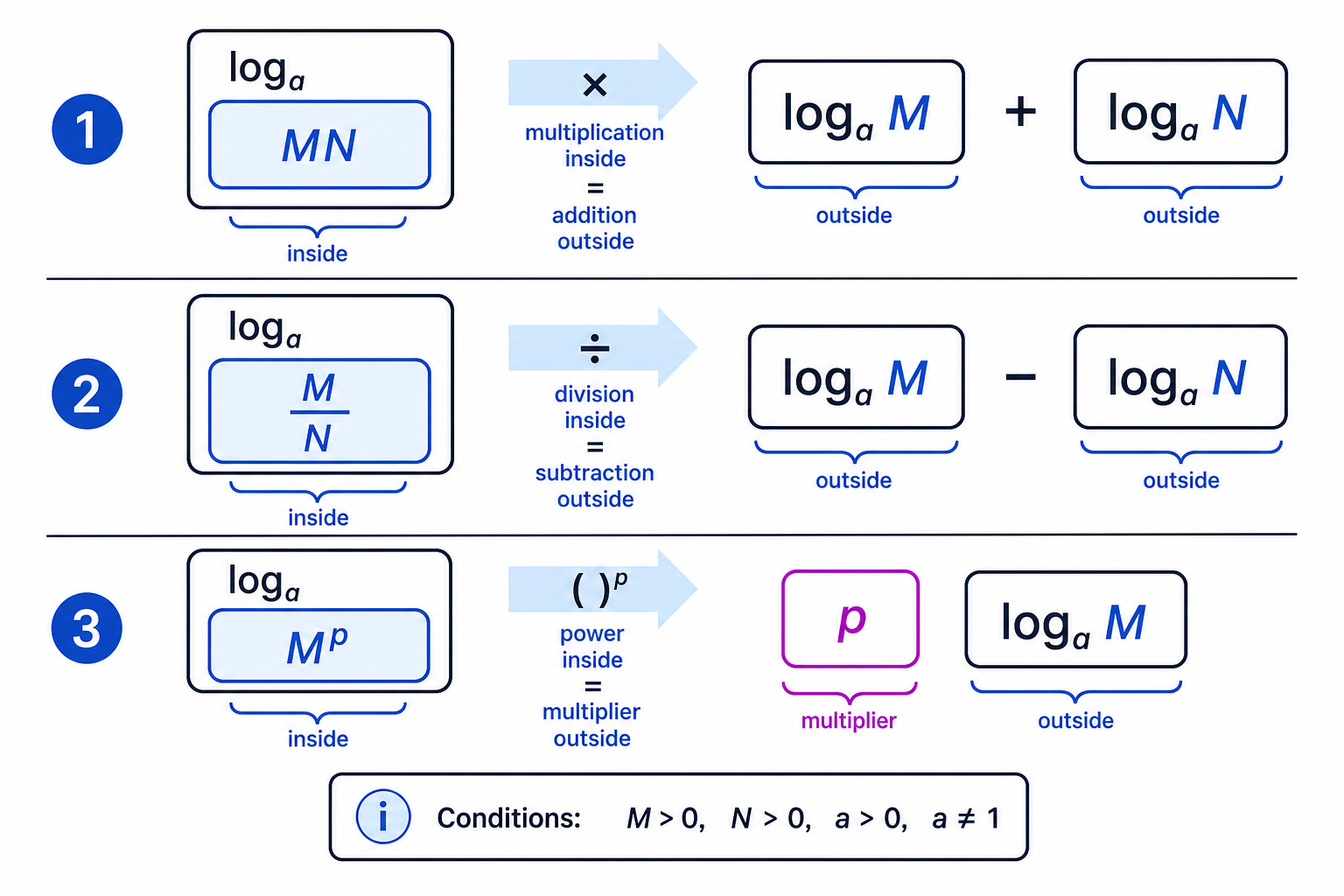
Log laws let you combine or split logarithms. They are especially useful when solving equations.
Log laws
For M>0M>0M>0, N>0N>0N>0, a>0a>0a>0 and a≠1a\neq 1a=1:
loga(MN)=logaM+logaNloga(MN)=logaM−logaNloga(Mp)=plogaM\begin{aligned} \log_a(MN)&=\log_a M+\log_a N\\ \log_a\left(\frac{M}{N}\right)&=\log_a M-\log_a N\\ \log_a(M^p)&=p\log_a M \end{aligned}loga(MN)loga(NM)loga(Mp)=logaM+logaN=logaM−logaN=plogaMWriting as a single logarithm
Express 2loga(x+3)−loga72\log_a(x+3)-\log_a 72loga(x+3)−loga7 as a single logarithm.
-
Use the power law on the first term:
2loga(x+3)=loga((x+3)2)2\log_a(x+3)=\log_a\left((x+3)^2\right)2loga(x+3)=loga((x+3)2) -
Use the subtraction law:
loga((x+3)2)−loga7=loga((x+3)27)\log_a\left((x+3)^2\right)-\log_a 7=\log_a\left(\frac{(x+3)^2}{7}\right)loga((x+3)2)−loga7=loga(7(x+3)2) -
State the restriction from the log input:
x>−3x>-3x>−3
Solving a log equation
Solve 2log2x−log25=32\log_2 x-\log_2 5=32log2x−log25=3.
-
Use the power law:
2log2x=log2(x2)2\log_2 x=\log_2(x^2)2log2x=log2(x2) -
Combine into one logarithm:
log2(x25)=3\log_2\left(\frac{x^2}{5}\right)=3log2(5x2)=3 -
Convert from log form to exponential form:
x25=23\frac{x^2}{5}=2^35x2=23 -
Solve, remembering x>0x>0x>0 because log2x\log_2 xlog2x is only defined for positive xxx:
x=210x=2\sqrt{10}x=210
Logs do not split over addition
loga(M+N)\log_a(M+N)loga(M+N) is not the same as logaM+logaN\log_a M+\log_a NlogaM+logaN. Log laws work with multiplication, division and powers, not addition inside the log.
Sometimes you are told y=log2xy=\log_2 xy=log2x and asked to rewrite related expressions.
Using
Given y=log2xy=\log_2 xy=log2x, write these in terms of yyy: log2(x2)\log_2(x^2)log2(x2), log2(8x)\log_2(8x)log2(8x) and log4x\log_4 xlog4x.
-
Use the power law:
log2(x2)=2log2x=2y\log_2(x^2)=2\log_2 x=2ylog2(x2)=2log2x=2y -
Write 8 as 232^323, then use the multiplication law:
log2(8x)=log28+log2x=3+y\log_2(8x)=\log_2 8+\log_2 x=3+ylog2(8x)=log28+log2x=3+y -
For base 4, remember 4=224=2^24=22:
log4x=log2xlog24=y2\log_4 x=\frac{\log_2 x}{\log_2 4}=\frac{y}{2}log4x=log24log2x=2y
4. Solving equations involving lnx\ln xlnx
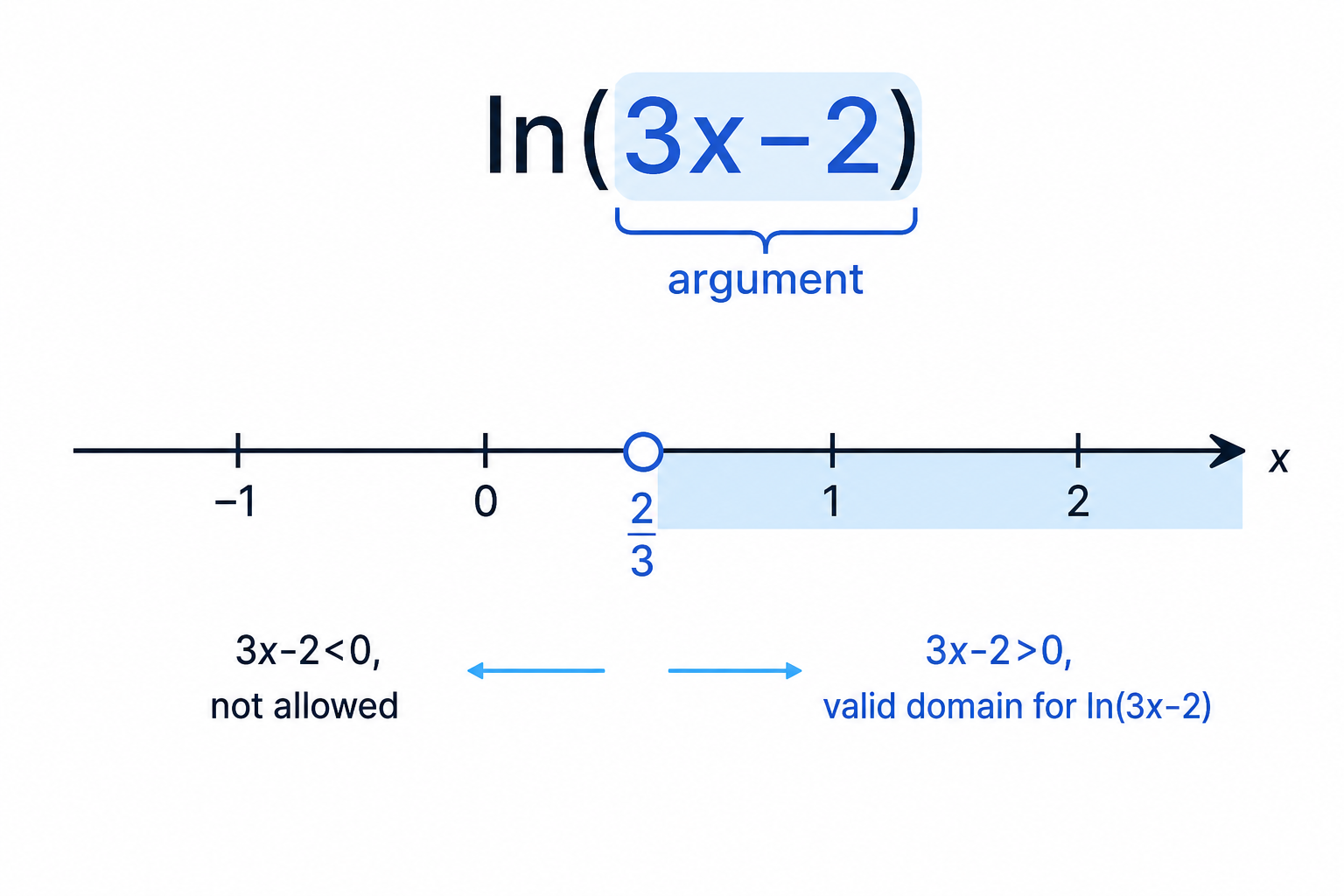
The argument of a logarithm is the expression inside it. For ln(3x−2)\ln(3x-2)ln(3x−2), the argument is 3x−23x-23x−2. The argument must be positive.
Log inputs must be positive
You can only take ln\lnln or log\loglog of a positive number. Always check the argument, especially when a solution has come from squaring or from a quadratic.
Solving a natural log equation
Solve ln(3x−2)=1\ln(3x-2)=1ln(3x−2)=1.
-
Exponentiate both sides to undo ln\lnln:
3x−2=e13x-2=e^13x−2=e1 -
Rearrange:
x=e+23x=\frac{e+2}{3}x=3e+2 -
Check the argument is positive:
3x−2=e>03x-2=e>03x−2=e>0
You can also use logs to solve simultaneous equations by substituting one expression into the other.
A simultaneous equation with and
Solve to 2 decimal places:
e2y=x+2,ln(x−1)=2y−1e^{2y}=x+2,\qquad \ln(x-1)=2y-1e2y=x+2,ln(x−1)=2y−1-
Take logs of the first equation:
2y=ln(x+2)2y=\ln(x+2)2y=ln(x+2) -
Substitute into the second equation:
ln(x−1)=ln(x+2)−1\ln(x-1)=\ln(x+2)-1ln(x−1)=ln(x+2)−1 -
Combine the logarithms:
ln(x−1x+2)=−1\ln\left(\frac{x-1}{x+2}\right)=-1ln(x+2x−1)=−1 -
Exponentiate and solve for xxx:
x−1x+2=e−1\frac{x-1}{x+2}=e^{-1}x+2x−1=e−1 -
Rearranging gives:
x=e+2e−1≈2.75x=\frac{e+2}{e-1}\approx 2.75x=e−1e+2≈2.75 -
Substitute into 2y=ln(x+2)2y=\ln(x+2)2y=ln(x+2):
y≈0.78y\approx 0.78y≈0.78
5. Equations that become quadratics
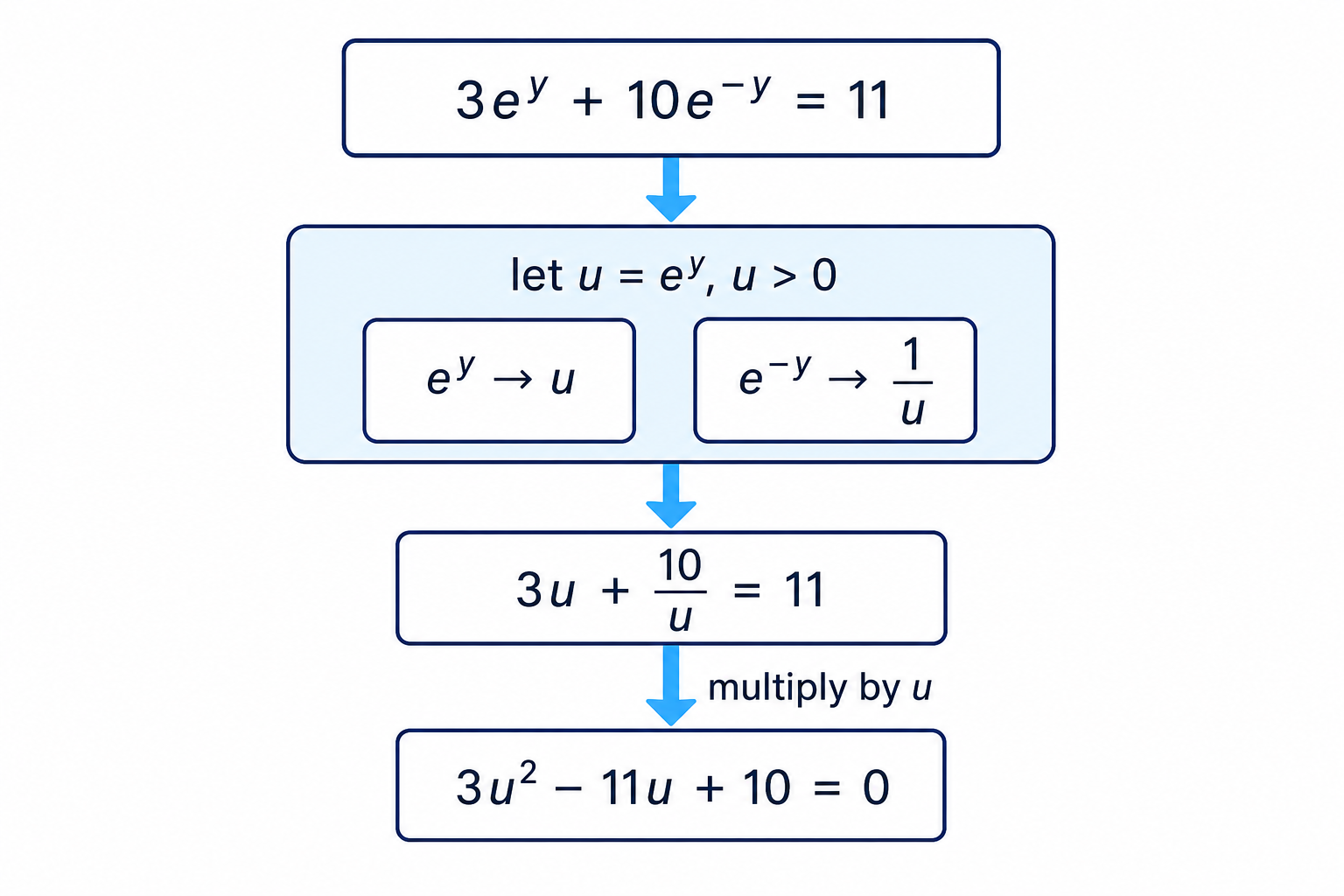
Some equations contain both eye^yey and e−ye^{-y}e−y. Since e−y=1eye^{-y}=\frac{1}{e^y}e−y=ey1, a substitution often turns the equation into a quadratic.
Using the substitution
Solve exactly:
3ey+10e−y=113e^y+10e^{-y}=113ey+10e−y=11-
Let u=eyu=e^yu=ey, so e−y=1ue^{-y}=\frac{1}{u}e−y=u1 and u>0u>0u>0.
-
Substitute and multiply by uuu:
3u+10u=113u+\frac{10}{u}=113u+u10=11 -
Rearrange into a quadratic:
3u2−11u+10=03u^2-11u+10=03u2−11u+10=0 -
Factorise:
(3u−5)(u−2)=0(3u-5)(u-2)=0(3u−5)(u−2)=0 -
Convert back to yyy:
y=ln(53)ory=ln2y=\ln\left(\frac{5}{3}\right)\quad \text{or}\quad y=\ln 2y=ln(35)ory=ln2
6. Exponential models and rates of change
Exponential models often look like P=AektP=Ae^{kt}P=Aekt. Here, AAA is the initial amount and kkk controls the rate of growth or decay.
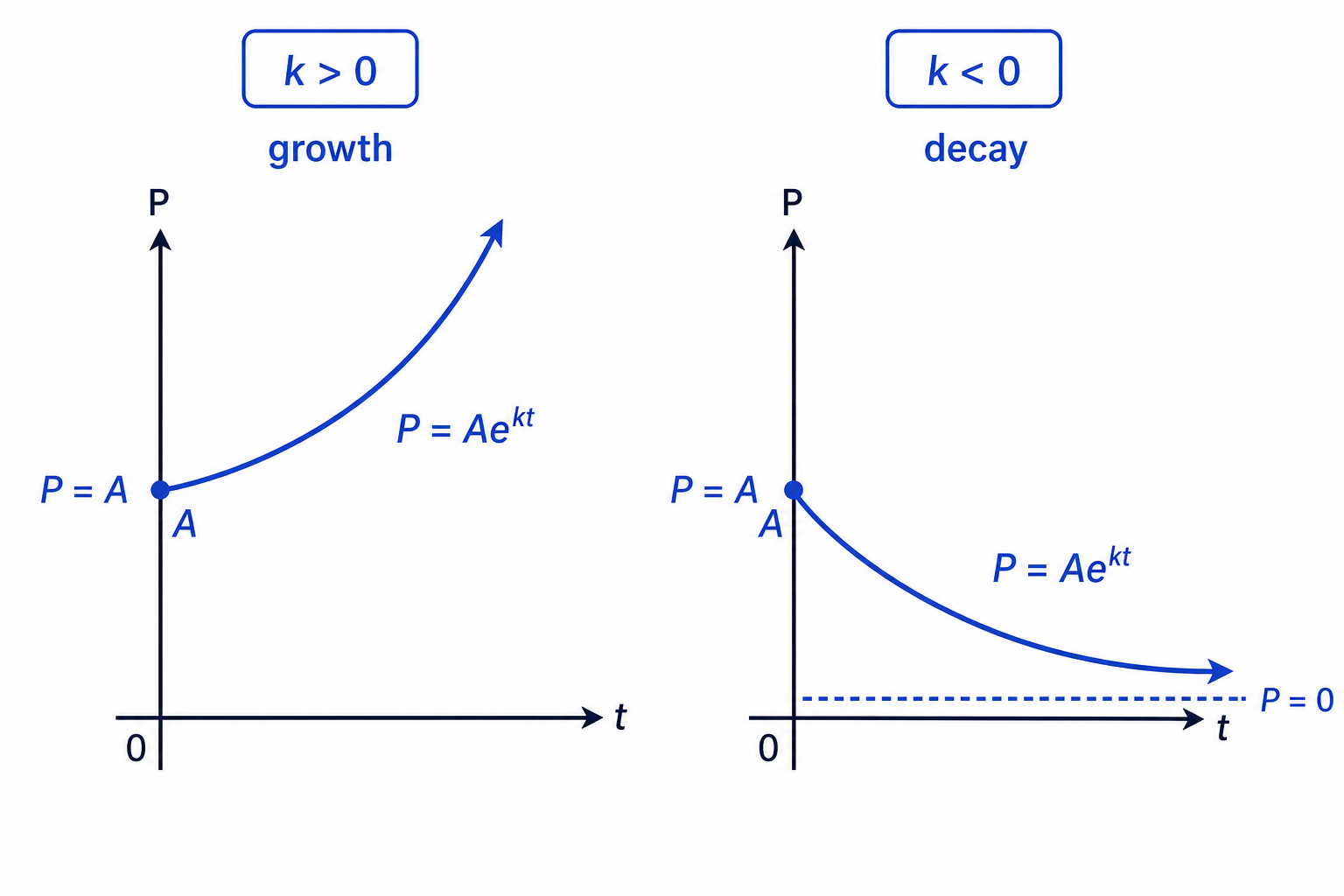
If k>0k>0k>0, the model grows. If the exponent is negative, such as Ae−ktAe^{-kt}Ae−kt, the model decays.
Derivative of an exponential model
If P=AektP=Ae^{kt}P=Aekt, then dPdt=kAekt\frac{dP}{dt}=kAe^{kt}dtdP=kAekt. The rate of change is proportional to the current amount.
A growth model
A plant population is modelled by P=60e0.07tP=60e^{0.07t}P=60e0.07t, where ttt is measured in weeks.
-
Find the initial population by putting t=0t=0t=0:
P(0)=60e0=60P(0)=60e^0=60P(0)=60e0=60 -
Differentiate to find the rate of increase:
dPdt=60⋅0.07e0.07t=4.2e0.07t\frac{dP}{dt}=60\cdot 0.07e^{0.07t}=4.2e^{0.07t}dtdP=60⋅0.07e0.07t=4.2e0.07t -
At 10 weeks, the rate is:
4.2e0.7≈8.464.2e^{0.7}\approx 8.464.2e0.7≈8.46 -
To find when the population exceeds 300, solve the inequality:
60e0.07t>30060e^{0.07t}>30060e0.07t>300 -
Take logs and solve:
t>ln50.07≈22.99t>\frac{\ln 5}{0.07}\approx 22.99t>0.07ln5≈22.99
Interpreting model answers
If time is continuous, “22.99 weeks” is fine to 2 decimal places. If the question asks for a whole number of weeks, round up to 23 weeks because the population must exceed the target.
For cooling or radioactive decay, you are often given one data point to find the constant kkk.
Finding a decay constant
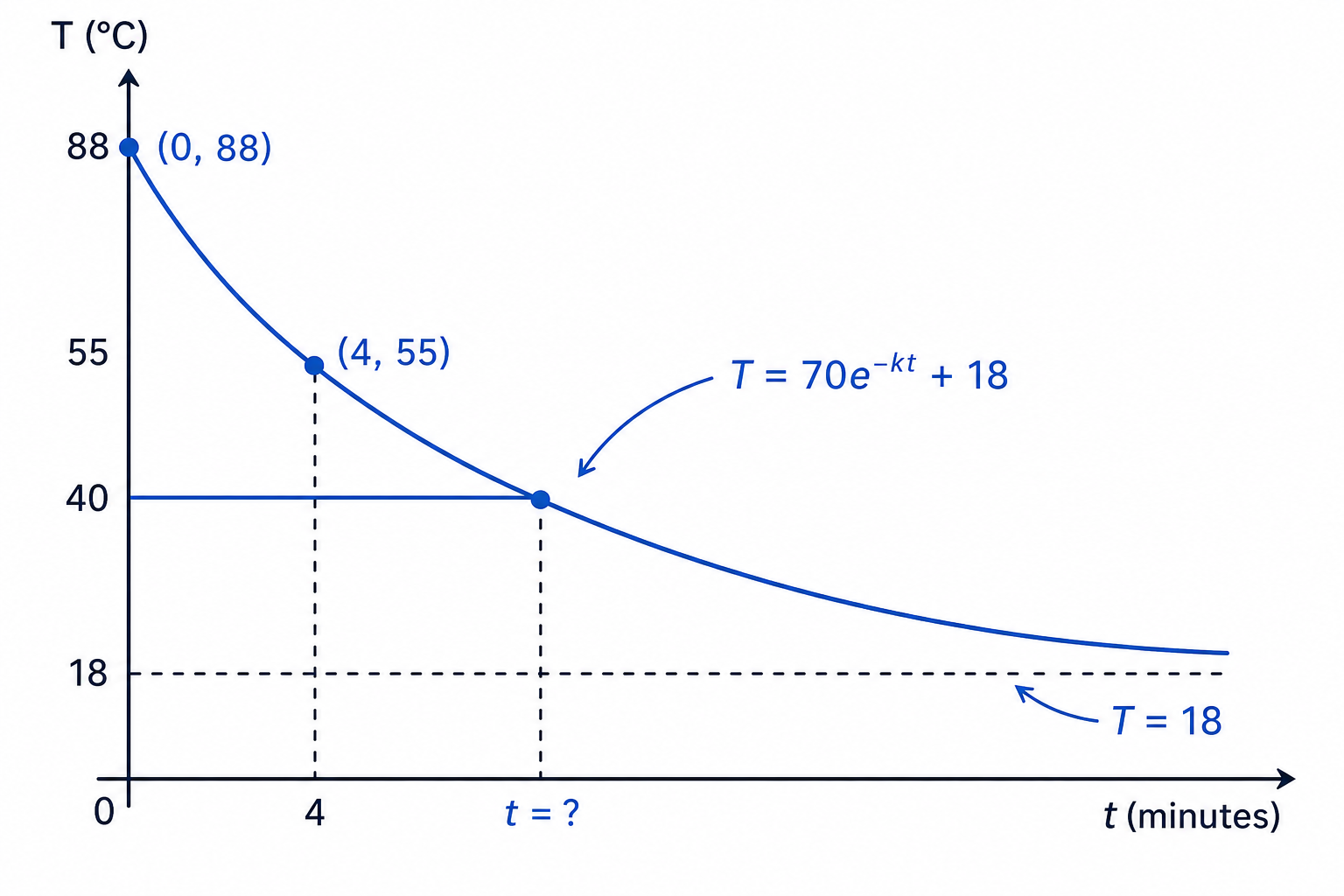
A temperature model is T=70e−kt+18T=70e^{-kt}+18T=70e−kt+18. After 4 minutes, T=55T=55T=55. Find kkk and then find when T=40T=40T=40.
-
Substitute t=4t=4t=4 and T=55T=55T=55:
55=70e−4k+1855=70e^{-4k}+1855=70e−4k+18 -
Rearrange:
e−4k=3770e^{-4k}=\frac{37}{70}e−4k=7037 -
Take logs:
k=−14ln(3770)≈0.159k=-\frac{1}{4}\ln\left(\frac{37}{70}\right)\approx 0.159k=−41ln(7037)≈0.159 -
Now set T=40T=40T=40:
40=70e−kt+1840=70e^{-kt}+1840=70e−kt+18 -
Solve for ttt:
t=−ln(1135)k≈7.27t=-\frac{\ln\left(\frac{11}{35}\right)}{k}\approx 7.27t=−kln(3511)≈7.27
7. Exponential graphs, range, intercepts and tangents
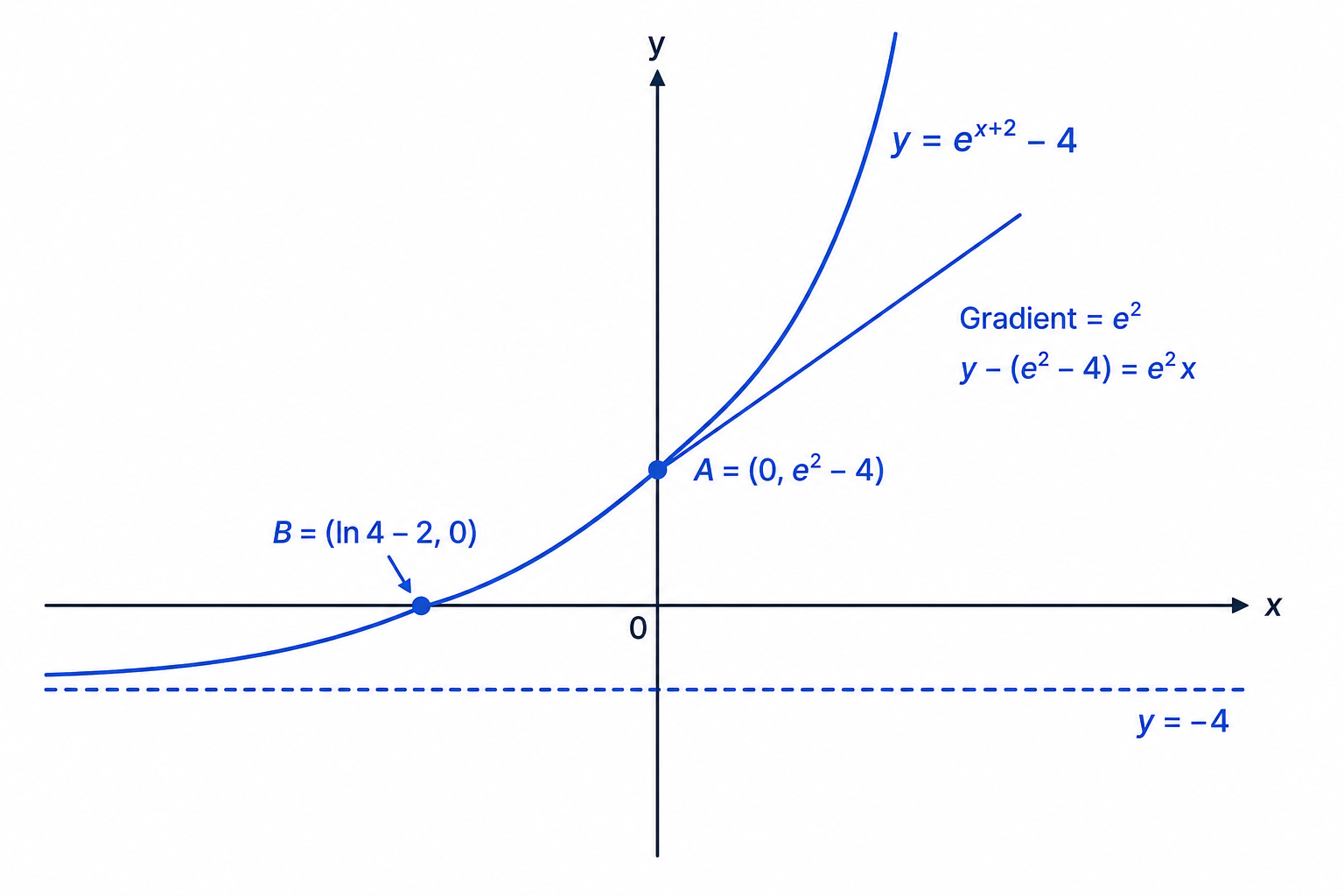
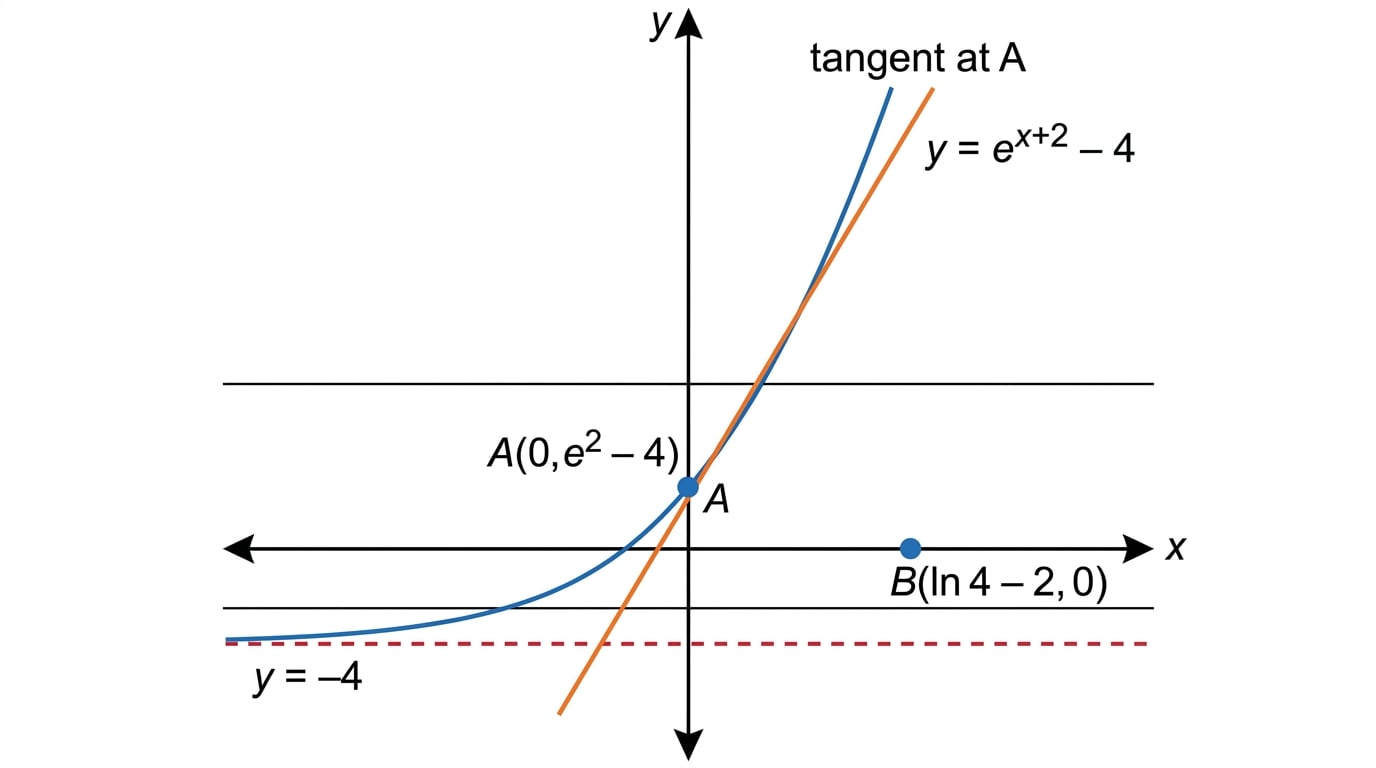
The graph of y=ex+2−4y=e^{x+2}-4y=ex+2−4 is the graph of y=exy=e^xy=ex shifted left 2 and down 4. It has a horizontal asymptote at y=−4y=-4y=−4.
Range and asymptote
The range is the set of possible output values of a function. A horizontal asymptote is a horizontal line that the curve approaches but never reaches.
Range, intercepts and tangent
Let f(x)=ex+2−4f(x)=e^{x+2}-4f(x)=ex+2−4.
-
Since ex+2>0e^{x+2}>0ex+2>0, the function is always greater than -4:
f(x)>−4f(x)>-4f(x)>−4 -
The range is:
y>−4y>-4y>−4 -
Find the y-intercept by putting x=0x=0x=0:
A=(0,e2−4)A=(0,e^2-4)A=(0,e2−4) -
Find the x-intercept by putting f(x)=0f(x)=0f(x)=0:
ex+2=4e^{x+2}=4ex+2=4 -
Take logs:
B=(ln4−2,0)B=(\ln 4-2,0)B=(ln4−2,0) -
Differentiate:
f′(x)=ex+2f'(x)=e^{x+2}f′(x)=ex+2 -
At AAA, the gradient is e2e^2e2, so the tangent is:
y−(e2−4)=e2xy-(e^2-4)=e^2xy−(e2−4)=e2x
In the exam
- Check whether bases match before reaching for logs.
- When solving log equations, combine logs into a single logarithm before converting to exponential form.
- In modelling questions, identify the initial value, differentiate for rate questions, and use logs to solve for time.
Check yourself
- Can you explain why exe^xex is always positive?
- Can you solve an equation containing both eye^yey and e−ye^{-y}e−y using a substitution?
- Can you state the range of y=e3x−5y=e^{3x}-5y=e3x−5 without sketching the graph?