

What you'll learn
- How integration reverses differentiation.
- How to integrate polynomials, brackets, roots and reciprocal powers.
- How to find the constant of integration using a point on a curve.
- How definite integrals give areas, including areas between curves.
Integration as reverse differentiation
You already know that differentiation finds a gradient function. Integration goes the other way: it starts with a gradient function and works back to the original function.
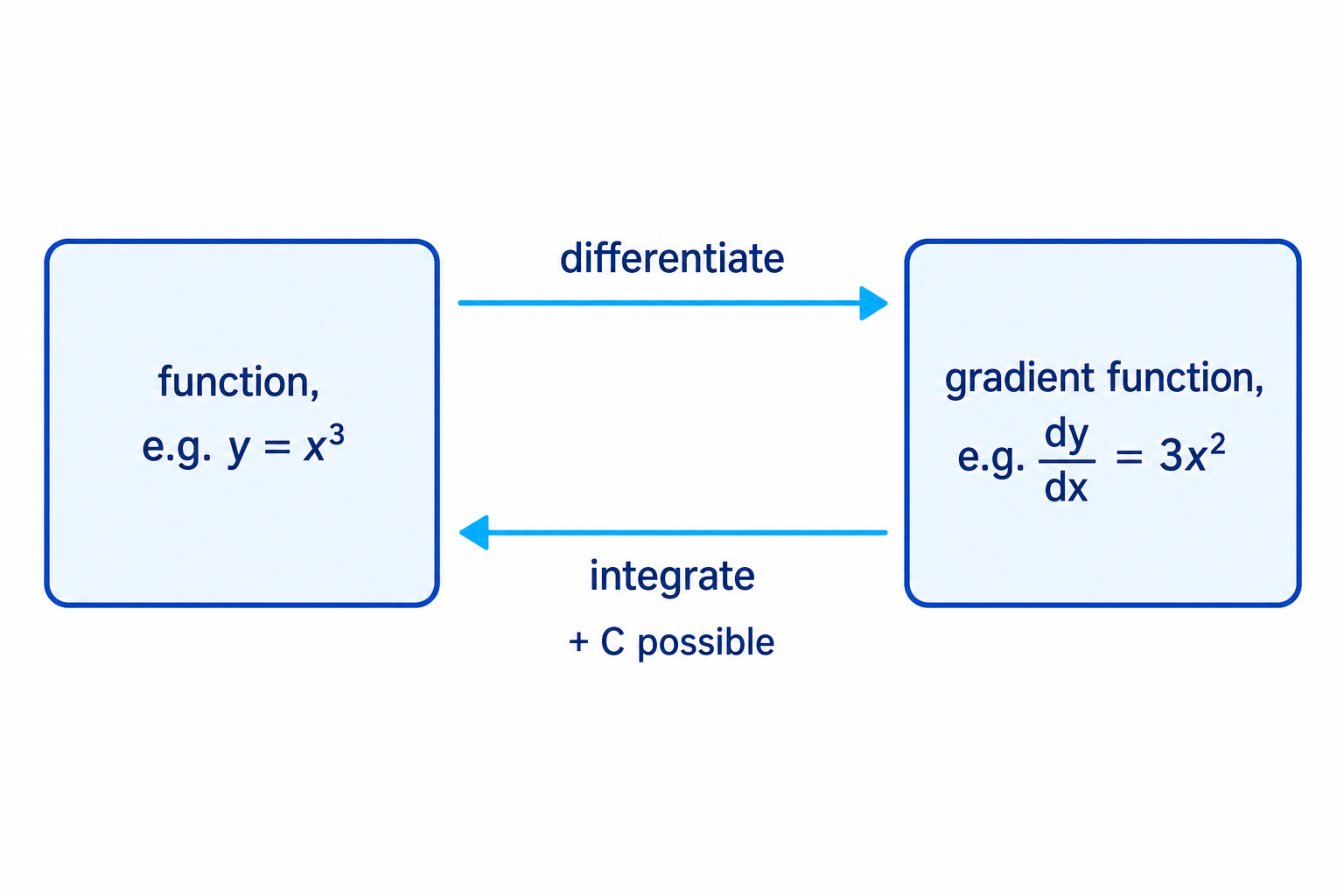
For example, if
ddx(x3)=3x2\frac{d}{dx}(x^3)=3x^2dxd(x3)=3x2then integrating 3x23x^23x2 gives x3x^3x3, plus possibly a constant.
Integral and antiderivative
If F′(x)=f(x)F'(x)=f(x)F′(x)=f(x), then F(x)F(x)F(x) is called an antiderivative of f(x)f(x)f(x). The symbol ∫f(x) dx\int f(x)\,dx∫f(x)dx means “integrate f(x)f(x)f(x) with respect to xxx”.
The little dxdxdx tells you the variable you are integrating with respect to. In AS Pure, this will usually be xxx.
The power rule for integration
The reverse power rule
To integrate a power of xxx, increase the power by 1, then divide by the new power.
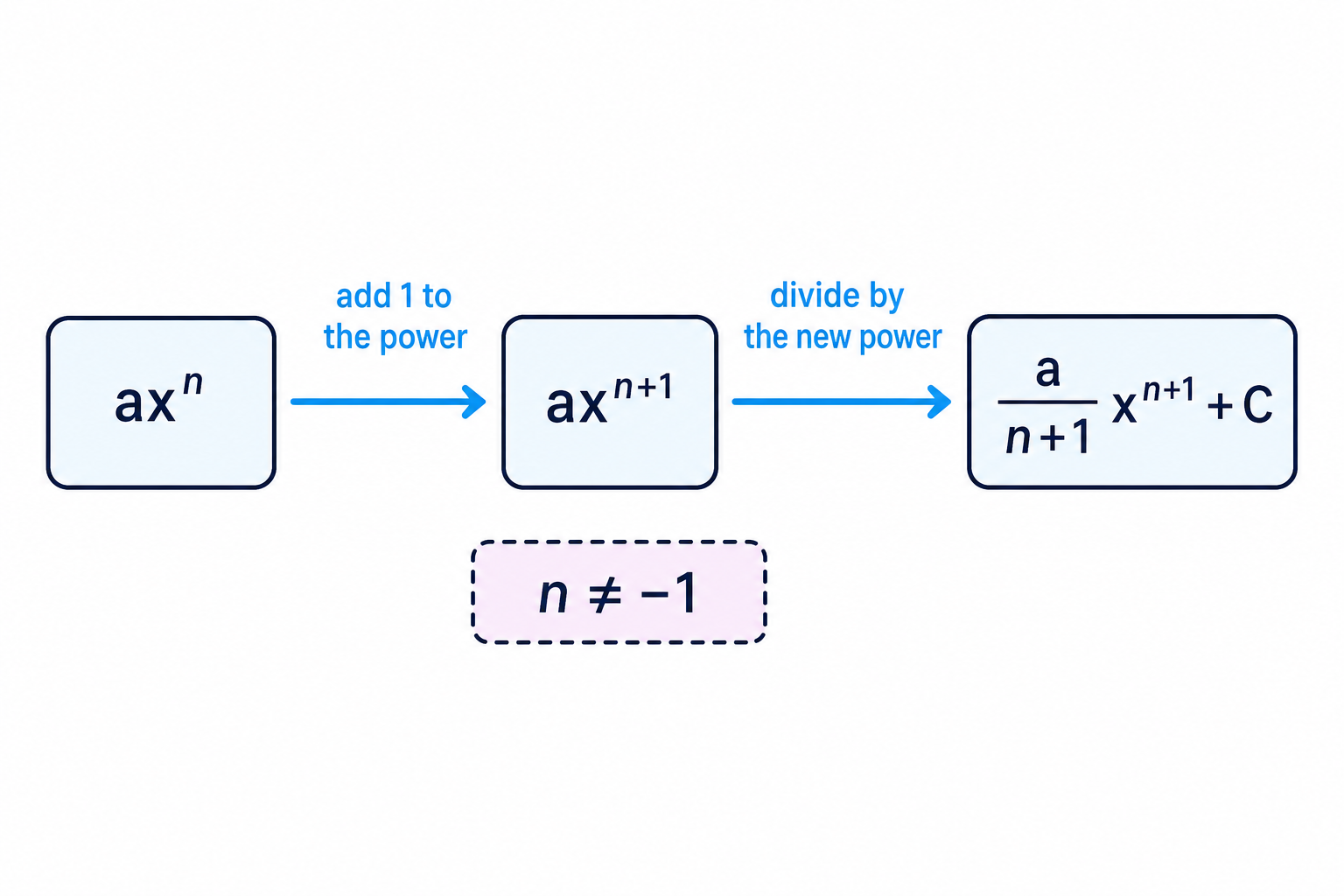
For any constant aaa,
∫axn dx=an+1xn+1+C,n≠−1\int ax^n\,dx=\frac{a}{n+1}x^{n+1}+C,\qquad n\neq -1∫axndx=n+1axn+1+C,n=−1The CCC is called the constant of integration. It is needed because differentiating any constant gives zero.
Integrating a polynomial
Find ∫(4x3−6x2+5x−9) dx\int \left(4x^3-6x^2+5x-9\right)\,dx∫(4x3−6x2+5x−9)dx.
-
Integrate each term separately.
∫4x3 dx=x4\int 4x^3\,dx=x^4∫4x3dx=x4 -
Continue term by term, remembering that a constant integrates to a multiple of xxx.
∫−6x2 dx=−2x3,∫5x dx=52x2,∫−9 dx=−9x\int -6x^2\,dx=-2x^3,\qquad \int 5x\,dx=\frac{5}{2}x^2,\qquad \int -9\,dx=-9x∫−6x2dx=−2x3,∫5xdx=25x2,∫−9dx=−9x -
Add the constant of integration.
∫(4x3−6x2+5x−9) dx=x4−2x3+52x2−9x+C\int \left(4x^3-6x^2+5x-9\right)\,dx=x^4-2x^3+\frac{5}{2}x^2-9x+C∫(4x3−6x2+5x−9)dx=x4−2x3+25x2−9x+C
Quick check
Differentiate your answer. If you get back the original expression, your integration is correct.
Expanding before integrating
Sometimes you are asked to integrate an expression in brackets. The power rule works best when the expression is written as a sum of powers of xxx, so expand first.
Integrating a product of brackets
Find ∫(x+5)(x−2) dx\int (x+5)(x-2)\,dx∫(x+5)(x−2)dx.
-
Expand the brackets first.
(x+5)(x−2)=x2+3x−10(x+5)(x-2)=x^2+3x-10(x+5)(x−2)=x2+3x−10 -
Integrate the expanded expression term by term.
∫(x2+3x−10) dx=13x3+32x2−10x+C\int \left(x^2+3x-10\right)\,dx=\frac{1}{3}x^3+\frac{3}{2}x^2-10x+C∫(x2+3x−10)dx=31x3+23x2−10x+C
Do not integrate each bracket separately
There is no rule that lets you integrate (x+5)(x−2)(x+5)(x-2)(x+5)(x−2) by integrating each bracket on its own. Expand first, then integrate.
Roots and fractions as powers
Before integrating roots or fractions involving xxx, rewrite them using powers.
Useful rewrites include:
- x=x12\sqrt{x}=x^{\frac{1}{2}}x=x21
- 1x2=x−2\frac{1}{x^2}=x^{-2}x21=x−2
- 1x=x−12\frac{1}{\sqrt{x}}=x^{-\frac{1}{2}}x1=x−21
The power rule exception
The reverse power rule above does not work for x−1x^{-1}x−1. At AS level, questions in this topic usually avoid needing to integrate 1x\frac{1}{x}x1.
Integrating roots and reciprocal powers
Find ∫(6x+4x2+3) dx\int \left(6\sqrt{x}+\frac{4}{x^2}+3\right)\,dx∫(6x+x24+3)dx.
-
Rewrite the expression using powers of xxx.
6x+4x2+3=6x12+4x−2+36\sqrt{x}+\frac{4}{x^2}+3=6x^{\frac{1}{2}}+4x^{-2}+36x+x24+3=6x21+4x−2+3 -
Apply the reverse power rule to each term.
∫6x12 dx=4x32,∫4x−2 dx=−4x−1,∫3 dx=3x\int 6x^{\frac{1}{2}}\,dx=4x^{\frac{3}{2}},\qquad \int 4x^{-2}\,dx=-4x^{-1},\qquad \int 3\,dx=3x∫6x21dx=4x23,∫4x−2dx=−4x−1,∫3dx=3x -
Write the final answer in a neat form.
∫(6x+4x2+3) dx=4x32−4x+3x+C\int \left(6\sqrt{x}+\frac{4}{x^2}+3\right)\,dx=4x^{\frac{3}{2}}-\frac{4}{x}+3x+C∫(6x+x24+3)dx=4x23−x4+3x+C
Finding the constant using a point
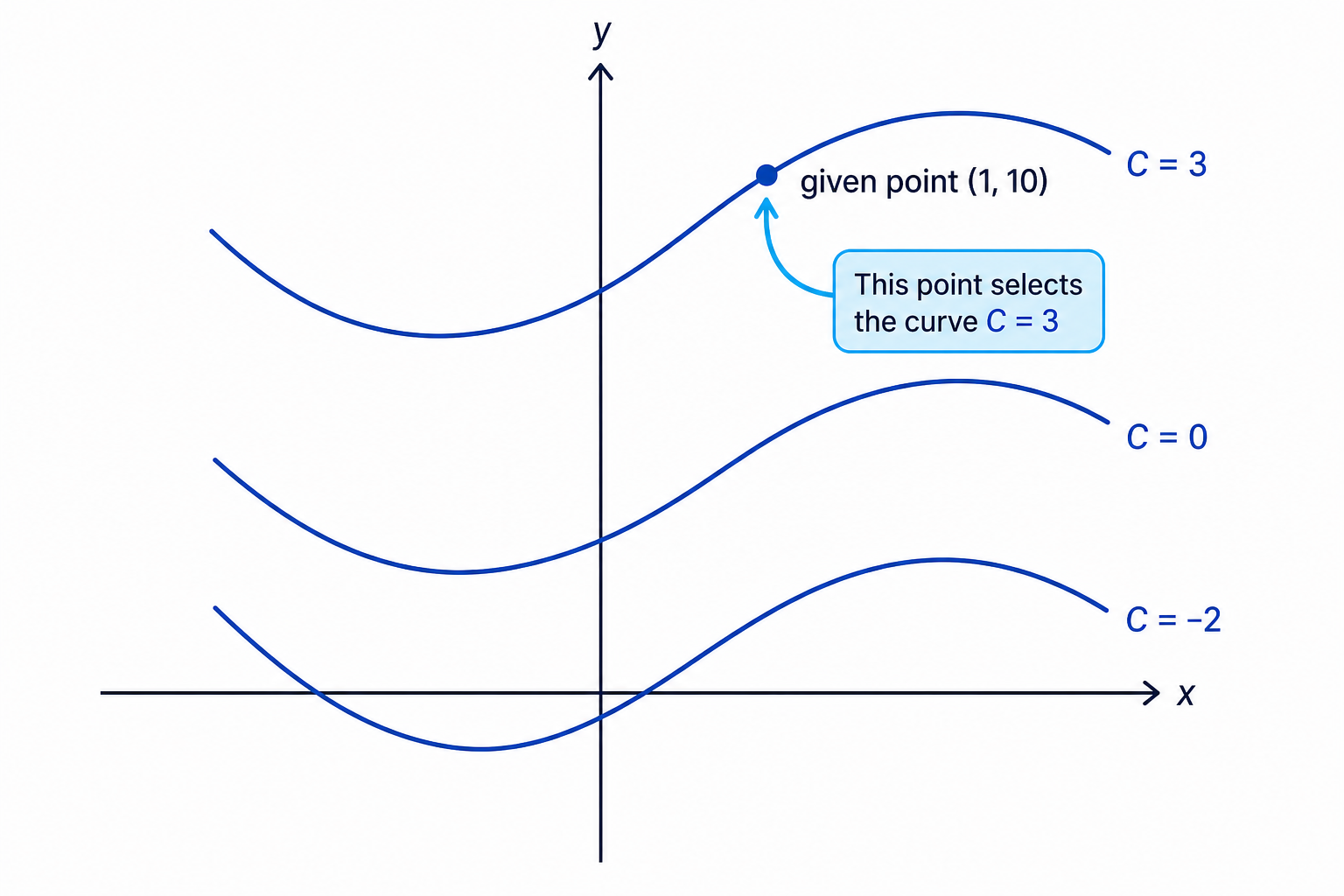
An indefinite integral gives a family of curves because of the unknown CCC. If you are told a point lies on the curve, substitute its coordinates to find CCC.
Finding a function from its derivative
Given that dydx=6x2−4x+7\frac{dy}{dx}=6x^2-4x+7dxdy=6x2−4x+7 and the curve passes through (1,10)(1,10)(1,10), find yyy in terms of xxx.
-
Integrate the derivative.
y=∫(6x2−4x+7) dxy=\int \left(6x^2-4x+7\right)\,dxy=∫(6x2−4x+7)dx -
Write the general solution.
y=2x3−2x2+7x+Cy=2x^3-2x^2+7x+Cy=2x3−2x2+7x+C -
Substitute the point (1,10)(1,10)(1,10), so x=1x=1x=1 and y=10y=10y=10.
10=2(1)3−2(1)2+7(1)+C10=2(1)^3-2(1)^2+7(1)+C10=2(1)3−2(1)2+7(1)+C -
Solve for CCC.
10=7+C,C=310=7+C,\qquad C=310=7+C,C=3 -
Give the final expression for the curve.
y=2x3−2x2+7x+3y=2x^3-2x^2+7x+3y=2x3−2x2+7x+3
Definite integrals
A definite integral has a lower limit and an upper limit. It gives a number, not a function.
If a curve is above the xxx-axis, the definite integral represents the area under the curve between the two limits.
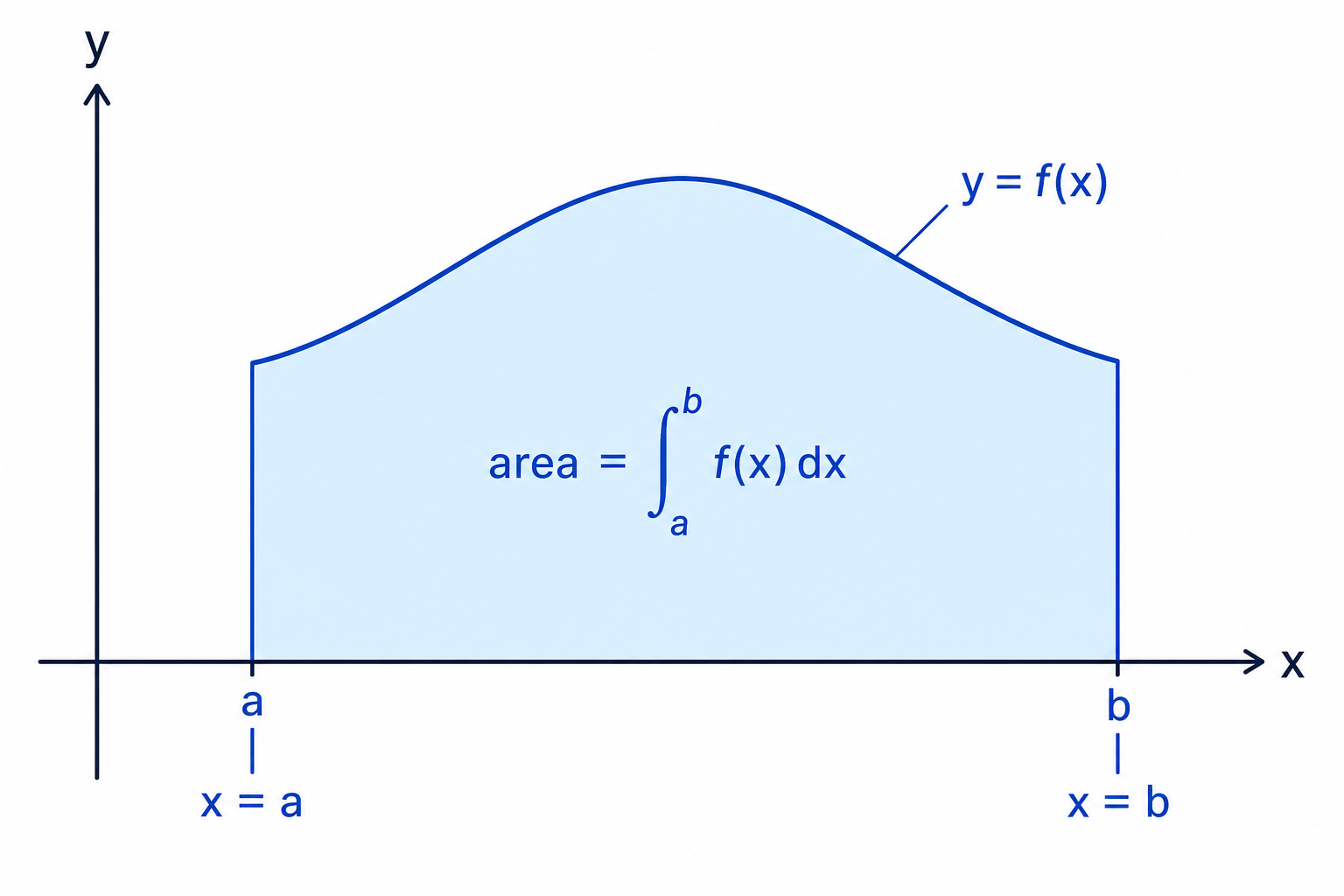
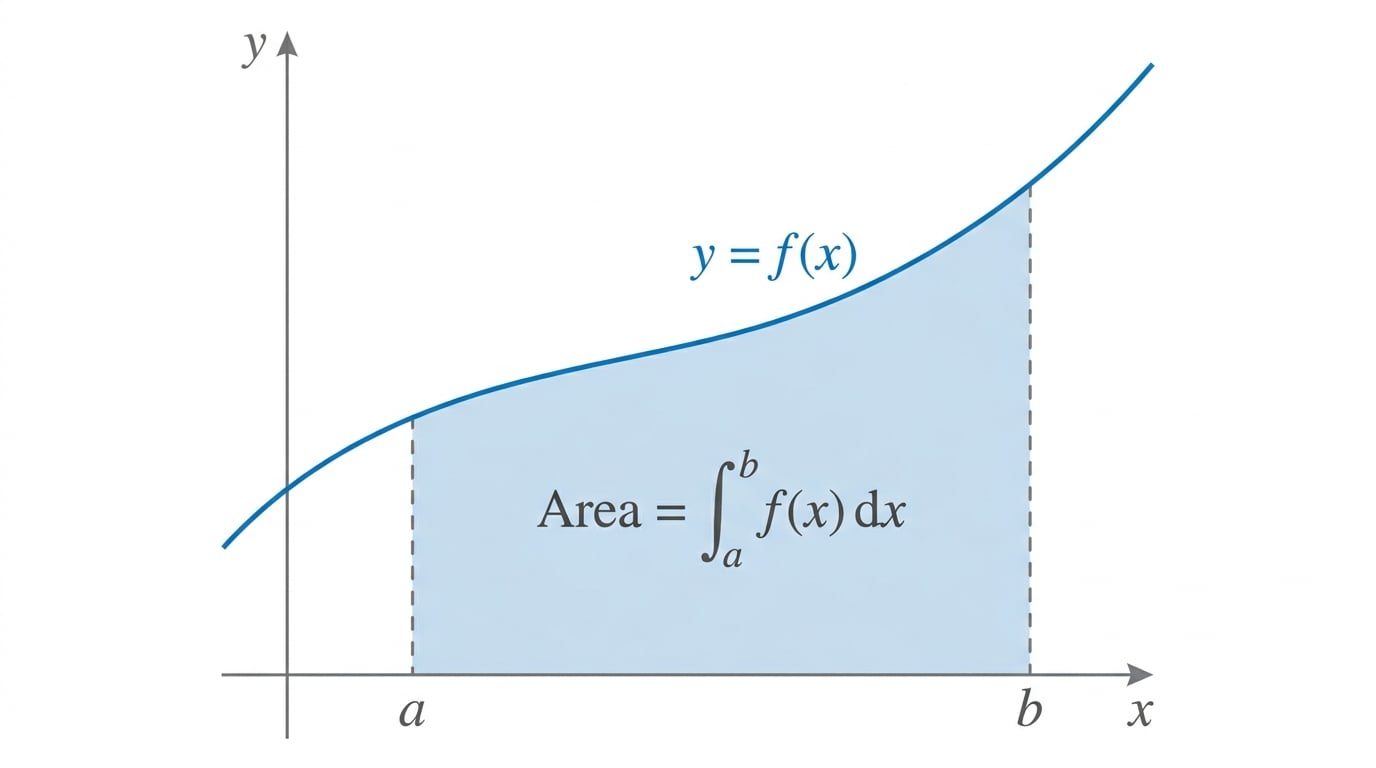
To evaluate a definite integral:
- Find an antiderivative.
- Substitute the upper limit.
- Subtract the value at the lower limit.
Evaluating a definite integral
Find ∫14(6+2x) dx\int_1^4 \left(6+\frac{2}{\sqrt{x}}\right)\,dx∫14(6+x2)dx.
-
Rewrite the integrand using powers.
6+2x=6+2x−126+\frac{2}{\sqrt{x}}=6+2x^{-\frac{1}{2}}6+x2=6+2x−21 -
Integrate to get an antiderivative.
∫(6+2x−12) dx=6x+4x12\int \left(6+2x^{-\frac{1}{2}}\right)\,dx=6x+4x^{\frac{1}{2}}∫(6+2x−21)dx=6x+4x21 -
Substitute the limits using upper minus lower.
[6x+4x12]14=(24+8)−(6+4)\left[6x+4x^{\frac{1}{2}}\right]_1^4=(24+8)-(6+4)[6x+4x21]14=(24+8)−(6+4) -
Calculate the final value.
∫14(6+2x) dx=22\int_1^4 \left(6+\frac{2}{\sqrt{x}}\right)\,dx=22∫14(6+x2)dx=22
Forgetting upper minus lower
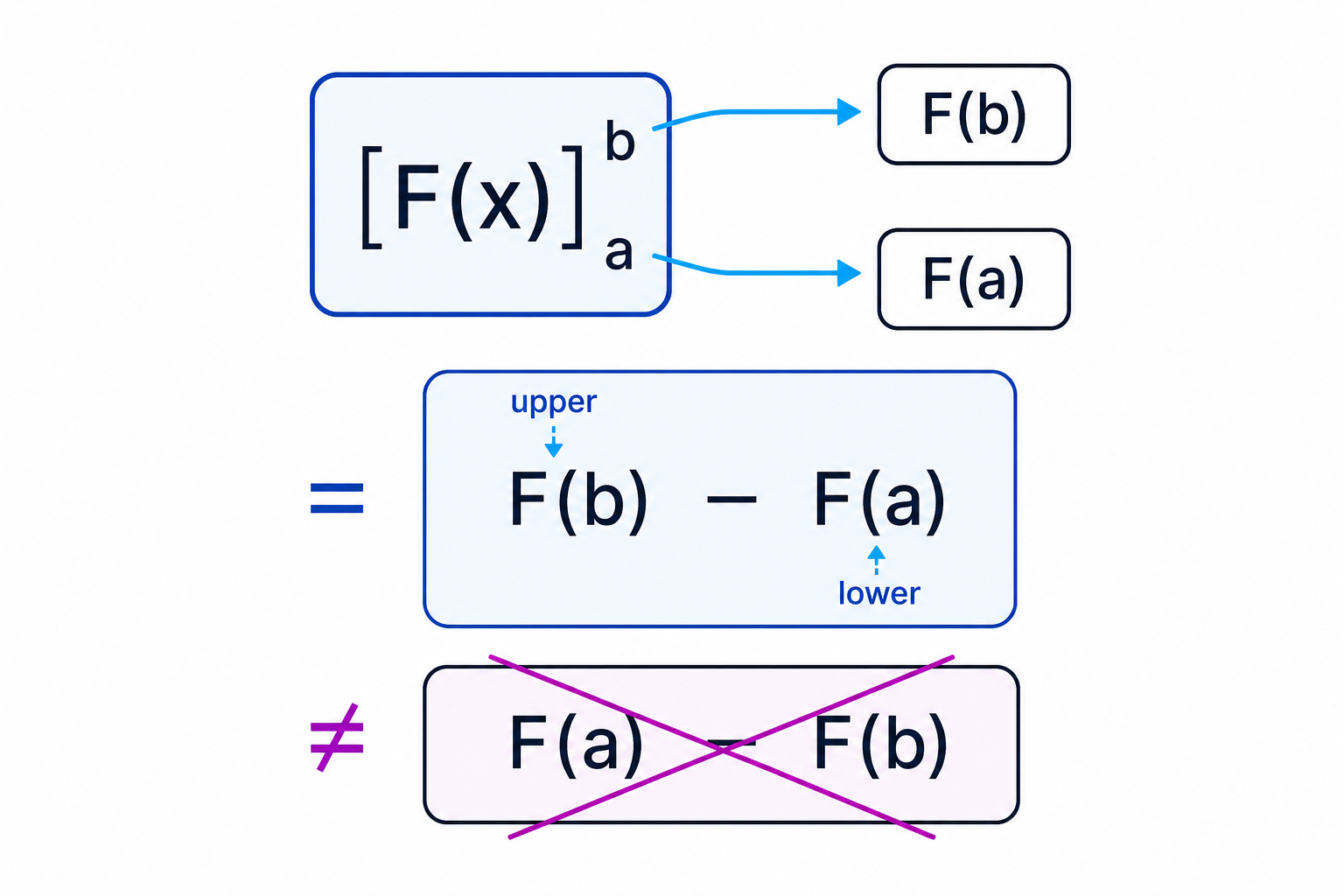
The notation [F(x)]ab\left[F(x)\right]_a^b[F(x)]ab means F(b)−F(a)F(b)-F(a)F(b)−F(a), not F(a)−F(b)F(a)-F(b)F(a)−F(b).
Areas between curves
For the area between two curves, find the intersection points first. These give the limits of integration.
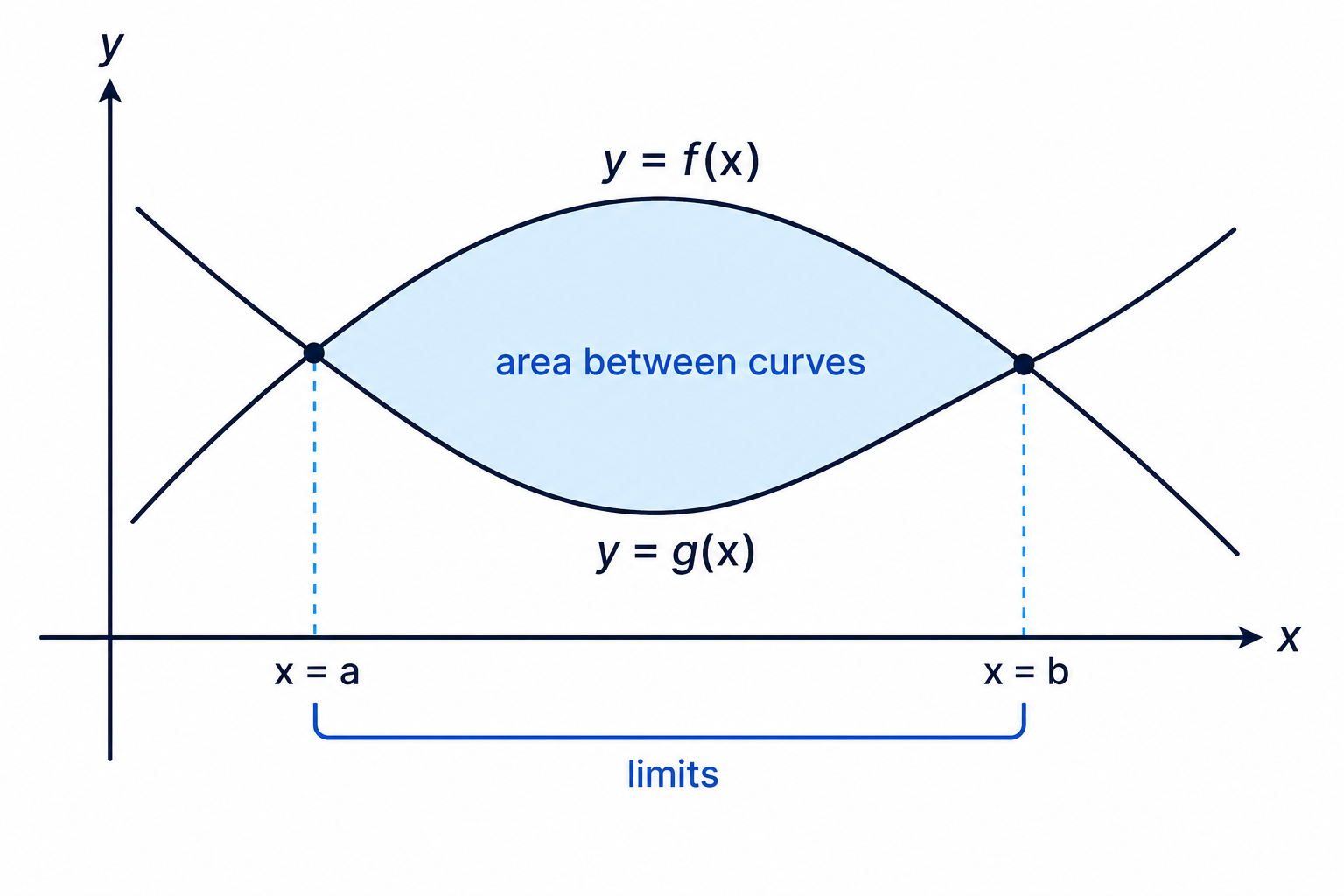
If one curve is above the other throughout the interval, use:
Area=∫ab(top curve−bottom curve) dx\text{Area}=\int_a^b \left(\text{top curve}-\text{bottom curve}\right)\,dxArea=∫ab(top curve−bottom curve)dx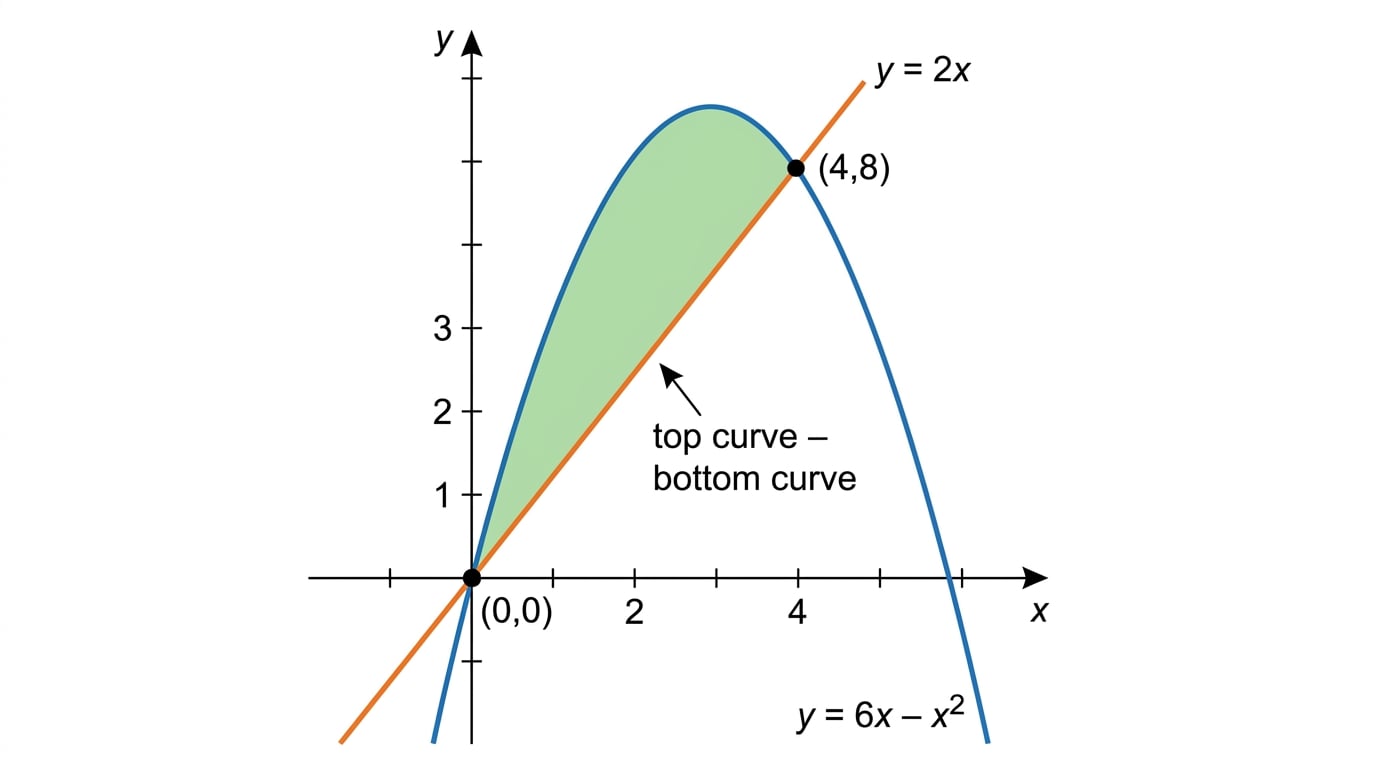
Area between a curve and a line
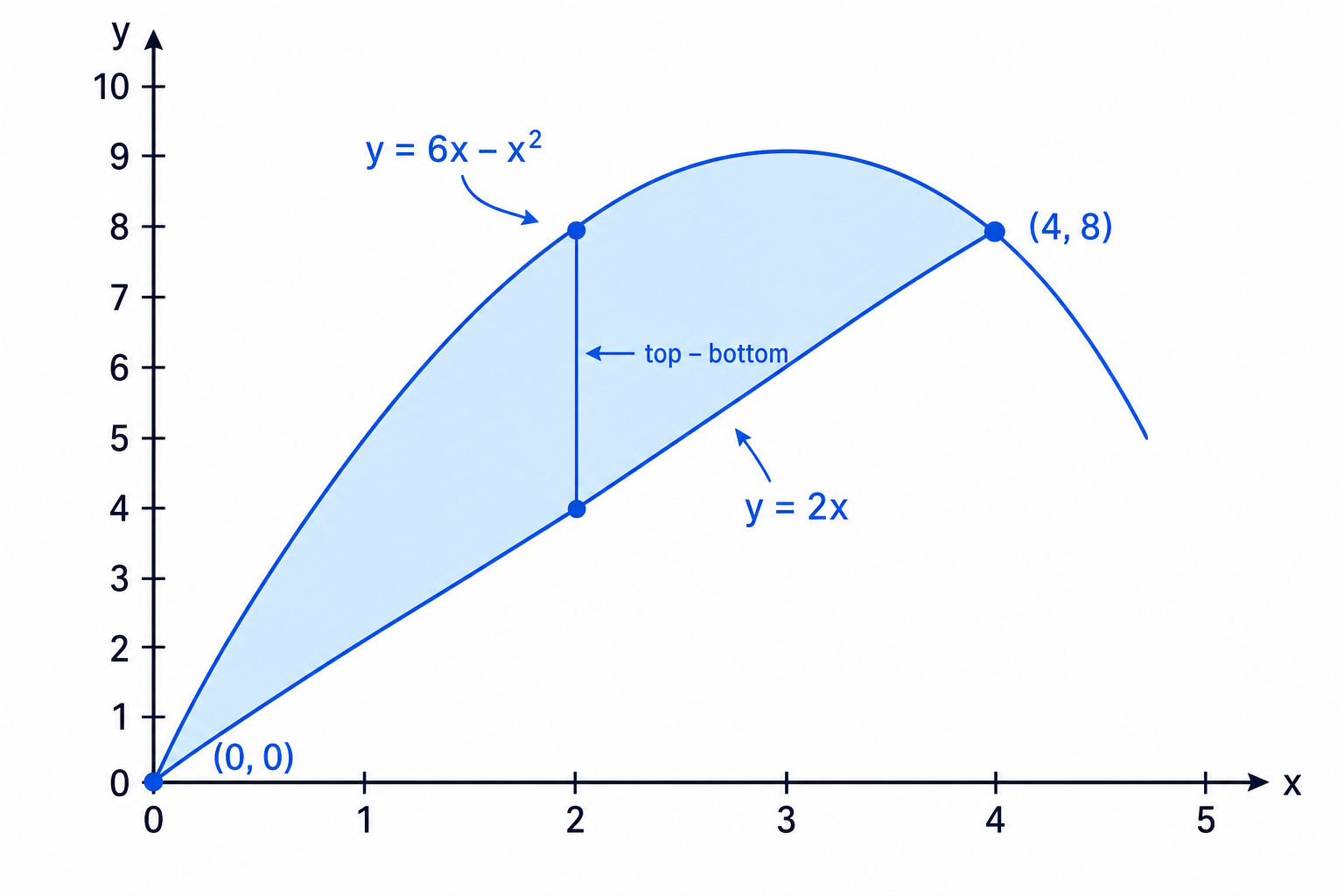
The curve y=6x−x2y=6x-x^2y=6x−x2 and the line y=2xy=2xy=2x enclose a finite region. Find the coordinates of their intersections and the area of the region.
-
Set the two expressions for yyy equal to find the intersections.
6x−x2=2x6x-x^2=2x6x−x2=2x -
Rearrange and factorise.
−x2+4x=0,x(4−x)=0-x^2+4x=0,\qquad x(4-x)=0−x2+4x=0,x(4−x)=0 -
Find the coordinates using y=2xy=2xy=2x.
x=0⇒y=0,x=4⇒y=8x=0 \Rightarrow y=0,\qquad x=4 \Rightarrow y=8x=0⇒y=0,x=4⇒y=8 -
Decide which curve is on top between the limits. At x=2x=2x=2, the curve gives 8 and the line gives 4, so the curve is above the line.
Area=∫04((6x−x2)−2x) dx\text{Area}=\int_0^4 \left((6x-x^2)-2x\right)\,dxArea=∫04((6x−x2)−2x)dx -
Simplify and integrate.
∫04(4x−x2) dx=[2x2−13x3]04\int_0^4 \left(4x-x^2\right)\,dx=\left[2x^2-\frac{1}{3}x^3\right]_0^4∫04(4x−x2)dx=[2x2−31x3]04 -
Evaluate to get an area of 323\frac{32}{3}332 square units.
(32−643)−0=323\left(32-\frac{64}{3}\right)-0=\frac{32}{3}(32−364)−0=332
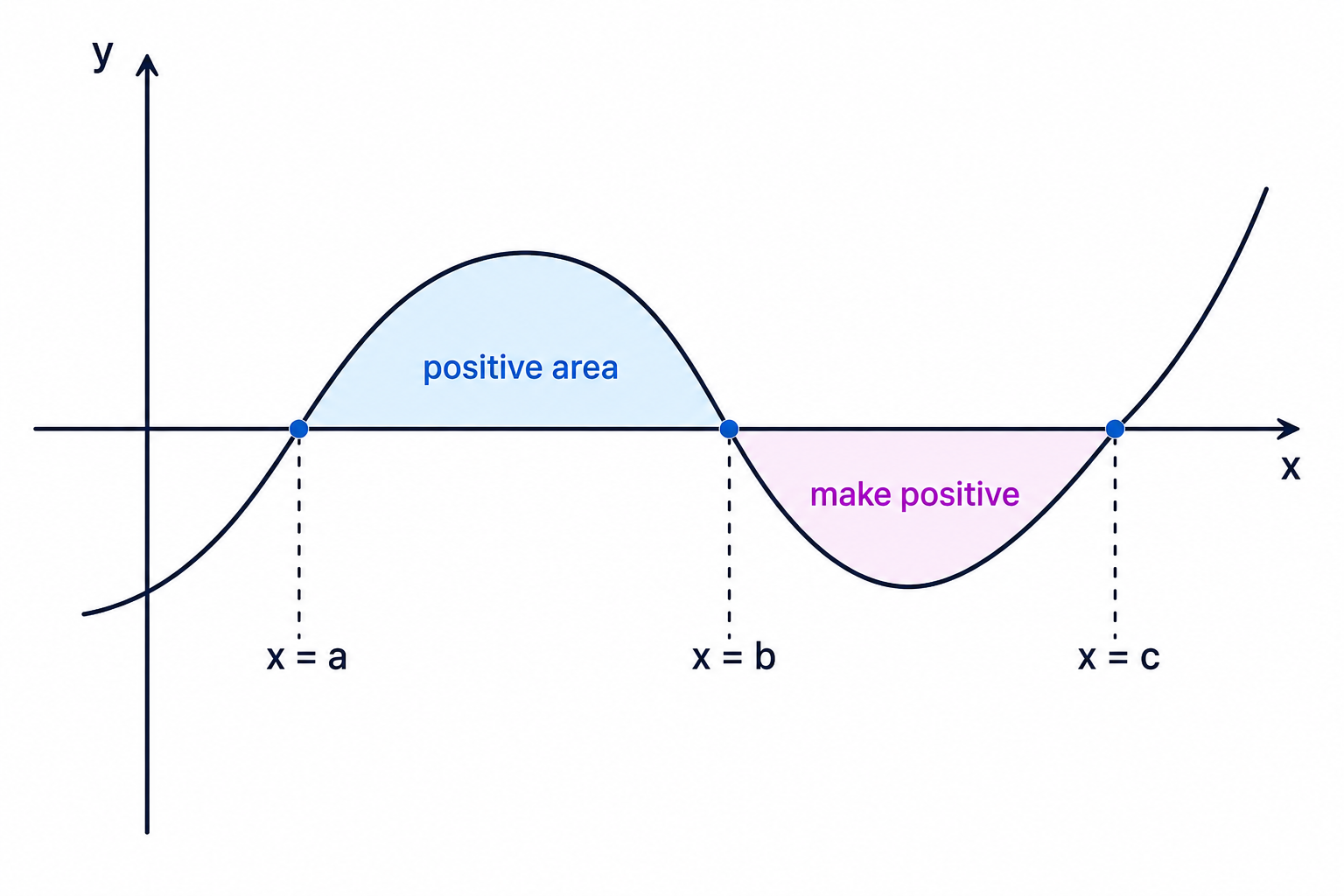
When the curve crosses the x-axis
If you are finding total area between a curve and the xxx-axis, split the calculation at any roots where the curve crosses the axis. Areas below the axis need to be made positive.
In the exam
- Rewrite roots and fractions as powers before integrating.
- Always include +C+C+C for indefinite integrals, unless you are evaluating between limits.
- For area questions, find intersections first and use top curve minus bottom curve.
Check yourself
- Can you explain why ∫5 dx=5x+C\int 5\,dx=5x+C∫5dx=5x+C?
- When should you include the constant of integration?
- How do you decide which expression goes first in an area-between-curves integral?
